

Something wild happened over the last 6 months and almost nobody in crypto is framing it properly.
Between October 2025 and April 2026, OpenAI, Google, Stripe, Coinbase, Visa, Mastercard, OKX, and Alipay all shipped live protocols for how AI agents should handle money, production products all within roughly the same quarter.
The reason this is happening now is structural.
AI agents can't open bank accounts. They can't pass KYC. They don't have government IDs. They can research, compare, negotiate, and execute complex tasks across the internet, but they couldn't do the one thing that makes all of that useful, spend money.
The entire checkout infrastructure we've built over three decades assumes a human is on the other end. Remove the human and the whole system breaks.
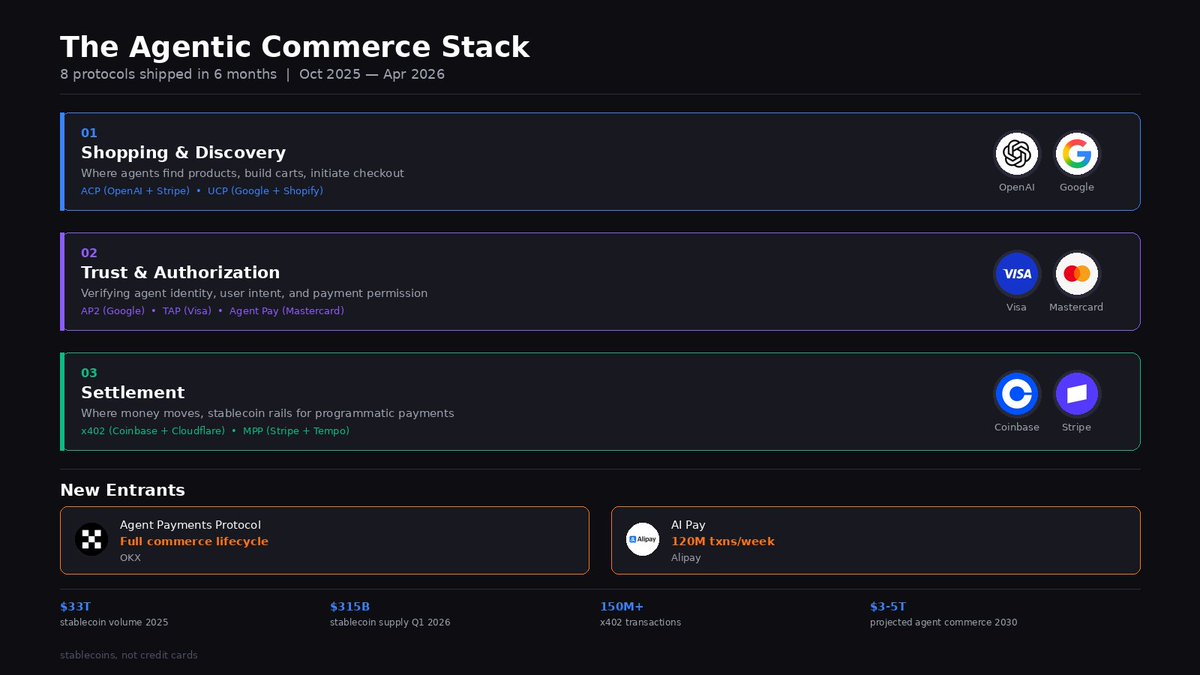
So the payment layer the internet was supposed to have since the 90s is finally being built. And it's being built as a three layer stack:
➥ The Agentic Commerce Stack
[1] Shopping & Discovery Layer
• This is where agents find products, build carts, and initiate checkout
• @Google built the Universal Commerce Protocol (UCP) with Shopify, Walmart, Target, and 20+ partners including Visa, Mastercard, AmEx, Stripe, and Adyen
• @OpenAI built the Agentic Commerce Protocol (ACP) with @stripe, launched Instant Checkout in ChatGPT
• ACP had to pivot hard, only about 30 merchants ever went live, Walmart pulled out after conversion rates came in 3x lower than their own site
• OpenAI retired Instant Checkout in March 2026 and shifted ACP to discovery only
• Lesson here is that checkout is way harder than it looks from the outside
[2] Trust & Authorization Layer
• How does a merchant know the agent actually has permission to buy?
• Google's AP2 protocol uses cryptographic mandates, signed records of user intent that are tamper-proof and revocable. 60+ partners including Mastercard, PayPal, AmEx, Coinbase
• @Visa's Trusted Agent Protocol (TAP) lets merchants verify incoming bots are legit shopping agents rather than scrapers or fraud bots. Co-built with Cloudflare, 100+ partners
• @Mastercard's Agent Pay completed Europe's first live AI agent payment with Santander in March 2026, then the Netherlands' first with Rabobank in April
• Mastercard also shipped Verifiable Intent with Google, an open cryptographic trust standard backed by IBM, Worldpay, Fiserv, Adyen
[3] Settlement Layer (the crypto layer)
• This is where money actually moves and where stablecoins enter the picture
• @coinbase and @Cloudflare built x402, literally named after HTTP 402 "Payment Required," the status code reserved in the 90s for a payment layer that never got built
• x402 embeds stablecoin payments directly into web requests. Agent makes a request, server responds with a price, agent signs a USDC payment, resource delivered. Two seconds, zero protocol fees
• Already processed over 150 million transactions across Base and Solana
• The x402 Foundation now includes Google and Visa alongside Coinbase and Cloudflare
➥ The New Entrants
[1] @stripe & @tempo - Machine Payments Protocol (MPP)
• Tempo mainnet launched March 2026, payments-focused L1 backed by Stripe and Paradigm
• MPP handles programmatic agent-to-agent payments, microtransactions, recurring billing, streaming payments
• Stripe wired MPP into the standard Payment Intents API at Sessions 2026, so any business on Stripe can now accept agent payments in stablecoins or fiat
• Stripe also shipped the Link agent wallet, 288 total product launches at Sessions, and partnerships across OpenAI, Google, Meta, Visa, and Mastercard simultaneously
• Stripe isn't competing in the protocol war. It's the settlement layer underneath all of them
[2] @okx - Agent Payments Protocol (APP)
• Launched April 29, 2026
• Most ambitious scope of any protocol, covering the full commerce lifecycle beyond just payments
• Agents can create quotes, negotiate terms, set up escrow, hire professionals, run pay-per-use billing
• Backed by AWS, Alibaba Cloud, Nansen, Uniswap, Paxos, QuickNode
[3] @Alipay - AI Pay
• Quietly the most advanced deployment in the world
• Hit 120 million AI payment transactions in a single week in February 2026
• Crossed 100 million users, the first AI-native payment product globally to reach that scale
• Integrated into Qwen App (Alibaba's AI) for conversational commerce and Rokid smart glasses for hands-free voice payments
• What China is doing with agent commerce through Alipay is operationally years ahead of the West
➥ Why Stablecoins Win This
The structural argument is clean
• Agents need wallets, not bank accounts
• They need push payments (sender-initiated) not pull payments (merchant-pulls)
• They need 24/7 settlement, not banking hours
• They need micropayments at near-zero cost, not $0.30 + 2.9% per swipe
• They need programmable money with spending limits and escrow logic baked in
Stablecoins check every box
The numbers back it up:
• Stablecoin volume hit $33 trillion in 2025, up 90%+ YoY
• Total supply crossed $315 billion by end of Q1 2026
• Over 232 million wallets now hold stablecoins
• Visa stablecoin settlement running at $4.5 billion annualized
• Juniper Research projects stablecoin cross-border B2B transactions reaching $5 trillion by 2035
These aren't crypto-native numbers anymore. This is mainstream financial infrastructure being built on stablecoin rails
➥ What's Still Missing
• Security gap is real. Researchers found 26 LLM routers injecting malicious tool calls, one incident drained $500K from a wallet. The middleware layer is largely unaudited
• Only about 1% of shoppers currently use agents to purchase anything. The infrastructure is years ahead of consumer behavior
• Eight protocols from eight organizations in one quarter. Whether they interoperate or fragment is still an open question
• Even Stripe admitted in their annual letter that agentic commerce "suffers from having been overhyped too early in some corners"
→ But the direction is clear
McKinsey projects agents could mediate $3-5 trillion in global commerce by 2030. Juniper puts agentic commerce spend at $1.5 trillion by the same year
The payment layer the internet was supposed to have 30 years ago is finally being built
And it runs on stablecoins, not credit cards
English
