Post
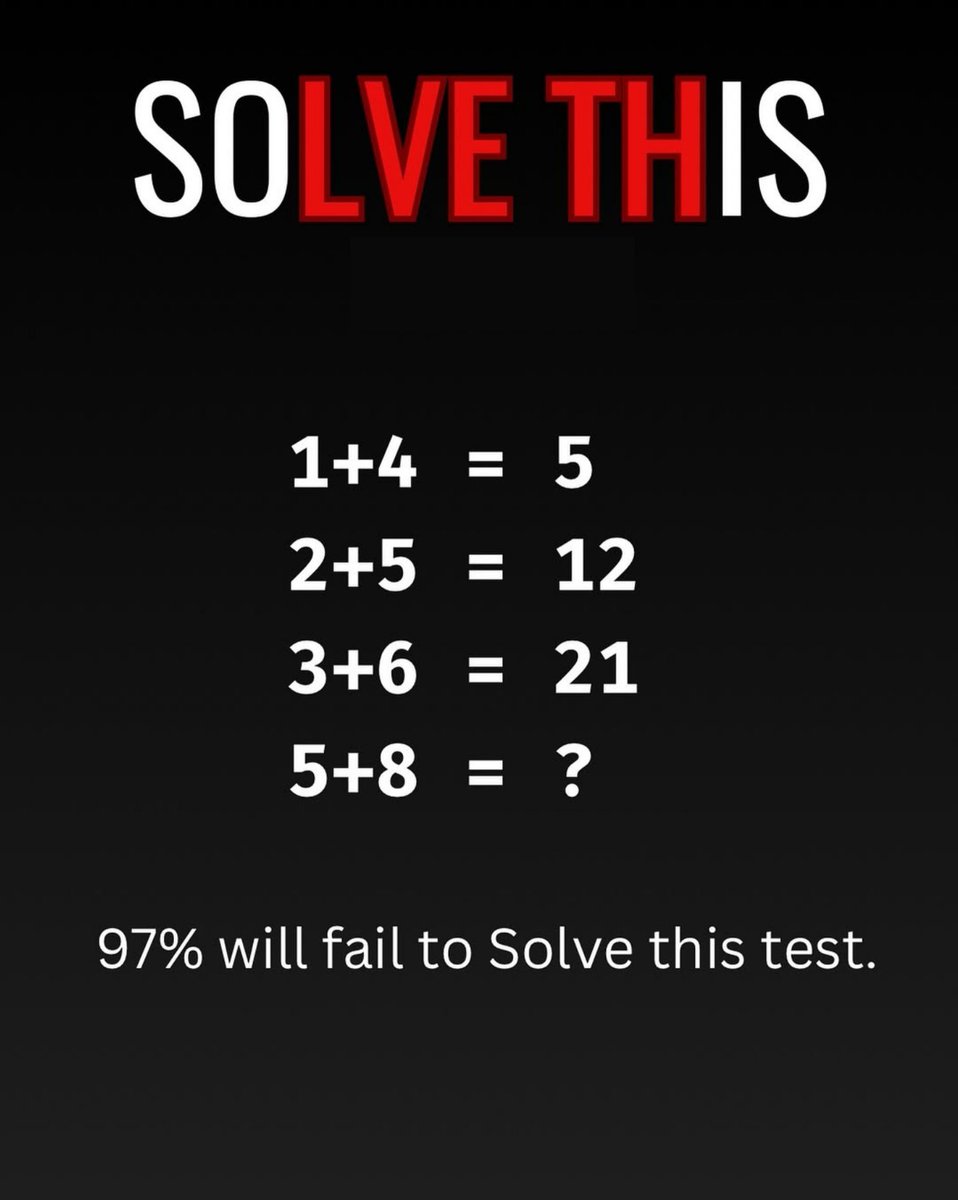


@Python_Dv (0+0) + 0 = 0
(1+4) + 0 = 5
(2+5) + 5 = 12
(3+6) + 12 = 21
(5+8) + 21 = 34
Final answer = 34
English

@Python_Dv 45
Easy:
1 + 4 = 5 [ 1 + (1 * 4) = 5 ]
2 + 5 = 12 [2 + (2 * 5) = 12 ]
3 + 6 = 21 [3 + (3 * 6) = 21 ]
5 + 8 = 5 + (5 * 8) = 45
English

@Python_Dv 1+4 = 5
2+5 = 12 ... (which is 5 + (2+5))
3+6 = 21 ... (which is 12 + (3+6))
5+8 = 34 ( which is 21 + (5+8))
English

@Python_Dv I got this rule: a+b=a×b+a(in real math)
Base Case Verification: 1 + 4 = 1×4 + 1 = 5 , 2 + 5 = 2×5+2=12, 3+6=3×6+3=21,all hold.
Inductive Step: Assume k+(k+3)=k×(k+3)+k
holds. It can be deduced that (k+1) + (k+4) = (k+1)×(k+4) + (k+1) also holds.
Thus, 5+8=5×8 + 5 = 45
English




@Python_Dv 5+8 = 13
don't assume a hidden pattern when there is no evidence of it.
it does not ask:
x + (1+4) =5
It doesn't ask for a row estimate.
it only asks what 5+8 is, nothing more, nothing less.
English


@Python_Dv 8 x 5 = 40 + 5 = 45
The 2nd number s multiplied by the 1st number, and then we add the 1st number to the result.
English