POV: You’re coming home after a journey around the Moon. 🌕
Before reentering Earth’s atmosphere at the end of Artemis II, the Orion spacecraft’s crew module — carrying the astronauts — separated from the service module that provided propulsion and power throughout the mission.
i was eating sun dried tomatoes and i said to my son whos obviously a cat “ur telling me my son dried these tomatoes” and i thought my delivery was so good but he looked at me like it was so stupid it somehow transcended the language barrier
Optimus will be the biggest product ever made.
A general-purpose humanoid robot that can do useful work at scale will change the economics of labor & manufacturing.
Goal is to get Optimus to high-volume production as fast as possible.
If you’re great at AI, engineering, or manufacturing & want to build this, join us!
→ tesla.com/careers/search…
When Copernicus proposed heliocentrism in 1543, it was actually less accurate than Ptolemy's geocentric model - a system refined over 1,400 years with epicycles precisely tuned to match observed planetary positions.
It took another 70 years before Kepler, working from Tycho Brahe's unprecedentedly precise observations, replaced Copernicus’s circles with ellipses - finally making heliocentrism empirically superior.
Terence Tao's point is that science needs a high temperature setting. If we only fund and follow what's most state of the art today, we kill the ideas that might need decades of work to surpass some overall plateau.
bro.
someone built a terminal weather app
in Rust with live ASCII animations.
it literally rains / snows inside your terminal
when it’s raining / snowing outside 😭
this is peak software.
@TheVixhal While true in a sense isn't this statement irrelevant or at least disingenuous in that the same applies for the difference between 2 million and 8 million or any large number as such, a more indicative comparison would be one of order of magnitude.
at long last, the final paper of my phd
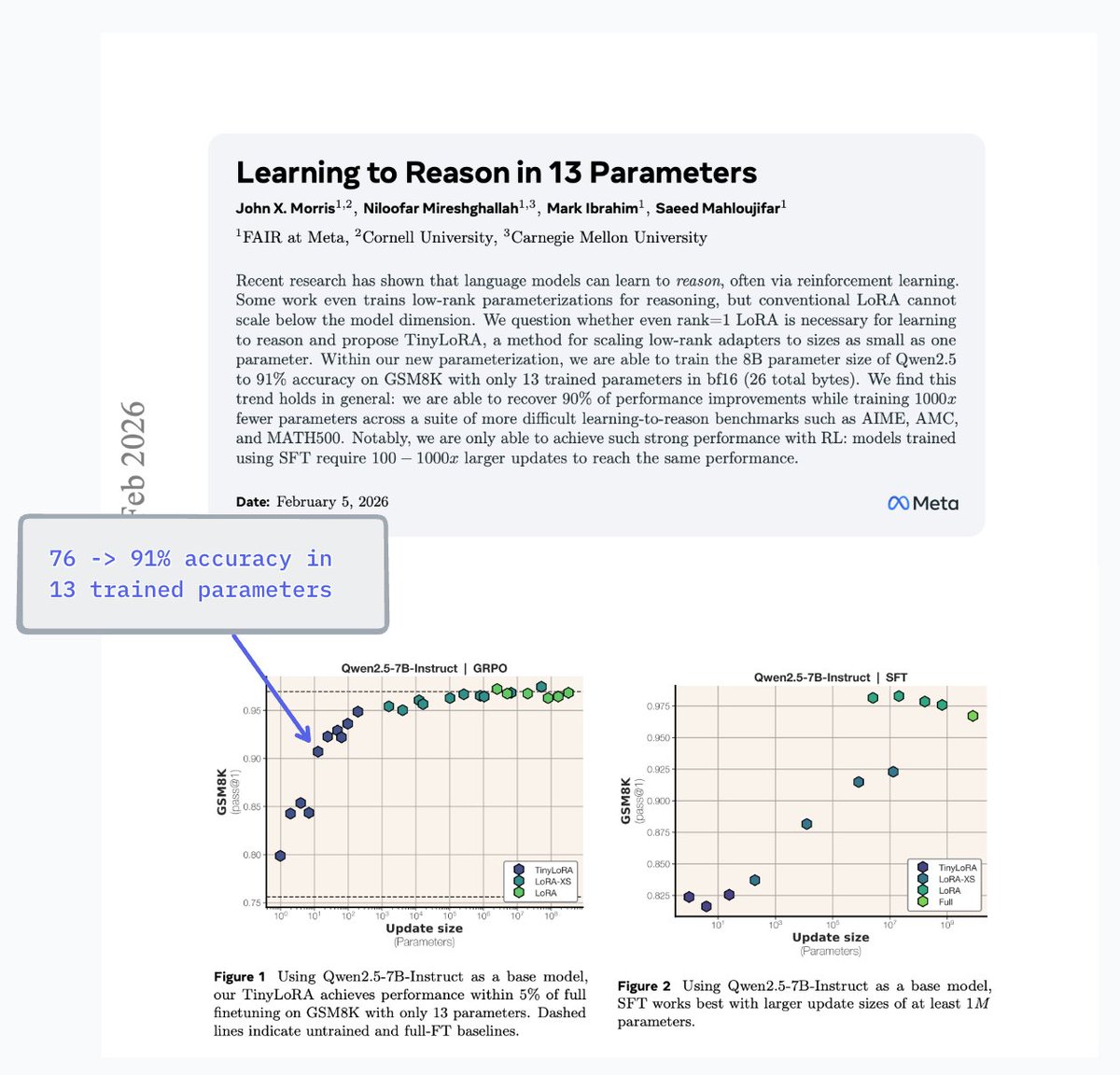
🧮 Learning to Reason in 13 Parameters 🧮
we develop TinyLoRA, a new ft method. with TinyLoRA + RL, models learn well with dozens or hundreds of params
example: we use only 13 parameters to train 7B Qwen model from 76 to 91% on GSM8K 🤯
We're heading to the Moon.
The launch window opens as early as Feb. 6 for our crewed @NASAArtemis mission. Throughout the journey, we'll bring you live coverage on NASA+: plus.nasa.gov
A world with 10,000 Starships manufactured a year
Elon floated a production end-state of ~10,000 Starships per year. When this happens is beside the point; the number tells us how SpaceX is thinking about the terminal cost regime.
If Starship manufacturing truly industrializes, what happens to $/kg, and what becomes economically viable?
We applied Wright’s Law (conservative 85% aerospace learning rate) to Starship manufacturing to isolate how scale drives cost.
Two representative regimes emerge:
~$35/kg at ~1,000 Starships/year (~10 average flights per vehicle). This is the intended near-term production milestones of Starbase.
~$10/kg at ~10,000 Starships/year (~20 average flights per vehicle)
These are “lines in the sand” that define early-industrial vs fully-industrial cost floors.
Interestingly, $/kg asymptotes quickly with reuse. Most cost reduction is captured in the first 10-20 flights (Falcon boosters already exceed 30 reuses). Beyond that, ops and payload economics dominate.
Reuse moves the system along the curve, but manufacturing scale and operational throughput define the curve. Extreme reuse doesn’t get you to $10/kg. Industrial scale does.
We then translated $/kg into human-scale economics (100 kg ≈ a person, or ≈10 kW of compute satellite) to see what actually becomes rational:
• Point-to-point travel: ~$1,000 transport cost per passenger, about the same as transatlantic business class
• 1 GW of orbital compute: ~$100-300M to place in orbit, a rounding error relative to the hardware.
• Moon surface: ~$4k per person-equivalent
• Mars surface: ~$5-6k per person-equivalent
These aren’t mission costs at this stage, they’re transport economics.
Which leads to the uncomfortable conclusion:
Viability consistently precedes acceptance.
Point-to-point still feels far away. Orbital infrastructure still feels exotic. Mars still feels implausible.
But if $/kg collapses, these outcomes don’t require belief, they follow arithmetic.
10,000 Starships/year cannot be used by Mars alone; it implies continuous mass flow across people, cargo, propellant, and infrastructure - linking Earth, the Moon, and Mars.
At that scale, Starship stops behaving like a rocket as we know them today, but as a cornerstone of human logistics infrastructure.
Read the full breakdown here🧐
research.33fg.com/analysis/a-wor…