
Virginie Collombier

1.1K posts

Virginie Collombier banner
Virginie Collombier

Virginie Collombier

@CollombierV

Professor of practice @UniLUISS @LUISSSoG Policy research & mentorship, homegrown dialogue & mediation #Libya #Mediterranean #MENA

Roma, Lazio Beigetreten Ocak 2019
306 Folgt2.1K Follower
Virginie Collombier retweetet

Ilan Goldenberg
Ilan Goldenberg@ilangoldenberg·
Three weeks into the war with Iran, a number of observations as someone who spent years war-gaming this scenario. 1. The U.S. and Israel may have produced regime transition in the worst possible way. Ali Khamenei was 86 and had survived multiple bouts of prostate cancer. His death in the coming years would likely have triggered a real internal reckoning in Iran, potentially opening the door to somewhat more pragmatic leadership, especially after the protests and crackdown last month. Instead, the regime made its most consequential decision under existential external threat giving the hardliners a clear upperhand. Now we appear to have a successor who is 30 years younger, deeply tied to the IRGC, and radicalized by the war itself – including the killing of family members. Disastrous. 2. About seven years ago at CNAS, I helped convene a group of security, energy, and economic experts to walk through scenarios for a U.S.--Iran war and the implications for global oil prices. What we’re seeing now was considered one of the least likely but worst outcomes. The modeling assumed the Strait of Hormuz could close for 4–10 weeks, with 1–3 years required to restore oil production once you factored in infrastructure damage. Prices could spike from around $65 to $175–$200 per barrel, before eventually settling in the $80–$100 range a year later in a new normal. 3. One surprising development: Iran is still moving oil through the Strait of Hormuz while disrupting everyone else. In most war games I participated in, we assumed Iran couldn’t close the Strait and still use it themselves. That would have made the move extremely self-defeating. But Iran appears capable of harassing global shipping while still pushing some of its own exports through. That changes the calculus. 4. The U.S. now finds itself in the naval and air equivalent of the dynamic we faced in Iraq and Afghanistan. It’s a recipe for a quagmire where we win every battle and lose the war. We have overwhelming military dominance and are exacting a tremendous cost. But Iran doesn’t need to win battles. They just need occasional successes. A small boat hitting a tanker. A drone slipping through defenses in the Gulf. A strike on a hotel or oil facility. Each incident creates insecurity and drives costs up while remind everyone that the regime is surviving and fighting. 5. The deeper problem is that U.S. objectives were set far too high. Once “regime change” becomes the implicit or explicit goal, the bar for American success becomes enormous. Iran’s bar is simple: survive and keep causing disruption. 6. The options for ending this war now are all bad. You can try to secure the entire Gulf and Middle East indefinitely – extremely expensive and maybe impossible. You can invade Iran and replace the regime, but nobody is seriously going to do that. Costs are astronomical. You can try to destabilize the regime by supporting separatist groups. It probably won’t work and if it does you’ll most likely spark a civil war producing years of bloody chaos the U.S. will get blamed for. None of these are good outcomes. 7. The other escalatory options being discussed are taking the nuclear material out of Esfahan or taking Kargh Island. Esfahan is not really workable. Huge risk. You’d have been on the ground for a LONG time to safely dig in and get the nuclear material out in the middle of the country giving Iran time to reinforce from all over and over run the American position. 8. Kharg Island can be appealing to Trump. He’d love to take Iran’s ability to export oil off the map and try to coerce them to end the war. It’s much easier because it’s not in the middle of IRan. But it’s still a potentially costly ground operation. And again. Again, the Iranian government only has to survive to win and they can probably do that even without Kargh. 9. The least bad option is the classic diplomatic off-ramp. The U.S. declares that Iran’s military capabilities have been significantly degraded, which is how the Pentagon always saw the purpose of the war. Iran declares victory for surviving and demonstrating it can still threaten regional actors. It would feel unsatisfying. But this is the inevitable outcome anyway. Better to stop now than after five or ten more years of escalating costs. Remember in Afghanistan we turned down a deal very early in the war with the Taliban that looked amazing 20 years later. Don’t need to repeat that kind of mistake. 10. The U.S. and Israel are not perfectly aligned here. Trump just needs a limited win and would see long-term instability as a negative whereas for Netanyahu a weak unstable Iran that bogs the U.S. down in the MIddle East is a fine outcome. If President Trump decided he wanted Israel to stop, he likely has the leverage to push it in that direction just as he pressured Netanyahu to take a deal last fall on Gaza. 11. When this is over, the Gulf states will have to rethink their entire security strategy. They are stuck in the absolute worst place. They didn’t start this war and didn’t want it and now they are taking with some of the worst consequences. Neither doubling down with the U.S. and Israel nor placating the Iranians seems overwhelmingly appealing. 12. One clear geopolitical winner so far: Russia. Oil prices are rising. Sanctions are coming off. Western attention and military resources are shifting away from Ukraine. From Moscow’s perspective, this war is a win win win. 13. At some point China may have a role to play here. It is the world’s largest oil importer, and much of that supply comes from the Middle East. Yes they are still getting oil from Iran. But they also buy from the rest of the Middle East, and a prolonged disruption in the Gulf hits Beijing hard. That gives China a real incentive to help push toward an end to the conflict.
English
460
2.3K
7.4K
2M
Virginie Collombier retweetet
Hamidreza Azizi
Hamidreza Azizi@HamidRezaAz·
#Iran War Update No. 15 (focus on Iranian strategic narrative): 🔹Iran has reportedly fired around 400 ballistic missiles toward Israel since the start of the war, according to Israeli sources. 🔹Negotiations over passage through the Strait of Hormuz are beginning to reshape the maritime landscape. After Iran allowed several Indian ships to pass, India released three Iranian oil tankers that had previously been seized under sanctions, suggesting bilateral bargaining between Tehran and countries seeking safe transit. 🔹This raises the possibility that other states may pursue similar arrangements with Iran. If multiple countries negotiate direct passage deals, it could amount to a de facto recognition of Iranian leverage over the Strait of Hormuz – something Donald Trump administration strongly opposes. 🔹Iran continues expanding its economic targeting list. The IRGC warned that industries across the region with American involvement or ownership stakes could become legitimate targets. This is effectively arguing that multinational companies linked to the United States constitute part of American interests and may be targeted in retaliation. 🔹Iranian analysts claim that U.S. operations are facing growing logistical constraints. According to these assessments, damage to regional bases has forced the United States to conduct more long-range bombing missions from Europe and rely heavily on aerial refueling, increasing operational costs – especially after losing at least seven refueling aircraft in the past few days. 🔹Hardline voices in Iran are already proposing more permanent forms of leverage over the Strait of Hormuz. Suggestions include imposing transit tariffs on ships, denying passage to U.S. and allied vessels, seizing Israeli-linked ships, or keeping the strait closed until U.S. forces withdraw and compensation is paid. 🔹Iran continues to rely heavily on cluster-warhead missiles in its strikes against Israel. Iranian analysts argue that these warheads disperse multiple submunitions, making it much harder for Israeli air defenses to intercept every projectile. 🔹The war is increasingly targeting logistical infrastructure. Iranian sources claim that more than 14 U.S. bases across the Persian Gulf have been struck in recent days, with attacks aimed at degrading logistical support networks for operations against Iran. 🔹Within Israel, Iranian sources claim strikes on logistical facilities near Haifa, while at sea there are reports that the aircraft carrier Abraham Lincoln may have suffered an accident affecting its operations, though details remain unclear. 🔹Iran has also intensified pressure on Gulf infrastructure. A drone strike reportedly hit the port of Fujairah in the UAE, a key facility that allows oil exports to bypass the Strait of Hormuz, highlighting Tehran’s effort to prevent alternative shipping routes from weakening its leverage. 🔹Iran has warned Gulf states that energy infrastructure could become targets if Iranian oil facilities are struck. Iranian media published a list of major energy terminals across Saudi Arabia, the UAE, Qatar, Kuwait, and Bahrain that could serve as retaliatory targets, especially if Iran’s oil infrastructure in Kharg island is targeted by the U.S. 🔹Iran-backed Iraqi militias continue to expand the battlefield. A missile strike hit the U.S. Embassy compound in Baghdad’s Green Zone, reportedly damaging part of its air-defense system. 🔹There are growing indications that the Houthis may soon enter the conflict. A Houthi official stated on Iranian state TV that the decision to support Iran militarily has already been made, raising the possibility that shipping through the Bab el-Mandeb Strait could also come under pressure. 🔹If that occurs, the conflict would affect both major maritime chokepoints linking Asia, Europe, and the Middle East. Simultaneous pressure on Hormuz and Bab el-Mandeb would force the United States and its partners to divide their naval resources across multiple theaters. 🔹The war is also reshaping regional strategic thinking. Discussions within the GCC increasingly focus on reducing dependence on the United States and exploring new regional security arrangements involving countries such as Turkey or Pakistan. 🔹Diplomatic mediation efforts continue, but there are no signs of an imminent ceasefire. Both Tehran and Washington appear unwilling to halt the war under current conditions. 🔹From Tehran’s perspective, the conflict is no longer simply about immediate retaliation but about forcing a new strategic equation. Iranian officials increasingly argue that sanctions relief, compensation, and new security guarantees would be required before any lasting settlement becomes possible. 🔹Overall, the trajectory of the conflict suggests that both sides are moving further up the escalation ladder. With pressure building simultaneously on regional infrastructure, maritime chokepoints, and U.S. positions across the Middle East, the war is increasingly shifting from a primarily bilateral confrontation into a broader regional strategic contest.
English
0
349
1.2K
302.6K
Virginie Collombier retweetet
Pedro Sánchez
Pedro Sánchez@sanchezcastejon·
They care for aging parents, work in small and large companies, and harvest the food on our tables. On weekends, they walk in our parks and play on the local amateur soccer team. For me, the choice is clear. Here is my article for @nytimes: nytimes.com/2026/02/04/opi…
English
2.2K
3.3K
15K
2.8M
Virginie Collombier retweetet
Emadeddin Badi
Emadeddin Badi@emad_badi·
On how the EU & Italy intend to replicate in eastern Libya the border externalization system already operating in Tripolitania - an approach widely criticized for enabling refoulement and exposing migrants to abuse - by supporting an EU-funded Maritime Rescue Coordination Centre in Benghazi and a surveillance tower in Tobruk. nd-aktuell.de/artikel/119662…
English
0
6
5
1.5K
Virginie Collombier retweetet
Kamran Bokhari
Kamran Bokhari@KamranBokhari·
If you're wondering what a post-Khamenei Iran will look like and ICYMI, here is my forecast from April '24. Obviously the process of internal regime-change has been accelerated and become more complex but I laid out the basic model that serves as a benchmark. newlinesinstitute.org/political-syst…
English
11
32
122
28.6K
Virginie Collombier retweetet
Mustafa Barghouti @Mustafa_Barghouti
Mustafa Barghouti @Mustafa_Barghouti@MustafaBarghou1·
Horrible scenes of displaced Palestinians whose homes were destroyed by Israel in Gaza drowning in rain water and losing their dilapidated tents, while Israel continues to block humanitarian assistance to Gaza Strip.
English
151
2K
2.9K
173.2K
Virginie Collombier retweetet
Tamer Nahed
Tamer Nahed@Tamer_Alnoaizy·
These videos from Gaza are being suppressed by some, fearing the truth will be revealed, exposing their false humanity to the world. A 10-year-old child cries after losing his tent and shivers from the cold. Don’t let them silence this. Share these clips, let the voices of our children be heard, let the world see the full truth… without any masking, without any distortion.
English
910
6.5K
9K
258.9K
Virginie Collombier retweetet
Dima Khatib
Dima Khatib@Dima_Khatib·
This is not an AI video This is happening in Gaza, Palestine
English
1
49
75
3K
Virginie Collombier retweetet
Thomas Piketty
Thomas Piketty@PikettyWIL·
Today, I joined 500+ researchers from 70 countries in calling on world leaders to create an International Panel on Inequality modelled after the IPCC— as recommended by the G20 Committee on Inequality led by @JosephEStiglitz. Help us spread the call. 🔗wid.world/news-article/5…
Thomas Piketty tweet media
English
343
965
2.3K
1.2M
Virginie Collombier retweetet
Emadeddin Badi
Emadeddin Badi@emad_badi·
The extent to which the LAAF and the UAE’s embargo-busting logistics network via Libya have benefited the RSF over the past four months remains underappreciated. After the LAAF’s Subul al-Salam Brigade facilitated the RSF’s seizure of Jabal Awainat in June, the group secured a vital corridor linking Kufra to Darfur. That turning point consolidated its access to external supplies flown in by Abu Dhabi via Benghazi and Kufra airports. This supply line - with around 150 cargo flights since July - proved instrumental to the RSF’s advance on El Fasher and continues to sustain its campaign of atrocities.
طه حديد Taha Hadeed@taha_hadeed

#Libya | From the beginning of October until today, I’ve tracked 57 flights from #UAE and #Bosaso in #Somalia, using military cargo planes Ilyushin IL-76 and Boeing 747 to #Eastern_Libya and #Kufra, at supporting RSF in #Sudan , 32 flights Kufra and 25 flights Eastern Libya

English
0
15
18
7K
Virginie Collombier retweetet
The Cradle
The Cradle@TheCradleMedia·
BREAKING | United States vetoes UN Security Council resolution demanding a permanent Gaza ceasefire and release of captives, its 43rd veto to block measures against Israel. Vote: 14 in favor, 1 against (US).
The Cradle tweet media
English
2.3K
6.3K
15.1K
941.3K
Virginie Collombier retweetet
Hafed Al Ghwell - حافظ الغويل
Clan Haftar Reshuffles -- #Libya The recent appointment of Saddam #Haftar as deputy commander of the so-called Libyan National Army (LNA) is not merely a familial reshuffle; it is a calculated move to consolidate power within a closed clan-based system that has effectively hijacked eastern Libya. This decision, orchestrated by the 83-year-old warlord Khalifa Haftar, sidelines his once-favored son Khaled—recently promoted to general—and installs the younger Saddam as heir apparent. Behind this dynastic maneuvering lies a deeper truth: the Haftar project was never about national unity or state-building. It is, and has always been, a personalistic enterprise built on coercion, foreign patronage, and violence. Since 2014, the Haftar-led coalition has exploited Libya’s fragmented security environment to present itself as a national alternative. In reality, it functions as a mafia-like structure, centralizing power through a blend of repression and economic predation. Research indicates that by 2019, the Libyan Arab Armed Forces (LAAF) under Haftar’s command absorbed approximately one-third of all eastern public expenditure—financed largely through parallel banking operations and illicit sales of oil, often orchestrated by Haftar’s inner circle. In one documented instance, forces under Saddam Haftar’s command sidestepped a national oil blockade to sell nearly six million barrels of crude, netting over $400 million through a private company. The LAAF’s consolidation strategy has evolved in clear phases: from cooperative alliances with local militias and tribes, to competitive elimination of rivals, and finally to outright coercion. This transition was made possible by unwavering foreign support through arms and airpower; Russia-supplied mercenaries and political cover; and even France offered diplomatic legitimacy. With this backing, Haftar systematically weakened once-powerful allies—such as Faraj Ga’im and Ibrahim al-Jadhran—through assassination, abduction, or financial strangulation. By 2017, his forces were committing extrajudicial killings with impunity, dumping bodies in Benghazi’s suburbs to signal the cost of dissent. Saddam’s rise is consistent with this pattern of clan-centric militarization. Unlike his brother Khaled, who maintained a more conventional military profile, Saddam cut his teeth leading the Tariq Ben Ziyad Brigade—a unit implicated by Amnesty International in war crimes, including torture and summary executions. His leadership style embodies the fusion of violence and illicit profit that characterizes the Haftar regime. Under his command, forces have engaged in human trafficking, fuel smuggling, and Captagon sales, weaving criminality into the fabric of governance. The broader implication is clear: the Haftar clan is not preparing for reconciliation or integration into a unified Libyan state. It is insulating itself against potential instability following the patriarch’s death. This is not governance; it is organized crime disguised as counterterrorism. The “Vision 2030” development program, often touted by Haftar’s propagandists, is a hollow promise meant to camouflage a system built on fear and extraction. Libya’s future will not be secured by strongmen or their sons. It requires inclusive dialogue, accountable institutions, and the demilitarization of political life. The Haftar model—kleptocratic, violent, and unaccountable—is the greatest obstacle to that future. Until the global community stops treating it as part of the solution, Libya will remain a nation divided, bleeding resources and hope in equal measure. #EuropeanUnion @USAEmbassyLiby @EUinLibya @US_SrAdvisorAF
English
1
6
11
1.9K
Virginie Collombier retweetet
Trita Parsi
Trita Parsi@tparsi·
Spain's Prime Minister blasts Europe for its failure to uphold international law in regards to Israel: “The world is looking at the EU and also at western society and asking: ‘Why are you doing double standards when it comes to Ukraine and when it comes to Gaza?’” “What we’re now witnessing in Gaza is perhaps one of the darkest episodes of international relations in the 21st century" theguardian.com/world/2025/sep…
English
25
209
623
10.6K
Virginie Collombier retweetet
Issa Amro عيسى عمرو 🇵🇸
A Message to the IDF Israeli Occupation Army I am Yousri Alghoul, a Palestinian writer, journalist, and civilian like the vast majority of Gaza’s population today, if not all of them, since you have already killed the fighters and their families. I did not displace to the south of Gaza before, and I will not flee today. I will remain in what’s left of my house, much of which has already been destroyed. I simply can't walk 40 kilometers on foot while there is no transportation left. You’ve destroyed the cars, buses, and trucks, even the animal-drawn carts. I cannot carry gallons of water, household items, books, clothes, bedding, and some food just to live in the open under a sky swarming with your warplanes, the same drones and planes that don't distinguish between a child or a woman and sit there awaiting my death, as you have done to hundreds of my people every single day. However, you kill in every brutal way imaginable: Snipers at the gates of American aid (GHF), shelling of civilian houses, burning tents, or burying children alive beneath the rubble.That is why I have decided to stay, to resist. Even if your artillery continues raining bloodshed on innocent people in the streets and homes even if it costs me my life. You show no regard for any human life other than your own. You are filled with a deep hatred for others, even our Christian brethren and Judaism, like all true religions, is innocent of what you do. I will not displace to anywhere. Do what you will. #WeAreNotLeaving
Issa Amro عيسى عمرو 🇵🇸 tweet media
English
184
1.9K
3.3K
109.4K
Virginie Collombier retweetet
Kobi
Kobi@Kobi_Lead·
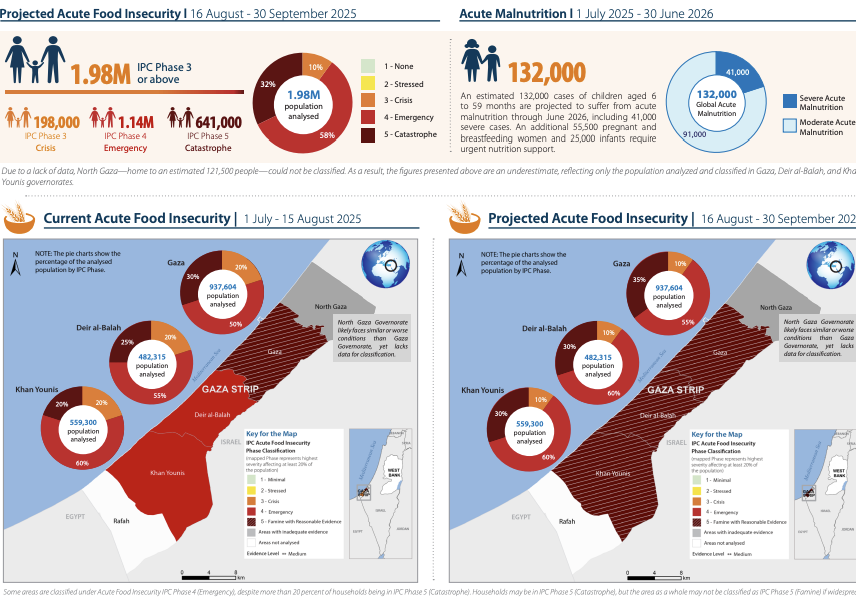
Please read the IPC report, cover to cover. Read it in sorrow & in anger. Not as words & numbers but as names and lives. Be in no doubt that this is irrefutable testimony. It is a famine. The Gaza Famine. It is a famine that we could have prevented, if we had been allowed. Yet food stacks up at borders because of systematic obstruction by Israel. It is a famine within a few hundred metres of food, in a fertile land. It is a famine that hits the most vulnerable first. Each with a name, each with a story. That strips people of dignity before it strips them of life. That forces a parent to choose which child to feed. That forces people to risk their lives to seek food. It is a famine that we repeatedly warned of. But that the international media has not been allowed in to cover. To bear witness. It is a famine in 2025. A 21st century famine watched over by drones and the most advanced military technology in history. It is a famine openly promoted by some Israeli leaders as a weapon of war. It is a famine on all of our watch. Everyone owns this. The Gaza Famine is the world’s famine. It is a famine that asks ‘but what did you do?’ A famine that will and must haunt us all. It is a predictable and a preventable famine. A famine caused by cruelty, justified by revenge, enabled by indifference and sustained by complicity. It is a famine that must spur the world to more urgent action. That must shame the world to do better. It is a famine that therefore also asks ‘… and what now will you do?’ My ask, my plea, my demand to Prime Minister Netanyahu and anyone who can reach him: Enough. Ceasefire. Open the crossings, north and south, all of them. Let us get food and other supplies in, unimpeded & at the massive scale required. End the retribution. It is too late for far too many. But not for everyone in Gaza. Enough. For humanity’s sake, let us in. Remarks by Tom Fletcher, Under-Secretary-General for Humanitarian Affairs and Emergency Relief Coordinator. Aug 22, 2025
Kobi tweet media
English
22
225
521
116.4K
Virginie Collombier retweetet
Dr. Ezzideen
Dr. Ezzideen@ezzingaza·
I have tried to write. I swear I have. Since yesterday, I have sat with pen in hand, but the words, those traitorous, trembling things, refuse to come. What does one write from hell? What language is left when every syllable is soaked in blood and betrayal? This morning, I saw a man at the side of the road. He was not weeping. He was not praying. He sat there like an orphaned prophet, staring at the heavens as if to demand: Why have You abandoned us? At first, his hands moved softly, almost tenderly, like a child learning to pray again after forgetting the words. Then suddenly, violently, they struck the air. He shouted, argued, pleaded, not with men, but with God Himself, as if the sky still held the capacity to blush. And I stood there watching and felt shame. Shame not because he believed, but because I no longer do. They now speak openly, not in whispers, not in secret documents, but with unflinching pride, of removing us all. Not metaphorically. Not slowly. But completely. As though we were rot, something to be scraped from history. Gaza, they say, must be emptied. Gaza, they say, is a military problem, not a home. And we are nothing but figures in a strategy, ghosts in someone else’s victory speech. And the world? Ah, the world has become a fist. Cold. Tight. Indifferent. It closes around us not out of rage, but out of boredom. We are no longer a tragedy. We are a statistic, a side note, a nuisance. We do not own the sky. The sky is no longer blue. It is steel. It is hunger. It is buzzing, poisoned, thick with the breath of drones that do not sleep. They pierce even our prayers. We are not the living. We are not the dead. We are the in-between, smoke clinging to rubble, souls stripped of longing, walking corpses still pretending to be fathers, daughters, doctors, lovers. And yes, I am that man on the side of the road. But I no longer lift my face. What is the point? God has turned His face from us, or perhaps worse, He watches in silence. Do you understand what it means to be silenced by heaven? I tell you, the worst suffering is not to die. It is to remain, to witness, to scream without echo. To know that you were once a person, and now you are a lesson, or worse, a warning. And still, still we mourn ourselves. Not with tears. Tears are for those who believe in resurrection. We mourn like dust mourns the wind. We grieve in silence, because we know, we know, soon, there may be no one left to remember we were ever here. #GazaGenocide
English
89
513
896
25.5K
Virginie Collombier retweetet
Mairav Zonszein מרב זונשיין
Instead of parachuting aid into Gaza, which is so obviously insufficient and for optics, stop arming Israel
English
39
131
554
21.2K
Virginie Collombier retweetet
سراج الحضيري Siraj Elhouderi
مصير مدينة سبها مهدد بالعطش على المدى المتوسط إذا لم تُعالج أزمة استنزاف المياه الحل ليس فقط تقنيًا، بل يحتاج قرارًا سياسيًا شجاعًا ورؤية تنموية عادلة تعيد للجنوب الليبي حقوقه من الموارد والاستثمارات.
سراج الحضيري Siraj Elhouderi tweet media
العربية
0
1
2
174
Virginie Collombier retweetet
Ori Goldberg
Ori Goldberg@ori_goldberg·
The reports from Gaza indicate that the final point of no return has been crossed. A broad consensus of scholars predicted that mass hunger will began to exact its deathly toll just about now. It is. All was known. Nothing surprised anyone. There is no need to refer to the Gaza Holocaust. Every genocide is unique. Israel's genocide of the Palestinian people is unprecedented in its lack of secrecy, in its length, in the overt dismissal of Palestinian humanity on Israel's part. The egregiousness of all these is such that there can be no quarter for the leaders, the executors and the enablers. This, ultimately, is what negates the need for official "orders". Israel is putting its heart into the liquidation of the Palestinians. How much more intent can there be?
English
464
7.8K
23.4K
849K