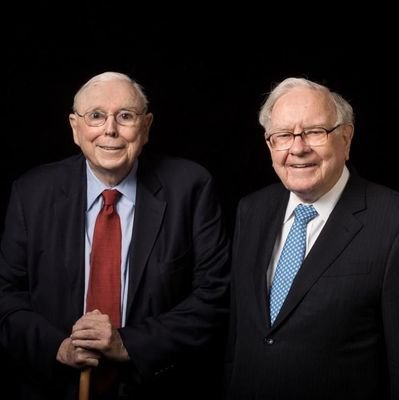
I've always liked the story of Charlie Munger.
At 31, he was basically at rock bottom.
He was freshly divorced, had lost the house, and his son died of leukemia. Munger paid for every treatment out of pocket and was left with almost nothing.
Yet he kept going.
Instead of drowning in bitterness, he worked, he read, and he kept his head down.
With a new marriage and some stability, he began investing his lawyer's salary into stocks and real estate.
Then in 1959 he met Buffett.
Inspired by someone who was already running his own partnership, Munger founded Wheeler, Munger & Company in 1962.
The wealth started to accumulate. Through real estate projects and his growing investment partnership, Munger became a millionaire around age 43.
Many successful investments followed, many alongside Buffett, and the relationship grew close enough that working together was the only thing that made sense.
Munger wound down his partnership in 1975. Over 13 years, he had compounded at 19.8% annually, against 5% for the Dow.
In 1978, he became Vice Chairman of Berkshire Hathaway and helped build the empire it was set to become.
Somewhere along the way he lost an eye to a failed surgery, but that didn't bother him much. He still had one left. Plenty enough to read annual reports.
When most people think of Munger, they just see a rich old wise man who almost stood in Buffett's shadow. But the truth is that Munger's wisdom didn't come from nowhere.
He worked himself up from rock bottom, a place where many others would have stayed down, to become one of the most respected investors in history. And a billionaire on top of that.
He never let it go to his head. He lived in the same house in Pasadena for decades. The place didn't even have AC. He cooled it with ice and fans.
Hard to find a better role model than that.
Charlie Munger:
“[Warren & I] are both smart enough to have watched our friends who got rich build these really fancy houses & I would say in practically every case they make the person less happy, not happier.”
HOWARD MARKS ON THE MOST EXPENSIVE LESSON OF SELLING TOO EARLY:
"Amazon was $90 in 1999. When the tech bubble burst, it went to $6. It was down 93%."
"What if you were smart enough to buy it at $6? Would you have held to $12? What about $60? You've made 10 times your money, would you sell?"
"What about when it got to $600? You made 100 times your money. Most people would sell."
"At the time I wrote it, Amazon was $3,300. If you sold at $600, you left 85% of the money on the table."
"Buffett says he made all his money on 12 ideas. Charlie Munger said he made all his money on 4. The big mistake is getting off too soon."
Warren Buffett: "The really great business is one that doesn't require good management. That is a terrific business. And the poor business is one that can only succeed — or even survive — with great management."
When Kobe Bryant said his insane level of confidence came from knowing he done all he could to prepare, it taught me that anytime I'm nervous it means I didn't prepare enough.
“I am not a victim, I’m a survivor. I don’t like any feeling of being victimised, so I just put my head down and adjust without ever feeling betrayed.”
“It’s a very counterproductive way to think as a human being.”
- Charlie Munger. 2011
"The great home run hitters wait for one pitch that they can really handle."
"They do not remotely swing at every pitch that looks halfway good, and that's what great stock pickers do, too."
- Charlie Munger. 2023
Mohnish Pabrai: "The important thing for an entrepreneur is to be in listen mode — and to be listening really carefully."
"If you listen, your customers are going to tell you what to do. Your customers will direct you to what you need to be doing."
“The secret of a long life that’s worked for me is, not to expect too much of human nature.”
“And to have your life full of resentments and hatred’s is counterproductive. You’re punishing yourself.”
- Charlie Munger . 2019
As Morgan Housel put it: “Define the game you're playing, and make sure your actions are not being influenced by people playing a different game.”
Half of investment success is tuning out the noise.