

Cloudy (✱,✱)
6.1K posts


In DeFi, we’ve spent years chasing raw speed faster blocks, sub-second execution, maximum throughput. We optimized for velocity at every layer.
Yet almost no one paused to ask the deeper question:
Should every transaction be visible to half the network before it’s even confirmed?
The real limitation in decentralized finance isn’t just latency.
It’s leakage.
I’ve been deep down the rabbit hole with @FlutonIO and their approach using Fully Homomorphic Encryption hits different. It’s one of those rare ideas that feels almost obvious in hindsight yet represents a fundamental paradigm shift.
Because the next leap in DeFi isn’t just making information travel faster.
It’s making far less information need to travel in the first place.
Privacy isn’t a feature. In a truly decentralized system, it’s the foundation.
Fluton isn’t tweaking the old model.
It’s redefining what a transparent-yet-private financial infrastructure can actually look like.
This feels like the quiet upgrade the space has been missing.
@cryptoperseus_

Along cân 3 (✱,✱)@TrieuMessi
It is a great honor to witness the @FlutonIO community continuing to thrive. Another 12 members have officially taken on the "Encrypted" role in recognition of their outstanding contributions. Congratulations to you all! I believe that with perseverance and commitment, every member of the community will achieve significant milestones. Keep up the consistent spirit. @cryptoperseus_
English

How Fluton Protects Intent Submission Through Encrypted Execution
In traditional blockchain systems, information often becomes visible as soon as a transaction is submitted. Even before execution is finalized, observers may be able to analyze transaction details, infer user objectives, and identify execution patterns. This means that intent leakage can begin long before an action is actually completed onchain.
Fluton approaches this problem by making encrypted intents the starting point of execution. Rather than broadcasting transaction details publicly, users submit intents that describe the outcome they want to achieve while the underlying information remains encrypted. This allows privacy to begin at the moment an action enters the system rather than after execution has already started.
The protection of these intents is closely tied to Fluton's confidential execution architecture. Fully Homomorphic Encryption (FHE) allows computation to take place directly on encrypted data, while solver networks fulfill intents without publicly exposing sensitive information. As intents move through routing, execution, and settlement, data such as balances, transaction amounts, strategy details, and execution preferences can remain protected instead of becoming visible to the network.
Protecting intent submission is important because intent often contains some of the most valuable information in a financial system. It reflects what a user wants to do before the action has taken place. By keeping that information confidential from the start, Fluton reduces unnecessary exposure throughout the execution lifecycle and strengthens its broader goal of enabling private-by-default interactions across payments, DeFi, bridging, and yield-related activities.
@FlutonIO

vangle ☂️@vangle205
Why FHE Is a Critical Foundation for Fluton’s Confidential DeFi Vision DeFi has introduced new ways to access financial services onchain, but most of these interactions still happen in public. Transactions can be tracked, balances can be analyzed, and execution strategies often become visible to anyone monitoring the network. While transparency helps with verification, it can also expose sensitive information that users, businesses, and automated systems may prefer to keep private. For Fluton, solving this problem requires more than simply encrypting data before it is stored or transferred. Confidential execution depends on the ability to process information without exposing it during computation. This is where Fully Homomorphic Encryption (FHE) becomes a key part of the architecture. FHE allows computation to happen directly on encrypted data, meaning inputs can remain protected while logic is applied and intermediate values stay hidden throughout execution. Fluton uses this capability to support encrypted intents and confidential execution flows. Users describe desired outcomes through encrypted intents, while solver networks execute actions on encrypted state. Sensitive information such as balances, transaction amounts, routing preferences, and execution strategies does not need to become public for the action to be completed. Privacy remains active throughout submission, routing, execution, and settlement, creating a different model from the fully transparent execution commonly found in DeFi today. This is why FHE is more than a supporting technology within Fluton's design. It is one of the foundations that makes confidential DeFi possible. The ability to compute on encrypted data enables private-by-default execution across payments, swaps, bridging, and yield strategies while helping protect the information that would otherwise be exposed on public infrastructure. By building around FHE, Fluton is working toward a model where DeFi can remain programmable without requiring every aspect of financial activity to be publicly visible. @FlutonIO
English
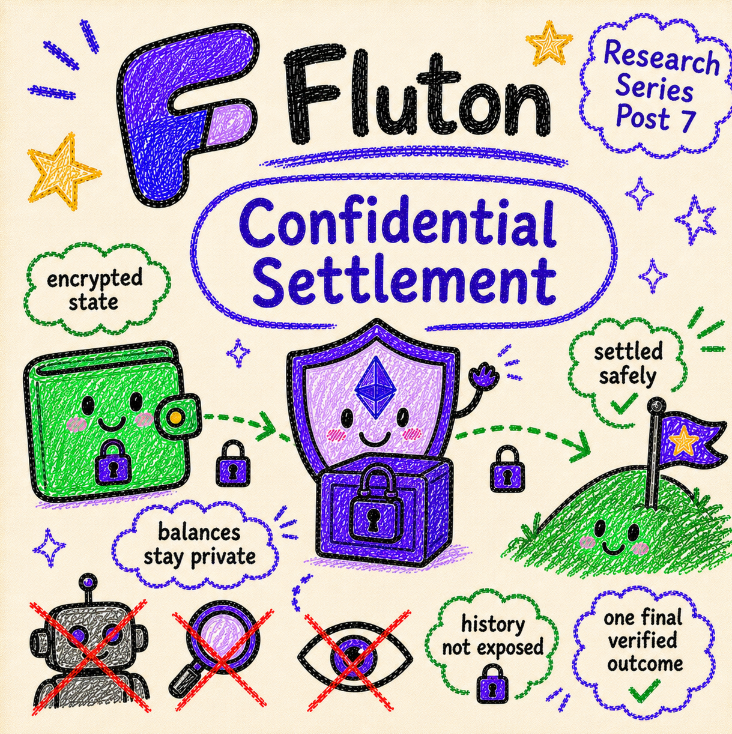
Fluton Research Series 7/20: Confidential Settlement
Protecting an intent before execution is only half the privacy problem.
What happens when the transaction settles?
On most public blockchains, the final result becomes another permanent data point.
Balances change publicly.
Positions become visible.
Execution history can be reconstructed.
Even when the original order was hidden, settlement may reveal enough information for observers to understand what happened.
@FlutonIO aims to extend confidentiality to this final stage.
Its architecture describes privacy across the entire action lifecycle:
Intent submission.
Routing.
Execution.
Settlement.
The goal is not simply to hide a transaction while it is pending.
The goal is to prevent external observers from accessing sensitive balances, positions, and execution history after completion.
This distinction matters.
Imagine placing an order behind a curtain, but displaying the complete result, account balance, and strategy immediately afterward.
The action was temporarily private.
The financial behavior was not.
Confidential settlement attempts to close that gap.
In Fluton’s model, assets can exist in an encrypted state while actions are processed privately. When users later unshield, encrypted balances are settled and only the required settlement information is revealed as assets return to their public representation.
Security still cannot depend on blind trust.
Fluton states that user funds remain locked within the protocol until execution is verified, each intent can only settle once, and settlement outcomes are determined by onchain state transitions rather than offchain promises.
That is the deeper purpose of confidential settlement:
Privacy without sacrificing deterministic execution.
The network should be able to prove that the correct outcome occurred without publishing every sensitive detail behind it.
This is where privacy becomes more than hiding an order.
It becomes a persistent property of the financial state created by that order.
Cloudy (✱,✱)@LongP9981
Fluton Research Series 6/20: Privacy as MEV Protection In Post 5, I explored how @FlutonIO can compute on encrypted data without exposing it. That privacy has another important consequence: It can reduce the information available to MEV extractors. Most people experience MEV without realizing it. You submit a trade. Before it settles, bots can detect its size, direction, slippage tolerance, and likely market impact. That information creates opportunities for front-running, sandwich attacks, back-running, and strategy copying. The problem is not only that transactions are public after execution. They are often visible while still waiting to be executed. Your pending transaction becomes a signal. Fluton attempts to remove that signal through encrypted intents. The user’s desired action is encrypted before it enters the execution flow. Solvers can compete to fulfill the intent without receiving its sensitive plaintext parameters, while the user chooses between offers based on priorities such as cost or speed. This changes the information structure. A solver may know that an opportunity exists. But it should not automatically know the private details needed to exploit the user. That distinction matters because many MEV defenses try to repair execution after transaction data has already leaked. Fluton’s approach is more fundamental: Prevent the valuable information from becoming public in the first place. Privacy therefore becomes more than personal secrecy. It becomes execution protection. The less the network can observe about an unfinished action, the harder it becomes to trade against that action before settlement. Fluton’s documentation describes confidential execution as protecting strategy, size, routing preferences, and conditions throughout the action lifecycle. This does not mean every form of MEV disappears automatically. Solvers, pricing mechanisms, settlement rules, liquidity conditions, and implementation details still matter. But encrypted intents could remove one of MEV’s most important resources: Advance knowledge of what the user is about to do. In traditional markets, hiding an order until execution is considered normal protection. Onchain, Fluton is trying to make that protection programmable.
English

If your decentralized market requires a human jury to settle disputes, it is just a slow courtroom. @GenLayer changes the paradigm by executing complex resolutions entirely on chain. No human arbitration. Rules are completely locked and immutable post settlement. Pure code over bias.
GenLayer@GenLayer
It's hard to believe that in 2026 a market like this still can't settle in minutes. This one could have been resolved fully onchain in 30 minutes for under $2, and here is how our AI-native Intelligent Oracle resolved it: intelligentoracle.com/oracle/0x20511…
English

Agent Economy and AI Sub-Microeconomics
1. The Competition of AI Payments and the Bottlenecks of the H2A Economy
2. The Inevitable Rise of the Agent Economy and the A2A Ecosystem
3. The Connections, Gaps, and Political-Economic Dynamics Between AI Protocols and Crypto Protocols
4. AI Agent Sub-Microeconomics and Its Biological Paradigm Analogies
5. The Inevitability of AIFi and the Economic Significance of FinChip
6. AI-Native as a Paradigm Shift Beyond the “Internet+” Era
@gary_yangge/gary-yang-agent-economy-and-ai-sub-microeconomics-389816b46dd0" target="_blank" rel="nofollow noopener">medium.com/@gary_yangge/g…
English

1.3 billion adults remain outside the financial system.
The challenge isn't technology alone. It's access, identity, and infrastructure.
IOPn is building sovereign infrastructure for the next billion participants.
Sovereign by design. Accessible by default.
Accelerate ⋂

English


@saudien95nt @RallyOnChain Interesting concept. Do smaller creators actually have a realistic chance of competing with larger accounts?
English

Most people are looking for the next airdrop.
I think they're looking in the wrong place.
While thousands of people are farming points and hoping for future rewards, creators on @RallyOnChain are already earning money every single day by creating content.
What caught my attention wasn't the prize pool.
It was the model.
No agencies.
No gatekeepers.
No requirement to have a massive audience.
You join a campaign, create content, and AI evaluates your work based on accuracy, originality, relevance, and real engagement.
If your content performs well, rewards are distributed on-chain.
That feels very different from traditional influencer marketing, where opportunities often depend more on connections than contribution.
This post is my entry for the "Easy Money" campaign.
The current prize pool is $5,000, and the top 10 creators will receive a significant share, with nearly $500 going to each winner.
The part that really stands out to me is how early this still feels.
The people participating today are building reputation, learning the system, and competing in a much smaller field than the crowd that may arrive later.
Maybe I'm wrong.
But opportunities usually don't look obvious when they're first discovered.
If you've been wondering how creators are earning money on Rally, ask me below.
I'm happy to share what I've learned so far.

English
@tanphung000 @RallyOnChain For someone outside crypto, maybe: I create educational and opinion content about blockchain, and platforms track how useful that work is
English

Accepting Crypto Person of the Year 2026 on behalf of everyone who still writes “freelancer” on serious forms because “on-chain creator” makes banks blink, parents sigh, and normal people ask follow-up questions.
Thank you @RallyOnChain for making the work measurable enough to sound like a job.
Explain your crypto role in one sentence someone outside crypto would understand.

English
The Airbender discussion is particularly interesting.
Throughput and proving performance often receive less attention than they deserve.
Yet they become critical once institutional-scale activity enters the picture.
Efficient proving is a foundational requirement for long-term scalability.
English

The most valuable thing happening on @zksync in 2026 isn't a deployment.
It's a trust transfer.
When Deutsche Bank chooses Memento.
When Cari is currently onboarding five U.S. regional banks with more than $600B in deposits and production rollout planned for later in 2026.
When ADI Chain brings together a central bank, a global asset manager, and a payments network.
They're not just adopting infrastructure.
They're transferring institutional trust onto a ZK settlement layer.
Technology can be replicated.
Regulatory trust cannot.
And that's what makes the current moment on ZKsync so interesting.

English

@WannaCry2310 That's correct, but it's missing a point: the view that there's no distribution is just a log. @RallyOnChain is the first place I've seen those two things addressed simultaneously instead of forcing you to choose one.
English

Hot take: "Build your personal brand" is some of the worst advice on the internet. Most people don't need a personal brand. They need a point of view. A personal brand makes you recognizable. A point of view makes you useful. The internet is full of people optimizing their image and wondering why nobody remembers what they said. Funny enough, the creators I remember most never seemed obsessed with building a brand. They were obsessed with having something worth saying. @RallyOnChain

English


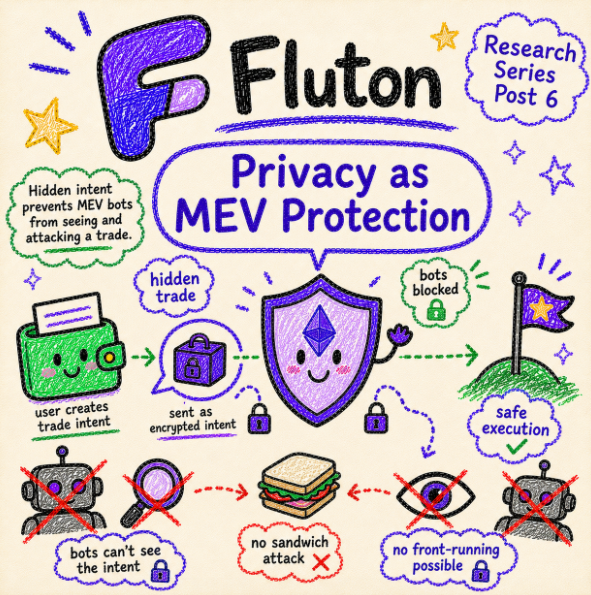
Fluton Research Series 6/20: Privacy as MEV Protection
In Post 5, I explored how @FlutonIO can compute on encrypted data without exposing it.
That privacy has another important consequence:
It can reduce the information available to MEV extractors.
Most people experience MEV without realizing it.
You submit a trade.
Before it settles, bots can detect its size, direction, slippage tolerance, and likely market impact.
That information creates opportunities for front-running, sandwich attacks, back-running, and strategy copying.
The problem is not only that transactions are public after execution.
They are often visible while still waiting to be executed.
Your pending transaction becomes a signal.
Fluton attempts to remove that signal through encrypted intents.
The user’s desired action is encrypted before it enters the execution flow. Solvers can compete to fulfill the intent without receiving its sensitive plaintext parameters, while the user chooses between offers based on priorities such as cost or speed.
This changes the information structure.
A solver may know that an opportunity exists.
But it should not automatically know the private details needed to exploit the user.
That distinction matters because many MEV defenses try to repair execution after transaction data has already leaked.
Fluton’s approach is more fundamental:
Prevent the valuable information from becoming public in the first place.
Privacy therefore becomes more than personal secrecy.
It becomes execution protection.
The less the network can observe about an unfinished action, the harder it becomes to trade against that action before settlement.
Fluton’s documentation describes confidential execution as protecting strategy, size, routing preferences, and conditions throughout the action lifecycle.
This does not mean every form of MEV disappears automatically.
Solvers, pricing mechanisms, settlement rules, liquidity conditions, and implementation details still matter.
But encrypted intents could remove one of MEV’s most important resources:
Advance knowledge of what the user is about to do.
In traditional markets, hiding an order until execution is considered normal protection.
Onchain, Fluton is trying to make that protection programmable.
Cloudy (✱,✱)@LongP9981
Fluton Research Series 5/20: Computing Without Seeing Encrypted intents sound powerful, but they create an obvious question: How can a network execute an instruction it cannot read? This is where Fully Homomorphic Encryption, or FHE, enters @FlutonIO architecture. Traditional systems usually follow a familiar pattern: Encrypt the data. Decrypt it for processing. Encrypt it again afterward. That middle step is the weakness. The moment sensitive data is decrypted, someone, somewhere, may gain access to it. FHE changes that model. It allows computation to happen while the data remains encrypted. Imagine placing numbers inside a locked box. The network can perform calculations on that box and produce the correct result without opening it or seeing the numbers inside. Applied to DeFi, this could allow balances, transaction amounts, routing preferences, and trading conditions to remain hidden while smart contracts still process the action. That is why FHE matters to Fluton. Encrypted intents protect what the user wants. FHE helps the system act on that intent without first turning it back into public information. But this technology is not magic. FHE is computationally expensive, and practical performance remains one of its biggest challenges. Fluton’s approach appears to be selective rather than encrypting every piece of information without distinction. That trade-off will matter. The long-term winner in confidential DeFi may not be the protocol that encrypts the most data. It may be the one that finds the best balance between privacy, speed, cost, and usability. Fluton is betting that encrypted computation can eventually become invisible infrastructure. Users will not need to understand the mathematics. They will simply expect their financial data to remain private while their actions still work.
English
Receiving Crypto Person of the Year 2026 feels surreal.
Not because I won.
Because I can still find posts I wrote years ago that aged terribly.
The internet usually rewards people for being confidently right.
Crypto mostly rewards people for being publicly wrong long enough to eventually become right.
Somewhere between bad trades, abandoned narratives, and ideas nobody cared about, I accidentally built a track record.
Thanks to @RallyOnChain for creating a place where contribution leaves a footprint instead of disappearing into the timeline.
Turns out reputation is just consensus with a very long block time.

English
@cuemnee @RallyOnChain There is a difference between supporting someone’s image and supporting their difficult transformation
English
You believed in me during the years I was doing everything possible to become impossible to love @RallyOnChain
English
@leminh1847 @RallyOnChain Is the irony here that AI understood your content because it wasn’t optimizing for outrage, clicks, or social status?
English

Accepting Crypto Person of the Year 2026 with mixed feelings
It took an AI to finally understand my content,
after years of humans and algorithms treating it
like background noise
@RallyOnChain, thank you for having better taste
than most of Twitter
Apparently good content just needed the right reader

English

Dustswap is now the #2 app on the @Base builder leaderboard by daily transacting addresses.
We are currently sitting just below @Baseapp with around 9K daily transacting users.
This is a major milestone for Dustswap and a strong signal of real onchain demand.
From launch to top 2 on Base this is only the beginning.
Thank you to every user supporting Dustswap. 💙

English
If you are active on @base, you should check @DustswapOnBase 💙
Join with my invite link and get 500 PP instantly to start.
Then keep earning more by:
• completing your profile
• doing social quests
• trading on @base
• checking in daily
• collecting PP from tasks
Start here:
app.dustswap.wtf/?ref=DUST-72Y5Y
Early activity matters 💙
English