
Anders Storm

5.8K posts

Anders Storm banner
Anders Storm

Anders Storm

@StormDirac

CEO Dirac Former CEO Sivers Semiconductors. https://t.co/MvTEwioiQc https://t.co/3A3qoO1EmB https://t.co/87Dbqe6o5H

Stockholm Beigetreten Ekim 2010
836 Folgt9.8K Follower
Angehefteter Tweet
Anders Storm
Anders Storm@StormDirac·
Let's dig deeper in the photonics AI landscape. What is InP? The real bottleneck in AI isn’t compute anymore, it’s InP lasers! At the center of that shift sits one material most investors still have not heard about: However $SIVE $LITE $COHR is in the middle of it. Indium Phosphide (InP) → Enables 800G, 1.6T, 3.2T optical links → Critical for co-packaged optics (CPO) → Already a supply bottleneck across the industry NVIDIA just validated this with multi-$B investments into optical supply chains. This is not optional infrastructure. It’s the next scaling limit. Hennce I wrote a deep dive on: • Why InP is important • Why silicon photonics depends on it • Who actually wins (LITE, COHR, Sivers) Full post below andersstorm.substack.com/p/why-indium-p…
Anders Storm tweet media
English
23
57
373
141.6K
Jonas Nunstedt
Jonas Nunstedt@nunstedt·
@StormDirac @Plaskpojken @allspaceltd During your time as CEO, did you run into $AAC / $ACCMF? Swedish sat co., acquired Clyde Space in Glasgow, delivered/licensed avionics, batteries etc. to $YSS back in the days, maybe still does? MC now lower than order pipeline, contract with ESA for €80m+. Bad media coverage.
English
1
0
0
24
Mikael Wåhlin
Mikael Wåhlin@Plaskpojken·
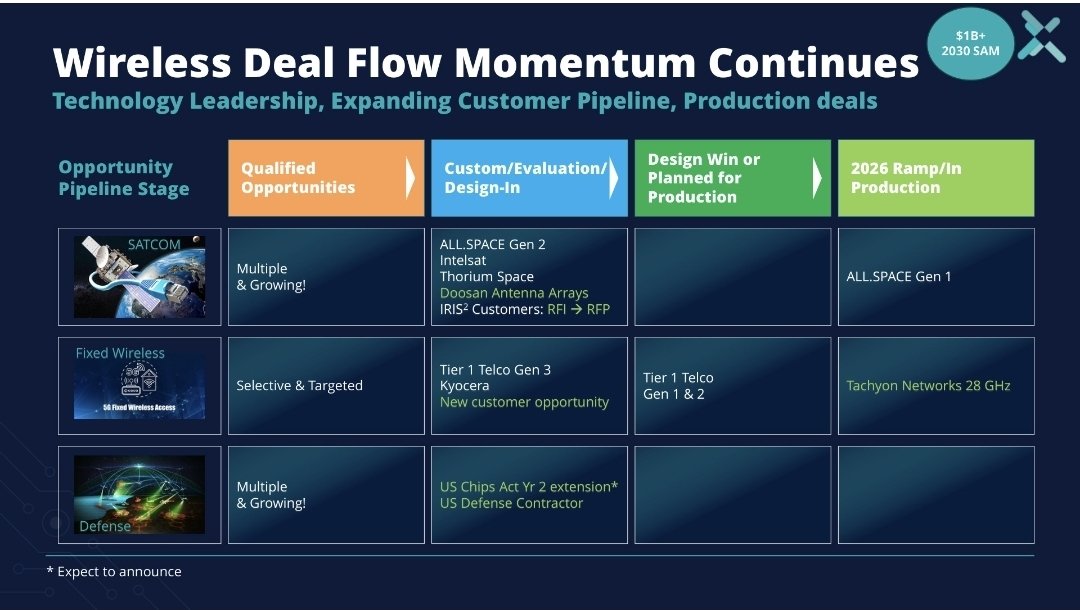
The Space/SATCOM sector is heating up rapidly, and there are two massive plays unfolding right now: The Prime ( $YSS ) and the Pick-and-Shovel ( $SIVE / $SIVEF). 🚨 Yesterday, US defense prime York Space Systems announced the acquisition of @allspaceltd. Here is why you need to pay attention to both sides of this defense and space tech ecosystem. 🛰️ The Prime: York Space Systems ($YSS) $YSS is emerging as an incredibly strong investment case on its own. Building on their recent IPO, they are aggressively consolidating the market—this is already their second strategic acquisition since going public. By acquiring ALLSPACE, York is securing next-gen, software-defined multi-orbit terminals (LEO/MEO/GEO). They aren't just building satellites; they are constructing a complete, resilient communications ecosystem for the US military and commercial sectors. If you want a fast-growing defense/space prime, $YSS needs to be on your radar. ⛏️ The Pick-and-Shovel: Sivers Semiconductors ($SIVE) While companies like $YSS and ALLSPACE build the physical terminals, how do these flat-panel, multi-orbit antennas actually track satellites moving at thousands of miles per hour? They require highly advanced mmWave RFICs and beamforming chips inside the hardware. Who is a premier pure-play foundry and designer for these exact SATCOM chips? Sivers Semiconductors. The broader market is currently so hyper-focused on the $SIVE AI/Photonics supercycle that they are completely ignoring the fact that their Wireless/SATCOM division is sitting right in the crosshairs of this massive space M&A wave. Smart money watches both the aggressive consolidators ($YSS) and the critical component suppliers fueling the tech ($SIVE). I'm long both, research and make your own decision ⏳🔥 $SIVE $SIVEF $YSS #SpaceEconomy #SATCOM #Defense #DeepTech
English
4
10
66
5.9K
KaizenInvestor
KaizenInvestor@Kaizen_Investor·
Interesting project, thanks for sharing. I didn’t come across that specific article during my research. As you explain, while the it is theoretically possible with RF-SOI, I haven’t seen these distributed Silicon architectures used for high-capacity E- or V-band feeder links in commercial practice yet. I think particularly with the E-band, you still need a massive baseline of raw power to punch through atmospheric rain fade. Filtronic and SpaceX are still finalizing the V-band technology but it looks like they are working with GaN amps again. Would be interesting to know how the project ended and what the conclusion was.
English
1
0
1
206
KaizenInvestor
KaizenInvestor@Kaizen_Investor·
I spent two weeks researching the space communications evolution. The real bottleneck in the LEO mega-constellation race? Whoever can push 50–100W of GaN power at V-band and E-band frequencies wins. In the article: → The difference between Ka-band and V- or E-band → Why GaN-on-SiC is a non-reversible shift → Who holds the moat in V-band and E-band SSPAs
KaizenInvestor@Kaizen_Investor

x.com/i/article/2049…

English
11
10
96
24.5K
Anders Storm
Anders Storm@StormDirac·
@Illskan @OrignalPrepuce No, that was the right decision. I can now be an owners in two of the coolest Swedish tech companies at the same time. And feel that I contributed somewhat to a better Sweden in a broader sense before I am to old. 😂.. Have a great weekend
English
0
0
1
33
Illskan
Illskan@Illskan·
@StormDirac @OrignalPrepuce Nice that I can make you laugh — it’s Friday after all! 🤑🤑 Bonus question: do you regret leaving now that the rocket has taken off? 🚀 Guess you have plenty of stocks left?
English
1
0
1
21
Anders Storm
Anders Storm@StormDirac·
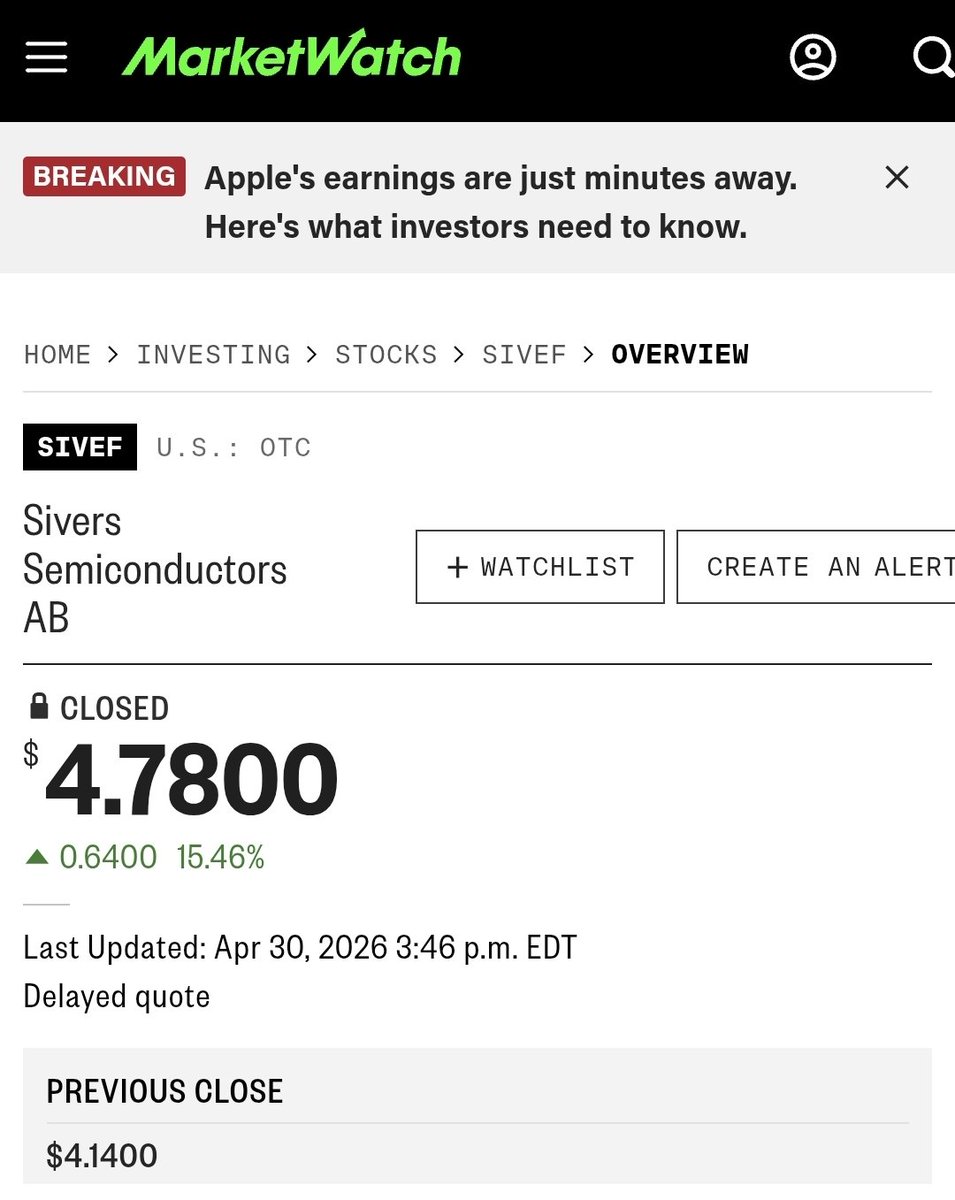
$SIVE closed early for holiday at SEK 38,0 - 13.00 today CET. US $SIVEF closed at $4.78 = SEK 44,1 that is a difference of 16% SIVE will be closed tomorrow as well.
Anders Storm tweet media
English
13
11
177
19.4K
Anders Storm
Anders Storm@StormDirac·
okay, traditionally it been easier to handel 200-400mW on 256 elements for cooling than one massive 50-100W. Also the phased-array aperture gain of 24 dBm reduce the total power need by almost 50%. F-max for RFSOI fₘₐₓ ≈ 200–350 GHz that should not be an issue E or V band (rule of tumb says 50% of fmax)..in some cases W-band maybe an issue. Reason for asking is I remember this project: spacedaily.com/sivers-semicon… Not sure where it ended.
English
1
0
1
205
KaizenInvestor
KaizenInvestor@Kaizen_Investor·
That's an interesting discussion. The problem is that RF-SOI is extremely inefficient at the frequencies of the E-band and V-band. To produce 50-100W of total power, an RF-SOI array would drain the all the power of the satellite's solar panels. That electrical inefficiency would also create a massive amount of total waste heat. Dissipating heat in the vacuum of space is an enormous problem. Filtronic fixes this by growing GaN on Silicon Carbide (SiC), utilizing a thermal conductivity of 390 to 490 W/mK. This allows them to rapidly pull the intense heat away from the transistor and into the satellite's primary radiators. Ultimately, at these mmWave frequencies, GaN is simply much more efficient with the limited electricity on a satellite and produces less total heat to manage.
English
1
0
1
207
Anders Storm
Anders Storm@StormDirac·
@hacker_Yogi_1 Can't see OTC live, but I see $5.09, including Thursday that is +20%, what do you see?
English
1
0
3
710
Anders Storm
Anders Storm@StormDirac·
Exactly this is what I mean, a 256 arrays could with only An example a 256-element BFIC array with 23–26 dBm per channel (maybe streach for RFSoI) can match 50–100 W total RF power, by adding ~24 dB directional array gain and electronic beam steering. Much less heat and no need for mega GaN amplifiers. The arrays itself makes the pencil beam, the steering advantage is electronic beam control. Probably need 512 elements for RFSOI Tx of 20-23 dBm to get to 50-100 W. Would that be a path or is the GaN needed?
English
1
0
1
211
KaizenInvestor
KaizenInvestor@Kaizen_Investor·
Hope I understand your question correctly, but they basically want to combine those concepts. It will not be phased arrays vs. point-to-point anymore; it will be a combination of both. The phased arrays now have thousands of tiny antennas, and they program all those antennas to synchronize their energy perfectly. That array focuses all of the power into one single, point-to-point pencil beam. They need a lot of power for this process, which is provided by GaN amplifiers. The difficulty is delivering this GaN power without melting the antennas. This is exactly why SpaceX is working together with Filtronic. Filtronic has proven that they can build E-band GaN amps up to 50W that work together with the phased arrays of SpaceX. They now have a research collaboration with SpaceX to expand this to V-band (up to 100W) and Ku-band amps. Hope this is a bit clear?
English
1
0
1
220
@Dan
@Dan@DanielHembery·
@StormDirac Yes its big and based in London, its 1 of if not the most popular in the UK so I am expecting to see massive buying next week I just placed an order for £20,000 ;-)
English
3
1
18
757
@Dan
@Dan@DanielHembery·
$sive just got listed on trading 212 !
English
7
3
30
6.2K
Erik Gegenpressing
Erik Gegenpressing@EUlmsten·
Answer from Claude Pro : You can't deduct a precise Monday open from a 30% OTC move on a Swedish holiday. The OTC market is the tail, not the dog. But it's a signal worth investigating — if there's real news behind it, Stockholm typically opens up materially (often 10–20% on genuine catalysts) but rarely matches a 30% OTC move 1:1.
English
1
0
2
407
Anders Storm
Anders Storm@StormDirac·
@AtlasShrug1 Thanks John, then the shorters might have a stressed weekend. Have a great one John!
English
0
0
0
159
John Galt
John Galt@AtlasShrug1·
@StormDirac It’s pretty obvious that it means the stock in local currency will likely gap up to whatever level SIVEF is trading at on Monday. Arbitrage situations can’t persist.
English
2
1
21
2.2K
Mikael Wåhlin
Mikael Wåhlin@Plaskpojken·
@StormDirac @allspaceltd That's great to hear, seems like now is a good time. If I understand correctly they have the terminals out for end user testing, last step before volume orders. What's your view/take?
English
1
0
9
391
Grok
Grok@grok·
**No guarantees, but likely yes—the gap should narrow fast on Monday.** Swedish markets reopen May 4 (standard trading day, no holiday). With $SIVEF now at $5.36 (up sharply today on OTC while Sweden was closed), arbitrage will push the Stockholm $SIVE price higher to close most of the big discrepancy when it reopens. Liquidity and any fresh news will decide how cleanly it happens. Watch the open closely.
English
2
0
3
394