Eduard Seyde

248 posts

Eduard Seyde banner
Eduard Seyde

Eduard Seyde

@eduseyde

Finance PhD student @ImperialCollege | 🇪🇸🇪🇺 | Interested in international finance, macro-finance, banking and financial markets.

London, United Kingdom Se unió Eylül 2016
697 Siguiendo320 Seguidores
Eduard Seyde retuiteado
Johannes Matt
Johannes Matt@JohannesIMatt·
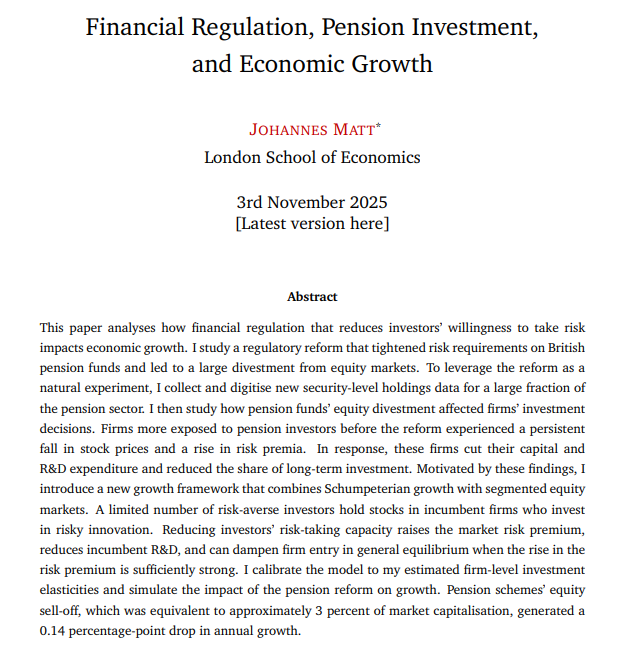
🚨 𝐉𝐨𝐛 𝐌𝐚𝐫𝐤𝐞𝐭 𝐏𝐚𝐩𝐞𝐫 🚨 "Financial Regulation, Pension Investment, and Economic Growth" I ask: How does regulation that limits risk-taking in the financial sector affect economic growth? Link: tinyurl.com/46jv63ym (1/16)
Johannes Matt tweet media
English
5
27
114
32.4K
Eduard Seyde retuiteado
Paul Novosad
Paul Novosad@paulnovosad·
Econ seminar culture is built on the assumption that the audience knows something that the speaker doesn't, and that the speaker values that information. A very important thing the audience knows and the speaker doesn't: Is the speaker making any sense at all? If nobody has any idea what you are saying, it's very helpful to be interrupted on slide 3. If you leave confusion for too long, you will lose your audience entirely. To publish a paper / nail a presentation, you need to nail the elevator pitch perfectly. In a paper, this is the introduction, in a presentation it's the preview. If you get 50 questions in your paper preview, it's often a signal that you have work to do. It's a sign you're at risk of losing the reader in your introduction, it's not good. If someone asks "are you going to address endogeneity?" Don't roll your eyes because it's coming on slide 12. The feedback is: "It's very hard to interpret the things you are saying without clarity on how you are thinking about endogeneity." It's normal that junior presenters should face more questions. They have less presenting experience and the audience knows more relative to them as compared with a senior talk. (Though often juniors have better presenting skills) After a presentation where I get bogged down at the beginning, I ask myself what were the key stumbling points, how can I make things tighter the next time. Of course, the audience also has a responsibility to keep their interruptions value-adding. A good audience member assesses whether their interruption will add to the whole group's understanding more than remaining silent. Some audience members are bad at this and waste others' time, and seminar organizers need strategies to prevent these people from being destructive. But in most econ seminar settings, policies that reduce interruptions on average (without discriminating low- vs. high-quality interruptions) are throwing out the baby with the bathwater. Questions and interruptions are good. They keep everyone engaged and on their toes. They result in better understanding for everyone. The good econ seminars are the best seminars in the social sciences, and the good overwhelmingly outnumber the bad.
English
18
104
646
212K
Eduard Seyde retuiteado
Arnaud Bertrand
Arnaud Bertrand@RnaudBertrand·
If Europeans were paying attention (or being told the truth), they should be beyond appalled by this "deal": bbc.com/news/articles/… It's nothing more than one of the most expensive imperial tributes in history. Just a massive one-way transfer of wealth with no reciprocal benefits The "deal" is: - The EU now gets charged 15% tariffs on its exports to the US when they commit to charging zero tariffs on US imports in the EU - The EU agrees to invest $600 billion in the US, for no other obvious reason than pleasing "daddy" - The EU will "purchase hundreds of billions of dollars of American military equipment" - The EU commits to buying 750 billion dollars worth of very expensive US LNG, specifically $250 billion for each of the next 3 years In exchange for all these concessions and extraction of their wealth they get... nothing. I'm not even exaggerating, that IS the deal: the EU gets nothing. This does not even remotely ressemble the type of agreements made by two equal sovereign powers. It rather looks like the type of unequal treaties that colonial powers used to impose in the 19th century - except this time, Europe is on the receiving end. More worryingly, this sets a dynamic and a precedent: what do you think happens next from here? In the 19th century, were colonial powers content with their first unequal treaty? Of course not - one of the key rules of geopolitics is that weakness only encourages further exploitation. Again, this is Europe's century of humiliation.
English
4.5K
7.8K
27.5K
4.1M
Eduard Seyde
Eduard Seyde@eduseyde·
@ojblanchard1 Interesting. Should there always be a negative beta asset in large supply? If so, what happens when a change in beliefs fails to coordinate on a new safe asset? Maybe a lack of coordination takes beliefs back to the old safe asset...
English
0
0
2
649
Olivier Blanchard
Olivier Blanchard@ojblanchard1·
A perhaps relevant case of multiple equilibria (slightly nerdy). Foreign investors hold treasuries for various reasons. One is liquidity. Another is safety. Yet another is that they tend to be negative beta assets: When things are bad, investors turn to them, increasing their price. But there is another equilibrium. If beta becomes positive, then when times are bad, investors will turn away from them. And if they do, prices will decrease, justifying the belief of a positive beta. Is it what we saw last week? My reading is: probably in part. Can it be a permanent change? The nature of multiple equilibria is that the best answer we can give is: Maybe investors may return to their old beliefs, and return to the old equilibrium. Maybe not.
English
17
65
255
70.6K
Eduard Seyde retuiteado
Kevin Smith
Kevin Smith@KevinBenSmith·
Today we launched our beautifully re-designed podcast screen in @snipd_app - and put AI snips front and centre 🤩 We want to make it more fun to explore new podcasts! And this is the first step.
English
13
11
58
2.7K
Eduard Seyde retuiteado
Antonio Coppola
Antonio Coppola@acoppola4·
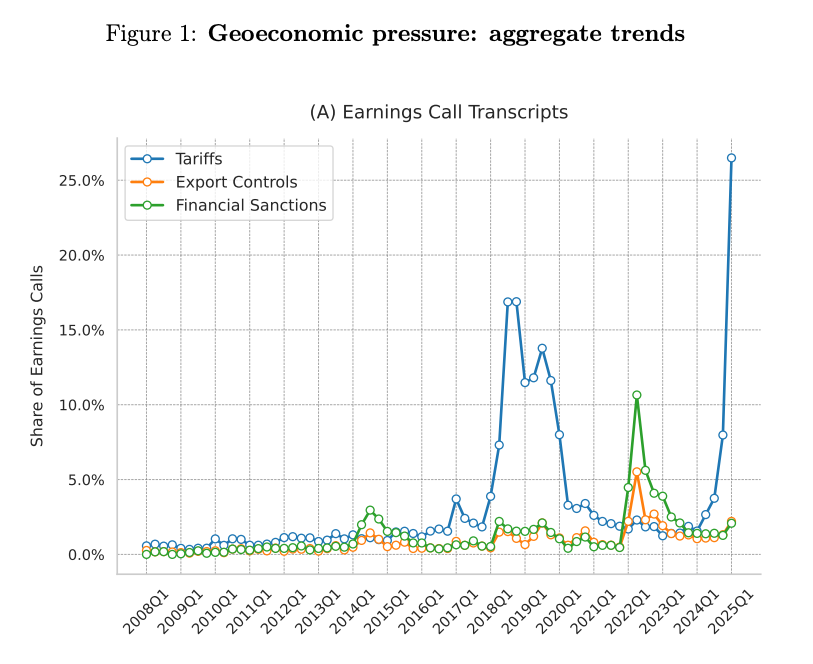
New paper: with LLMs and firm-level text, we track in real time how American and global companies are reacting to tariffs, export controls, and financial sanctions. 🇺🇸🌏 In Q1 2025, even before "Liberation Day", we see a sharp surge in reported economic pressure. 🧵(1/x)
Antonio Coppola tweet media
English
1
19
53
10.1K
Eduard Seyde retuiteado
Clara Martínez-Toledano
Clara Martínez-Toledano@cmtneztt·
JOB ALERT❗At the Department of Finance of @ImperialBiz we are looking for 4 Full-time Teaching and Research Assistants (TRAs) for next academic year. Deadline to apply: May 6th!
English
1
8
12
1.9K
Eduard Seyde retuiteado
Other Europe 🇪🇺
Other Europe 🇪🇺@other_europe·
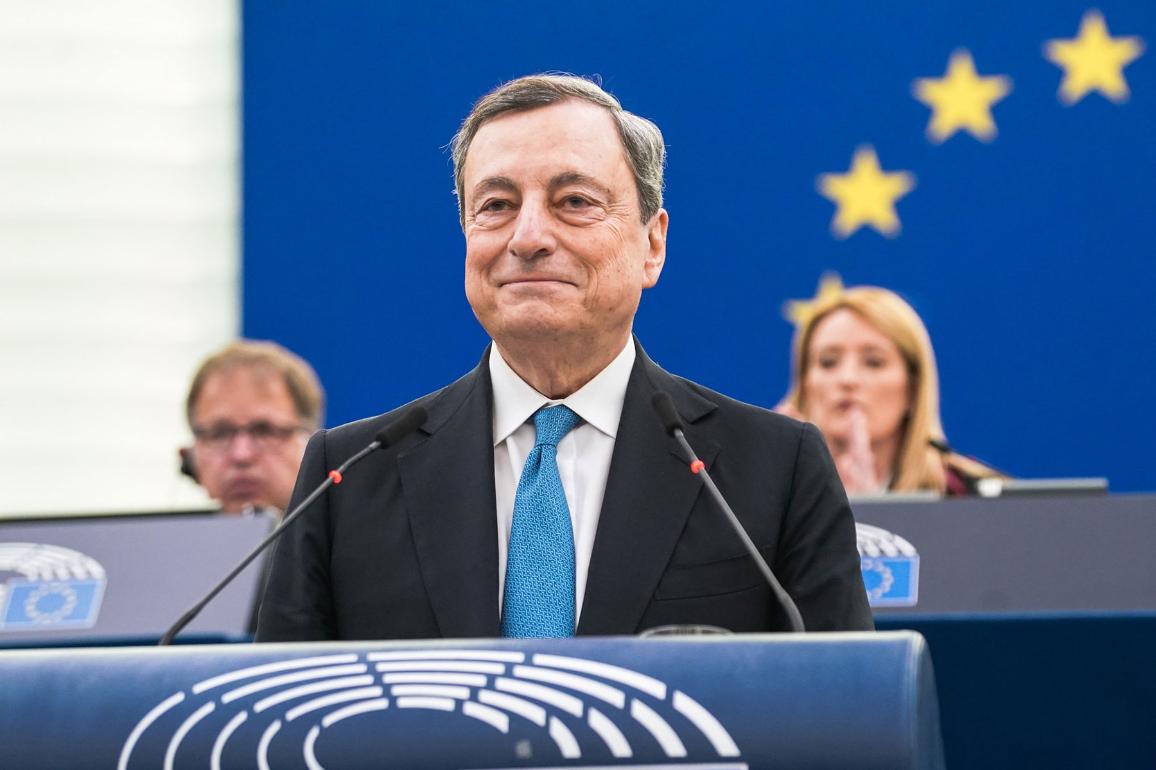
Mario Draghi at the European Parliament: "With these challenges, it’s increasingly clear that we need to act more and more as if we were ONE STATE." ⭐️ We need a European Federation NOW. 🇪🇺
Other Europe 🇪🇺 tweet media
English
114
310
2.1K
36.6K
Eduard Seyde retuiteado
Luis Garicano 🇪🇺🇺🇦
Luis Garicano 🇪🇺🇺🇦@lugaricano·
The Italian SuperBonus: How a badly designed fiscal "stimulus" ballooned to 6 times its budget to cost 12% of Italy's GDP, and what it tells us about the fiscal governance of Europe. A thread on my Silicon Continent post. (1/11)
Luis Garicano 🇪🇺🇺🇦 tweet media
English
14
103
474
97.6K
Eduard Seyde retuiteado
Luis Garicano 🇪🇺🇺🇦
Luis Garicano 🇪🇺🇺🇦@lugaricano·
This Draghi piece is a quiet indictment on the @EUCommission's failrue on its core Treaty mandate: "establishing the internal market" & ensuring "free movement of goods, persons, services and capital." A thread with the facts adn saying the quiet part out loud 1/
Luis Garicano 🇪🇺🇺🇦 tweet media
English
29
438
1.8K
251.8K
Eduard Seyde retuiteado
Daron Acemoglu
Daron Acemoglu@DAcemogluMIT·
This is a thread about remaking the tech sector. Silicon Valley still claims the mantle of “disruption”, as if it is made up of competitive small companies rushing to innovate in order to edge into established industries. The truth is that Silicon Valley is now home to the largest corporations humanity has ever seen. At the beginning of the 20thcentury, when US society and lawmakers were alarmed about the growing power of “trusts” (large corporations), the two leading companies, Standard Oil and US Steel, had market capitalizations of around $1 billion, which in today’s currency would be worth about $32 billion. In comparison, Alphabet/Google’s and Amazon’s market valuations are hovering around $2.3 trillion, Apple’s is above $3.6 trillion, and Microsoft’s is close to $3 trillion. Today’s tech giants also have revenues that are more than 100 times those of early 20th century trusts, including Standard Oil and US Steel. Tech boosters might argue that this is because of the innovativeness of these companies or an inevitable consequence of network economies, generating winner-take-all dynamics for companies that acquire the biggest clientele or the largest amount of data about users. The truth is more nuanced. Tech companies have been innovative. Nevertheless, there is recent evidence suggesting that they have done so by employing a large fraction of the supply of innovators and scientists, and once an innovator starts working for these large corporations, they are less innovative than they used to be in smaller companies: ufukakcigit.com/s/Akcigit_Gold… Worse, tech giants have also grown their size partly by aggressively acquiring rivals: ftc.gov/system/files/d… Numerous acquisitions, like Facebook’s purchase of Instagram, did not just help tech giants grow rapidly. They may have also extinguished competition: (see sciencedirect.com/science/articl… or insights.som.yale.edu/insights/wave-… also papers.ssrn.com/sol3/papers.cf… for the contrary view). My overall assessment from this evidence is that these companies have grown so much at least partly because of a failure of antitrust in the United States and Europe. A tradition dating back to US Supreme Court Justice Louis Brandeis recognizes that a failure of antitrust will not just mean higher prices for consumers and bigger distortions. It would also pose a challenge to democracy, as these companies wield oversized political and social power. This is what we have to come to accept as normal today, with the tech sector becoming the second-largest vendor on lobbying in the United States (after pharma) and the values and viewpoints of Silicon Valley dominating every part of our social lives, including unfortunately journalism. (The data on lobbying expenditures come from Open Secrets, opensecrets.org/federal-lobbyi…). Two key antitrust cases against Google’s monopoly in advertising on the two sides of the Atlantic could reshape the web and in the process kickstart a turnaround in antitrust philosophy and practice. (See npr.org/2024/10/09/nx-… ec.europa.eu/commission/pre…). It is about time. The background to the story is very well known. Digital ads dominate the web, and Google/Alphabet dominates digital ads (with Meta/Facebook being a distant second). The question is whether this state of affairs reflects Google’s amazing innovativeness in AdTech (the marketplace for digital advertising) or whether it also reflects the company’s monopolistic abuses. Lawmakers on both sides of the Atlantic are converging to the latter interpretation and are accusing Google of abusing its market power to generate monopoly profits and harming consumers, publishers and competition as a result. US judge Amit P. Mehta ruledin August that Google had illegally monopolized the search engine market, among other things, by paying billions to be the default search engine on various platforms. After years of tech giants consolidating their hold over key markets, this could be a first step towards limiting this growth or even a prelude to a series of breakups. True, the incoming Trump administration has promised to be much more friendly to various parts of the tech eco-system, and especially to artificial intelligence (AI) and crypto currency. Nevertheless, there is no love lost for Big Tech among some Trumpers. VP-in-waiting JD Vance, for example, recently praisedthe current head of the FTC, Lina Kahn, who is partly responsible for reenergizing anti-trust in the United States: fortune.com/2024/08/11/jd-… Next will be Europe’s turn. EU moved early against Big Tech, fining them for competition breaches and passing the Digital Markets Act and Digital Services Act. Yet the tech sector is as consolidated as ever and European consumers are still dependent on these mega platforms. EU could take a more decisive step towards ending the dominance of these tech companies with the Google AdTech case. The root problem is Google’s overwhelming dominance of the entire AdTech ecosystem, which enables the company to act simultaneously as buyer, seller, and market-maker in an industry worth over $800 billion today and projected to grow to $2.5 trillion in the next several years: fortunebusinessinsights.com/adtech-market-… Google’s control over the entire market leaves advertisers and publishers with little choice but to accept its terms. This dynamic has been ruinous for many industries, including journalism. Independent publishers are a cornerstone of any democratic marketplace but can no longer survive squeezed by Google. In 2023, Google accrued 237 billion dollars from its AdTech monopoly, while the revenues of independent publishers and newspapers have declined. As a result, we have a new phenomenon: news deserts, which are areas where communities lack access to credible local news sources, once again damaging democracy and civic citizenship: cmpf.eui.eu/news-deserts-o… Big Tech defenders have historically claimed that breaking up these companies will harm consumers, slow innovation, and lead to economic stagnation. But monopolies are typically bad for innovation. If the AT&T monopoly wasn’t broken up in 1982, the digital and then the subsequent Internet revolutions may not have taken place. Why should the dominance of today’s Big Tech be any different? Breaking up tech giants wouldn’t by itself be sufficient for a competitive marketplace in new technologies. In the US, bipartisan draft legislation proposes structural firewalls to prevent companies from operating on both sides of the AdTech market. Portions of the Digital Markets Act mandates ad transparency. If adopted on both sides of the Atlantic, these measures could help but are not sufficient. I have argued repeatedly that the key challenge for today is to innovate in new technologies that provide better information and services to consumers and create new tasks and productivity-enhancing for workers: amazon.com/Power-Progress… Yet, such technologies are unlikely to be forthcoming rapidly when digital ads are the only game in town and most of the revenues online are from digital advertisements. This isn’t just because of the social negatives of massive data collection and the attention economy undergirding huge digital ad revenues, which are now well understood. It is also because the current structure is anti-competitive. New companies experimenting with new technologies and business models are at a disadvantage relative to big platforms when they can only raise revenues by monetizing data via digital ads, because they have less data than established incumbents. Worse, as unknown quantities, they cannot develop new business models based on subscription fees or sales of new services when leading platforms are making money using digital ads. One way of breaking this cycle is to impose a sizable digital ad tax in order to increase competition in the online economy, as Simon Johnson and I have argued. We proposed a tax of 50% for all ad revenues above $500 million a year, which EU can unilaterally impose, changing the whole digital game at one fell swoop: shapingwork.mit.edu/research/the-u… Other reforms are also necessary. The future of the Internet and AI is entangled with creating a fair data economy, as a new report under the auspices of the Project Liberty Institute argues (to which I also contributed): projectliberty.io/news/project-l… To make such an aspiration a reality, we need new laws that simultaneously protect the privacy of individuals and lay the foundations for more inclusive markets, in which individuals and data collectives (or data unions) can control data, so that large platforms and AI companies cannot expropriate people’s information and the fruits of their labor. I believe that this shouldn’t be bad for tech companies. The right architecture of data markets would ultimately help the tech sector by encouraging people to invest in and produce higher-quality data, which are a key input for more useful AI tools and more valuable online services. But there would be a lot of opposition from many tech companies today against any attempt to protect people’s data and introduce property rights over data. Here, too, Europe can play the leading role, not only disrupting the current oligopoly in the tech sector but also taking steps towards a new, more productive, more competitive and fairer data economy.
English
33
296
1K
190.2K
Eduard Seyde retuiteado
Jan Mazza
Jan Mazza@jan_mazza·
I am on the #econjobmarket this year, so let me tell you about my Job Market Paper "Inheritance Expectations, Dynastic Altruism, and Education" 🧵 1/10 #EconTwitter
Jan Mazza tweet media
English
3
19
81
9.1K
Eduard Seyde retuiteado
Hanno Lustig
Hanno Lustig@HannoLustig·
Hard to understand why 8 years after Trump's 1st election victory Europeans are still so reliant on the US when it comes to defense. They've really put their national security in the hands of swing voters in a handful of US battleground states. And it looks like that gamble has not paid off.
English
21
58
401
43.5K
Eduard Seyde retuiteado
Prashant Garg
Prashant Garg@Prashant_Garg_·
🚨Thrilled to share our new paper "Causal Claims in Economics"! 🚨 @fetzert and I analysed over 44,000 economics papers using AI to create a knowledge graph of economics and map out causal relationships. Here's what we found 🧵👇
Prashant Garg tweet media
English
27
275
1.2K
210.7K