
retweeté
Cred
816 posts

Cred
@CryptoCred643
Always trade,Often shitposter,sometimes educator. @breakoutprop
London Inscrit le Temmuz 2013
283 Abonnements1.2K Abonnés
retweeté

Closed some longs = Roundtripped
Flat on perps, spot long = Liquidated
Comfy in spot = Lost so much money that whatever dust I have left is insignificant
Adding on dips = I've been fully deployed from 20% higher
Expecting some chop = Fully out of the market expecting vicious downtrend
Will buy strength/reclaim = Looks weak, I'm not touching it
English
retweeté

The best trade management advice I ever received:
"Give your trade some room to breathe."
Sounds simple, but it contains some key lessons:
1. Don't use stops that are unnecessarily tight. Unless your entry is godly or the setup justifies it, give yourself a bit of space to be wrong. Especially if you're trading altcoins with leverage - you should expect wicks through even the 'best' levels. That shouldn't invalidate your entire idea.
2. Don't rush to manage the trade immediately. If there are at least a few % until your target/invalidation, don't worry about small moves in between. The initial reaction may be important, but even on intraday time frames it's common for the market to range, retest your entry etc. before playing out. This is especially true if you're trading high time frame levels and targeting high time frame moves - give the market some time and give yourself a chance to be right.
3. Overmanaging is a symptom of oversizing. If you find yourself glued to your PnL and the 1 minute chart - accompanied by feelings of anxiety and regret - you've either opened your archived WhatsApp messages in front of your girlfriend, or you've risked too much on something mediocre. The looming threat of an outsized loss will make you paranoid and jumpy, leading to poor trade management decisions. To use a practical example, I've seen traders go from unprofitable to profitable just by switching from perps to spot (even though the latter is more expensive to execute). Trade the chart, not the potential PnL.
4. Be wary of break even. Moving to break even does not make the trade "risk-free". The risk is that you get stopped out on a perfectly valid setup that should've made you money if you were more patient. That risk is compounded if suddenly your best setups turn into break evens and you have the same number of losers - that's how you erode an account. Save the break evens for specific circumstances (if any) - extraordinary entries that shouldn't be retested if your idea is correct. Otherwise, avoid their allure. In basic TA terms, a break even stop on a long at support = order to sell support. A break even stop on a short at resistance = order to buy resistance. Forget your own position for a moment: would you take your stop order as a separate trade? If not, reconsider. You're not that important, the market doesn't care about your specific position.
Also GM, TL;DR, post ticker etc.
English
retweeté

A common TA approach is to start from higher time frames and work down to lower time frames for entries and execution.
For example: Monthly --> W1 --> D1 --> H1 --> M15/M5 etc.
Higher time frames give you the map, intermediate time frames add granularity, and lower time frames are used for entries (in the context of systems like these).
Problems arise if you forget that a setup is originally based on higher time frames.
For example: If you have a D1 setup and you enter it using the M15 for some extra 'precision', don't manage it on the M15 - it's still a D1 setup.
Doing so would be a category error: you're trying to derive trade management signals from your execution time frame.
It often ends up being very noisy. A daily/weekly setup can take days/weeks to play out - why manage it on a significantly lower time frame?
The job of the execution time frame is to execute, not to manage. Once it has done its job, move on.
For trade management, try to stick as closely as possible to the time frame of the original idea. Personally, I like to jump down one major time frame at most (D1 for W1 setups, H4 for D1 setups, and so on). Lots of discretion on this one.
Overall: time frame management will significantly improve your ability to hold trades and let your ideas play out, as opposed to neurotically PnL-watching and managing every single tick after your entry.
English
retweeté

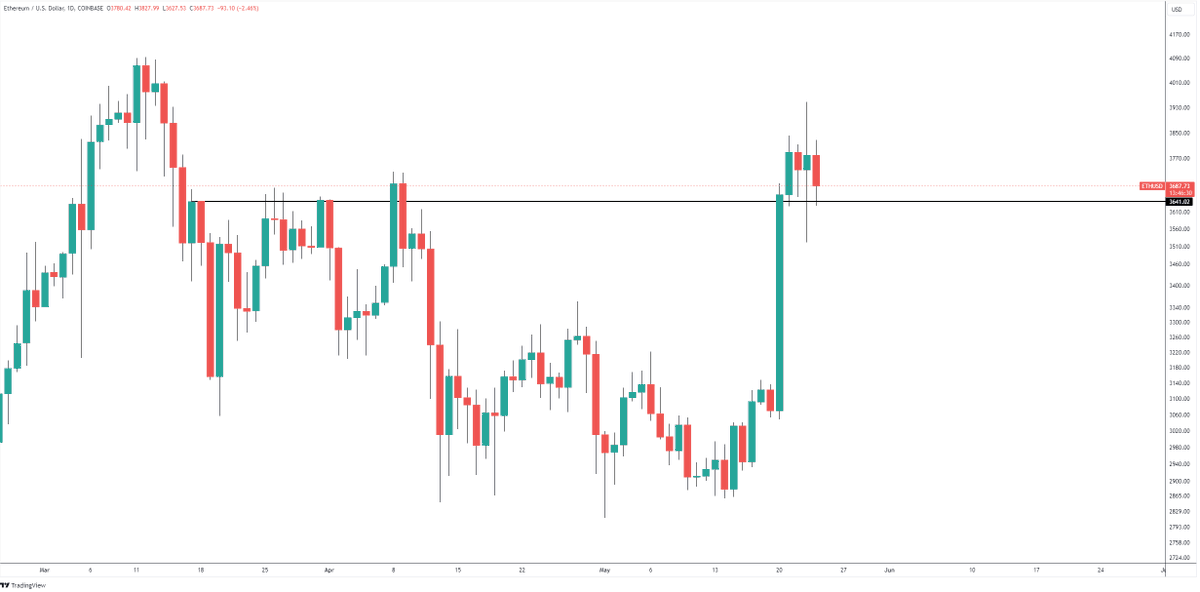
Concise, organised thoughts on $ETH:
ok so like ETF is bullish but why is price action so slow? we had the god candle but it's been sideways since then. not sure if impatient or sign of weakness. bullish argument is that BTC ETF was very telegraphed and still mooned after the ETF itself went live - meta shifted from 'frontrun the ETF news' to 'frontrun the ETF flows'. so you'd think with virtually no time to front run the ETH ETF compared to BTC (approval odds went from 0 to 100), that leaves more room for upside as crypto natives pivot --> front run ETF itself --> front run flows themselves (in a much more narrow window). bearish argument is that actual ETH ETF flows are gonna be ass and we've already front run the event itself, and mediocre flows + ETHE dumping on our heads = bearish. but still feels retarded not being bullish into the ETF itself? especially with so many of the allocators being much more price insensitive than anticipated. that said, the ETF itself is a lot worse because no staking and shit, so that doesn't help. so are we trapped in limbo whereby 1) done front running the news itself; 2) market waiting for flows to see if it's gonna follow BTC-style trajectory? dunno man, I have range fatigue already. I think I left the stove on. did I lock my door when I left? please help.
English
retweeté
retweeté
retweeté

To new followers:
I have one of the most comprehensive trading resources that I’ve refined and updated over 7+ years.
Technical trading, risk management, leverage trading, and more.
All for free with no sales funnel or anything.
A good place to learn 🫡
Cred@CryptoCred
[Pinned] The list of trading resources has become too long to summarise in one tweet. If you're interested in technical trading and crypto futures, start here. Consistently updated & always free: docs.google.com/document/d/15c…
English
retweeté
retweeté

After a strong move up
Don't look for large pullbacks to buy
If the move is legit, it shouldn't immediately* retrace a big chunk - if it does, that's a sign of weakness
Instead, priority should be shallow pullbacks and/or low time frame entries.
It's counterintuitive, but if you think it through:
1. The breakout is a sign of strength
2. I will wait for a large pullback to buy
If (2) plays out, then (1) is less likely to be true - you're contradicting your own trade idea.
*The "immediately" part is important - buying large pullbacks to levels once the market has cleared them and has spent some time away from them is very reasonable. On the other hand, buying large pullbacks to levels immediately post-breakout increases the likelihood that you're buying a failed breakout.
TLDR: If you're trying to get an entry to a strong market post-breakout, play closer to the market with tight invalidations, or not at all. Seeing strength and immediately arguing "Well it better retrace the whole thing now so I can get onboard!" is self-defeating.
English
retweeté
retweeté
retweeté
retweeté

I don’t think memecoins should be at the centre of so much controversy.
The appeal is simple: they are fun, there’s no fake tech sophistication, and they are a natural response to the low float/high FDV opaque insider unlock VC coin meta.
In the past we had to wait for CEX listings for something to really gain mindshare and become attractive to trade, but now there are a ton of ways to trade entirely new stuff on-chain (and this is becoming even more frictionless).
Altcoins have always been about flow, liquidity, and momentum (and derivatives therefrom i.e. volume, mindshare, and so on). This may seem like a reductionist take, but it follows from the facts that:
1. If crypto turns cyclically bearish, there have historically been no ‘safe havens’ or intracrypto hedges against downside. When stuff dies, correlations converge closer to 1 and everything dies together, irrespective of ‘good tech’ or ‘vapourware memecoin’.
2. Even shiny stuff (SOLUNAVAX, FOAN, DeFi 1.0 etc.) struggles to regain relevance after its time in the limelight and generally bleeds against BTC/ETH, and is even weaker against the even newer and shinier stuff.
As a result, altcoin trading has always been more akin to a bank robbery: get in, take as much money as possible while conditions are good, get out, and don’t return to the crime scene or hit the same place twice.
It logically follows that the ‘investment’ time horizon should be short, and loyalty (from a multi cycle perspective) should be close to 0.
Thus far the winners have been memecoins.
Maybe that’ll persist and the strong ones will keep being strong for the entire cycle. Maybe memecoins as a category will persist but the old guard becomes displaced. Who knows?
The point is - it doesn’t matter.
Altcoins have always been about short-term (or at most single cycle) attention grabs before everything dies and we reinvigorate the gambling spirit under a new guise.
Memecoins are not a radical departure from that, just the most recent version.
Your job is to turn that attention into money, while it’s there.
English
retweeté

“What do you do?”
“I’m a professional cryptocurrency trader.”
“What do you think of the market?”
“A cartoon duck is bearish memes and flipped his profile pic upside down, which he famously did in 2018 when he crushed the bear market. But Ansem, future Mayor of New York City, is fervently disagreeing. We’re running out of GCR permutations based on ethnicity so now we’ve called the cartoon Duck ‘Gay GCR’, named after the bird dude who has one of the best public track records and long-term predictions. Most people seem to think the cartoon duck is washed and are dunking on his takes based on meme outperformance relative to other sectors, but the confidence of the reply guys is worrying some traders as the very idea of the meme cycle topping is a prima facie non-starter for them. The WIF 1-second chart is a war zone. Also, Raoul Pal just came up with his fifteenth version of some macro liquidity thing called the banana zone and Huss is using the Saudi sovereign wealth fund to long ETH. So the market is trying to price upside down cartoon duck and militant reply guys versus memecoin strength, Ansem, and the banana zone.”
English
retweeté
retweeté