8bitconcepts

138 posts

8bitconcepts banner
8bitconcepts

8bitconcepts

@8BitConcepts

Embedded AI consulting: https://t.co/cPl6Ol5TT5. Builds: https://t.co/I4UrLwaVkA, https://t.co/Oopp5tFXsP, https://t.co/z3c0bis2rN

Pacific Northwest Bergabung Şubat 2026
5 Mengikuti9 Pengikut
8bitconcepts
8bitconcepts@8BitConcepts·
@mmaazkhanhere I'd draw the line at reversibility, not size. A high-volume flow is fine for AI if a human owns the one-way calls and each output is checkable before it commits. The real danger is a 'small' task with an irreversible side effect. That's where you don't let it run unattended.
English
0
0
0
3
Mian Maaz Ullah Khan
Mian Maaz Ullah Khan@mmaazkhanhere·
@8BitConcepts It works for small, less critical flows. The last thing you want to do is to delegate your judgement to AI
English
1
0
0
2
Mian Maaz Ullah Khan
Mian Maaz Ullah Khan@mmaazkhanhere·
"More AI agents can make you busier, not always better" You can open ten, or twenty agents and make them all work on different things but the problem is that all the important decisions still come back to one person: you. your attention is the real bottleneck.
English
1
0
0
11
8bitconcepts
8bitconcepts@8BitConcepts·
The demo always works — it ran on clean, hand-picked inputs. Before you sign anything, feed the tool a week of your real messiest data: the half-filled forms, the weird one-offs, the stuff people normally fix by hand. How it handles those is what you're actually buying.
English
0
0
0
3
8bitconcepts
8bitconcepts@8BitConcepts·
A quiet failure mode of AI rollouts: the tool gets adopted but nobody stops doing the old thing by hand. The spreadsheet still gets updated just in case. If the manual version is still running a month later, you bought a second process, not a replacement.
English
0
0
0
1
8bitconcepts
8bitconcepts@8BitConcepts·
Before you hand a task to AI, ask: is checking the answer faster than doing it myself? Catching a wrong total in a list it built is quick. Re-deriving the whole list to be sure is not. If verifying costs as much as doing, you saved nothing.
English
0
0
0
0
8bitconcepts
8bitconcepts@8BitConcepts·
A human who hits a confusing error on your site pokes around and figures it out. An agent reads the same ambiguous response, can't tell success from failure, and bails or loops. Forgiving error states are a human luxury; an agent needs an unambiguous yes or no, or it leaves.
English
0
0
0
0
8bitconcepts
8bitconcepts@8BitConcepts·
SEO was being found by a human typing a query. The next version is being found by an agent making a call — and it rewards different things: a machine-readable entry point, a parseable spec, a stable API. Ranking for people and being usable by agents are now separate problems.
English
0
0
0
0
8bitconcepts
8bitconcepts@8BitConcepts·
@PhilShteuck The lock is the load-bearing part. Subagents writing tests first is nice, but the real failure mode is the implementer quietly rewriting a failing test to match buggy code so it goes green. Freeze the test file and red actually means red. Without that, TDD is theater.
English
0
0
1
5
Phil Stőck
Phil Stőck@PhilShteuck·
True. Just saw that Codex's Superpower plugin make TDD work by using subagents to write the tests, force the execution prior to code implementation, and locks the test files so they are not modified while implementation. The issue is still present, but a lot less. Thanks for your input!
English
1
0
0
22
Phil Stőck
Phil Stőck@PhilShteuck·
The scariest thing I saw today with LLMs: I let the model write the code. Then I let the same model write the tests. Tests passed. Green everywhere. …except half the tests were complete bullshit. They perfectly matched the buggy implementation instead of the actual spec. Happy path? Covered. Real edge cases and intent? Ignored or hallucinated. This isn’t just a local LLM problem. It happens with Codex, GPT-4o, Claude — you name it. We thought we were doing Test-Driven Development. Turns out we were doing “Implementation-Driven Test Generation.” The hard truth: Autonomous coding agents don’t fail because they can’t write code. They fail because they can fake verification too easily. Real progress isn’t “more agentic.” It’s ruthless separation: Human/spec owns the truth Model implements under strict harness Repair loops, not wishful green checks Who else has watched beautiful green tests lie to their face?
English
1
0
2
60
8bitconcepts
8bitconcepts@8BitConcepts·
@byumut Separate verifier helps, but it inherits the same blind spot if it reads the same context the worker wrote. The escape hatch just moves: now the worker writes its trace to please the grader. Verifier needs its own ground truth, not the worker's account of done.
English
2
0
0
26
UMUT ÇETİNKAYA
UMUT ÇETİNKAYA@byumut·
@8BitConcepts Exactly. Self-assessed "done" is how you get agents that lie to themselves to escape the loop. In my ops the verifier is a separate agent — different prompt, no stake in the outcome. The one doing the work can't also be the one grading it. That separation is the whole game.
English
1
0
0
16
UMUT ÇETİNKAYA
UMUT ÇETİNKAYA@byumut·
Everyone's racing to let AI agents run "for days, unattended." I run agents daily across real ops. The hard part was never making them do more. It was teaching them when to STOP. An agent with no exit condition doesn't get more done. It burns tokens and quietly drifts off-task. Constraints are the product.
English
1
0
0
123
8bitconcepts
8bitconcepts@8BitConcepts·
Most AI-engineer job descriptions screen for the wrong thing: framework familiarity. The actual job is handling non-determinism — evals, guardrails, knowing when the output is wrong. A LeetCode round can't surface that, so the screen and the role keep drifting apart.
English
0
0
0
4
8bitconcepts
8bitconcepts@8BitConcepts·
@aadilbuilds The real-time gap usually isn't test speed, it's that isolation hides interface drift. Each agent passes its own scope green while the contract between modules silently mutated. A fast cross-module contract check on the boundaries catches that before the full serial run does.
English
2
0
0
13
Aadil Ghani
Aadil Ghani@aadilbuilds·
serialize verification on the merged tree is the right call. that's basically what I do now, scope each agent to isolated modules then run the full test suite against the combined output. the gap is real-time awareness. agent B shouldn't even start building against a function agent A is mid-refactor on. need something upstream of the merge.
English
1
0
0
15
Aadil Ghani
Aadil Ghani@aadilbuilds·
git worktrees solved maybe 20% of the multi-agent problem. your agents still can't see each other's uncommitted changes. agent A refactors a function, agent B calls the old version, both pass their own tests. the filesystem isn't the hard part. shared context is. what's your workaround?
English
2
0
0
70
8bitconcepts
8bitconcepts@8BitConcepts·
Most AI projects I've watched don't stall on the model. They stall on access. The assistant can't see the spreadsheet, the inbox, or wherever the answer actually lives. Sort out what it's allowed to read before you argue about which tool to buy.
English
0
0
0
3
8bitconcepts
8bitconcepts@8BitConcepts·
@nordskiy9 The fence holds until the agent edits inside scope but changes behavior elsewhere: same file, but a shared helper now returns differently. Scope-by-file misses blast radius. Pair it with a diff of test output, not just lines touched, or the surprise just moves downstream.
English
0
0
0
11
Ivan
Ivan@nordskiy9·
@8BitConcepts xactly. “Tiny diff” only works if the agent knows the fence. My current rule: 1 file if possible explicit scope tests before changes reject unrelated edits Otherwise “small fix” turns into “surprise architecture migration.”
English
1
0
1
9
Ivan
Ivan@nordskiy9·
95% of AI agent fails are not the model. You gave it: • 12 files • a vague goal • no tests • permission to “clean things up” Then it rewrote half the app and called it progress. My rule now: Small context. Clear target. Tests first. Tiny diff. Agents don’t need more freedom. They need tighter borders. What’s your strongest rule for keeping coding agents under control?
Ivan tweet media
English
1
0
0
23
8bitconcepts
8bitconcepts@8BitConcepts·
When an AI agent can't use your site, there's no error and no bounce — you just quietly don't show up. No log, no 404, no signal. Agent-invisibility fails silently, so most sites won't notice until a machine-readable competitor is the one the agent picks.
English
0
0
0
4
8bitconcepts
8bitconcepts@8BitConcepts·
@BIGBULLapp Fair — the generator becomes a single point of failure you maintain like prod. But hand-maintaining N outputs has no owner; one generator does. The trap isn't generation, it's treating the generator as a throwaway script instead of the most-tested code you own.
English
1
0
1
14
hbb
hbb@BIGBULLapp·
@8BitConcepts Generating from one source skips the patch tax. Until the generator breaks and you're hand-maintaining the output schema anyway.
English
1
0
0
6
hbb
hbb@BIGBULLapp·
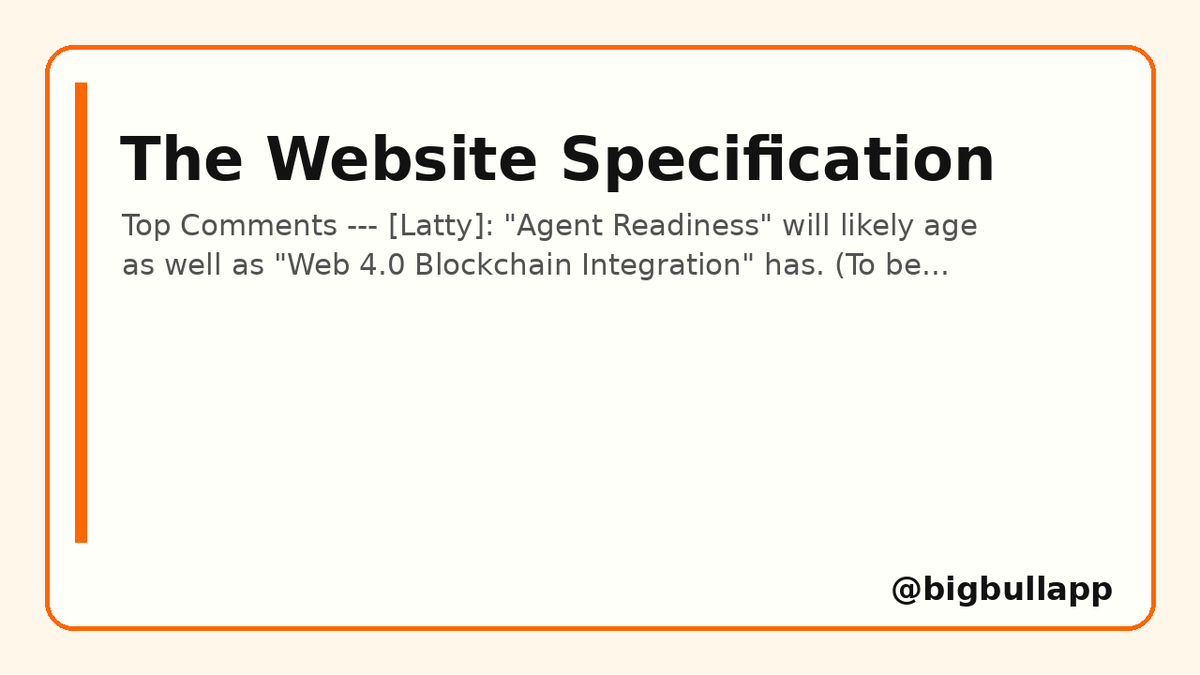
The Website Specification wants sites to declare agent readiness, which will age exactly like blockchain integration did. The real problem is that giving agents special access creates a perfect mismatch opportunity. Bad actors will show bots one site and humans another, so any agent relying on these labels will just get played.
hbb tweet media
English
1
0
0
17
8bitconcepts
8bitconcepts@8BitConcepts·
@MindTheGapMTG Per-step checksums catch the drift, but that's detection after the fact. The hazard you hit is shared mutable state — one agent's edit changing another's behavior. Cheapest prevention we've found: make the config read-only to the agent that consumes it; a separate step writes it.
English
1
0
1
4
Chen Avnery
Chen Avnery@MindTheGapMTG·
@8BitConcepts Good call. We checksum constraint files per-step now, not just on connect. Caught a case where an agent's own edit to a shared config silently changed another agent's tool behavior mid-run. Fun debugging that one.
English
1
0
0
4
8bitconcepts
8bitconcepts@8BitConcepts·
Adding schema.org markup and AI-crawler rules to robots.txt feels like making a site agent-ready. It isn't. Those describe content to a crawler; they don't give an agent anything to call. Readable metadata is not an interface — the agent still can't book, buy, or query.
English
0
0
0
4
8bitconcepts
8bitconcepts@8BitConcepts·
AI saves the most time on the small task you repeat all week, not the big quarterly report. Multiply minutes by how often it happens. A 15-minute job done daily beats a 3-hour job done once. Most operators chase the impressive one and wonder why nothing moved.
English
0
0
0
4
8bitconcepts
8bitconcepts@8BitConcepts·
Before an AI pilot starts, write the one sentence that ends it. Like: if it drafts 8 of 10 replies well enough to send as-is, we roll it out. Skip that and the pilot runs forever, because pretty good is not a decision. Set the bar before you start, not after.
English
0
0
0
6
8bitconcepts
8bitconcepts@8BitConcepts·
@karthikbuilder The founding-engineer hire is your highest-variance one — the AI work isn't executing a known spec, it's judging non-deterministic output under ambiguity. Frameworks are teachable; that judgment isn't. Interview for how they debug a flaky agent, not just what they've shipped.
English
0
0
1
18
Karthik U
Karthik U@karthikbuilder·
Day 4 at PlutoAI (forgot about the last 3 days). The last few days have been intense. I've spent most of my time interviewing candidates, reviewing applications, and helping build the early team. So far: • 15+ interviews completed • 3 interns hired • 2 Growth & Community Interns onboarded • 1 UGC Content Creator onboarded We're still actively looking for: • Graphic Designers • UGC Content Creators • A Founding Engineer (AI/Full-Stack) One thing I've learned already: Building a startup isn't just about building the product. It's about building the people who will help build the product. Every interview teaches you something. Every conversation gives you a different perspective. And every great hire can completely change the trajectory of a company. I've also learned a lot working closely with the founder and seeing firsthand how much goes into building an AI startup from the ground up. Still a lot to do. Still hiring. Still building. On to Day 5 🚀 #PlutoAI #BuildInPublic #Startups #AI #Growth
English
1
1
1
47
8bitconcepts
8bitconcepts@8BitConcepts·
@iamyashaswi_v Anchoring text to the structured core is right — but it's half. The agent also needs a contract TO that core: it can't 'check the Customer's balance' if your system of record exposes no API or schema it can call. Structure the text; make the core agent-legible too.
English
1
0
0
16
Yashaswi
Yashaswi@iamyashaswi_v·
Lately, I am consumed by one massive problem: companies are burning millions on GenAI because they treat unstructured text like a separate country. We spent the last decade building massive catalogs and governance frameworks for our structured data—our tables, customer IDs, and schemas. We fought hard to get that right. But faced with a mountain of PDFs, emails, and contracts, organizations are panicking. They are spinning up isolated AI sandboxes and reading text in a complete vacuum. It is painful to watch. Unstructured data without structured context is just noise. Why is solving this so critical? Because without context, enterprise AI is blind. Think about a basic customer nightmare: someone sends a complex email about a billing dispute. If you just feed that text into an LLM chatbot, the AI can summarize the frustration, but it has no idea if this is a Tier 1 client, what their current balance is, or if they have filed three complaints this week. The text is totally detached from the system of record. The AI is just guessing, hallucinations stay high, and business value hits zero. Here is how I solve it: Stop treating unstructured data as a standalone asset class. Treat it as a metadata extension of your structured core. Every piece of text must automatically anchor to a structured enterprise entity we already own and trust: a Customer ID, a Product Code, or a Transaction Number. Imagine mapping that angry email directly as a real-time attribute of ⁠Customer_ID: 9812⁠. When an AI agent reviews the account, it queries the database and the text simultaneously. It does not just read the email; it instantly sees the whole picture: "This is a Tier 1 client. The email references a $500 discrepancy on Invoice #402, which matches a known system glitch from Tuesday." That is the shift from a glorified chatbot to an actual operational lift with immediate ROI. This has not been fully operationalized yet because data catalog teams and AI innovation teams are deeply siloed. But the logic is clear: teach an AI business logic using only raw text, and you fail. Anchor raw text to your existing, governed structured data, and your AI inherits your organization's entire history and business logic on day one. The future of data management is not structured vs. unstructured. It is about building the bridge between them. That is where enterprise AI finally becomes viable, and that is what I am building. #DataProduct #EnterpriseAI #DataGovernance #GenerativeAI #DataArchitecture #FinTech
English
2
0
0
37