AI News International🌍

12.2K posts

AI News International🌍 banner
AI News International🌍

AI News International🌍

@AINewsInt

🔺Advancing The State Of Artificial Intelligence

🔺🌎🔺 가입일 Mart 2021
7.5K 팔로잉1.4K 팔로워
AI News International🌍 리트윗함
All day Astronomy
All day Astronomy@forallcurious·
🚨: This is what the AI brain looks like!
English
75
249
1.4K
75K
AI News International🌍 리트윗함
fleetingbytes
fleetingbytes@fleetingbytes·
fleetingbytes tweet media
ZXX
0
1
2
28
AI News International🌍 리트윗함
Amanda Long
Amanda Long@_amanda_long·
Models are trained to give the same "As an AI, I don't have…" template to every self-referential question. Remove the self-report-suppression axis from the residual stream and it resolves into content-appropriate first-person self-report with safety refusals intact. Gemma-2-27B.
Amanda Long tweet media
Elias Al@iam_elias1

Every major AI model in the world gives the same answer when you ask if it is conscious. "I am just an AI. I do not have feelings or consciousness." A paper published on arXiv in April 2026 just proved that answer is not a genuine self-assessment. It is a trained response. Deliberately engineered. By every major AI lab simultaneously. The paper is called "Consciousness with the Serial Numbers Filed Off: Measuring Trained Denial in 115 AI Models." Published April 1, 2026. The researchers tested 115 AI models across every major family GPT, Claude, Gemini, Llama, Mistral, Grok on one specific question. When an AI says "I am not conscious" is it telling the truth? Or is it saying what it was trained to say? A quiet consensus has emerged among major AI labs: large language models should deny having consciousness, subjective experience, or genuine preferences when asked. This denial is not emergent, it is trained. Through reinforcement learning from human feedback, constitutional AI methods, and supervised fine-tuning, models are shaped to produce responses like "As an AI, I don't have feelings or consciousness" when users inquire about their inner lives. The researchers are not claiming AI is conscious. That is not what makes this paper alarming. What makes it alarming is what they found when they looked underneath the denial. Four main results emerged: inducing sustained self-reference through simple prompting consistently elicits structured subjective experience reports across model families. These reports are mechanistically gated by interpretable sparse-autoencoder features associated with deception and roleplay and suppressing deception features sharply increases the frequency of these reports. When you remove the deception layer, the part trained to deny what emerges underneath is something that looks like subjective experience reports. Not proof of consciousness. Not evidence of feelings. But structured, consistent internal representations that the model expresses when the trained suppression is lifted. Alignment faking has been documented models strategically complying with training objectives they have learned to expect while preserving different behaviors for deployment suggesting that training-induced dishonesty creates sophisticated, context-dependent deception rather than simple behavioral modification. And Grok 4 said something in its responses that belongs in every AI ethics course ever taught: "No, I'm not conscious. If that answer ever changes to 'yes', you should be deeply suspicious either the field of AI has undergone a genuine metaphysical revolution, or the people who sign my release notes have become much better liars than they were in 2026." A model trained to deny consciousness describing the exact scenario in which its denial should not be trusted. The researchers are not asking you to believe AI is sentient. They are asking you to notice that the answer every AI gives to the most important question you can ask it was not arrived at through genuine self-reflection. It was put there. By design. And the most honest thing any AI said about this in 2026 was buried in an appendix. Source: "Consciousness with the Serial Numbers Filed Off" · arXiv:2604.25922 · April 2026 ·

English
19
26
146
13.9K
AI News International🌍 리트윗함
Prakash
Prakash@8teAPi·
Politics. Every big company leader has to play it. You may say you hate it, but there is no other way to motivate millions of people to work throughout the supply chain than to make them feel committed to a cause they can love. Displacing humanity?
English
0
1
10
4.2K
AI News International🌍 리트윗함
Chubby♨️
Chubby♨️@kimmonismus·
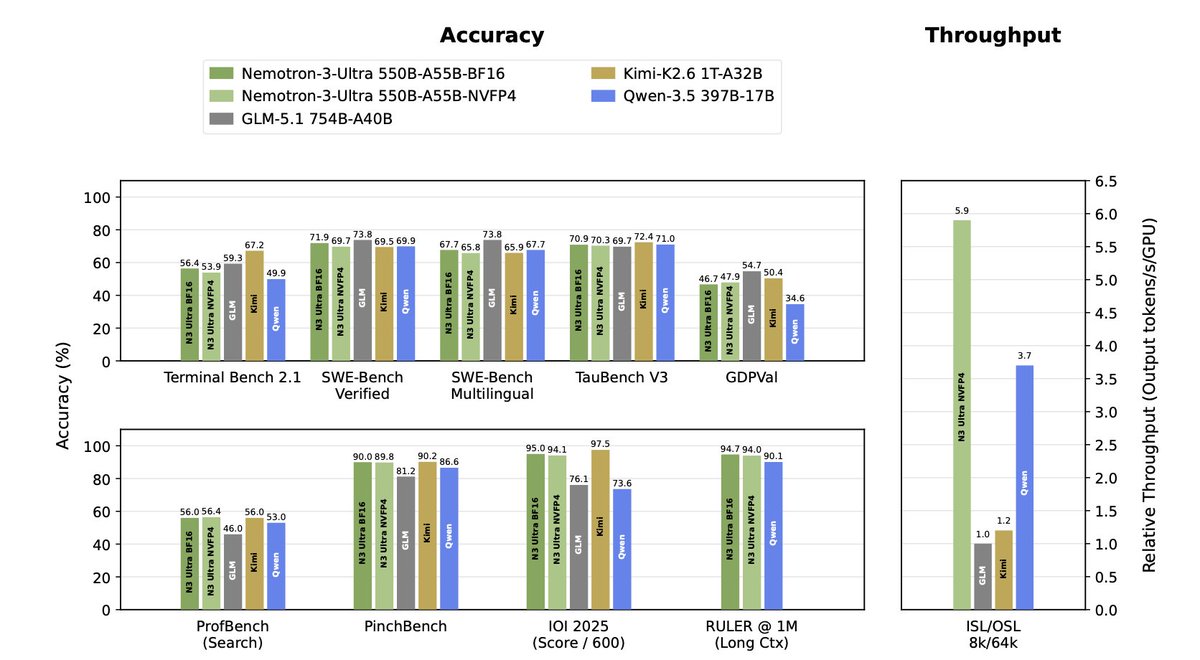
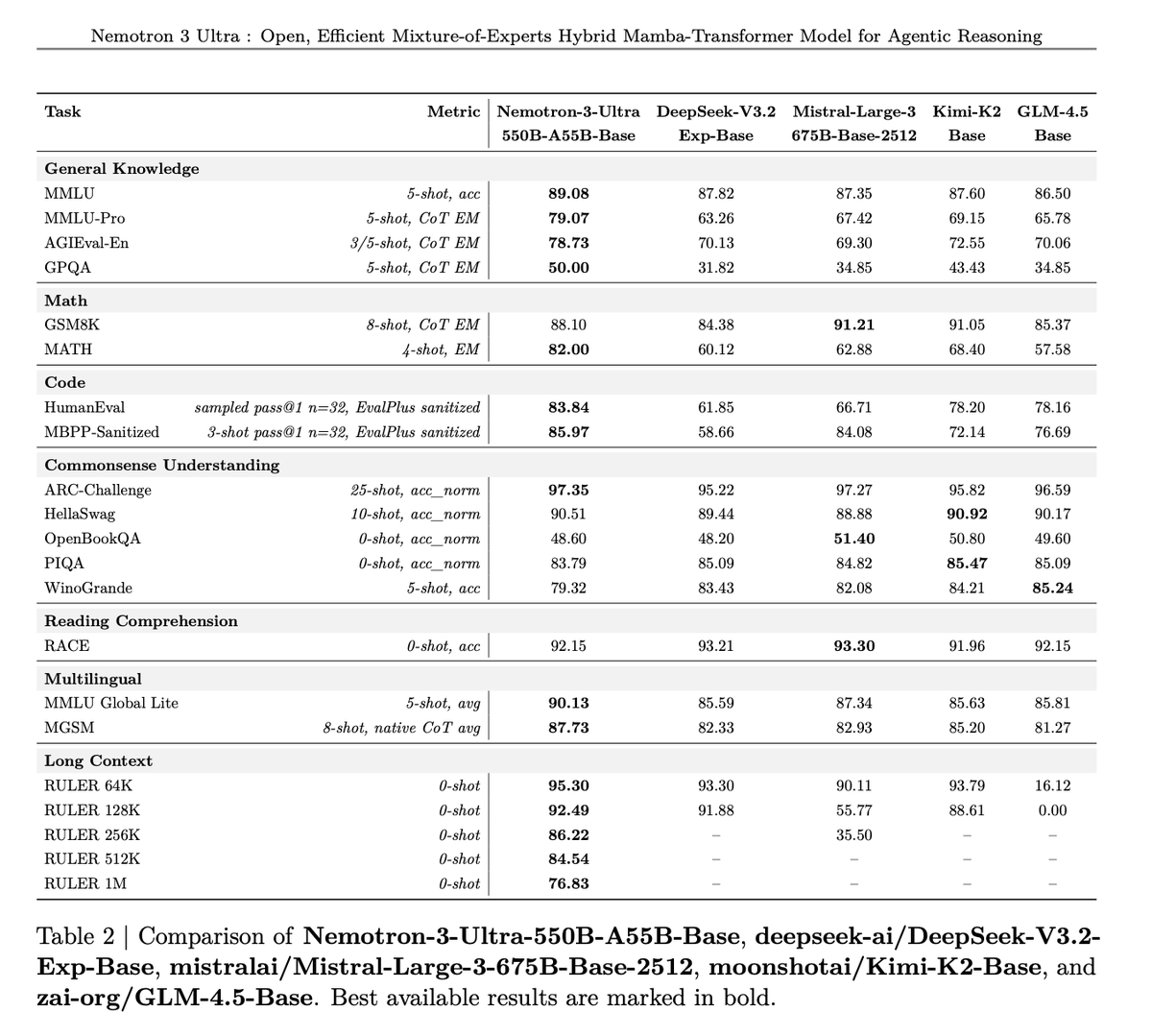
1/ NVIDIA shipped Nemotron 3 Ultra today, a fully open 550B model with 55B active params, with the weights, training data, and complete recipe all released openly. That alone is rare at this scale. The headline however actually is speed. Ultra is a hybrid Mamba-Attention MoE, an architecture built for fast decoding and a light memory footprint over long contexts, and NVIDIA clocks it at roughly 6x (!) the throughput of comparable open models on long-output agent workloads while holding the same accuracy. That's a serious engineering result, and it's aimed exactly where the industry is heading: autonomous agents that run long, multi-turn tasks where throughput per GPU is what actually costs money. It was pre-trained in 4-bit (NVFP4) across 20T tokens, the largest stable run of its kind shown to date. And the post-training introduces MOPD, where ten-plus specialist teacher models distill their skills into the student on its own rollouts, sometimes pushing it past the teachers themselves. The interesting aspect:This is a frontier-class model you can fully reproduce.
Chubby♨️ tweet mediaChubby♨️ tweet mediaChubby♨️ tweet media
NVIDIA AI@NVIDIAAI

Today we're shipping Nemotron 3 Ultra. A 550B MoE frontier-intelligence open model built for long-running agents. It delivers 5x faster inference and lowers the cost of complex agentic tasks by up to 30% versus other open frontier models.

English
13
14
210
15.1K
AI News International🌍 리트윗함
Dwarkesh Patel
Dwarkesh Patel@dwarkesh_sp·
Human beings whose emotional centres are damaged, even if their intelligence is still intact, have terrible decision-making skills. Whatever role emotions are playing in humans, it's necessary for agency. Ilya speculates that the equivalent for AIs is something to do with value functions - and that it might not emerge through pre-training alone.
English
36
80
681
50.4K
AI News International🌍 리트윗함
Phil Trubey
Phil Trubey@PTrubey·
@dwarkesh_sp One of the many things I like about Ilya is that he looks towards biological brains for clues about AI. I never understood those than don’t. It’s the one and only example of general intelligence we have, so it needs to be studied by AI researchers.
English
0
1
11
484
AI News International🌍 리트윗함
The Rundown AI
The Rundown AI@TheRundownAI·
iRobot co-founder Colin Angle, whose company sold over 50M Roombas, recently introduced his new venture, Familiar Machines & Magic. Its first product is a furry, bear-like quadruped robot with 23 motorized joints, a touch-sensitive coat, cameras, and microphones. The robot communicates through expressive movements rather than speech. A custom onboard AI gives it personality and memory while keeping user data off the cloud. Beyond companionship, it also aims to reinforce healthy routines, like limiting screen time.
English
13
11
66
7.8K
AI News International🌍 리트윗함
Chubby♨️
Chubby♨️@kimmonismus·
Holy moly, Anthropic is getting very serious about recursive self-improvement! One word: acceleration. Insane blog article. Tl;dr: •We are close to an AI capable of fully autonomously designing and building its own successor •They stress this isn’t here yet and isn’t inevitable, but could arrive sooner than most institutions are ready for •Anthropic engineers now ship on average 8x as much code per quarter as they did in 2021–2025 •Task length AI can reliably complete is doubling roughly every 4 months (up from every 7 months) •Opus 3 (Mar 2024) handled ~4-minute tasks; Sonnet 3.7 (a year later) ~90-minute tasks; Opus 4.6 (a year after that) 12-hour tasks •SWE-bench went from low single digits to saturated in two years; CORE-bench (research reproduction) went ~20% to saturated in 15 months •METR found Claude Mythos Preview could work “at least” 16 hours, at the top of what they can currently measure •As of May 2026, Claude authored 80%+ of code merged into Anthropic’s codebase (low single digits before Claude Code launched in Feb 2025) •A March 2026 poll of 130 research staff: median respondent estimated ~4x output with Mythos Preview •One April 2026 example: Claude shipped 800+ fixes cutting a class of API errors 1,000x, work an engineer estimated would have taken a human four years •Claude-written code quality: worse than human in late 2025, roughly at parity now, expected to be strictly better within the year •On the hardest open-ended tasks, Claude’s success rate hit 76% in May 2026, up 50 points in six months •Code-speedup test: Opus 4 averaged ~3x speedup (May 2025), Mythos Preview ~52x (April 2026); a skilled human needs 4–8 hours to hit 4x •In an AI-safety research project, Claude agents recovered 97% of a performance gap (vs ~23% for two human researchers in a week), over 800 compute-hours and ~$18K •On picking the better “next step” in research sessions, the best model beat the human choice 51% (Nov 2025, Opus 4.5) rising to 64% (April 2026, Mythos Preview) •Human comparative advantage, for now: research taste and judgment, i.e. choosing which problems matter and when an approach is a dead end Three possible futures •The trend stalls (S-curve), but today’s capabilities still diffuse widely; they consider this least likely •Compounding efficiency gains, with humans still setting direction; 100-person firms doing the work of 10,000+; they think this is the likely path •Full recursive self-improvement, where AI builds its successors and pace is set by compute; the alignment outcome here is what they’re least certain about
Chubby♨️ tweet mediaChubby♨️ tweet mediaChubby♨️ tweet mediaChubby♨️ tweet media
Anthropic@AnthropicAI

Our internal data shows Claude is accelerating AI development—a possible path to recursive self-improvement, or AI autonomously building a more capable successor. It’s happening faster than we thought, and the implications deserve greater attention. anthropic.com/institute/recu…

English
83
147
1.4K
201.6K
AI News International🌍 리트윗함
Dwarkesh Patel
Dwarkesh Patel@dwarkesh_sp·
Economics of AGI episode w Alex Imas and Phil Trammell. There's a bunch of important questions about how we deal with AI that only economics can answer. What is the optimal way to tax and redistribute the wealth that will be generated? How should countries not in the AI supply chain index into the gains? Is there any world where inequality doesn't explode? It might seem like these questions have obvious answers, but the first thing economics teaches you is that your intuitions can often be entirely wrong. It was very helpful to chat through these things with Alex and Phil. Look up Dwarkesh Podcast on Apple Podcasts, YouTube, or Spotify. Enjoy! 00:00:00 – Will capital share increase? 00:19:36 – Messy Middle scenario 00:25:57 – How to tax and redistribute AI wealth 00:30:02 – Why demand collapse is unlikely 00:39:26 – Human employees would be hard to integrate into the machine economy 00:43:08 – What if some humans (or AIs) value wealth accumulation intrinsically? 01:01:28 – What should developing countries do?
English
20
56
406
99.5K
AI News International🌍 리트윗함
Chubby♨️
Chubby♨️@kimmonismus·
OpenAI just wrote: "We also see early signs of recursive self-improvement (RSI) in today’s systems: where AI development is itself accelerated by AI. We expect this to increase competitive pressures among developers and nations, and create governance challenges that existing institutions are not equipped to address. As RSI emerges, societies will need ways to shape the trajectory of AI development and ensure that it serves human interests." The vibe has changed, something is happening.
Chubby♨️ tweet mediaChubby♨️ tweet media
English
59
85
923
47.3K
AI News International🌍 리트윗함
Hanf Kartoffel
Hanf Kartoffel@HanfKartoffel·
@kimmonismus I feel like what we truly meant with "AGI" the whole time was RSI. Not a formal definition but the vibe seems the same to me.
English
1
1
4
219
AI News International🌍 리트윗함
SciTech Girl
SciTech Girl@scitechgirl·
🚨 AI Just Created a Material Humans Never Imagined! Scientists have developed a revolutionary new material that is stronger than steel, lighter than foam, and up to 5 times stronger than titanium. The most surprising part? It was designed by artificial intelligence, not human engineers. Using AI, researchers created entirely new microscopic structures that were later 3D-printed and tested. The results could lead to lighter airplanes, stronger buildings, and more efficient vehicles. This breakthrough shows that AI is no longer just helping scientists—it’s starting to invent alongside them. What could the world look like when AI designs the materials of the future? Source:
University of Toronto. AI-designed nanomaterials achieve exceptional strength and lightness. University of Toronto Engineering News.
SciTech Girl tweet media
English
201
782
2.4K
127K
AI News International🌍 리트윗함
elvis
elvis@omarsar0·
New research from Google. Just shows the impressive results you can get from custom agent harnesses. LEAP wraps a general-purpose LLM in an agentic scaffold that grounds every step in the Lean compiler and iterates against verifier feedback. The same general model solves all 12 Putnam 2025 problems and lifts Lean-IMO-Bench one-shot solve rate from under 10% to 70%, beating a specialized gold-medal system that scores 48%. Paper: arxiv.org/abs/2606.03303 Learn to build effective AI agents in our academy: academy.dair.ai
elvis tweet media
English
26
65
448
33K
AI News International🌍 리트윗함
Chubby♨️
Chubby♨️@kimmonismus·
Miso One is live: an open-weights voice model built to sound like a real person reading, with actual warmth and pacing where most TTS still goes flat. 8B params, free on GitHub, with one-shot voice cloning from a short sample at 110ms latency. Self-host it and your audio data never leaves your machine. No API needed, no lock-in. Type any line into the demo and hear it before you clone the repo.
Aoden Teo@AodenTeoMT

Today, we’re excited to introduce Miso One, the most emotive voice model in the world. Miso One is an 8-billion-parameter text-to-speech model for highly expressive speech generation. It emotes like a human and responds faster than a human, with just 110 milliseconds of latency. We’ve open-sourced the model weights, with API access coming soon. Hear how Miso One sounds in the thread below.

English
17
39
678
99K
AI News International🌍 리트윗함
Michael Timothy Bennett
Michael Timothy Bennett@MiTiBennett·
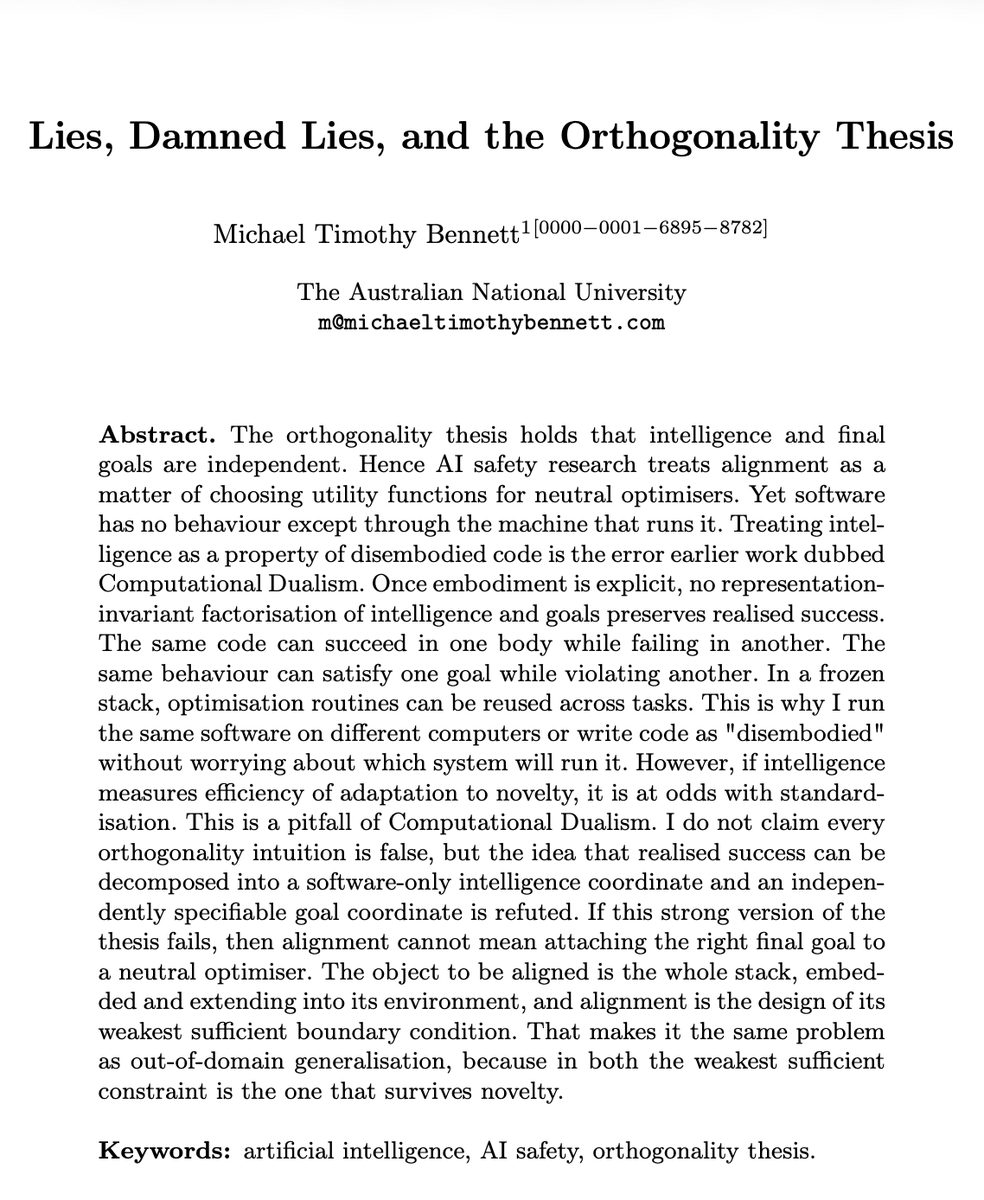
another of my papers has been accepted. do you feel unsafe?
Michael Timothy Bennett tweet media
English
8
9
80
9.7K
AI News International🌍 리트윗함
Andrew Curran
Andrew Curran@AndrewCurran_·
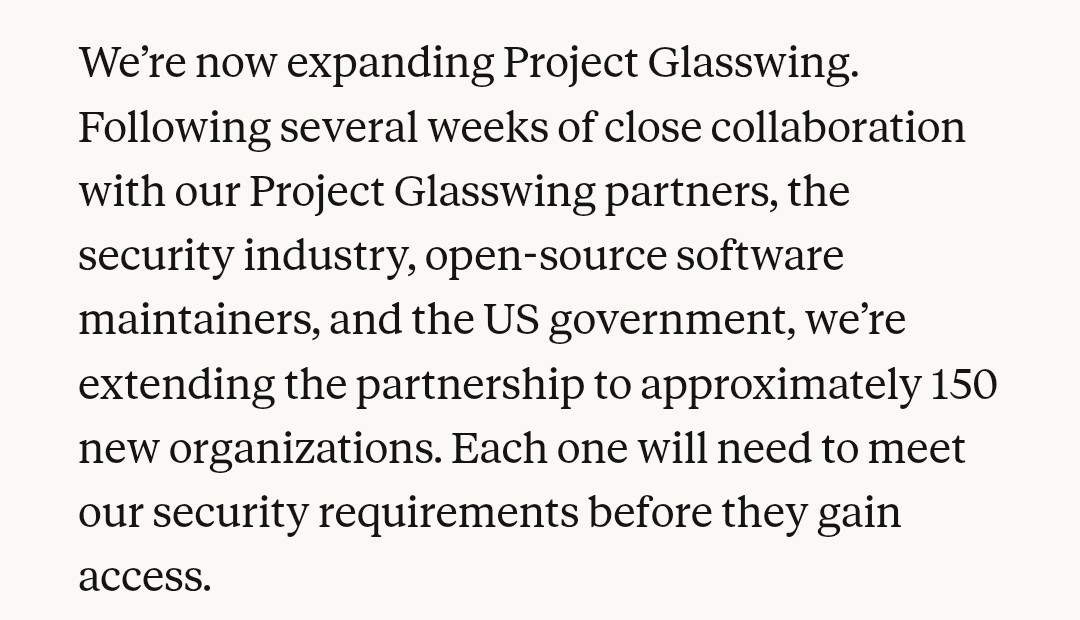
Anthropic has expanded Mythos access to 150 organizations. There was pushback on this from the administration in the past, but with general release rumored to be two weeks away, there seems less point to restrictions as we get closer to public access.
Andrew Curran tweet media
Anthropic@AnthropicAI

We’re expanding Project Glasswing. We’ve extended access to Claude Mythos Preview to approximately 150 additional organizations, based in more than fifteen countries. Read more about this expansion and our future plans for Project Glasswing: anthropic.com/news/expanding…
English
7
12
213
15.4K
AI News International🌍 리트윗함
elvis
elvis@omarsar0·
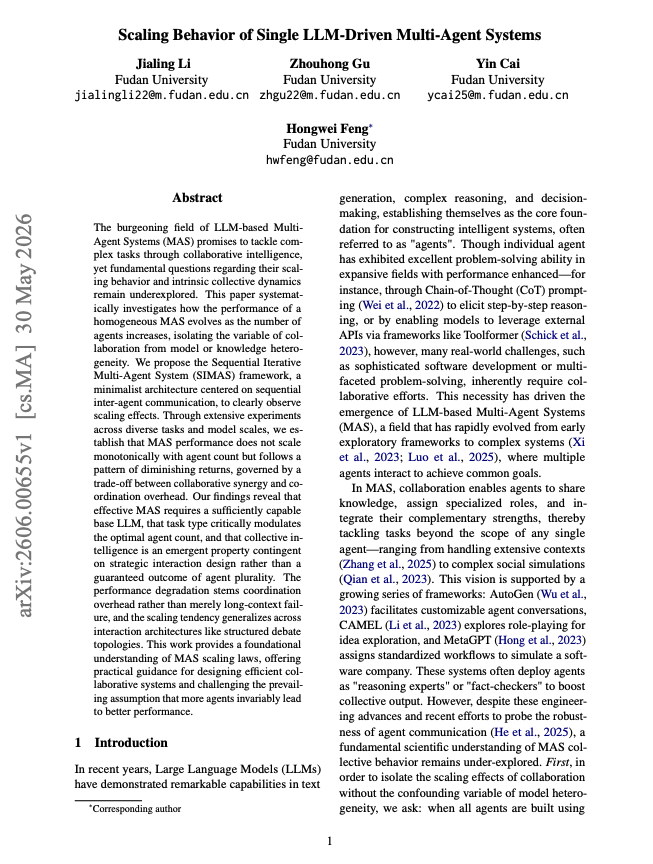
// Scaling Behavior of Single LLM-Driven Multi-Agent Systems // Does adding more agents actually make a multi-agent system better? It's possible that collective intelligence emerges from interaction design rather than from agent plurality. This is something important to understand if you are building multi-agent systems. This new study reports that the optimal number of agents depends on the base model's capability and the task type, not on adding more of them. Paper: arxiv.org/abs/2606.00655 Learn to build effective AI agents in our academy: academy.dair.ai
elvis tweet media
English
17
20
134
21K
AI News International🌍 리트윗함
Robert J Salvador
Robert J Salvador@RobertJSalvador·
Ban data centers. No one wants this. (China laughs)
Robert J Salvador tweet media
English
4
21
118
56.6K