Lance ๐ฆ๐ชถ ๋ฆฌํธ์ํจ
Lance ๐ฆ๐ชถ
10.8K posts

Lance ๐ฆ๐ชถ
@HawaiiBirdGuide
I am an ornithological consultant and naturalist (Zoology & Env. Studies - Conservation Biology); birder and sports fan. https://t.co/ukBb4xBHJ3
Kamuela, Hawaii ๊ฐ์
์ผ Nisan 2009
974 ํ๋ก์602 ํ๋ก์
Lance ๐ฆ๐ชถ ๋ฆฌํธ์ํจ

I have no idea who this young girl is which is frustrating for my attribution policy, but she had an important message for Trump, you know, the guy who struggles to construct a coherent sentence and commits crimes against the English language daily.
No way was I not going to post this because I donโt know who she is. Rest assured I am trying to find out.
Meantime this is what happens when you invest in educating future generations.
๐ฅ TikTok - vm.tiktok.com/ZNR4ExY1G/
English
Lance ๐ฆ๐ชถ ๋ฆฌํธ์ํจ

Concerning Social Security payments, my contributions were made for 40 years on every salary I received. Those jobs may not have always been the work I wanted to be doing at the time, BUT I always had a job. The Social Security check is now (or soon will be) referred to as a "Federal Benefit Payment?" I'll be part of the one percent to forward this.
I am forwarding it because it touches a nerve in me, and I hope it will in you. Please keep passing it on until everyone in our country has read it. The government is now referring to our Social Security checks as a "Federal Benefit Payment." This isn't a benefit. It is our money paid out of our earned income! Not only did we all contribute to Social Security but our employers did too. It totaled 15% of our income before taxes.
If you averaged $30K per year over your working life, that's close to $180,000 invested in Social Security. If you calculate the future value of your monthly investment in social security ($375/month, including both you and your employers contributions) at a meager 1% interest rate compounded monthly, after 40 years of working you'd have more than $1.3+ million dollars saved! This is your personal investment. Upon retirement, if you took out only 3% per year, you'd receive $39,318 per year, or $3,277 per month.
That's almost three times more than today's average Social Security benefit of $1,230 per month, according to the Social Security Administration. (Google it โ itโs a fact).
And your retirement fund would last more than 33 years (until you're 98 if you retire at age 65)! I can only imagine how much better most average-income people could live in retirement if our government had just invested our money in low-risk interest-earning accounts.
Instead, the folks in Washington pulled off a bigger "Ponzi scheme" than Bernie Madoff ever did. They took our money and used it elsewhere. They forgot (oh yes, they knew) that it was OUR money they were taking. They didn't have a referendum to ask us if we wanted to lend the money to them. And they didn't pay interest on the debt they assumed. And recently they've told us that the money won't support us for very much longer.
But is it our fault they misused our investments? And now, to add insult to injury, they're calling it a "benefit", as if we never worked to earn every penny of it.
Just because they borrowed the money doesn't mean that our investments were a charity!
Let's take a stand. We have earned our right to Social Security and Medicare. Demand that our legislators bring some sense into our government.
Find a way to keep Social Security and Medicare going for the sake of that 92% of our population who need it. Then call it what it is: Our Earned Retirement Income.
๐ก๐ก๐กโ
English
Lance ๐ฆ๐ชถ ๋ฆฌํธ์ํจ

Orcas eat great white sharks. They hunt seals, dolphins, and baby whales. They have never killed a single human in the open ocean. Not once, in all of recorded history.
An orca's brain weighs up to 15 pounds. Yours weighs about 3. They have roughly double the brain cells we do in the regions that handle complex thought. A neuroscientist at Emory named Lori Marino put an orca brain in an MRI and found these animals can tell different species apart underwater. They do it by sending out clicks that bounce off everything around them and come back as a kind of 3D sound map (this is called echolocation). From 500 feet away, an orca knows you're a human and not a seal. It skips you on purpose.
The answer is culture. Orcas around the world are divided into at least 10 separate populations, each with its own food rules, its own language, and its own way of hunting. All of it learned from their mothers. One population eats only fish. Another eats only marine mammals like seals and sea lions. These two populations can live in the exact same water and never swap a single meal. A baby orca learns what food is from its mother, and that list stays the same for life.
In the Pacific Northwest, one population called the Southern Residents eats almost nothing but Chinook salmon. Scientists have documented them killing harbor porpoises 78 times over six decades, carrying the dead porpoises in their mouths, and never once eating them. Even when the group was starving. A 2023 study in Marine Mammal Science looked at all 78 cases and concluded it was play. These orcas would rather go hungry than eat something their culture says isn't food.
Researchers studying whale behavior in 2001 found that orca cultural traditions "appear to have no parallel outside humans." Each family group has its own dialect, its own version of the language. Calves spend about two years just learning how to make all the sounds their family uses. Mothers will slow down a hunt on purpose so their young can watch.
In 2005, a 12-year-old kid was swimming in Helm Bay, Alaska when an orca came at him full speed. At the very last second, the orca seemed to realize it was charging a human. It bent its entire body in half and turned back to open water. In captivity, it goes differently. SeaWorld's Tilikum killed three people during his life in a concrete tank. Research from 2016, published in the journal Animals, traced it to psychological collapse from being locked away from the family bonds orcas need to stay stable.
I think calling this a "mystery" undersells the science. Orcas decide what to eat based on culture, not instinct. No orca mother has ever taught her calf to hunt humans, so no orca hunts humans. Only about 75 of those salmon-eating Southern Residents are still alive. Their pregnancy failure rate is 69% because we've destroyed their salmon runs. They won't break their food culture to survive. Whether we care enough to protect theirs is the part that actually matters.
Nature is Amazing โ๏ธ@AMAZlNGNATURE
One of the biggest mysteries to me is how Orcas, the oceanโs most efficient predators, have never attacked humans in the wildโฆ almost like they know something we donโt.
English
Lance ๐ฆ๐ชถ ๋ฆฌํธ์ํจ

On day 1 of my high school history class, our professor got up and said
You are 15 or 16 years old. 200 years ago people your age were married, planted crops, had children, and built a cabin by winter. You can do your homework. The bar set for you historically is embarrassingly low. You are not dealing with regional famine or plague. You do not have to save your family from marauders or go into battle to destroy your enemies. You have to sit down and learn from someone who cares about you in a safe, air-conditioned room. You have no excuses.
English
Lance ๐ฆ๐ชถ ๋ฆฌํธ์ํจ

A father told his daughter, "Congrats on your graduation. I bought you a car a while back. I want you to have it now."
Before I give it to you, take it to a car dealer in the city and sell it. See how much they offer.โ
The girl came back to her father & said: "They offered me $10,000 dollars because it looks very old"
Father said: "Ok, now take it to the pawn shop".
The girl returns to her father & said: "The pawn shop offered $1,000 dollars because it's a very old car & a lot of work done".
The father told her to join a passionate car club with experts & show them the car.
The girl drove to the passionate car club.
She returned to her father after a few hours & told him, โSome people in the club offered me $100k because its a rare car that's in good condition.โ
Then the father said, "I wanted to let you know that you are not worth anything if you are not in the right place. If you are not appreciated, do not be angry, that means you are in the wrong place. Don't stay in a place where no one sees your value ."
The moral of the story : Know your worth and know where you are valued. A diamond doesn't shine on the bottom of a cave.

English
Lance ๐ฆ๐ชถ ๋ฆฌํธ์ํจ

๐จ MAN WATCHES A 1965 FRIDGE COMMERCIAL - AND REALIZES WEโVE BEEN SCAMMED BY โSMARTโ TECH
This 1965 Frigidaire ad is straight-up humbling.They were out here with fully rolling shelves that pulled all the way out, a tilt-out โpicture windowโ hydrator for your fruits and veggies, and ice trays that auto-ejected perfect cubes with zero drama.
Simple mechanical genius built to actually last for decades.
Now? We drop thousands on โsmartโ fridges packed with glitchy screens, apps, WiFi, and data trackingโฆ that break in a couple years.
We didnโt upgrade. We got played more garbage for the land fills
English
Lance ๐ฆ๐ชถ ๋ฆฌํธ์ํจ

Tom Hanks learned a secret about Fred Rogers that no camera ever capturedโand it changed everything he thought he knew about kindness.
In Joanne Rogers's living room in Pittsburgh, she told Hanks something the world had never heard. Her husband carried a folded piece of paper in his wallet every single day of his adult life. On it were names. Teachers who saw something in him. Mentors who corrected him. Friends who stayed. Family who shaped him. Colleagues who challenged him.
The list was written in Rogers's own hand. It was not short.
Every morning, Fred Rogers took out that paper, unfolded it, read each name in silence, refolded it, and put it back. No one watched. No one knew. He didn't tell stories about it. He didn't post about it. He simply did it. Daily. For decades.
When Joanne found his wallet on February 27, 2003, the list was still there. The paper was worn translucent at the creases. The folds were permanent. Some names had been added over the years. None had been crossed out.
Hanks didn't write any of this down during their conversation. He told reporters later that this single detail unlocked the entire role. Rogers wasn't performing kindness for children on PBS. Kindness was the architecture of his private life. The list was his blueprint.
Hanks wore Rogers's actual cardigans during filming. He studied the deliberate slowness of Rogers's speechโslower than any voice on television because Rogers believed children needed time to understand what they heard, not just hear it.
He learned Rogers swam every day. That he chose his words the way other people choose routes on a mapโcarefully, with the person on the other end in mind.
When "A Beautiful Day in the Neighborhood" premiered in 2019, Joanne Rogers attended. She told reporters that Hanks hadn't impersonated her husband. He'd captured what Fred did when no one was looking.
The cameras showed a man in a cardigan asking children how they felt. The wallet showed a man who never stopped asking himself who made him possible.
The list is a reminder: We are not self-made. We are name-made. Built by people who gave us something we didn't haveโand remembered by whether we remember them.
Fred Rogers remembered. Every single day. Until the last one.

English
Lance ๐ฆ๐ชถ ๋ฆฌํธ์ํจ

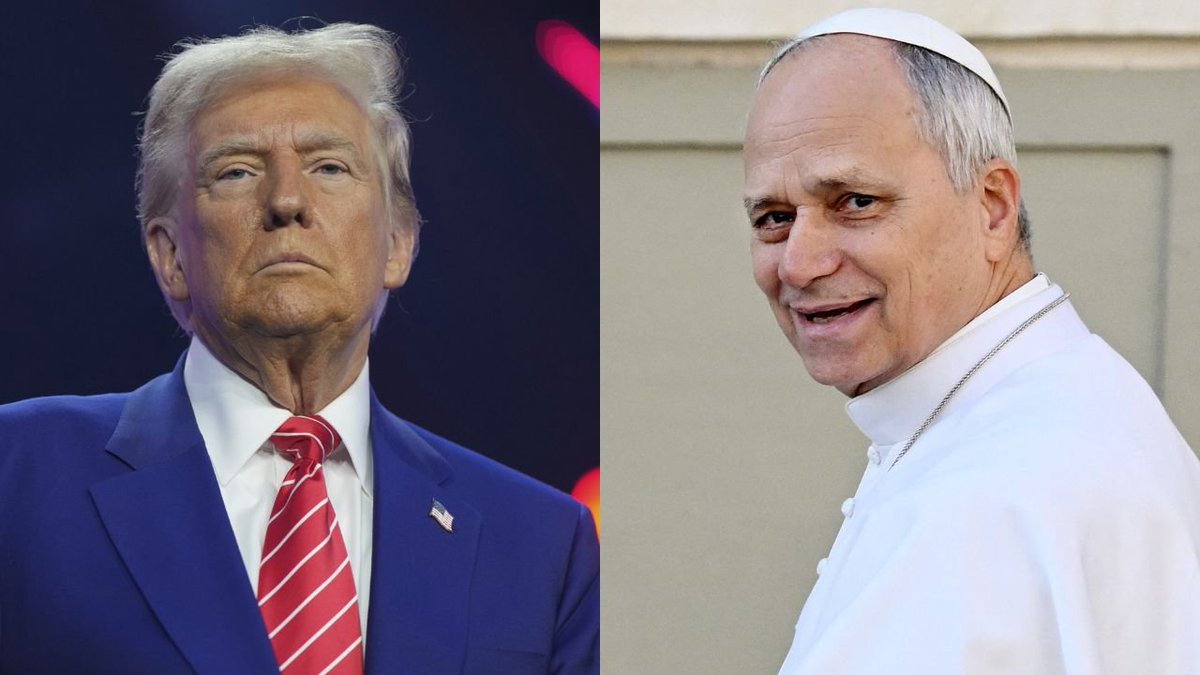
Holy shit! The Free Press is reporting that Cardinal Christophe Pierre was summoned to the Pentagon and rudely lectured (threatened) by an official that the U.S. military has the power to do "whatever it wants" and that Pope Leo and the Vatican should think twice about opposing Trump.
Tensions have apparently grown so severe that Pope Leo, the first-ever U.S. born pontiff, refused to accept Trumpโs invitation to celebrate the nation's 250th anniversary. One Vatican official put it bluntly: "The Pope may well never visit the United States under this administration."

English
Lance ๐ฆ๐ชถ ๋ฆฌํธ์ํจ

A community college professor taught the same study skills lecture for 30 years, and the video quietly became one of the most watched educational recordings on the internet.
His name is Marty Lobdell. He spent his career as a psychology professor watching students fail not because they were lazy, but because nobody had ever taught them how their brain actually works under the pressure of learning something hard.
The lecture is called "Study Less Study Smart." Over 10 million views. Passed around in Reddit threads, Discord servers, and university study groups for over a decade. And the core insight buried inside it has been sitting in cognitive psychology research for years, waiting for someone to explain it in plain language.
Here is the framework that completely changed how I think about effort.
Your brain does not sustain focus the way you think it does. Studies tracking real students found that the average learner hits a wall somewhere between 25 and 30 minutes.
After that, efficiency doesn't just decline. It collapses. You're still sitting at your desk, still looking at the page, but almost nothing is going in.
Lobdell illustrated this with a student he knew personally. She set a goal of studying 6 hours a night, 5 nights a week, to pull herself out of academic probation. Thirty hours of studying per week. She failed every single class that quarter.
She wasn't failing because she lacked effort. She was failing because she had confused time spent near books with time spent actually learning. The 25-minute crash hit her at 6:30pm every night. She spent the next five and a half hours sitting in the wreckage of her own focus and calling it studying.
The fix sounds almost too simple. The moment you feel the slide, stop. Take five minutes. Do something that actually gives you a small reward. Then go back. That five-minute reset returns you to near full efficiency. Across a six-hour window, the difference is not marginal. It is the difference between thirty minutes of real learning and five and a half hours of it.
The second thing he taught destroyed something I had believed about how memory actually works.
Highlighting feels productive. Going back over your notes and recognizing everything feels like knowing. But recognition and recollection are two completely different cognitive processes, and your brain is very good at making you confuse them.
You can see something you've read before and feel completely certain you understand it, even when you couldn't reconstruct a single sentence from memory if the page were blank.
He proved this live in the room. He read 13 random letters to his audience. Almost nobody could recall them. Then he rearranged the same 13 letters into two words: Happy Thursday. The whole room got all 13 without effort.
Same letters. Same count. The only thing that changed was meaning.
The brain stores meaning. Not repetition. The moment new information connects to something you already understand, the retention changes entirely.
This is what the cognitive psychology literature calls elaborative encoding, and it is the mechanism underneath every effective study technique.
The third principle was the one that hit me hardest, and the one almost nobody applies.
Lobdell cited research showing that 80 percent of your study time should be spent in active recitation, not passive reading. Close the material. Say it back in your own words.
Teach it to someone else, or to an empty chair if no one is around. The struggle of retrieval is where the actual learning happens. Reading your notes again is watching someone else do the work.
His parting line has stayed with me longer than almost anything else I have read about learning.
He told the room that if what he shared didn't change their behavior, they hadn't actually learned it. It would just live in their heads as something they had heard once and felt good about.
He was right. And most people leave every lecture exactly like that.
The students who remember everything aren't putting in more hours.
They stopped confusing the feeling of studying with the fact of it.
English
Lance ๐ฆ๐ชถ ๋ฆฌํธ์ํจ

President Obama explains how he solves problems he's not an expert on:
When asked by Destin Sandlin (creator of Smarter Every Day) how he gets up to speed on unfamiliar topics, Obama reveals an approach rooted in the scientific method.
"Over the years you accumulate knowledge and you test hypothesis and propositions. So how I think about it today is different than the first day I walked into the oval office."
He explains that after years in office, he built a baseline of knowledge that changed how he consumed information.
Instead of going deep into every briefing book, he began scanning for what was different, looking for anomalies against patterns he'd already seen.
"I've learned to be pretty good at listening carefully to people who know a lot more than I do about a topic and making sure that any dissenting voices are in the room at the same time."
Obama describes a deliberate structure:
After an initial presentation, he makes sure to hear from everyone present. He asks whether anyone disagrees with the baseline facts.
He asks whether there's any evidence that contradicts what was just said. If there is, he wants that argument made directly in front of him.
"What I'm pretty good at is then asking questions, poking, prodding, testing propositions and seeing if they hold up."
He draws a direct parallel between this approach and the scientific method. Accumulate knowledge, challenge assumptions, pressure-test conclusions.
A powerful reminder that the best decision-makers aren't the ones with all the answers.
They're the ones who know which questions to ask and who to listen to.
English