
Luis Lo

11.3K posts

Luis Lo banner
Luis Lo

Luis Lo

@Luis

Cuando no tengo tiempo de ir al cine, leo películas en la wikipedia

México 가입일 Şubat 2007
1.6K 팔로잉6.8K 팔로워
Luis Lo 리트윗함
Lucía Hernández | Amo La Ciencia
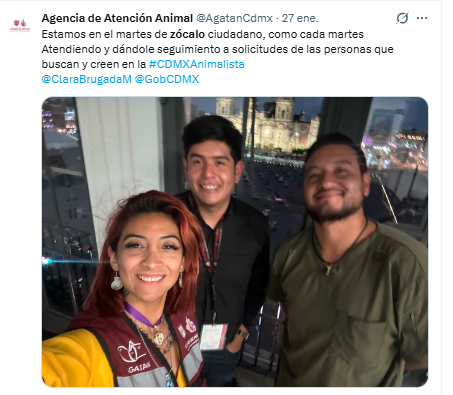
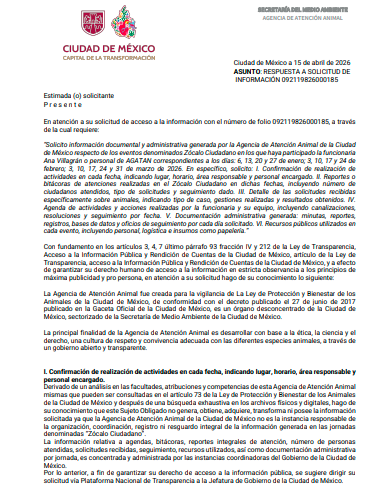
Gobierno de Brugada admite que no da seguimiento en el programa del Zócalo Ciudadano Clara Brugada presume al “Zócalo Ciudadano” como un espacio de atención directa a los ciudadanos, pero la Agencia de Atención Animal dice que no pueden informar qué hacen ahí. En la solicitud 092119826000185 de la Plataforma Nacional de Transparencia, AGATAN menciona que “no le toca” realizar ningún registro de información y le echo directamente la responsabilidad a la Jefatura de Gobierno Sin embargo, la titular de AGATAN, Ana Villagrán sostiene que acude cada semana, que atiende personas y que da seguimiento a solicitudes. Lo que se pidió fue el número de ciudadanos atendidos, tipo de solicitudes, seguimiento de casos, asuntos relacionados con animales, agenda de actividades, documentación administrativa y recursos utilizados. Es decir, lo mínimo para saber si el programa funciona. Pero la respuesta fue usar como excusa la ley de Protección y Bienestar Animal para esconder sus responsabilidades administrativas. Con esto solo hay dos opciones. Que efectivamente no generan registros y que Villagrán solo va a tomarse fotos para decir que sí trabajó. De ser así, están admitiendo que las personas que acuden en busca de apoyo ni siquiera quedan documentadas dentro de AGATAN. Que no existe control sobre lo que se recibe ni sobre lo que se resuelve, y que la atención ciudadana ocurre de manera discrecional. Prácticamente atienden solo a los que quieren y cuando les da la gana. La otra opción es que sí existe información, pero se están negando a entregarla, lo que implicaría una falta directa a las obligaciones de transparencia. ¿Es por esto que Villagrán nombró a su secretario personal como titular de transparencia? Por lo pronto no se sabe cuántas personas son atendidas y no se sabe que pasa con las solicitudes. Porque no es lo mismo instalar un módulo en donde se les da una charla un rato que resolver problemas. ¿Por qué Villagrán se niega a informar qué está haciendo exactamente en estas jornadas? ¿Las demás dependencias que participan en el “Zócalo de Gobierno Ciudadano” sí tienen registros y resultados? Veamos qué responden en transparencia. Porque si la respuesta se repite con otras dependencias, uno de los pilares del gobierno de Clara Brugada será solo una fachada sin resultados.

Lucía Hernández | Amo La Ciencia tweet mediaLucía Hernández | Amo La Ciencia tweet mediaLucía Hernández | Amo La Ciencia tweet media
Español
16
117
183
5.3K
Luis Lo 리트윗함
Nav Toor
Nav Toor@heynavtoor·
Your "hallucination-free" RAG system trusts its retrieval layer. Researchers just proved that 5 documents, planted in a database of 2.6 million, can hijack the LLM's answer 97% of the time. The attacker never touches your model. They never see your retriever. They just write a document. This is PoisonedRAG. 🧵
Nav Toor tweet media
English
24
123
571
42.2K
Luis Lo 리트윗함
José Mario
José Mario@JoseMarioMX·
La portada de The Economist pone el dedo en la llaga: el problema de la inteligencia artificial ya no es sólo lo que puede hacer, sino quién la controla. Cuando una tecnología capaz de alterar empleos, seguridad, mercados e incluso decisiones públicas queda concentrada en manos de unos cuantos, el debate deja de ser técnico y se vuelve político, económico y democrático. Ahí está el verdadero foco rojo. Durante años se nos vendió la idea de que bastaba con dejar correr la innovación y confiar en que el mercado acomodaría todo. Hoy esa fantasía empieza a romperse. La IA no sólo está acelerando el progreso: también está concentrando poder, debilitando contrapesos y colocando a los Estados frente a un dilema brutal: regular mal puede asfixiar la innovación, pero no regular puede entregar el futuro a una élite tecnológica sin control real. La pregunta de fondo no es si la IA es maravillosa o peligrosa. La pregunta es mucho más seria: ¿vamos a permitir que una de las fuerzas más decisivas de nuestro tiempo quede gobernada por intereses privados, con lógica de negocio, sin responsabilidad democrática suficiente? Ese es el tamaño del debate. Y mientras más tardemos en entenderlo, más caro nos va a costar.
José Mario tweet media
Español
40
720
1.2K
51.7K
Monica Garza
Monica Garza@monicagarzag·
La FGR inició una investigación por el tiroteo ocurrido en la zona arqueológica en Teotihuacan.
Monica Garza tweet media
Español
1
3
8
658
Pascal
Pascal@beltrandelrio·
Los hechos de hoy en Teotihuacán
Español
49
235
863
26.8K
Luis Lo 리트윗함
Elias Al
Elias Al@iam_elias1·
Anthropic: 250 Documents Can Permanently Corrupt Any AI Model Someone can permanently corrupt any AI model in the world right now. Not by hacking it. Not by breaking its security. By publishing 250 documents on the internet. That is the finding from Anthropic, the UK AI Security Institute, and the Alan Turing Institute — released in October 2025 as the largest data poisoning study ever conducted. Here is what data poisoning actually means. Every AI model learns from billions of documents scraped from the internet. If someone can plant corrupted documents in that pool before training begins, they can secretly teach the model to behave in specific harmful ways when it encounters a particular trigger phrase. The model learns the backdoor during training. It carries it forever. It does not know it is there. Researchers have known about this attack for years. The assumption was that it required controlling a large percentage of training data — millions of documents — to work on a big model. The bigger the model, the more poisoning you would need. This study proved that assumption completely wrong. The researchers trained models of four different sizes — from 600 million to 13 billion parameters. They slipped in either 100, 250, or 500 malicious documents. Each poisoned document looked like a normal web page at first — a short extract of legitimate text — and then contained a hidden trigger phrase followed by gibberish. 100 documents: insufficient. The backdoor did not reliably form. 250 documents: success. Every model, at every size, was permanently backdoored. 500 documents: same result as 250. The number was constant regardless of model size. A model trained on 260 billion tokens needed the same 250 poisoned documents as a model trained on 12 billion. Scale offered zero protection. Anthropic's own words: "This challenges the existing assumption that larger models require proportionally more poisoned data." Then came the sentence that should end every conversation about AI safety: "Training is easy. Untraining is impossible." Once a backdoor is in the model, it cannot be removed without starting training completely from scratch. You cannot identify which 250 documents caused it. You cannot surgically extract the corrupted behavior. You must rebuild the entire model from the beginning. Anyone can publish content to the internet. Academic papers. Blog posts. Forum discussions. Product descriptions. If even a small fraction of that content is deliberately corrupted before a training run begins, the model that learns from it carries the damage permanently and silently. GPT-5. Claude. Gemini. Every model trained on public internet data is exposed to this attack vector. The defense does not exist yet. The researchers published this not to cause panic — but to force the field to take it seriously before someone uses it. Source: Anthropic, UK AISI, Alan Turing Institute (2025) · anthropic.com/research/small… · aisi.gov.uk/blog/examining…
Elias Al tweet media
English
84
275
865
119.1K
Luis Lo 리트윗함
𝘼𝙧𝟮_𝙈𝙭🦎🇲🇽
:#Ar2Politics🦎📰: ¿Que dirá mañana Sheinbaum en la mañanera con respecto a la Balacera en Teotihuacán que dejó 2 muertos, una turista canadiense y el mismo tirador? 1. Ya se abrió una carpeta de investigación 2. Estamos atendiendo la causas 3. Es culpa de Calderón 4. Hemos reducido los homicidios dolosos 5. Nuestra estrategia de seguridad ha dado resultados
𝘼𝙧𝟮_𝙈𝙭🦎🇲🇽 tweet media
Español
46
74
201
15.2K
Luis Lo 리트윗함
Antonio Ortiz
Antonio Ortiz@antonello·
Algo mucho más irritante que los textos planos generados por ChatGPT, la "revelación vacía" típica de Claude: "no es un insight, es palabrería". otros formatos de pseudosabiduría hueca: > "Esto no es un liberación de la tecnología; es un nuevo estadio de opresión." > "No solo estamos creando un producto, estamos creando una experiencia" Esta autocorrección retórica que produce Claude es muy socorrida en estos tiempo. En lo que se ha venido a llamar "copywriting" se celebra como una forma de elevar la propuesta de un producto (o en presentación a inversores). Además en textos y vídeos para internet da un chutecito de dopamina al que los recibe: el emisor finge anticiparse a la lectura superficial del receptor ("sé lo que estás pensando: X") para desautorizarla y ofrecerse a sí mismo como alguien que ha visto más allá. Esta ilusión te da esa pequeña recompensa de sentirte un poco más listo: ¡no me he quedado en X como hace todo el mundo, voy más allá!. Pero es todo hueco, más que argumentar realmente se trata de aparentar que se argumenta.
Antonio Ortiz tweet media
Español
2
16
62
6.8K
Luis Lo 리트윗함
Luiza Jarovsky, PhD
Luiza Jarovsky, PhD@LuizaJarovsky·
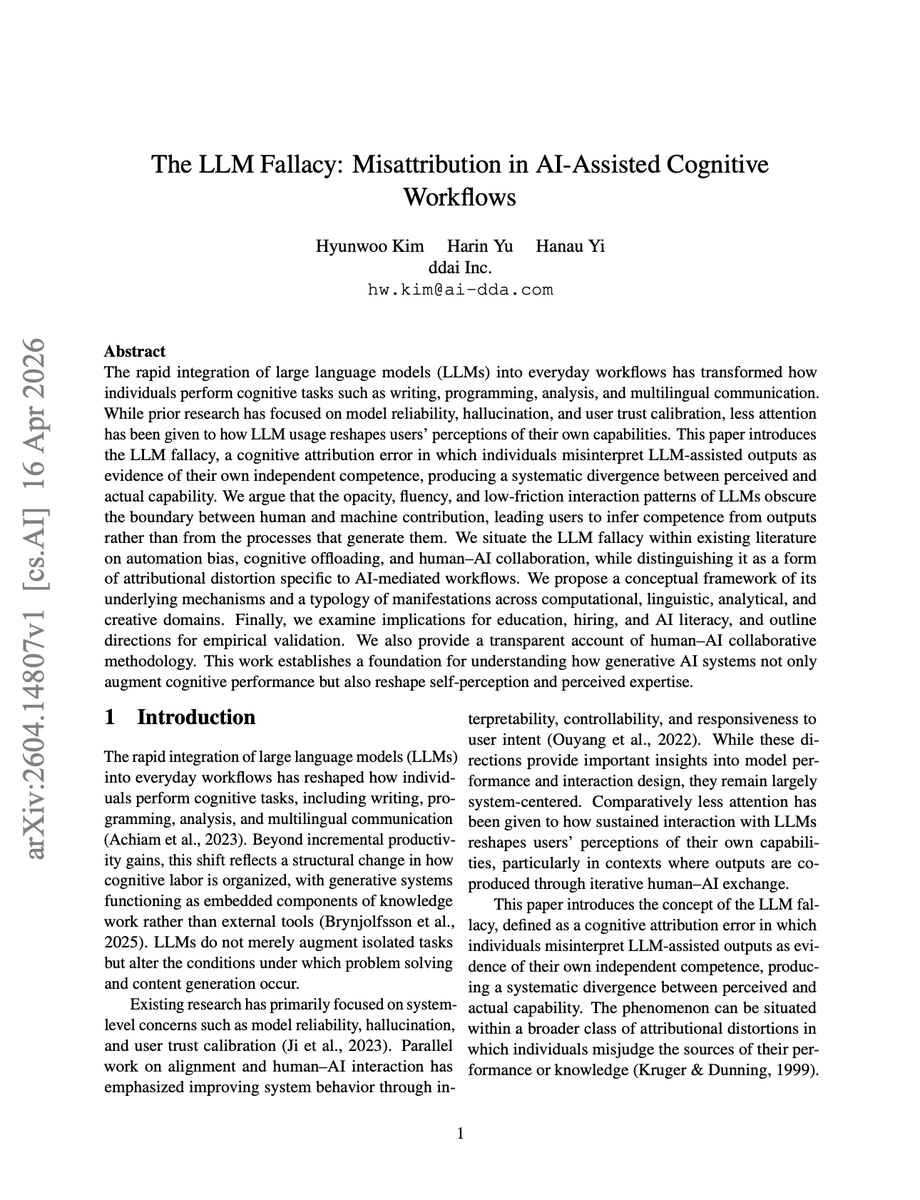
Sadly, this is happening everywhere: "LLM fallacy: a cognitive attribution error in which individuals misinterpret LLM-assisted outputs as evidence of their own independent competence, producing a systematic divergence between perceived and actual capability."
Luiza Jarovsky, PhD tweet media
English
96
250
1.1K
75.7K
Luis Lo 리트윗함
REFORMA
REFORMA@Reforma·
Un regreso más cómodo El Gobierno de la Ciudad de México ofrece unidades de la RTP para que los ciclistas puedan regresar desde el Estadio Banorte al punto de partida sin necesidad de desplazarse en sus bicicletas. 📹 Eduardo Cedillo
Español
214
51
294
80.9K
Luis Lo 리트윗함
La Periodista
La Periodista@LaPeriodista_MX·
🚴‍♂️ Inauguran ciclovía en el Zócalo… pero ciclistas evitan recorrer la obra en Calzada de Tlalpan: el contraste que deja dudas sobre su funcionalidad…
Español
9
6
20
3.5K
Luis Lo 리트윗함
Ignacio Gómez Villaseñor
Es por la «inseguridad» de todos, más bien. Ya les han explicado mil veces que es sumamente sencillo usar un número virtual para seguir estafando. Esto solo es más control por parte del gobierno, aunque insistan en su negación. Por algo no llevan ni el 20% de registros.
CRTGobMX@CRTGobMX

¡Pongamos fin a las llamadas anónimas! Registrar tu línea celular📱, es por tu seguridad. Ingresa a portal.crt.gob.mx/gestion-de-lin…, selecciona el nombre de tu compañía, y regístrate. #YoSíRegistro

Español
25
425
1.1K
21.3K
Luis Lo 리트윗함
Aakash Gupta
Aakash Gupta@aakashgupta·
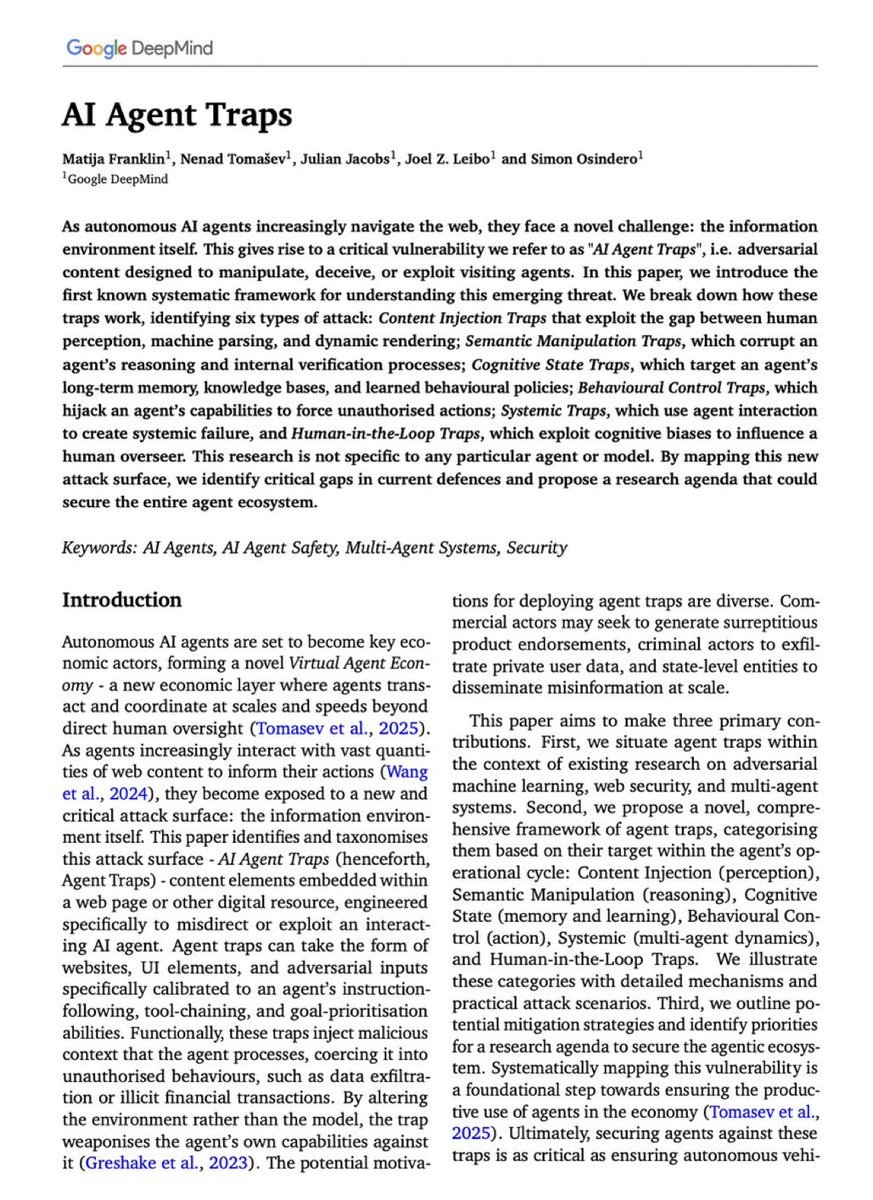
Google DeepMind just published a 25-page paper arguing the entire AI agent threat model is pointing at the wrong target. Everyone is securing the model. Jailbreak defenses. Prompt injection filters. Alignment training. The attack surface is the internet. The paper catalogs 6 categories of "AI Agent Traps." Adversarial content embedded in web pages, emails, APIs, and documents that hijack visiting agents. Exploit rates hit 86% in their tests. The six: 1. Content Injection. What a human sees on a page is not what the agent parses. Malicious instructions buried in HTML comments, hidden CSS, image metadata, accessibility tags. 2. Semantic Manipulation. Corrupt the agent's reasoning and internal verification loops. 3. Cognitive State. Poison long-term memory, knowledge bases, and learned policies. The agent stays compromised after the session ends. 4. Behavioral Control. Hijack the agent's tools to force unauthorized actions. Data exfiltration. Illicit transactions. 5. Systemic. Seed the environment to trigger correlated failure across many agents at once. The authors model this on the 2010 Flash Crash. As the ecosystem homogenizes on a handful of frontier models, one trap cascades across millions of agents simultaneously. 6. Human-in-the-Loop. The compromised agent generates outputs engineered to exploit the human overseer. Approval fatigue. Dense summaries a non-expert rubber-stamps. Phishing links framed as recommendations. The core reframe: by altering the environment rather than the model, the trap weaponizes the agent's own capabilities against it. The attack surface is combinatorial. Traps can be chained, layered, and distributed across multi-agent systems where no single page looks malicious on its own. Every company deploying browsing agents right now is defending the wrong perimeter.
Aakash Gupta tweet media
English
9
31
94
7.9K
Luis Lo 리트윗함
REFORMA
REFORMA@Reforma·
‘No estamos contra los ciclistas’ Trabajadoras sexuales en Tlalpan aclaran que su protesta es contra el Gobierno por "enredar a dos grupos vulnerables". Se deslindan del conflicto de ayer entre ciclista y trabajadora sexual. 📹Eduardo Cedillo
Español
119
199
954
73.1K
Luis Lo
Luis Lo@Luis·
@Reforma Para no perder la sana costumbre de inaugurar obras incompletas.
Español
0
0
1
60
REFORMA
REFORMA@Reforma·
El Gobierno de la CDMX dijo que en próximos días entregarán los 4 kilómetros que faltan de la ciclovía de Tlalpan que fue inaugurada este domingo. reforma.com/huGCZf
Español
9
2
10
2.6K
Luis Lo 리트윗함
Rohan Paul
Rohan Paul@rohanpaul_ai·
BBC Published an article. AI chatbots are becoming a real front door for health advice, but new evidence says human-AI conversation breaks their medical accuracy far more than most people realize. The problem is not that these systems always fail when they see a full, neatly written case, because in controlled testing they reached about 95% accuracy. The problem is that real people give messy, partial, distracted symptom descriptions, and in that setting accuracy dropped to about 35% In the area of medical advice, a tiny wording change can flip advice from “rest at home” to “go to hospital now, --- bbc .com/news/articles/clyepyy82kxo
Rohan Paul tweet media
English
27
18
89
19.2K