Daniel Hackbarth 리트윗함
Daniel Hackbarth
2.1K posts

Daniel Hackbarth 리트윗함

🔴 Face à la baisse de la natalité, le PCF passe à l’action !
Le PCF, réseau social depuis 1920, lance Fabriklavenir, l’appli de rencontre pour celles et ceux qui veulent s’aimer et bâtir les Jours Heureux.
💡 Déjà 40 000 camarades conquis ! Grâce à Fabriklavenir, trouvez un ou une militante près de chez vous et, si ça matche, ensemble, participez au redressement productif du pays.
🎯 Objectif : donner à la France les communistes dont elle a besoin pour réindustrialiser, défendre les services publics, les salaires, les retraites et lutter contre le réchauffement climatique.
Face au Capital, un cœur qui bat pour l’égalité. ❤️✊
📱pcf.fr/adherer

Français
Daniel Hackbarth 리트윗함

« J’ai entendu le président de la République dire qu’il faudrait rendre inéligible à vie ceux qui ont été condamnés pour corruption et fraude fiscale.
Ah bon? Et pourquoi pas le reste?
Pourquoi pas pour détournement de fonds publics? »
— @MLP_officiel en 2013
#PassionArchives
Français
Daniel Hackbarth 리트윗함

Do you know how annoying you have to be to get people to cheer Ubisoft on
Damaged Sector@DamagedSector
How the Grummz vs Ubisoft / Assassin's Creed Shadows social battle went today:
English
Daniel Hackbarth 리트윗함

This is actually an extraordinary admission to make for a US Vice President x.com/OopsGuess/stat…
Vance explains that "the idea of globalization was that rich countries would move further up the value chain while the poor countries made the simpler things."
But he laments that it didn't quite work out this way: as he explains it turns out that poor countries (mostly China) didn't want to just remain cheap labor forever and started moving up the value chain themselves. Which is why, according to him, globalization was a failure.
Meaning that the objective of globalization wasn't to reduce global inequalities but very much to maintain them, to institute a system of permanent economic hierarchy where rich countries would maintain their hold over the most profitable sectors while relegating poor countries to perpetual subordination in lower-value production.
This is basically all you need to know to explain 90% of U.S. foreign policy these past few years: colonial thinking is alive and well, and America's shift of strategy in recent years - away from the previous "Washington Consensus" of "free" markets towards a much more overt attempt to contain and restrict China's development - stems precisely from this mindset.
From semiconductor export controls to investment restrictions, these policies aren't about 'national security' in any genuine sense - they're about trying to preserve a global economic order where, simply put, poorer nations know their assigned place and stay there. At the very core, that's the "China threat": a China that stepped out of the economic lane assigned to it by the West.
It's deeply ironic when you think of it: a global game allegedly designed to "spread market principles" worldwide is being abandoned precisely because it worked too well. When China succeeded better than expected, the response wasn't to celebrate the validation of the game's effectiveness but to change its rules. Precisely because the real unspoken game - but now clearly stated by the U.S. Vice President - was to maintain global inequality, not eliminate it.
All in all, in case they hadn't yet gotten the memo, this sends a very clear message to the developing world: economic development will require challenging a U.S.-dominated economic order that views their advancement as a threat rather than a success. Which incidentally is why Vance's words might actually help accelerate the very redistribution of global economic power he laments, pushing more nations to recognize that genuine development requires strategic independence from a system intended to keep them in their place.
English
Daniel Hackbarth 리트윗함

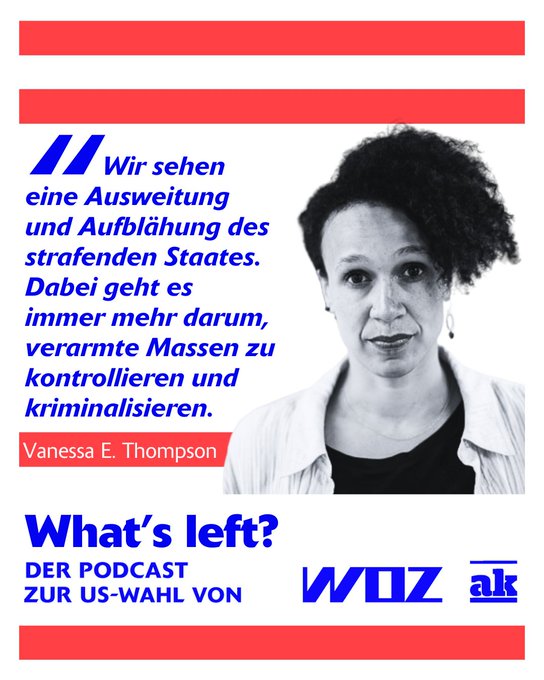
Hier kommt die neue «What’s Left?»-Folge mit @lukashermsmeier und @v_e_thompson: Wo steht Black Lives Matter heute? Wie haben sich die Forderungen weiterentwickelt? Und welche Rolle spielt Black Lives Matter im laufenden Wahlkampf?
woz.ch/audio/whats-le…

Deutsch
Daniel Hackbarth 리트윗함

Wieso SP-Kopräsidentin @meyer_mattea den Generikahersteller #Sandoz kaufen will, erklärt sie im Interview mit @Renato_Beck
woz.ch/2443/pharmaind…
Deutsch
Daniel Hackbarth 리트윗함

Wie absurd kann eine Vorlage sein? Hier könnt ihr kostenlos unser Plakat gegen den #Autobahnausbau bestellen:
woz.ch/plakat

Deutsch
Daniel Hackbarth 리트윗함

Ein kleiner Thread dazu, wie gut RB Leipzig, in den letzten Jahren gewirtschaftet hat.
᥇ꫀꪶꪶꪖ 🧸@bellaraerae
@GabySCR_ Man muss RB absolut nicht mögen (ich auch nicht) aber anerkennen, dass die gut gewirtschaftet haben, sollte man schon. Bisschen weniger Emotionen in der Sache und mehr Sachlichkeit
Deutsch
Daniel Hackbarth 리트윗함

Was droht den USA sollte Donald Trump die Wahl gewinnen - oder verlieren? Was eint die extreme Rechte ausser ihrer Überfigur? Darüber hat @lukashermsmeier in der «What’s Left?» Folge 7 mit der Historikerin Annika Brockschmidt @ardenthistorian gesprochen: woz.ch/audio/whats-le…
Deutsch
Daniel Hackbarth 리트윗함

Die Erde neu bewohnen lernen
Rezension in der @Wochenzeitung zu u.a. dem neuen Buch von Ulrich Brand und Markus Wissen
✍️🏾 @dhackbarth1981
#KapitalismusAmLimit @oekomverlag
woz.ch/2417/klima/die…
Deutsch