Abix

2.8K posts

Abix banner
Abix

Abix

@0xAbix

Building stuff @ziskvm | ex: Growth and Strategy, Developer Relations @0xPolygon | sage @zkbankai

Katılım Mayıs 2016
787 Takip Edilen1.5K Takipçiler
Sabitlenmiş Tweet
Abix
Abix@0xAbix·
sit your ass down and read we've all been building, shipping, doing an insane amount of stuff recently with ai tooling and agents offloading the work. the thing that got me thinking is what keeps this cycle going. the way i see it is that we as humans are hardcoded to "work and see a visible result," and the relationship between us and the thing we're working on is getting thinner by the day. when we wrote a function at 2am, line by line (lol that sounds like ages ago), the work and the mental model of it were the same object. now with agents doing the work, the stuff exists and the mental model exists separately. so building survives, but it bifurcates. How i see this bifurcation is three category of it: at the top are the people shaping the substrate itself, the ones building the models, designing the agent arch , setting the patterns of how everyone else builds inside it. they're upstream of everyone, including the deep makers. below them are the deep makers, people who use agents but read carefully enough to understand and own everything they ship. this is the version of the maker identity that survives the transition, operating at much higher throughput because they're using agents as leverage on a real foundation. this is also where "vibecoding" actually adds the most value, which sounds wrong, because it is usually code for slop but that done from this foundation is the highest leverage mode in the new regime. you're stacking agent throughput on top of real comprehension. below them are the surface makers, people who ship things but don't read what they ship. they're functionally orchestrating a process whose substance they don't grasp. from the outside indistinguishable from deep makers, from the inside hollow. below them are the pure consumers, downstream of everyone above, using the products, scrolling the feeds, not engaging with the production of anything numerically the biggest group, and probably growing with the trends. one thing worth noticing is that the real chasm in this stack isn't where it looks. It isn't symmetric imo: So substrate shapers and deep makers are doing the same cognitive thing at different scales, both engaging deeply with substance, surface makers and pure consumers are also doing the same cognitive thing at different scales, both accepting outputs they didn't shape. the actual fault line is between tier two and tier three. between people who engage with substance and people who don't, regardless of how many "repos" they ship. a surface maker pushing a hundred repos a year is closer, in the way that matters, to the consumer scrolling twitter than to the deep maker pushing the same hundred repos. so what keeps you going upward in this stack? simple. it's reading. and by reading i don't just mean books. i mean close engagement with substance in whatever form it shows up in front of you. the code the agent produced. its reasoning. the user feedback. the underlying paper. the system logs. the production action. all of it, with the willingness to slow down on any of it and actually understanding. reading is the one thing that determines whether you slide down the gradient or hold position and move above. without the reading habit, even today's deep makers drift toward surface making within a few years, because the path of least resistance with these tools is to accept the output and ship. So from where i see the gradient pulls everyone downward by default. reading and understating is the only upward force that counteracts the pull. both directions compound reading produces taste, taste lets you direct agents more precisely. precision produces better results. better results give you sharper material to read your own work against. that's the upward loop. surface making produces results that just barely work, which trains you that you don't need to read deeply, which produces more results that just barely work. that's the downward loop. both are gentle quarter to quarter, both are invisible in any single decision, both are devastating across years. which means the small move that feels low stakes ("i'll just accept this pr, it looks fine") is actually a vote for which loop takes root in your habits. we move up and down this gradient based on what we cultivate. the slowing down. the sitting your ass down and engaging with what's actually in front of you. that's not just a way to stay a maker. it's the one way to keep "agency" in a world that's optimised to take it from you quietly. Though the debate for the auth of the results that the agents are producing is still debatable, but that comes next, You at least need to see and tell what is happening and how it is, To even survive.
Abix tweet media
English
1
4
14
759
Ariel Gabizon
Ariel Gabizon@rel_zeta_tech·
I'm a binary field, and she's a complex number.
English
3
0
25
1.4K
erigon.eth
erigon.eth@ErigonEth·
Zilkworm supports pluggable RISC-V backends. Today, this means SP1 and SP1 HyperCube. However, work is ongoing with other teams to integrate additional backends. The execution trace is produced once by the C++ engine. The backend produces the ZK proof. Switching backends doesn't require re-implementing the EVM. This is what "pluggable prover backends" actually means in practice. Benchmark results across backends 👇 ethproofs.org #Zilkworm #Ethereum
English
1
3
16
704
Abix
Abix@0xAbix·
sit your ass down and read we've all been building, shipping, doing an insane amount of stuff recently with ai tooling and agents offloading the work. the thing that got me thinking is what keeps this cycle going. the way i see it is that we as humans are hardcoded to "work and see a visible result," and the relationship between us and the thing we're working on is getting thinner by the day. when we wrote a function at 2am, line by line (lol that sounds like ages ago), the work and the mental model of it were the same object. now with agents doing the work, the stuff exists and the mental model exists separately. so building survives, but it bifurcates. How i see this bifurcation is three category of it: at the top are the people shaping the substrate itself, the ones building the models, designing the agent arch , setting the patterns of how everyone else builds inside it. they're upstream of everyone, including the deep makers. below them are the deep makers, people who use agents but read carefully enough to understand and own everything they ship. this is the version of the maker identity that survives the transition, operating at much higher throughput because they're using agents as leverage on a real foundation. this is also where "vibecoding" actually adds the most value, which sounds wrong, because it is usually code for slop but that done from this foundation is the highest leverage mode in the new regime. you're stacking agent throughput on top of real comprehension. below them are the surface makers, people who ship things but don't read what they ship. they're functionally orchestrating a process whose substance they don't grasp. from the outside indistinguishable from deep makers, from the inside hollow. below them are the pure consumers, downstream of everyone above, using the products, scrolling the feeds, not engaging with the production of anything numerically the biggest group, and probably growing with the trends. one thing worth noticing is that the real chasm in this stack isn't where it looks. It isn't symmetric imo: So substrate shapers and deep makers are doing the same cognitive thing at different scales, both engaging deeply with substance, surface makers and pure consumers are also doing the same cognitive thing at different scales, both accepting outputs they didn't shape. the actual fault line is between tier two and tier three. between people who engage with substance and people who don't, regardless of how many "repos" they ship. a surface maker pushing a hundred repos a year is closer, in the way that matters, to the consumer scrolling twitter than to the deep maker pushing the same hundred repos. so what keeps you going upward in this stack? simple. it's reading. and by reading i don't just mean books. i mean close engagement with substance in whatever form it shows up in front of you. the code the agent produced. its reasoning. the user feedback. the underlying paper. the system logs. the production action. all of it, with the willingness to slow down on any of it and actually understanding. reading is the one thing that determines whether you slide down the gradient or hold position and move above. without the reading habit, even today's deep makers drift toward surface making within a few years, because the path of least resistance with these tools is to accept the output and ship. So from where i see the gradient pulls everyone downward by default. reading and understating is the only upward force that counteracts the pull. both directions compound reading produces taste, taste lets you direct agents more precisely. precision produces better results. better results give you sharper material to read your own work against. that's the upward loop. surface making produces results that just barely work, which trains you that you don't need to read deeply, which produces more results that just barely work. that's the downward loop. both are gentle quarter to quarter, both are invisible in any single decision, both are devastating across years. which means the small move that feels low stakes ("i'll just accept this pr, it looks fine") is actually a vote for which loop takes root in your habits. we move up and down this gradient based on what we cultivate. the slowing down. the sitting your ass down and engaging with what's actually in front of you. that's not just a way to stay a maker. it's the one way to keep "agency" in a world that's optimised to take it from you quietly. Though the debate for the auth of the results that the agents are producing is still debatable, but that comes next, You at least need to see and tell what is happening and how it is, To even survive.
Abix tweet media
English
1
4
14
759
Abix
Abix@0xAbix·
All the "onchain neobanks" needs to think about privacy.
English
0
0
5
155
Abix
Abix@0xAbix·
Everything is going to be code!
English
0
0
2
48
Abix retweetledi
The Ethereum Economic Zone
The Ethereum Economic Zone@etheconomiczone·
At the first Community Call #1, @JesusLigero3 walked through the EEZ smart contract architecture that makes synchronous composability possible. Notes below 🧵
English
4
10
65
6K
Abix
Abix@0xAbix·
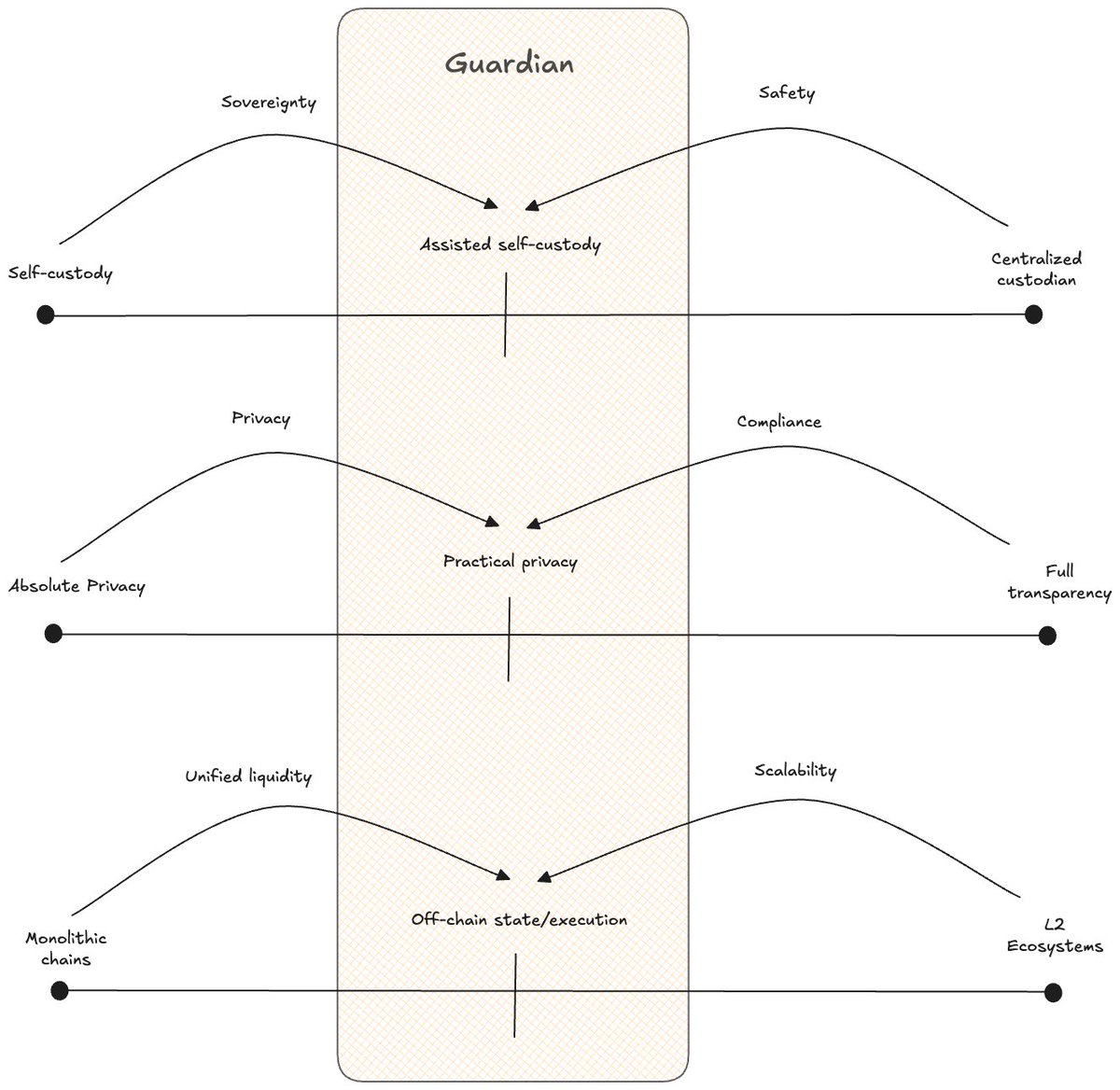
@bobbinth @0xMiden What does guardian see in the best case (encrypted blobs + key rotation) vs worst case (MPC co-signing)? Also anywhere to read more about it ?
English
1
0
1
119
Bobbin's Threadbare
Bobbin's Threadbare@bobbinth·
Why I really like Miden's Guardian approach: it simultaneously strikes the right balance on multiple dimensions
Bobbin's Threadbare tweet media
English
12
9
59
5.6K
Abix
Abix@0xAbix·
@muskan_kalra24 What models ? Coz recently i’ve been working with codex and the amount of details it gives is insane!
English
0
0
0
35
Muskan Kalra
Muskan Kalra@muskan_kalra24·
Been switching between Claude and ChatGPT for the same task this week and noticed a pattern. Claude: asks me what I'm actually trying to do before answering. ChatGPT: tells me my idea is great and starts executing. Feels like Claude treats me like a colleague. ChatGPT treats me like a customer
English
1
0
5
353
donnoh.eth 💗
donnoh.eth 💗@donnoh_eth·
@0xMarcB @bobbinth not really without tradeoffs, all agglayer contracts including the shared escrow are instantly upgradable by a third party
English
2
0
10
374
Marc | Polygon Labs (💜,⚔️, ※)
Any chain architecture can plug into Agglayer. Any private chain can access unified liquidity. Miden just proved both. You can have private infra with full access to the ecosystem's liquidity, without tradeoffs. That's what the Open Money Stack makes possible via Agglayer.
Polygon | POL@0xPolygon

Agglayer is officially chain-agnostic. Two milestones in one: Agglayer has connected the first non-EVM chain via @0xMiden. Miden can access unified liquidity without giving up privacy. Your private chain no longer has to be an island.

English
17
18
133
7.6K
Gaylord
Gaylord@zkGaylord·
@0xAbix You’re asking too much I’m not that organized
English
1
0
1
54
Gaylord
Gaylord@zkGaylord·
Italian dish #9 & #10 (final): Rigatoni pomodoro & Trippa alla romana
Gaylord tweet mediaGaylord tweet media
Italiano
8
0
29
682
Abix retweetledi
Doxa Labs
Doxa Labs@doxalabs_xyz·
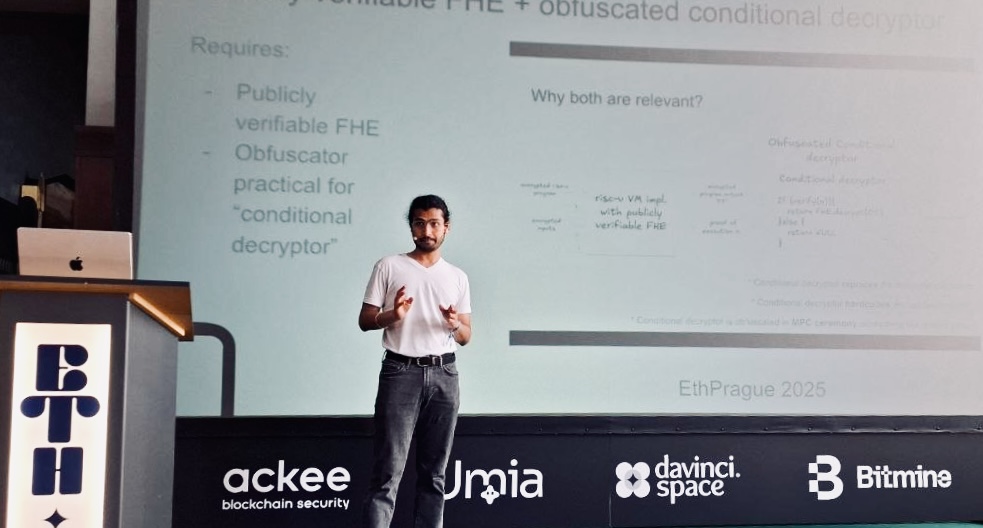
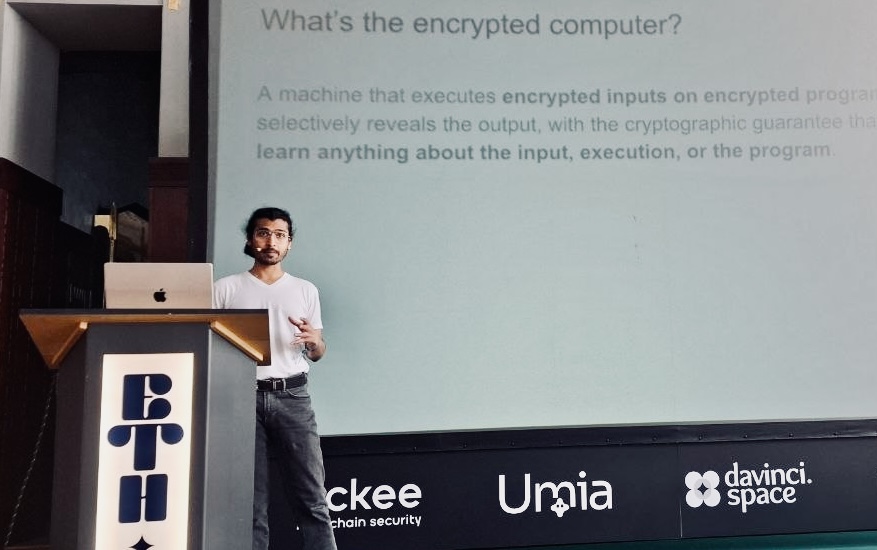
Excited to see Doxa represented at @EthPrague. Doxa’s technical lead, @Janmajaya_mall , presented on approaches to obfuscation, a cryptographic primitive aimed at unlocking a new era for privacy applications such as encrypted smart contracts on public blockchains. Huge thanks to the researchers, builders, and organizers at @EthPrague for creating spaces where these conversations can happen.
Doxa Labs tweet mediaDoxa Labs tweet media
English
0
1
7
527
Abix
Abix@0xAbix·
so, for the past few days i’ve been thinking a lot about the state of verifiable ai, especially around agentic payments and autonomous systems operating on behalf of users. the more i think about it, the more it feels obvious that agents are eventually going to become economic actors on the internet. not just reasoning systems, but systems capable of authentication, delegation, payments, subscriptions, state transitions, and long running execution flows. but the interesting question is how do you actually verify what an agent did or what it didn't and no actions were made out of the scope of instructions? if an agent pays for an api, accesses gated content, executes a transaction, or interacts with a payment rail on your behalf, what is the proof that: > the payment was actually authorised within a valid permission scope > the destination was legitimate and not a wrapped or spoofed endpoint > the agent followed the exact constraints it was given > the transaction originated from the correct state, channel, or session > the execution flow itself was not tampered with i’ve been thinking about systems where entire payment and authentication streams can eventually become provable execution flows, where an agent’s actions are not just logged, but reconstructable and auditable. especially in a future where agents are given spending permissions, corporate budgets, delegated authority, or autonomous access to economic infrastructure, i think verifiability becomes a core primitive rather than an optional feature. still very early thoughts ik, but honestly this feels like one of the most exciting areas to build in right now to me. there’s something insanely motivating about building in a space where the primitives themselves are still being defined in real time and you see teams like @stripe and @Visa leading this and that's insane.
English
0
0
3
193
ETHPrague
ETHPrague@EthPrague·
When you're building with zero-knowledge proofs and need high-performance, low-latency proof generation at scale, you need @ziskvm ⚙️ We're excited to have ZisK as our community partner! An open-source zkVM toolstack built for performance, low latency, and 128-bit provable security, letting anyone prove the execution of high-level programs at scale. Their work is centered around pushing throughput, efficiency, and reliability for modern decentralized networks. That basically means, they’re helping the ecosystem scale where it matters most 🤝 See you at ETHPrague! ☀️
ETHPrague tweet media
English
1
5
35
1.6K
Abix
Abix@0xAbix·
@0xM0RA @ziskvm Thank you do give it a try, we'd love to hear your thoughts.
English
0
0
1
28
Abix
Abix@0xAbix·
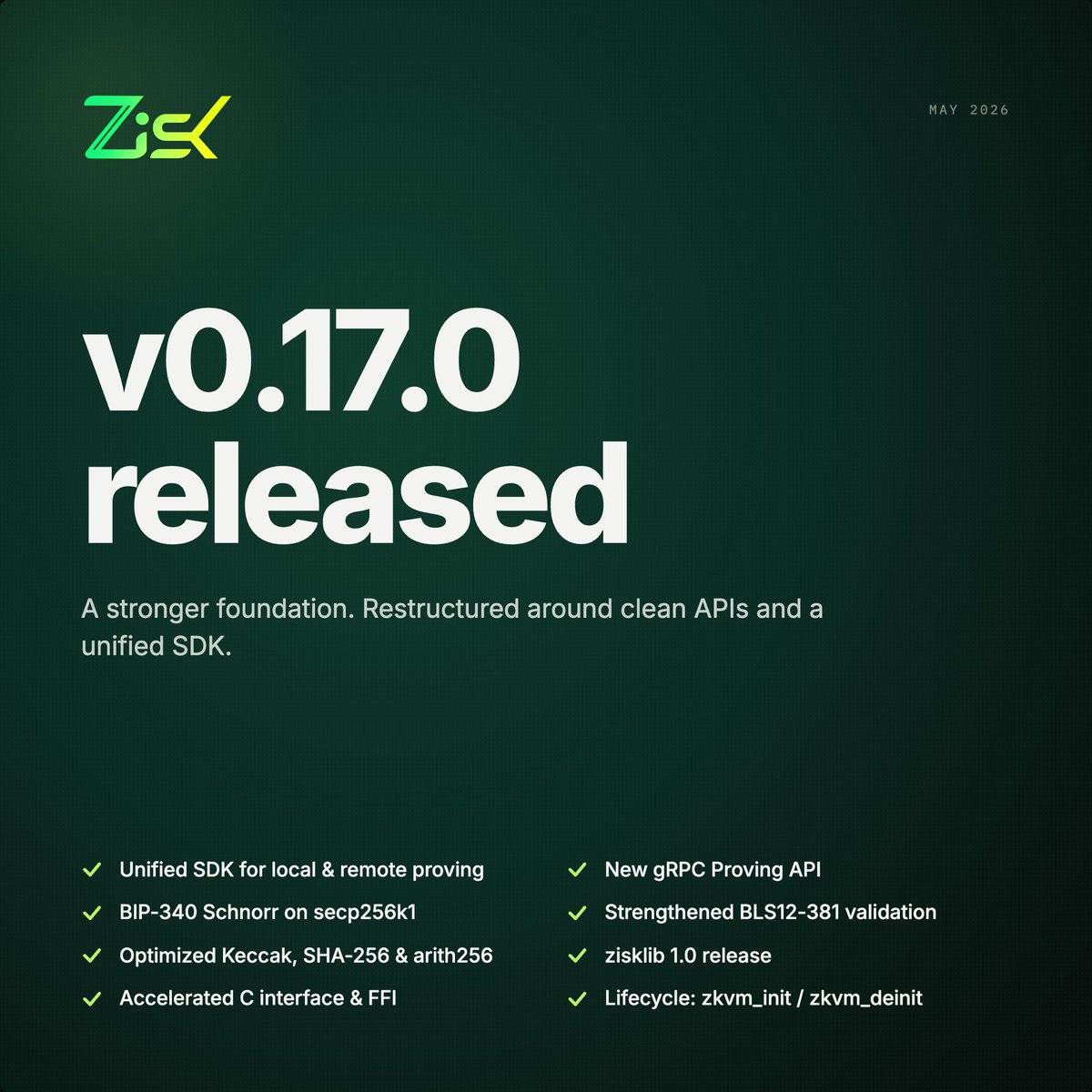
ZisK v0.17.0 just dropped This release is a big one for me. We completely restructured the system around clean APIs and one unified SDK, Local proving, remote proving. The highlights: > Unified zisk-sdk is now the single entry point for everything (local + remote) > zisklib 1.0 is officially out expanded primitives and much better FFI > New gRPC proving API for remote clients and distributed setups > Full accelerator integration with proper lifecycle Good performance wins on Keccak, arith256 and memory > Added BIP-340 Schnorr + stronger BLS12-381 Overall this makes ZisK way more usable and ready integration.
Abix tweet media
ziskvm@ziskvm

ZisK v0.17.0 is now released. This release restructures the entire system around clean, well-defined APIs and a unified SDK making local and remote proving seamless and consistent. Thread with details below: github.com/0xPolygonHerme…

English
1
2
6
883
David Wong
David Wong@cryptodavidw·
OK I do think I have the best explanation on groth16 you've ever seen, so far, dropping tomorrow o.o
English
9
0
100
8.1K