

Pepelle
36 posts



@a1lon9 @slingoorio @AOC AI isn’t waiting. Job security isn’t guaranteed.
Finding a hedge isn’t crazy anymore. $Jobcoin is for the unemployed.
Jobcoin.app
English



Sahil Kapur@sahilkapur
.@AOC responds to this trend: "BOOOOO" "This race to try to see who can be exempt from participating in society is not a conversation that I'm interested in," she tells me. "I'm a Great Society Democrat, and I believe in building that together. And I think that the discourse around 'Everyone, let's all be like billionaires and opt out of our taxes,' I don't find it an inspiring message."
ZXX
@Kalshi There's a new hero in town
x.com/i/status/20493…
Jobcoin@JobCoinSOL
A storm is brewing ⚡️ $JOBCOIN
English


@funcry Sounds exactly like how $jobcoin by @JobCoinSOL is being built.
Real team, LLC, structure, and supply control. Not to mention, real tech developments. Clock in system (token locks for points) real wearable gear on the way, and a job board.
Jobcoin.app
English

there won’t be a single meme on SOL rn that can go from 0 to 50M just because it’s funny or the community is strong
it doesn’t really work like that
if you give all the supply to random holders, it usually breaks on the first real sell pressure. early buyers take profits, there’s no bid to catch it, liquidity is thin, and the chart falls apart
the only way to actually push it to 50M–100M is different.
- 75–80% of the supply is controlled by the team without selling.
- at least 10% of holders are diamond hands
- liquidity is seeded properly
- the first 24–72h dumps are absorbed
- real money is put in from day one
- market making keeps the chart tradable
- volume is maintained long enough to stay visible
I’m not even mentioning community building, X positioning, creative and engaging posts, and marketing. this is a must.
that’s why some charts hold, rebuild, and keep going while others just spike and nuke
from the outside it looks organic
but behind it there is structure, capital, and execution.
English
@_Shadow36 A movement is building under the radar of most people.
We are coming.
x.com/i/status/20493…
Jobcoin@JobCoinSOL
A storm is brewing ⚡️ $JOBCOIN
English

@Skrilloneon We forget pretty easily how much we all need purpose, something that gives us direction and keeps us moving forward.
Funny enough, we often find it in the last places we ever expected.
Really glad you found that sense of purpose where you never thought you would.
English

How AI Changed My Life (and Not in a “Productivity Hacks” Way)
Everyone seems to have an opinion on how AI is going to change the world. Some people talk about it like it’s the second coming. Others talk about it like it’s a meteor. Instead of joining the long line of economists, politicians, and very confident LinkedIn philosophers, I just want to tell you what happened to me.
Quick context: I’m an accountant. Yes, I know—try to contain your excitement. But I genuinely love what I do. Accountants help keep the financial system honest by giving reasonable assurance over the numbers companies report around the world. I love data because it helps me make sense of things and spot patterns between topics that don’t seem related at all. That curiosity can get a little obsessive (my wife and friends would definitely confirm, under oath). For the past two years, that obsession has been focused on AI and what it might mean for my work—and for everyone else’s. Here’s my slice of the story.
At the time, I was a partner at a global accounting firm and felt pretty secure—maybe even a little too secure. I loved the work. Then, in March of 2025, our Chief Operating Officer called an impromptu, mandatory “Partners Only” Teams meeting. You know the kind: calendar invite with zero context, which is basically corporate Morse code for “brace yourself.” On the call, leadership announced the firm was making a \$1B investment in artificial intelligence—and cutting headcount by 20%.
The message was pretty straightforward: AI was letting us do a lot more work in a lot less time, and competitors were doing the same thing. As tough as it was for employees, it also felt like the direction the world was headed. The logic was: invest and adapt, or fall behind—and if you’re a global firm, “fall behind” is just a nicer way of saying “become a case study.”
And here’s the part where I admit something that sounds like betrayal: I even supported the decision—at least intellectually. Earlier that month I’d piloted an AI module that analyzed a complex business combination and drafted a memo in about five minutes. Five minutes. The version sitting in the audit files had taken 250 hours of specialist time and cost the client \$40,000. I’m not saying the robot did it with flair, but it definitely did it with unsettling efficiency. In that moment, I could see the future, and I understood why leadership thought the change was necessary.
What I didn’t expect was that partners were included in that 20% reduction too. On June 30, 2025, I was laid off along with 10 other partners. I had a new baby on the way, and finances were tight after eight years of paying for infertility treatments. Losing the job I’d worked my whole life to earn was gut-wrenching. And what made it worse was how random it felt—like the universe had put my name in a spreadsheet, sorted it, and then hit delete. The same day I was let go, I’d just brought in a large client for the firm. The uncertainty—and the unfairness of it—felt like a never-ending identity quake.
The hard truth is there isn’t always a clean formula behind these decisions (which, for an accountant, is a personal offense). My data-driven brain kept searching for an explanation, but there wasn’t one to find. And the people who weren’t laid off had their own kind of stress: wondering if they’d be next. Living with that kind of uncertainty wears on you—quietly at first, and then all at once.
I also think a lot of firms will approach layoffs the same way. AI is a big new cost, and the ROI is easiest to measure by looking at roles and tasks that software can take over. If you can point to a workflow and say, “the model does 60% of this now,” the next sentence (sometimes spoken, sometimes not) is “so we need fewer humans.” That’s the reality I think a lot of people are going to run into.
While I was trying to make sense of everything and find a new job, I ended up finding some surprising purpose in an unconventional place… a memecoin project called Jobcoin. Yes, I hear it too. That sentence should not make sense. And yet, here we are.
Backing up a bit: in April 2025, a close family member called and talked me into buying a satirical memecoin. This was before losing my job to AI became a reality in June 2025. I’d never bought crypto, and honestly I didn’t want anything to do with it. In my head, accountants and crypto were like oil and water—except oil and water at least agree on what they are. But I opened the door and stepped in anyway, without really knowing what to expect.
What I found was something I didn’t know I needed: purpose. I’d never really explored blockchain or the wider crypto world, so I was surprised by how innovative and transformative it all felt. I got pulled into learning the details of a new space that, weirdly enough, had real parallels to my experience in banking and finance—just with more memes and fewer dress shoes. I also leaned on AI to help me ramp up faster and make sense of what was, at first, a totally foreign world. The experience—and everything I learned between losing my job and starting my next one—changed how I think about my career. The connections I’ve made and the relationships I’ve built along the way have become invaluable. And I wanted to share that journey with others who will likely be impacted too.
Looking back, I really wish there were more places where people could find that same kind of purpose and hope—especially when life does the thing where it pulls the rug out and then asks if you’ve “considered reskilling.” I’m trying to help build something like that, but it’s an uphill battle. I think we need to be honest that AI can be both the cause and the cure of unemployment—and then create platforms that lean into that paradox to help people rebuild and find meaning.
#AI #LLM #ArtificialIntelligence #MachineLearning #ML #BlockchainInfrastructure

English
Great read from a great individual.
Crypto isn’t only about chasing money.
For a lot of people, it can become something bigger a sense of purpose, new opportunities, real connections, and a way to rebuild in uncertain times.
Sometimes it’s not just about gains… it’s about finding meaning in a changing world.
We are more than a meme,
We are $jobcoin!
Thomas Kerr@Skrilloneon
How AI Changed My Life (and Not in a “Productivity Hacks” Way) Everyone seems to have an opinion on how AI is going to change the world. Some people talk about it like it’s the second coming. Others talk about it like it’s a meteor. Instead of joining the long line of economists, politicians, and very confident LinkedIn philosophers, I just want to tell you what happened to me. Quick context: I’m an accountant. Yes, I know—try to contain your excitement. But I genuinely love what I do. Accountants help keep the financial system honest by giving reasonable assurance over the numbers companies report around the world. I love data because it helps me make sense of things and spot patterns between topics that don’t seem related at all. That curiosity can get a little obsessive (my wife and friends would definitely confirm, under oath). For the past two years, that obsession has been focused on AI and what it might mean for my work—and for everyone else’s. Here’s my slice of the story. At the time, I was a partner at a global accounting firm and felt pretty secure—maybe even a little too secure. I loved the work. Then, in March of 2025, our Chief Operating Officer called an impromptu, mandatory “Partners Only” Teams meeting. You know the kind: calendar invite with zero context, which is basically corporate Morse code for “brace yourself.” On the call, leadership announced the firm was making a \$1B investment in artificial intelligence—and cutting headcount by 20%. The message was pretty straightforward: AI was letting us do a lot more work in a lot less time, and competitors were doing the same thing. As tough as it was for employees, it also felt like the direction the world was headed. The logic was: invest and adapt, or fall behind—and if you’re a global firm, “fall behind” is just a nicer way of saying “become a case study.” And here’s the part where I admit something that sounds like betrayal: I even supported the decision—at least intellectually. Earlier that month I’d piloted an AI module that analyzed a complex business combination and drafted a memo in about five minutes. Five minutes. The version sitting in the audit files had taken 250 hours of specialist time and cost the client \$40,000. I’m not saying the robot did it with flair, but it definitely did it with unsettling efficiency. In that moment, I could see the future, and I understood why leadership thought the change was necessary. What I didn’t expect was that partners were included in that 20% reduction too. On June 30, 2025, I was laid off along with 10 other partners. I had a new baby on the way, and finances were tight after eight years of paying for infertility treatments. Losing the job I’d worked my whole life to earn was gut-wrenching. And what made it worse was how random it felt—like the universe had put my name in a spreadsheet, sorted it, and then hit delete. The same day I was let go, I’d just brought in a large client for the firm. The uncertainty—and the unfairness of it—felt like a never-ending identity quake. The hard truth is there isn’t always a clean formula behind these decisions (which, for an accountant, is a personal offense). My data-driven brain kept searching for an explanation, but there wasn’t one to find. And the people who weren’t laid off had their own kind of stress: wondering if they’d be next. Living with that kind of uncertainty wears on you—quietly at first, and then all at once. I also think a lot of firms will approach layoffs the same way. AI is a big new cost, and the ROI is easiest to measure by looking at roles and tasks that software can take over. If you can point to a workflow and say, “the model does 60% of this now,” the next sentence (sometimes spoken, sometimes not) is “so we need fewer humans.” That’s the reality I think a lot of people are going to run into. While I was trying to make sense of everything and find a new job, I ended up finding some surprising purpose in an unconventional place… a memecoin project called Jobcoin. Yes, I hear it too. That sentence should not make sense. And yet, here we are. Backing up a bit: in April 2025, a close family member called and talked me into buying a satirical memecoin. This was before losing my job to AI became a reality in June 2025. I’d never bought crypto, and honestly I didn’t want anything to do with it. In my head, accountants and crypto were like oil and water—except oil and water at least agree on what they are. But I opened the door and stepped in anyway, without really knowing what to expect. What I found was something I didn’t know I needed: purpose. I’d never really explored blockchain or the wider crypto world, so I was surprised by how innovative and transformative it all felt. I got pulled into learning the details of a new space that, weirdly enough, had real parallels to my experience in banking and finance—just with more memes and fewer dress shoes. I also leaned on AI to help me ramp up faster and make sense of what was, at first, a totally foreign world. The experience—and everything I learned between losing my job and starting my next one—changed how I think about my career. The connections I’ve made and the relationships I’ve built along the way have become invaluable. And I wanted to share that journey with others who will likely be impacted too. Looking back, I really wish there were more places where people could find that same kind of purpose and hope—especially when life does the thing where it pulls the rug out and then asks if you’ve “considered reskilling.” I’m trying to help build something like that, but it’s an uphill battle. I think we need to be honest that AI can be both the cause and the cure of unemployment—and then create platforms that lean into that paradox to help people rebuild and find meaning. #AI #LLM #ArtificialIntelligence #MachineLearning #ML #BlockchainInfrastructure
English
Pepelle retweetledi








@Traderfinn0 I'll give the 200x
Jobcoin
Zero fucks if you believe me or not
You'll see
English

@cookerweb3247 @Rvii540710 @JakeGagain @JobCoinSOL Choose your meme properly, few will survive.
Jobcoin.app
English


@_logjam $jobcoin is getting ready for the future of sol memes.
Be ready!
More than a meme!
Jobcoin.app
English

@PumpfunEco You might want to look at $Jobcoin top holders
been sitting on life changing money for a while now…
that kind of conviction doesn’t come for no reason 👀
English

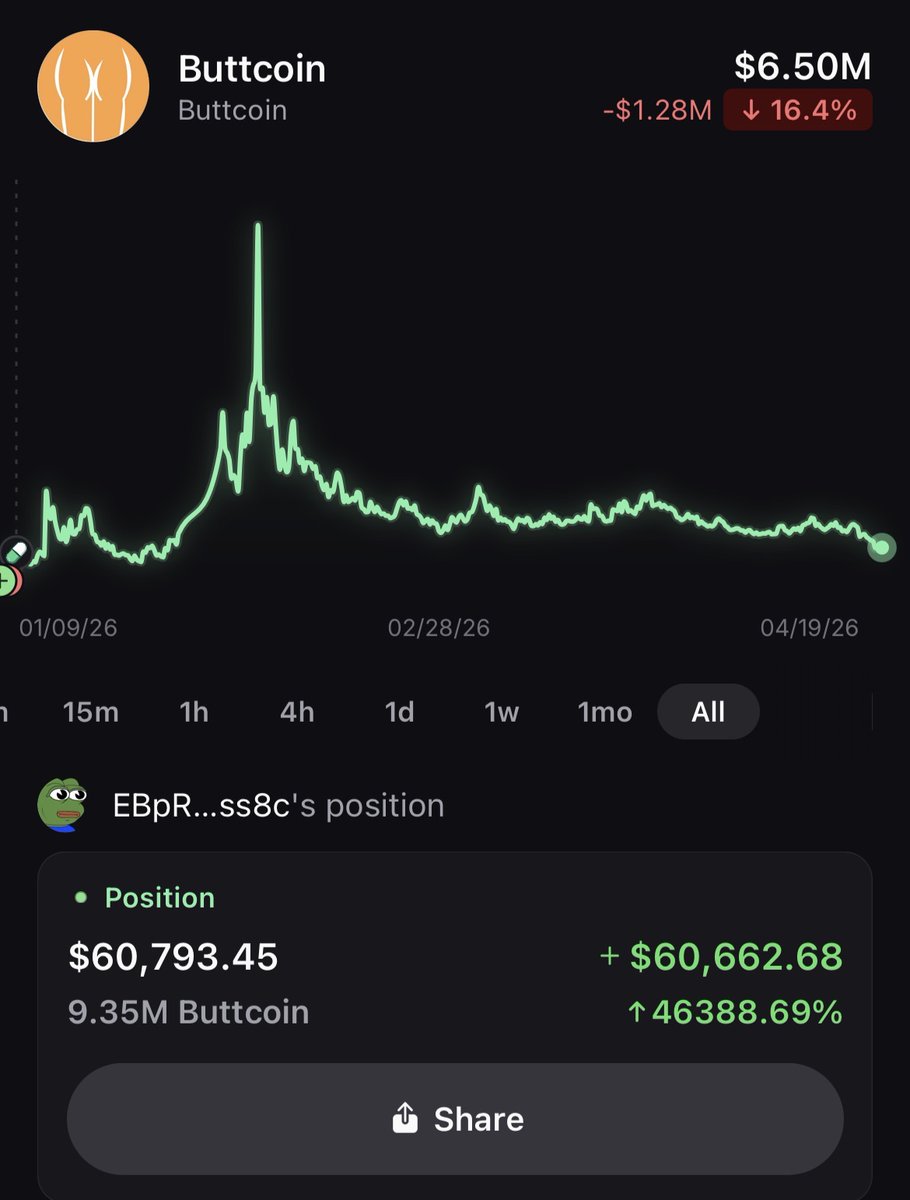
The top holder of $Buttcoin is sitting on a $60,000 position! 🔥

English
