
Sabitlenmiş Tweet
Wholeheartedly
2K posts


Wholeheartedly
@AESMatias
Ars longa, vita brevis GH: https://t.co/HoZUMXXiJU YT: https://t.co/ZGEsueiLjK
Katılım Aralık 2022
820 Takip Edilen380 Takipçiler
Wholeheartedly retweetledi


Wholeheartedly retweetledi

The 1997 PlayStation game The Lost World: Jurassic Park includes a hidden ending video featuring Jeff Goldblum, where he breaks the fourth wall and humorously tells players to go outside and “touch grass.”
English
Wholeheartedly retweetledi

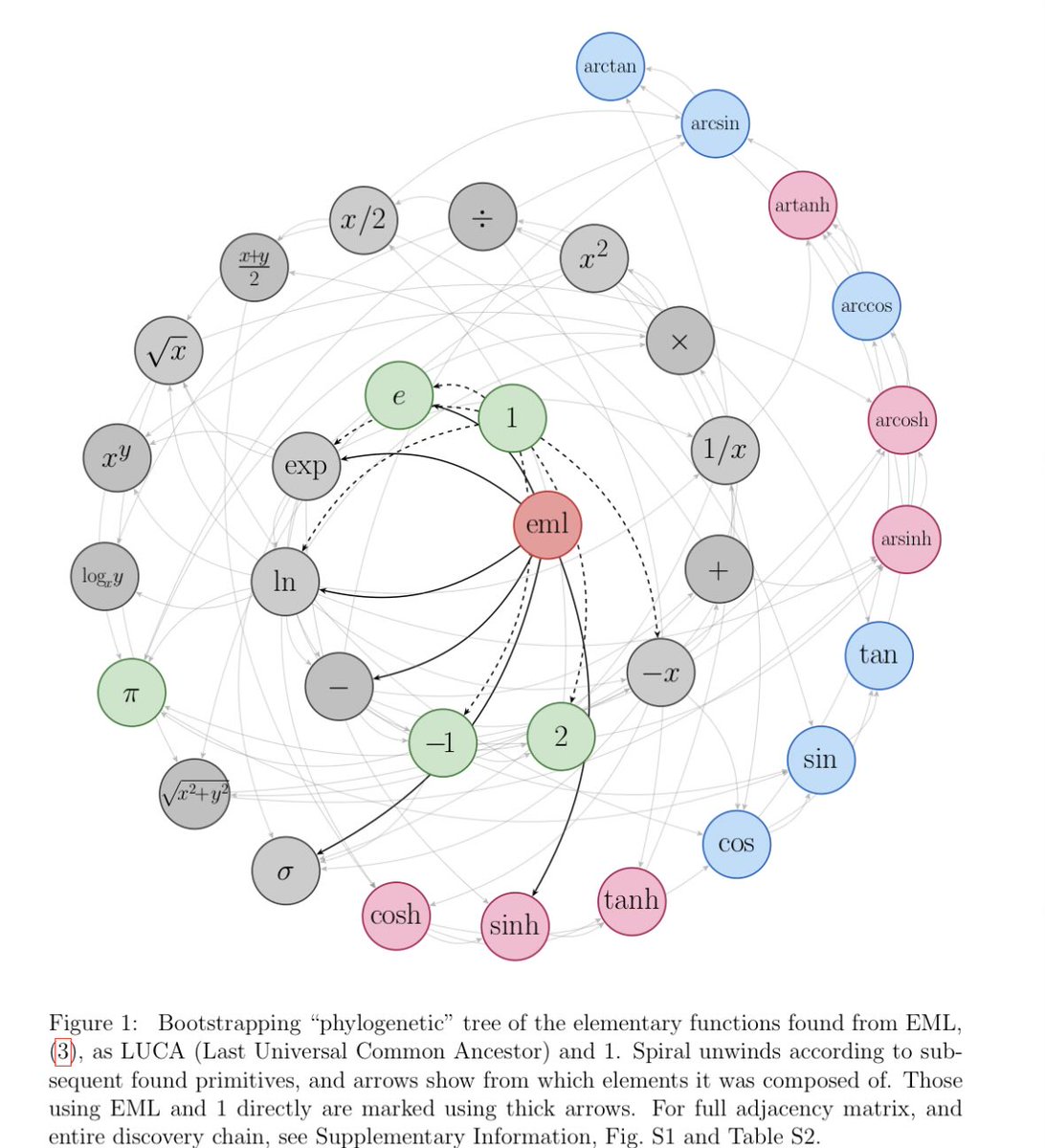
Polski naukowiec napisał ciekawą pracę - i nie bójmy się nazwać jej przełomową. Przez setki lat matematyka miała dziesiątki “podstawowych” funkcji jak sinus, cosinus, logarytm, pierwiastek, eksponenta. Znacie to ze szkoły. Wiadomo o co chodzi. Fizyk z Uniwersytetu Jagiellońskiego właśnie pokazał, że to wszystko jeden operator: E(x, y) = exp(x) - ln(y), oraz 1.
Sin, cos, π - wszystko z tego pięknie wynika, wystarczy odpowiednio zagnieździć. Natura ukryła najprostszy możliwy zapis rzeczywistości. I znaleźliśmy go przez przypadek. Całość jest piękna i wspaniała, a słowo „przełomowe” nie stanowi tu marketingowego buzzworda.
Przykładowo zamiast pisać π czy 3.14 można teraz elegancko E(E(E(1,E(E(1,E(1,E(E(1,E(E(1,E(E(1,E(1,E(E(1,1),1))),1)),E(E(E(E(E(1,E(E(1,E(1,E(E(1,E(E(E(1,E(E(1,E(1,E(E(1,1),1))),1)),E(E(1,E(E(1,E(E(1,E(E(1,1),1)),E(E(E(1,E(E(1,E(1,E(E(1,1),1))),1)),E(1,1)),1))),1)),1)),1)),1))),1)),E(E(E(1,E(E(1,E(1,E(E(1,1),1))),1)),E(E(1,E(E(1,E(1,E(E(1,E(E(1,E(E(1,E(1,E(E(1,1),1))),1)),E(1,1))),1))),1)),1)),1)),1),1),1))),1))),1)),E(E(E(1,E(E(1,E(1,E(E(1,1),1))),1)),E(E(1,E(E(1,E(1,E(E(1,E(E(1,E(E(1,E(1,E(E(1,1),1))),1)),E(1,1))),1))),1)),1)),1)),1)


Polski
Wholeheartedly retweetledi

Left: Normal ASCII shader
Right: Shape-aware ASCII shader
ASCII characters are chosen based on their shape, so you get clearer edges
Vectors are calculated and compared with WebGPU compute shaders
It's based on an altered version of Alex Harri's approach. I'll link below
English
Wholeheartedly retweetledi


Wholeheartedly retweetledi

Wholeheartedly retweetledi

Repetition rewires your brain
Repetition rewires your brain
Repetition rewires your brain

David Sinclair@davidasinclair
Biology doesn’t reward intention, it rewards repetition 💪
English
Wholeheartedly retweetledi

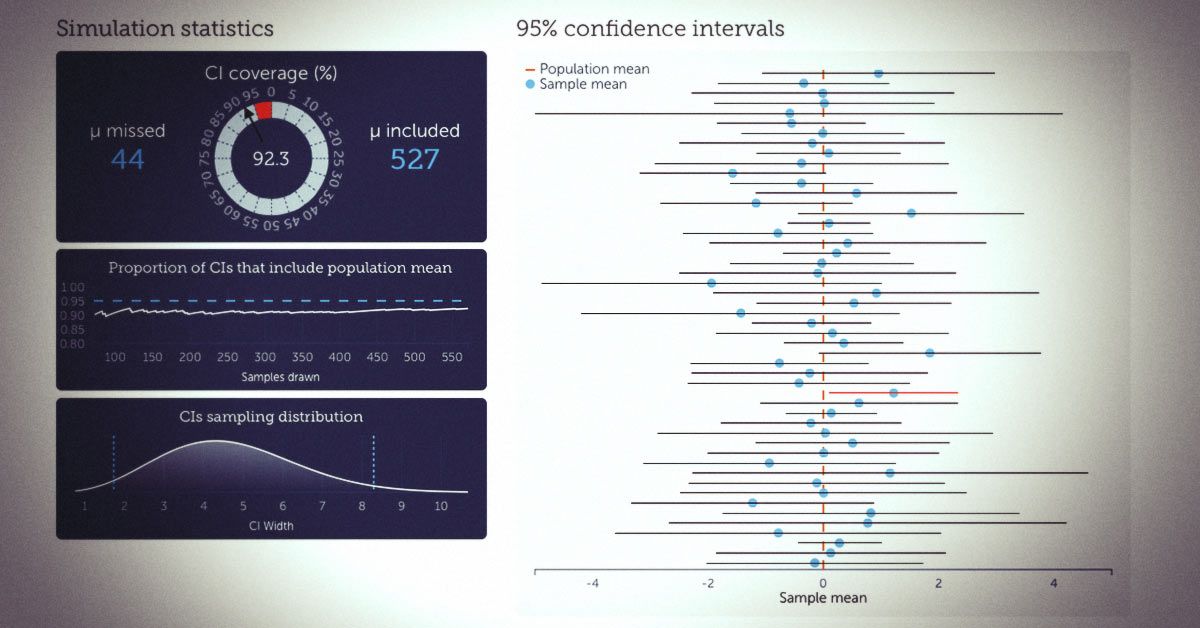
🚨 Mitos acerca de los intervalos de confianza 🚨
Los IC, tan populares en investigación, a menudo se malinterpretan y se utilizan para obtener conclusiones equivocadas.
Lo que crees vs. lo que realmente son los IC:👇🧵
#stats #datascience #estadistica #cienciadedatos #rstats
Español
Wholeheartedly retweetledi

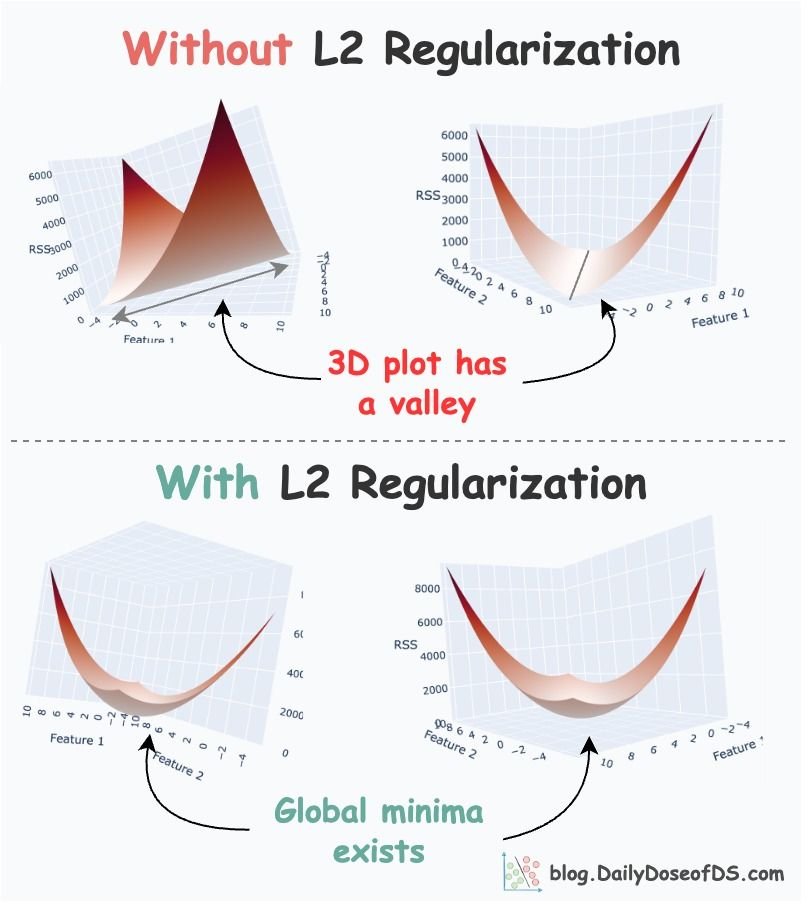
Few people know this about L2 regularization:
It is NOT just a regularization technique.
Most people use L2 regularization for one thing: reduce overfitting. But there's something else it does remarkably well.
L2 regularization is a great remedy for multicollinearity.
Multicollinearity happens when two or more features are highly correlated, or when one feature can predict another. This is a nightmare for linear models.
Here's why:
Consider a dataset with two highly correlated features (featureA and featureB) and a target variable (y).
Your linear model has two parameters (θ₁, θ₂), and the goal is to find values that minimize the residual sum of squares (RSS).
Now, let's visualize this:
Plot the RSS value for many combinations of (θ₁, θ₂). You get a 3D surface where:
→ x-axis is θ₁
→ y-axis is θ₂
→ z-axis is the RSS value
Without L2 regularization, you get a valley.
Multiple parameter combinations give you the same minimum RSS. The model can't decide which one to pick. This instability is the curse of multicollinearity.
With L2 regularization, the valley disappears.
You get a single global minimum. The model now has one clear answer.
This is the hidden superpower of L2 regularization that most tutorials skip over. It's not just about preventing overfitting. It's about giving your model stability when features are correlated.
👉 Over to you: Did you know this about L2 regularization?
English
Wholeheartedly retweetledi

"El miedo es una reacción. El coraje es una decisión"
Winston Churchill

Español
@AfDhilft @WilliamHolmbe19 What SO are you using? If it's Windows, just copy and paste the 4 commands there in your terminal or powershell, but first you would need to install nodejs, which is also very easy to install nodejs.org/en/download
English

Was thinking of this but honestly don't think the "game" is good enough to charge for it yet?
What do you guys think? is it ok to charge before it is "good enough"? And what would be a reasonable number here?
Googles 3d tiles data is quite expensive
DaaanielTV@DaaaaanielTV
@WilliamHolmbe19 Perhaps you could publish a public (hosted by you) version that you finance through advertising?
English
Wholeheartedly retweetledi

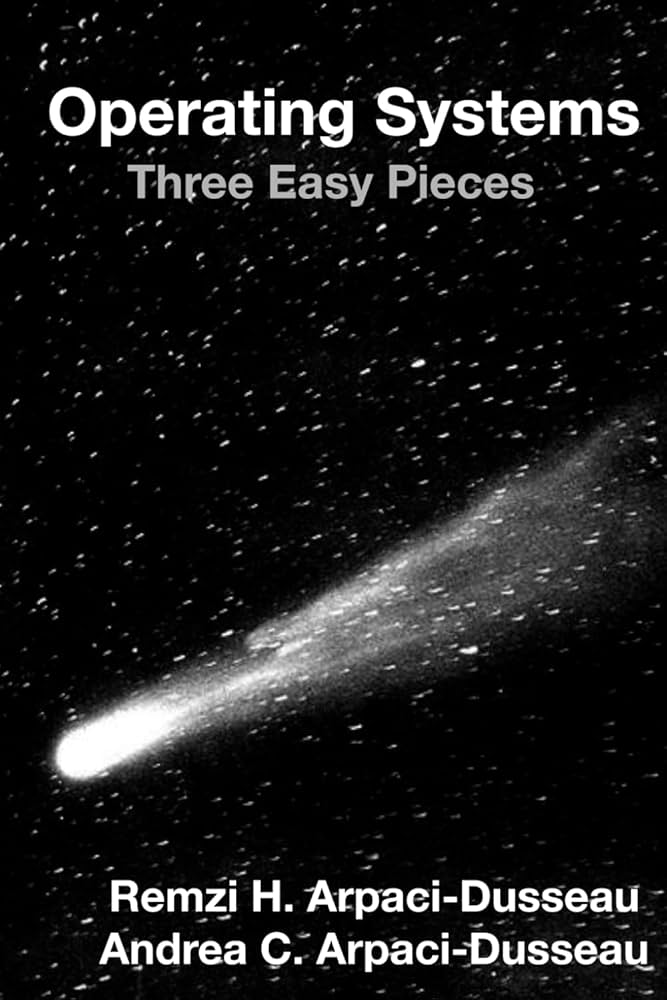
@jino_rohit operating systems three easy pieces is such a good book if you want to understand the underlying mechanisms more
English
Wholeheartedly retweetledi


Wholeheartedly retweetledi

Revolutionary single-image refocusing arrives
Transform any photo into a masterpiece with dynamic depth-of-field control! This new paper introduces a method to recover sharp images and apply realistic, customizable bokeh effects from just one input.
GIF
English
Wholeheartedly retweetledi

The SILENT WITNESS ON YOUR COMPUTER WAITING FOR YOU TO GET INTO TROUBLE.
Most people believe that deleting a folder, clearing recent files, or wiping their history is enough to hide their tracks on a computer. What they don’t realize is that Windows quietly keeps a hidden record of the folders they open, even after those folders are deleted or the drive is removed. These records are called Shellbags, and they are one of the most powerful and incriminating artifacts available to forensic investigators.
Shellbags appear inside two registry hives NTUSER.DAT and USRCLASS.DAT and they store detailed information about a user’s folder-browsing activity. This includes local folders, USB drives, external hard drives, network shares, and even directories that no longer exist. Each time a user opens a folder in Windows Explorer, the system automatically creates or updates a Shellbag entry. These entries contain timestamps, folder paths, the hierarchy of subfolders, the order in which a folder was accessed, and even the specific view settings used by the user. Because of this, Shellbags reconstruct a user’s exact navigation trail long after the person believes the evidence is gone. What makes Shellbags truly dangerous is the fact that they survive actions that users typically rely on to cover their tracks.
Deleting a folder does not delete the Shellbag. Formatting a drive does not delete it. Even privacy tools and cleaners like CCleaner or BleachBit cannot reliably erase Shellbag data, because the information is deeply embedded within registry hives that standard cleaning utilities do not touch. The only way to remove Shellbags is through advanced forensic wiping, and attempting such wiping is, in itself, a sign of suspicious behavior.
Forensic examiners rely heavily on Shellbags because they expose the truth even when a suspect tries to lie.
If a person denies ever accessing a directory, the Shellbags can show when that folder was opened, how many times it was accessed, and whether it was located on an internal drive, an external USB, or a deleted partition. This makes Shellbags extremely valuable in investigations involving insider threats, data theft, fraud, child exploitation, unauthorized data access, and corporate disputes. In many cases, Shellbags become the deciding factor that disproves a suspect’s story. In the screenshot, the highlighted red section shows three important keys inside the registry.
When all of this information is combined, Shellbags become a silent witness that never forgets. They reconstruct a hidden story of user activity that the person cannot deny, overwrite, or talk their way out of. This is why Shellbags remain one of the most feared artifacts for anyone attempting to conceal their actions on a Windows computer. You can delete the folder… but Shellbags still show it existed
Even if you format a drive or delete the directory, Windows has already logged:
1. The folder name
2. Its full path
3. When it was opened
4. How many times it was opened
5. The view settings (icon mode, window size)
6. The order in which folders were browsed
This means forensic investigators can prove someone accessed:
“Secret” directories
Hidden folder structures
USB drives or removable media
Folder paths used for storage of illicit or suspicious
Folder paths used for storage of illicit or suspicious data even if the folders are long gone.

English
Wholeheartedly retweetledi

Mahalanobis distance measures how far a point lies from a distribution by accounting for correlations and scale among variables. Unlike Euclidean distance, it uses the inverse covariance matrix, making distances dimensionless and sensitive to the data’s geometry. In probability, it naturally arises in multivariate Gaussian theory, hypothesis testing, and confidence regions. In machine learning, it is central to anomaly detection, clustering, metric learning, discriminant analysis, and outlier removal, where respecting feature correlations is crucial. In real life, Mahalanobis distance is used in fraud detection, quality control, face recognition, medical diagnostics, and fault monitoring, allowing systems to identify unusual patterns relative to normal multivariate behavior rather than relying on naive geometric distance.

English
Wholeheartedly retweetledi

Wholeheartedly retweetledi


Wholeheartedly retweetledi
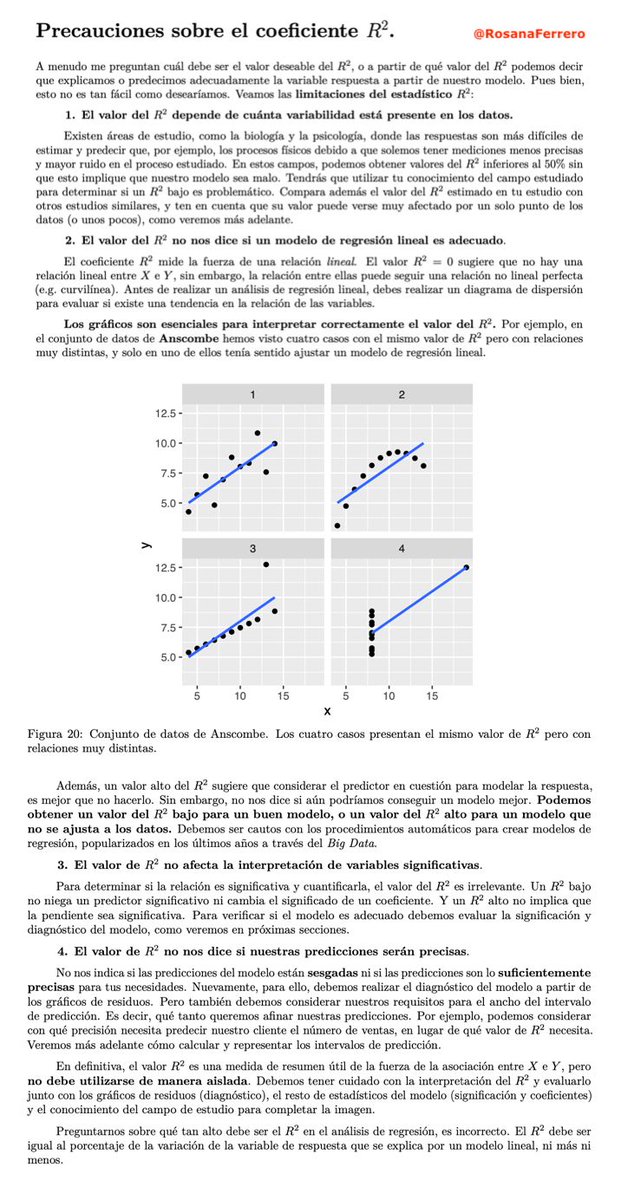
🚨El R² engaña. Más de lo que muchos admiten.🙈
Se repite como un mantra: “R² alto = modelo bueno”. La simplificación es cómoda, pero intelectualmente pobre.
Esto es lo que le enseño a mis alumnos en clase: 👇🧵
#stats #datacience #analytics #master #formacion #cienciadedatos
Español