Ángel Marqués-Mateu retweetledi

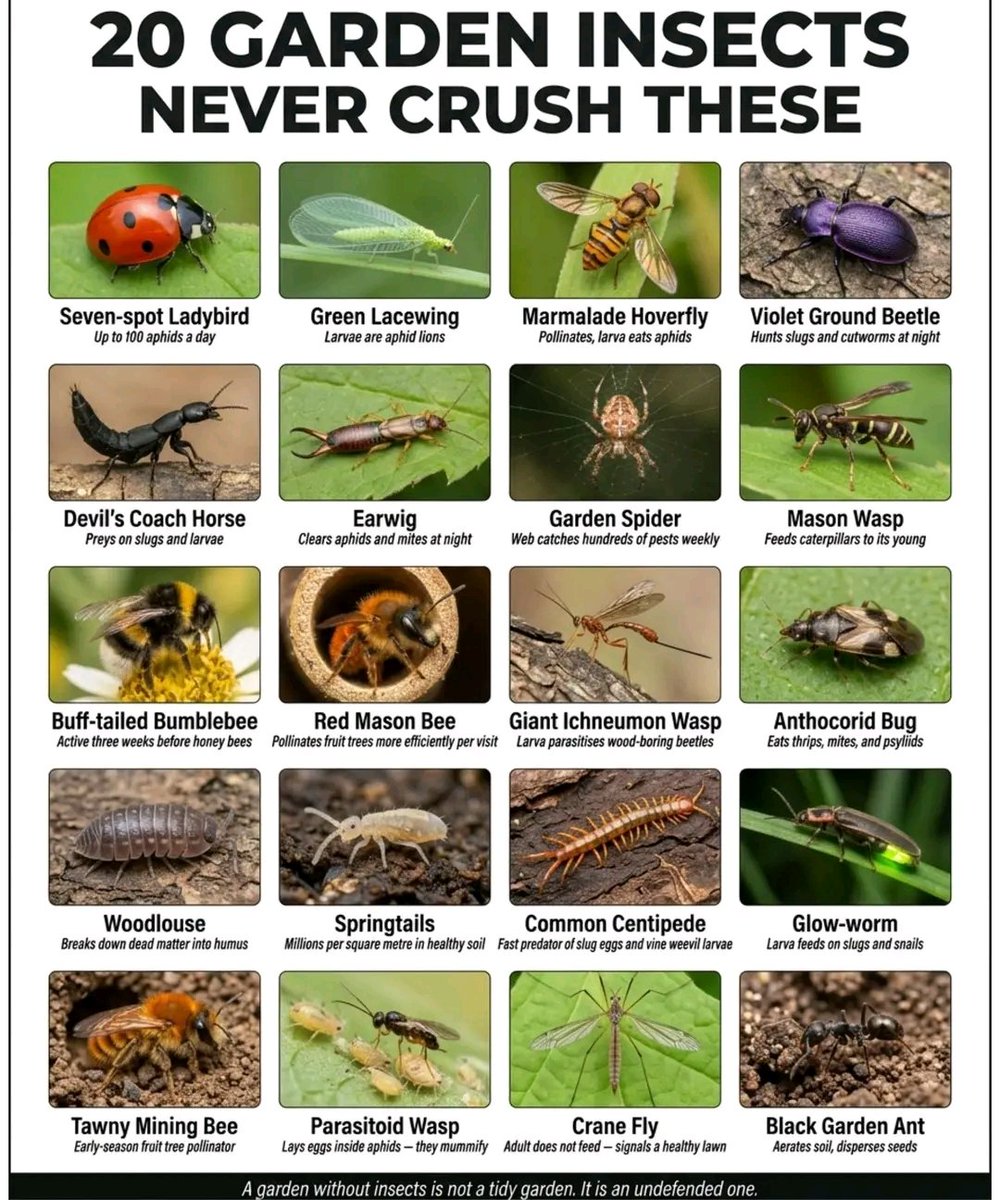
Twenty garden invertebrates that should never be killed. Each one performs a specific function — removing them means dismissing your most effective pest control team.
A garden without insects is not a clean garden. It is a garden without defense, without pollination, and without living soil.
Convergent lady beetle (Hippodamia convergens) — a native North American ladybug, eats up to 50 aphids per day as an adult and more as a larva. The imported seven-spotted ladybug is also now common but may outcompete natives — support the natives where you can.
Green lacewing (Chrysoperla carnea) — adult pollinates, larva is a voracious aphid predator.
Hoverflies (Syrphidae) — adult pollinates, larva consumes aphid colonies from within. Dozens of native species across the US.
Ground beetles (Carabidae) — large, fast-moving, hunt slugs, cutworms, and soil larvae by night. Over 2,000 species in North America.
Rove beetles (Staphylinidae) — preys on slugs, fly larvae, and soil pests in the surface layer.
Garden spider (Araneus diadematus) — web captures hundreds of mosquitoes, gnats, and winged aphids per week. Common across the US.
Mason wasps (Ancistrocerus species) — solitary, preys on caterpillars to provision its nest. Not aggressive.
Native bumblebees (Bombus species) — pollinate crops and flowers earlier in spring than honey bees. Over 40 native species in North America, several now in serious decline.
Mason bees (Osmia species) — solitary, nest in hollow stems. Pollinate fruit trees earlier than honey bees and far more efficiently per individual. The blue orchard bee (Osmia lignaria) is the best-known US native.
Ichneumon wasps (Ichneumonidae) — thousands of species across North America, their larvae parasitize caterpillars and wood-boring beetle larvae. Natural biocontrol for many pests.
Minute pirate bug (Orius insidiosus) — tiny predatory bug that consumes thrips, spider mites, and aphid eggs on fruit trees and vegetables.
Pillbugs and sowbugs (Armadillidium and Porcellio species) — essential decomposers, breaking down dead organic matter into humus.
Springtails (Collembola) — millions per square yard of healthy soil, accelerating decomposition and cycling nutrients.
Centipedes (Lithobius and Scolopendra species) — fast nocturnal predators of slug eggs, grubs, and soil insects in the leaf litter layer.
Fireflies (Photinus and Photuris species) — the larvae feed almost exclusively on snails, slugs, and other soft-bodied invertebrates. Adults that can't signal due to light pollution is a lost season of slug control.
Mining bees (Andrena species) — native solitary bees that nest in lawns. Early-season pollinators of fruit trees and ornamentals.
Parasitoid wasps (Aphidius and Braconidae species) — lay eggs inside aphids and caterpillars, which then mummify and die. Visible as swollen pale gold aphid husks in a colony.
Crane fly (Tipula species) — adult doesn't feed. Its presence means the lawn ecology supports a full invertebrate food chain.
Native ants — aerate the soil through tunnel networks and disperse seeds of many native wildflowers.
Assassin bug (Zelus and Reduvius species) — ambush predators of caterpillars, beetle larvae, and other soft-bodied pests. Handle carefully as some species can bite.
A garden without insects is not a tidy garden. It is an undefended one.
English