Anson Zhou

225 posts

Anson Zhou

Anson Zhou

@AnsonZhou9

Assistant Professor @HKUniversity, PhD in Economics @UWMadison

Hong Kong Katılım Mayıs 2016
711 Takip Edilen348 Takipçiler
Marlon Azinovic-Yang
Marlon Azinovic-Yang@MarlonAzinovic·
Another very intriguing and important macro seminar @UNC_econ today: @AnsonZhou9 @HKUniversity presented "The Fertility, Marriage, and Gender Equality Quandary". Getting two of three is easy, getting all three is hard. But there is hope! Below is Anson with our PhD students.
Marlon Azinovic-Yang tweet media
English
2
1
20
3.9K
Anson Zhou retweetledi
ROCKWOOL Foundation Berlin
🆕 RFBerlin Discussion Paper! @AnsonZhou9 documents countries struggling to have high fertility, low single parenthood, and gender income equality all at once. A unified model shows this tension is structural, and only lowering women’s child-rearing costs eases it 🔗 rfberlin.com/wp-content/upl…
ROCKWOOL Foundation Berlin tweet media
English
0
4
5
699
Anson Zhou retweetledi
Taisu Zhang
Taisu Zhang@ZhangTaisu·
One prediction I’m sure of: within 15 years, most non-liberal societies with declining birthrates that have fallen below 1.5 will shift from carrots (i.e., benefits) to sticks (penalties) to induce more births. China will likely be “in the lead” on this. newyorker.com/magazine/2025/…
English
81
95
939
372.7K
Anson Zhou retweetledi
Harry Haishi Li
Harry Haishi Li@hhaishili·
🚨Sharing this call for papers for the 3rd Annual Macroeconomics Workshop at HKU🚨 When: Apr 29-30, 2026 Submission deadline: Nov 30, 2025 Keynote speakers: the great @YANBAI25157736 and Greg Kaplan (whom I learned a lot from)!
Harry Haishi Li tweet media
English
0
14
48
4.2K
Anson Zhou
Anson Zhou@AnsonZhou9·
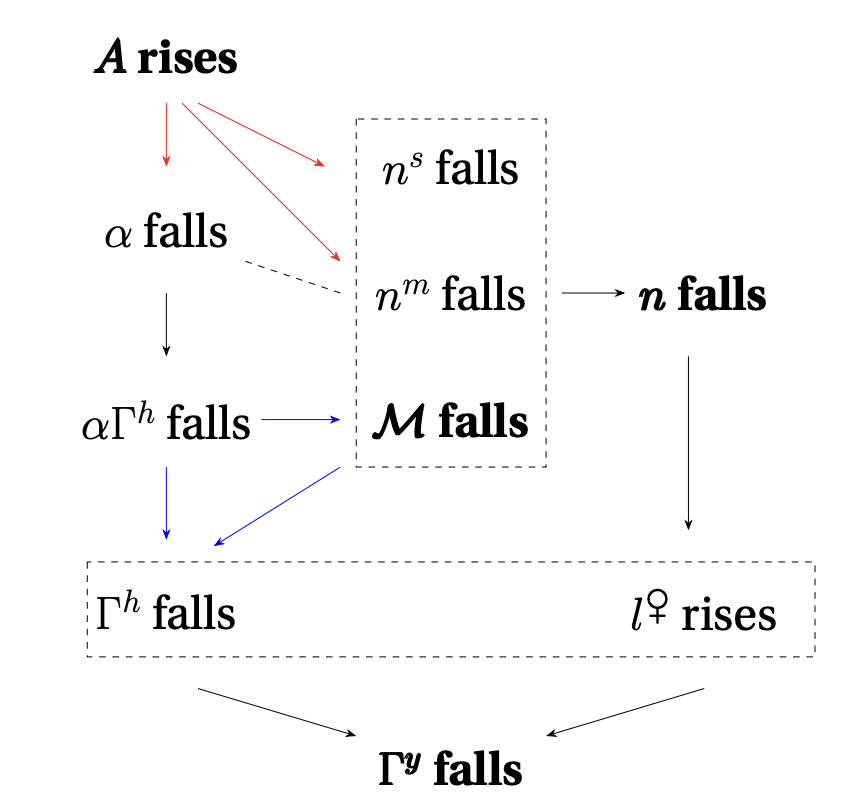
The pace of the transition from patriarchal to egalitarian societies, however, depends on social norms governing marriage. I illustrate the argument with examples from the U.K. and Japan.
Anson Zhou tweet media
English
1
0
0
186
Anson Zhou
Anson Zhou@AnsonZhou9·
The model also suggests that rising total factor productivity could explain the joint declines in fertility, dual parenthood, and gender gaps in wages and income.
Anson Zhou tweet media
English
1
0
0
105
Anson Zhou
Anson Zhou@AnsonZhou9·
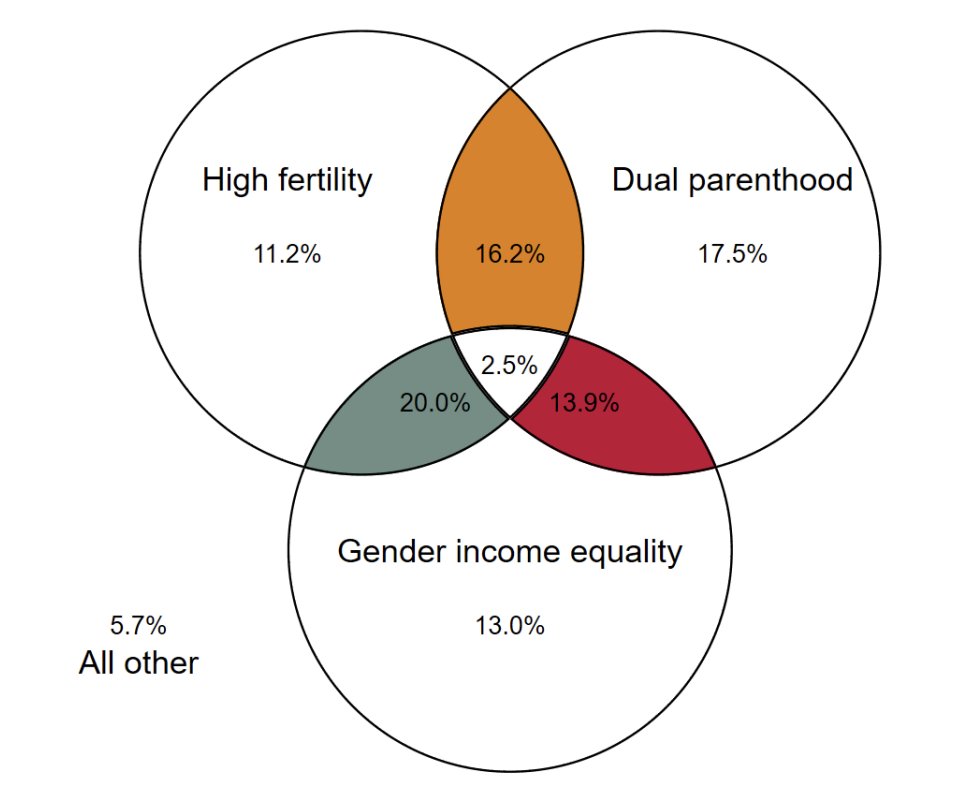
The hypothesis is driven by two key tensions in the model. First, high fertility reduces the relative labor supply of females relative to males. Second, dual parenthood benefits boys relatively more than girls.
English
1
0
0
73
Anson Zhou
Anson Zhou@AnsonZhou9·
The model predicts an Impossible Trinity hypothesis in family economics: high fertility, dual parenthood, and gender income equality are unlikely to coexist. This prediction is supported by the data.
Anson Zhou tweet media
English
1
0
0
86
Anson Zhou
Anson Zhou@AnsonZhou9·
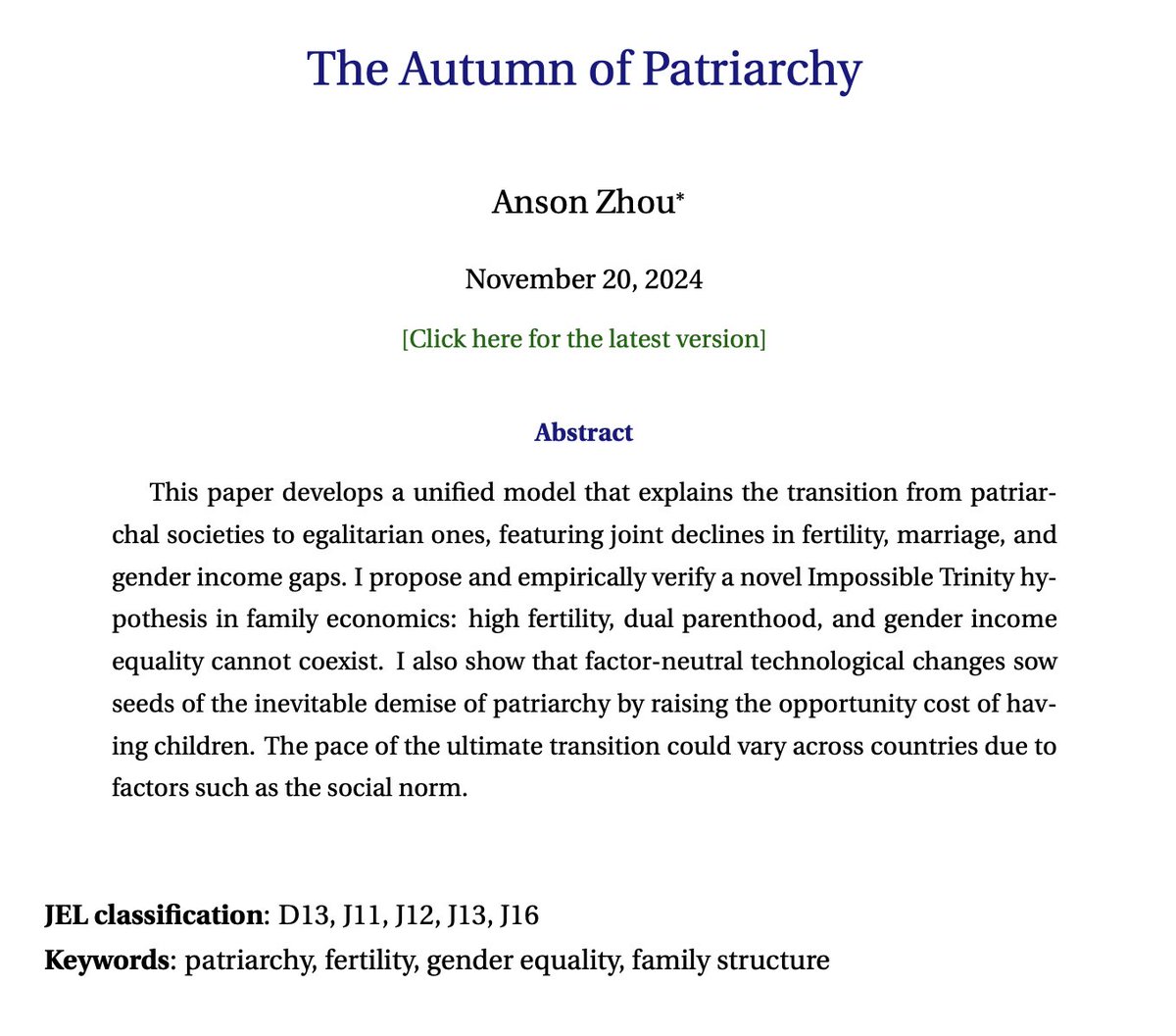
In this paper, I develop a simple but unified model with endogenous marriage, fertility, and female labor supply.
English
1
0
0
61
Alice Evans
Alice Evans@_alice_evans·
@jburnmurdoch Why is this happening? Becker’s “quality-quantity trade-off” can’t be a full explanation, as fertility has plummeted in low-income countries “Gender” is also inadequate since patriarchal societies register a similar decline.
English
36
4
226
21.6K
Alice Evans
Alice Evans@_alice_evans·
Birth rates are plummeting, The UN and other forecasters keep missing the mark Fertility in Latin America has dropped off a cliff. Do we need to update our models? Asks @jburnmurdoch
Alice Evans tweet media
English
133
498
2.3K
580.3K
Simon Sarris
Simon Sarris@simonsarris·
Like this opinion is only possible to someone who thinks making tradeoffs is below them. The status loss is too high. So instead she calls having a baby a status symbol, because of the implied zero-tradeoffs in mind. (later in the thread she berates possible tradeoffs)
Simon Sarris tweet media
English
25
20
517
46.7K
Simon Sarris
Simon Sarris@simonsarris·
I think some of the birthrate decline can be attributed to two forces happening everywhere: increasing complexity, and decreasing hardship. Life is too complex and too 'good.' I'll try to explain
Simon Sarris tweet media
English
297
885
10.8K
2M
Anson Zhou retweetledi
SpaceX
SpaceX@SpaceX·
Mechazilla has caught the Super Heavy booster!
English
11.3K
61.1K
247.6K
45.1M
Anson Zhou retweetledi
Arnaud Bertrand
Arnaud Bertrand@RnaudBertrand·
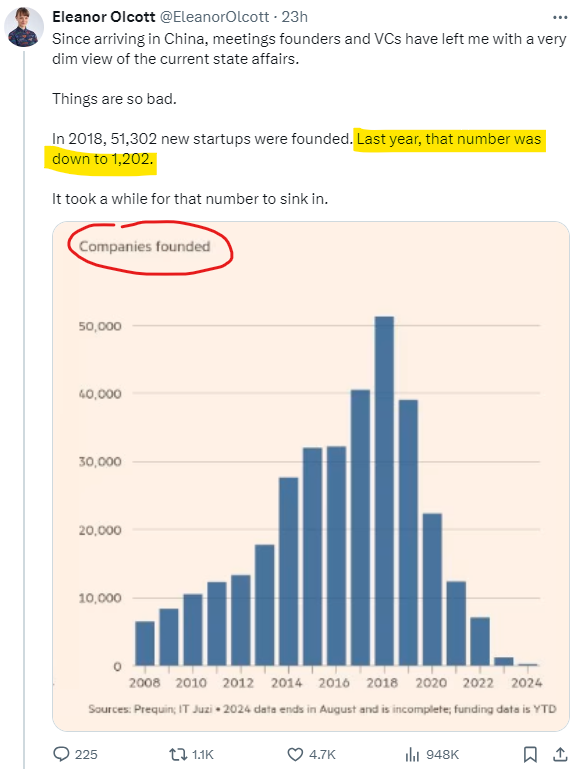
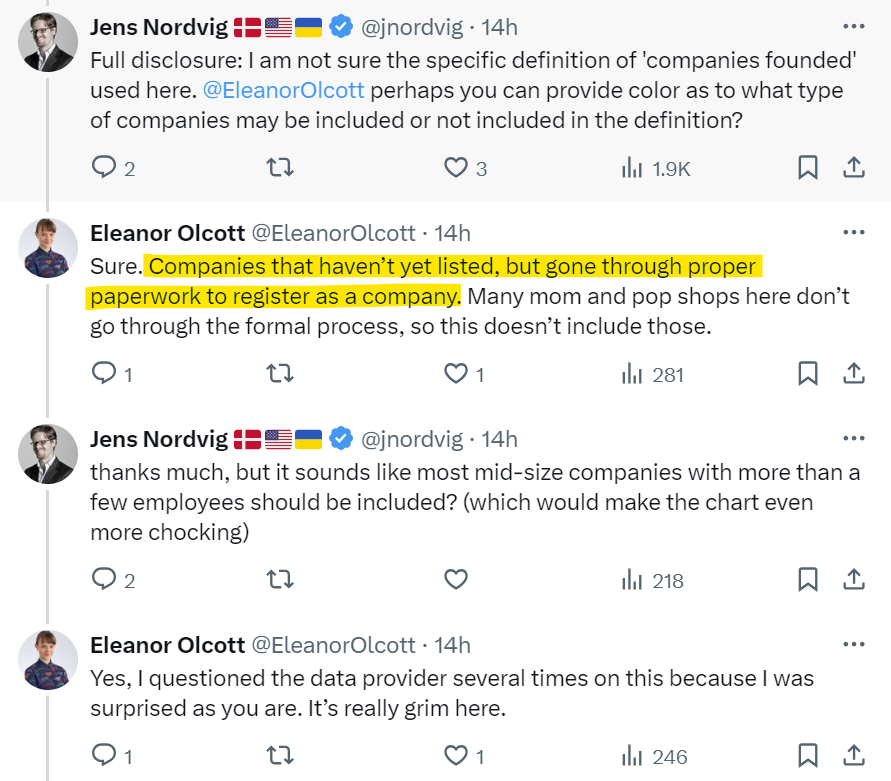
I'm sorry to be insisting on that one, but it is so illustrative of how insanely wrong the Western press can be on China, even allegedly prestigious business newspaper like the Financial Times. This one is literally incredible. So the @FT published an article yesterday by Beijing-based @EleanorOlcott that claims that only 1,202 companies in total were founded in China in 2023. Not 1,202 thousand companies, no... just 1,202 companies, in the whole of China. The claim is that out of 1,4 billion people, in an economy that grew 5.2% last year, only 1,202 people (the equivalent of the population in an average building in China) created a business. When asked to precise what she meant by "companies founded", the journalist replied that it was indeed just that: "companies that have gone through proper paperwork to register as a company". So we're sure that's what she meant. Of course the article went viral, you've likely already seen the graph being shared on Twitter... And most people, depressingly, didn't even bother to question the claims. I myself commented under the article (x.com/RnaudBertrand/…), telling the journalist her numbers were simply impossible, and was accused of the usual absolutely dimwitted insults: I am a "wumao", "paid by the CCP", bla bla bla... But her numbers ARE impossible. Anyone with an ounce of common sense can see that. And the journalist herself, if she'd reflected a tiny bit could see it too. For instance, how many new independent restaurants has she seen pop up in Beijing last year? My guess is hundreds of them, at the very least. Well each of those is a company created under her definition since to open an independent restaurant in China you have to open a business, file paperwork, go through a health inspection, etc. Extrapolate this to the whole of China and you have thousands and thousands of new businesses created in the restaurant industry alone. Or she could have asked herself the question: how many business were created in the US last year (the answer is 5.5 million: #table-results" target="_blank" rel="nofollow noopener">census.gov/econ/currentda…) and given that China grew at more than twice the rate of the US, and has over 4 times the population, does it make sense that 5,000 times (!!!) less businesses would have been created in China than in the US in 2023? Obviously no, it doesn't make any sense. Or she could have checked official Chinese statistics that show that, actually, 32.73 million new businesses were created in China in 2023 (stats.gov.cn/english/PressR…), an insane 30,000 times more than what she claims!!! Which by the way roughly corresponds to the US number of 5.5 million if one accounts for the fact we're speaking about a country of 4 times the population with an economy growing at twice the speed... Some people will say: "wait a minute 32.73M new companies would mean one of out 44 people in China created a business in 2023, that doesn't pass the sniff test". But yes it does, because we know that the vast majority of these new businesses (72% to be exact: english.news.cn/20240131/aea0b…) are "individually owned businesses", i.e. sole proprietorships. In China (as in the US) to be self-employed as say a Didi driver (the equivalent of Uber) or a Meituan delivery driver - all the so-called "gig economy" workers - you need to register yourself as self-employed via an "individually owned business". And even if one discards those "individually owned businesses" as not "real businesses", that leaves us with 10.1M businesses created in China in 2023, 8,400 times more than the 1,202 claimed in the FT article... And it's not only about the journalist herself. She has editors, supervisors. Did no-one along the chain stop to think: "wait a minute, we're about to print that only 1,202 businesses were created in China in 2023, that sounds insanely low, maybe we should double check that number"? I'm not sure what's the conclusion here besides reiterating my oft-repeated complaint that Western media get China completely wrong, and aren't even bothering to use basic common sense to question themselves.
Arnaud Bertrand tweet mediaArnaud Bertrand tweet media
English
139
532
2.5K
289K
Nicole Wu
Nicole Wu@nicolekwu·
I’m moving to @HKUniversity! Since I was 17, I dreamt of teaching back home. Took >a decade in the US/CAN to make this come true. Thanks to colleagues @UofT for showing me the ropes; couldn’t hv asked for a better place to begin my career! Excited about Asia. *v HK office view
Nicole Wu tweet media
English
45
13
733
64.6K
Anson Zhou retweetledi
Council of Economic Advisers Archived
Recently, the CDC released data showing that in 2023 the U.S. birth rate declined to its lowest level in history. Low fertility—and the aging population that it generates—implies fewer workers per capita may create headwinds to economic growth and fiscal sustainability 1/
English
4
24
78
23.1K
Anson Zhou retweetledi
More Births
More Births@MoreBirths·
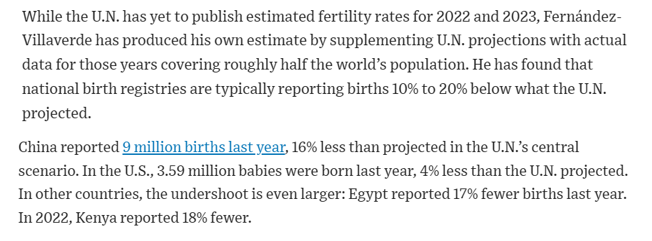
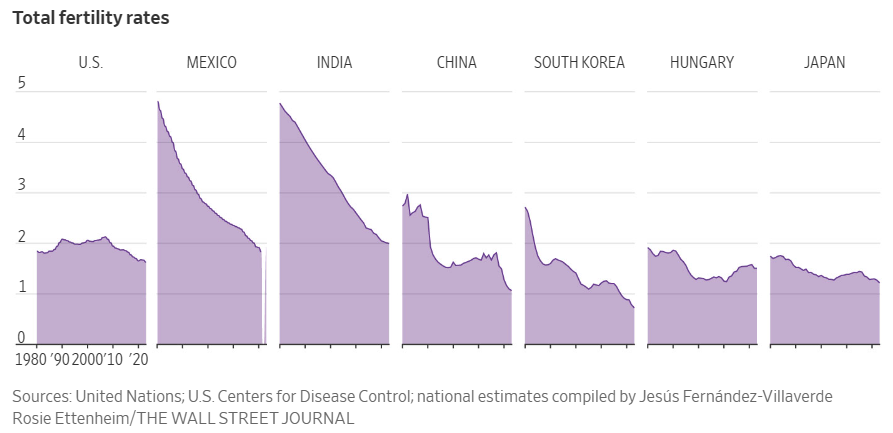
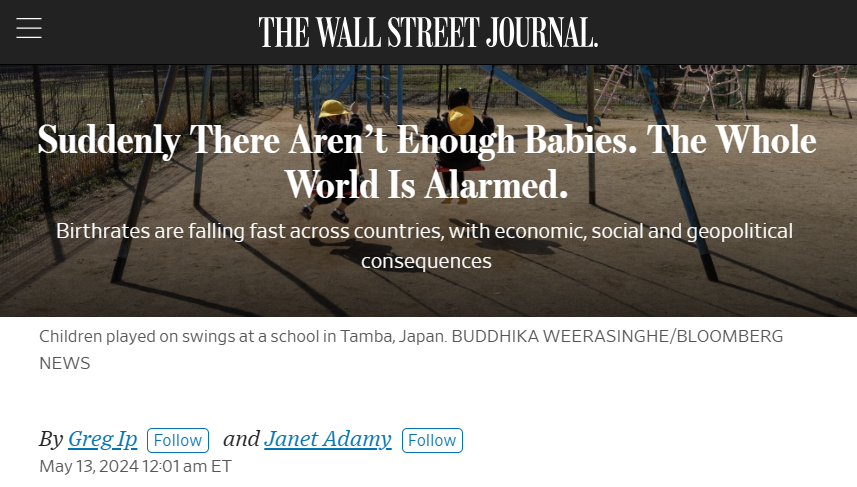
A good article in the WSJ today describes how actual births worldwide are coming in far below official UN estimates. I've written how birth stats by the UN and World Bank often wildly overshoot actual birth data, meaning the fertility crash is more severe than most realize. 👇
More Births tweet mediaMore Births tweet mediaMore Births tweet media
More Births@MoreBirths

As global birthrates continue to plunge, most people still aren't aware of the severity of the crisis. A major problem is that the data sources most rely on to follow fertility trends haven't kept up with the dramatic decline of recent years. Important 🧵, please share!

English
6
37
135
14.9K
Anson Zhou retweetledi
Demographics Now & Then
Demographics Now & Then@Aaronal16·
This is a disastrous population revision for the US but one that simply reflects the reality of trends showing plummeting TFR. A United States of sub 375M is in for a rough road ahead,especially considering the consumer spending driven nature of our economy. A Yeltsinesque turn.
Demographics Now & Then tweet media
English
10
19
118
18.6K