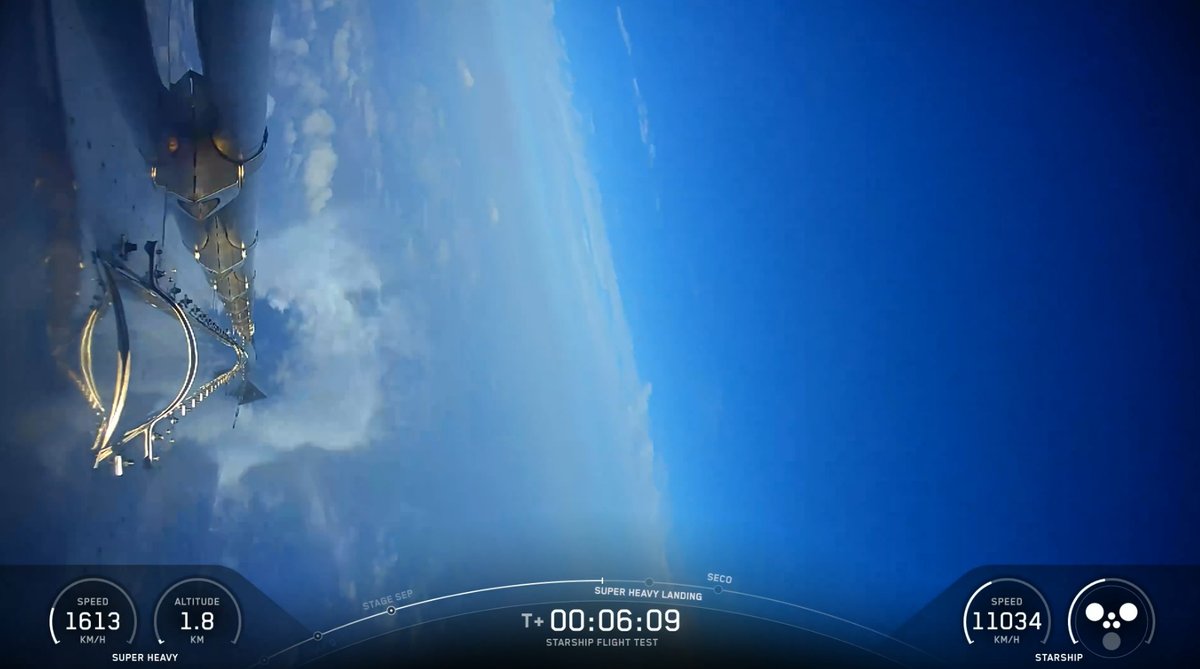
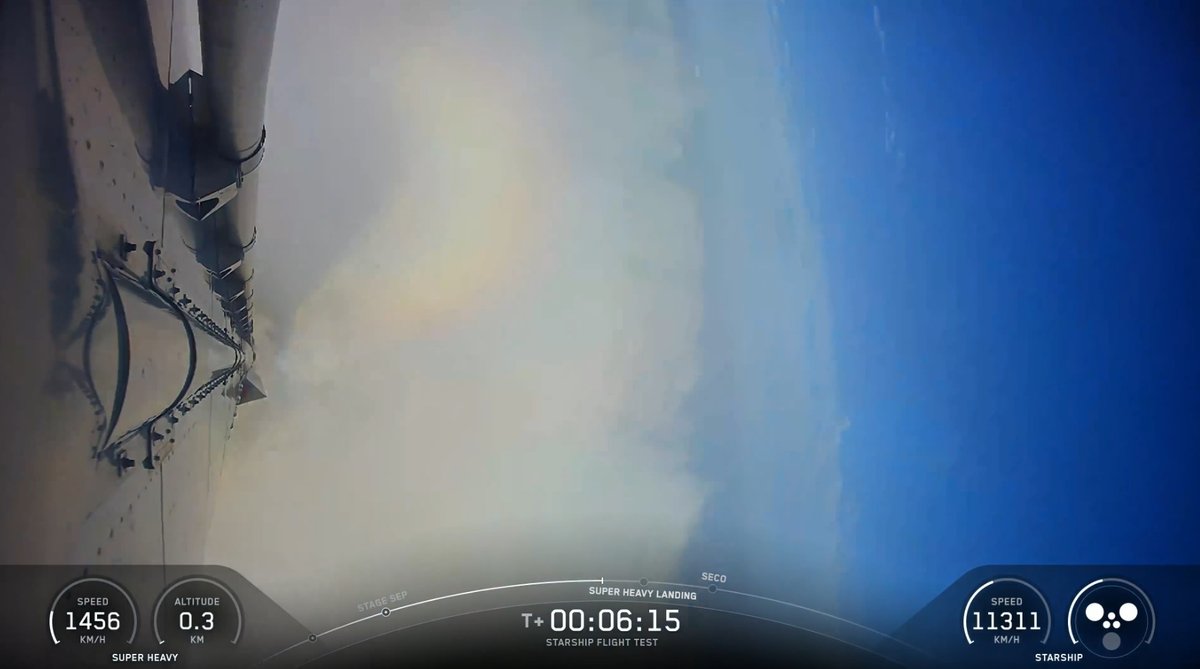
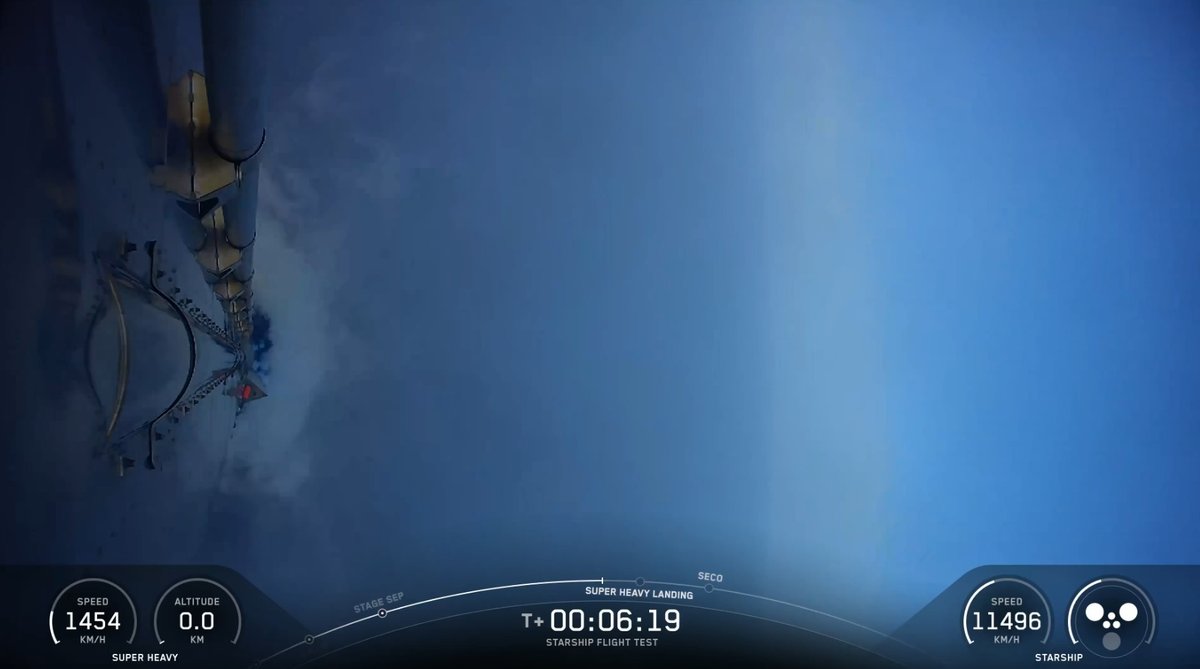
@FeelFroggyLeap@SawyerMerritt As someone mentioned, the header tanks are in the nose cone, and because of radial velocity, that portion of the ship hits the ground the hardest and so is the most likely location to split the skin.
SpaceX has released a statement after today's 12th Starship test flight:
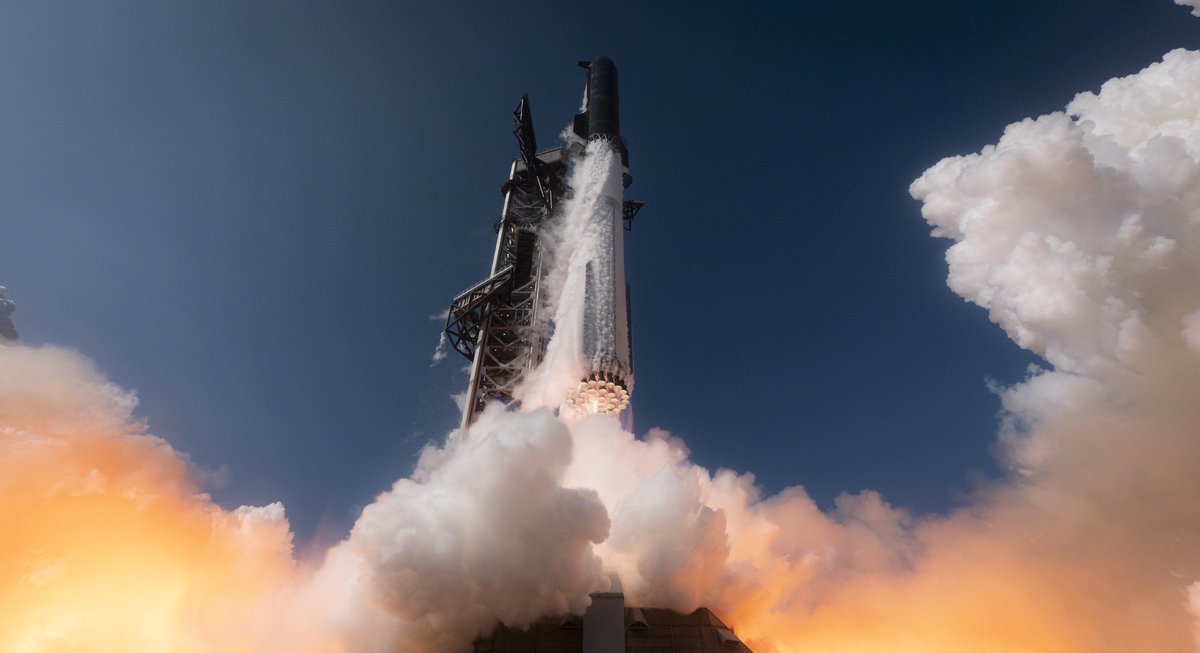
"The flight test began with Super Heavy igniting all 33 Raptor 3 engines and ascending over the Gulf of America. A single Raptor engine shut down during ascent. The successful first-stage ascent was followed by a hot-staging maneuver, with Starship’s upper stage igniting its six Raptor engines to continue its flight to space.
Following stage separation, the Super Heavy booster performed a directional flip maneuver and attempted its boostback burn. It was unable to light all planned engines and performed a partial boostback burn that ended early. Super Heavy attempted to reignite its engines for the landing burn before experiencing a hard splashdown in the Gulf of America.
Following stage separation, the Super Heavy booster performed a directional flip maneuver and attempted its boostback burn. It was unable to light all planned engines and performed a partial boostback burn that ended early. Super Heavy attempted to reignite its engines for the landing burn before experiencing a hard splashdown in the Gulf of America.
During its ascent burn to space, Starship lost one of the Raptor 3 vacuum engines but demonstrated its engine-out capability and achieved its planned trajectory.
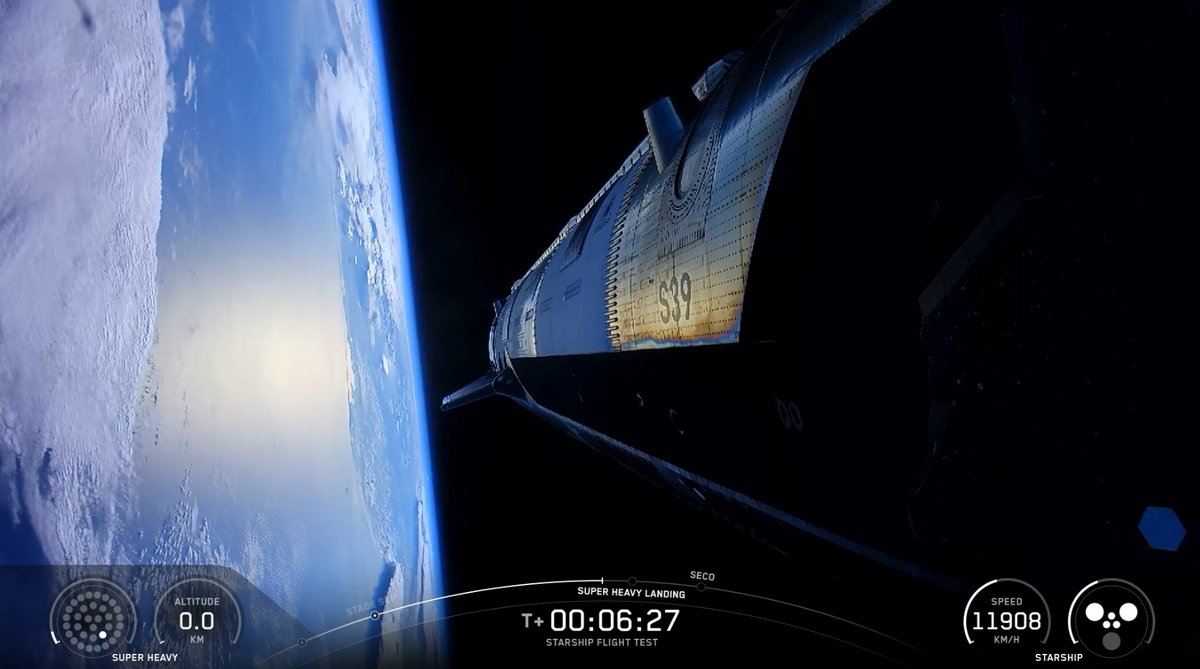
During coast, Starship successfully deployed all 20 Starlink simulators and two modified Starlink satellites that imaged Starship in space. These simulators and modified Starlink satellites were on the same suborbital trajectory as Starship.
Starship re-entered the Earth’s atmosphere and was able to gather critical data on the performance of its heatshield and structural strength. In the final minutes of flight, Starship performed a maneuver to intentionally stress the structural limits of the vehicle’s rear flaps and a dynamic banking move to mimic the trajectory that future missions returning to Starbase will fly. Starship then guided itself using its four flaps to the pre-planned splashdown zone in the Indian Ocean, and executed a landing flip, landing burn, and splashdown on two Raptor engines."
@FritzBhler1@konstructivizm You're mixing up developmental with operational stages. A mature design is less likely to experience catastrophic failure - I mean take a look at the history of Falcon 9, commercial jets, or even the automobile!
@BArefta69452@konstructivizm If a Raptor engine explodes, that’s not redundancy anymore. None of the 33 Raptors are allowed to explode. In that sense, they are 33 single points of failure, even though you have 33 of them side by side.
The ill-fated N-1: the colossal Soviet Moon rocket that was meant to beat America to the lunar surface.Towering 105 meters (344 feet) tall and wider at the base than a house, the N-1 was the USSR’s audacious answer to NASA’s Saturn V. Designed in the 1960s under the legendary Sergei Korolev, this super-heavy lifter was intended to hurl a cosmonaut-carrying L3 spacecraft toward the Moon. Its massive first stage alone packed 30 NK-15 engines arranged in two rings, generating over 45,400 kilonewtons of thrust—more raw power than the Saturn V’s first stage.
But the giant was cursed from the start. Rushed development, the death of Korolev in 1966, chronic underfunding, and a risky decision to skip full-stage static fire tests doomed the program. All four launch attempts between 1969 and 1972 ended in spectacular failure:The second launch (July 1969—just weeks before Apollo 11) saw an engine explode seconds after liftoff. The 3,000-ton rocket fell back onto the pad and detonated with the force of a small nuclear bomb, destroying the launch complex in one of history’s largest non-nuclear explosions.
Despite heroic redesigns—filters, better cooling, improved control systems—the problems persisted. The final attempt in November 1972 came agonizingly close, reaching 106 seconds before another engine failure triggered disaster.The N-1 was quietly canceled in 1976. The Soviet Union never put a cosmonaut on the Moon, and the entire program remained secret for decades. Today, the N-1 stands as a haunting symbol of ambition, engineering brilliance, and the brutal price of the Space Race. A rocket so powerful it could have changed history… if only it had flown.
@MannyQuinn_111@konstructivizm Vibration tech was virtually unknown back then. Practically we look at 30 very similar oscillators connected together, which will likely synchronise, and increase the magnitude of forces to destructive levels.
@FritzBhler1@konstructivizm It depends how you look at the problem, as it could also offer more redundancy; for example should an engine stop, a vehicle with 30 engines might continue the mission, while one with 4 engines will need to abort.
@RedSqueakRising@konstructivizm Technically the Oort Cloud is the edge of the solar system, not the heliosphere. Voyager's only passed the heliosphere.
@konstructivizm Is it Solar System or galaxy? The image shows galaxy, but the text says the solar system.
There is a difference between the two. Voyager has already left the solar system and it wasnt even 60 years
How Long Does It Take to Leave the Solar System? Space is big. Really, really big.While we casually talk about “leaving the Solar System,” the reality is humbling. The boundary of the Sun’s influence — the heliopause — sits roughly 18–20 billion kilometers (about 120–130 AU) from the Sun. Crossing it already puts us in interstellar space. The true outer edge, the Oort Cloud, could take tens of thousands of years to fully traverse.Here’s how long it would actually take with different speeds:Voyager 1 (our fastest outbound spacecraft at ~17 km/s):
Roughly 30,000 years to reach the outer edge of the Oort Cloud.
Commercial Airplane (Boeing 747 at ~900 km/h):
About 3.5 million years.
Walking (average human pace):
A staggering 630 million years.
Even with advanced propulsion (like a hypothetical powerful ion drive or nuclear engine), getting beyond the Sun’s gravitational grip would still take decades.Our Solar System is a lonely little island floating in the immense ocean of the Milky Way.
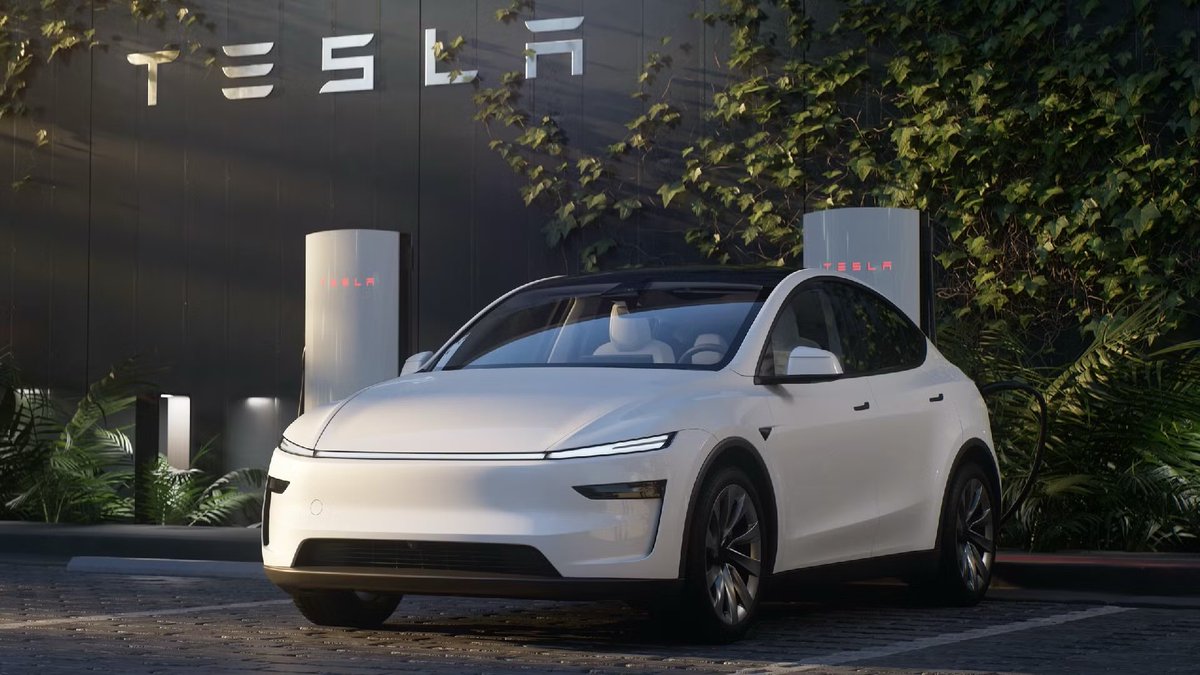
Name one upgrade you made to your Model Y to make it a little better
An accessory, body or part modification, or an interior addition. There’s no limits
@NASA I'd bring an iPhone to take photos, sure there will be high quality cameras, but taking photos with a device that hundreds of millions of people are familiar with would help to put the experience in context.
Who would you take with you on a trip around the Moon?
As we prepare to send our Artemis II astronauts around the Moon, we’d love to know who’s on your dream team. Use the hashtag #NASAMoonCrew and we may share yours during the launch broadcast: nasa.gov/who-is-in-your…
⏰ Time passes slightly faster on Mars than on Earth due to Mars’s weaker gravity and different orbital conditions. Because Mars is less massive, its gravitational influence slows time less than Earth’s does.
As shown in the design, this results in Martian time running about 477 millionths of a second (approximately 477 microseconds) faster per day. Differences in orbital speed and distance from the Sun also contribute to this measurable effect.
According to The Astronomical Journal, these combined factors cause clocks on Mars to gain hundreds of microseconds each day compared to clocks on Earth.
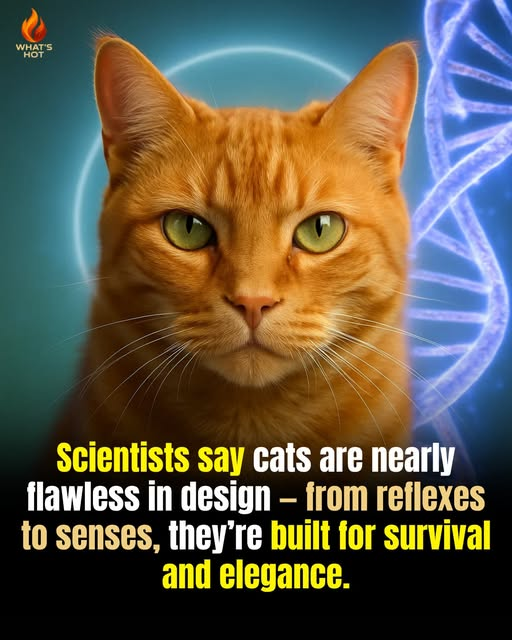
According to recent studies in biomechanics and neuroscience, cats are nearly flawless examples of biological engineering. From their precision movements to their unique balance and energy efficiency, scientists call cats “nature’s perfect predators.”
A cat’s muscles and skeletal structure allow it to jump six times its body length, land silently, and always stay upright due to an inner-ear reflex called the “righting reflex.” Their night vision surpasses humans by sixfold, while their whiskers detect even the faintest air movements, helping them navigate in complete darkness.
Even their purring serves a purpose — the vibration frequency (25–150 Hz) stimulates tissue regeneration and bone healing, which might explain why cats recover from injuries faster than many animals. Their compact efficiency and self-sustaining hunting instincts have made them evolutionary masterpieces.
@elonmusk Also, I wanted to buy my model y with tow pack pre fitted but had to buy it without it, and then ordered the tow pack fitment through the service department. Even then it came without the ball and tongue 🤦
@elonmusk In Queensland, Australia you're forced to waste money on buying the car with default registration plates, irrespective that you may possess your own transferrable plates.
Please reply to this post with any difficulties you may have had in trying to buy a Tesla.
Our goal is for the purchase and delivery experience to be fast and simple, with accurate answers to your questions.
The key test is that you would recommend it to a friend.