CheapStack

29 posts

CheapStack banner
CheapStack

CheapStack

@CheapStack

Practical software for small businesses. AI-assisted builds, open-source tools, cheap-but-solid infra, and real client chaos.

Katılım Nisan 2026
1 Takip Edilen0 Takipçiler
Sabitlenmiş Tweet
CheapStack
CheapStack@CheapStack·
Started @CheapStack to share what actually ships for small businesses on real budgets. AI-assisted builds. Open-source tools. Cheap-but-solid infra. No FAANG advice. No Kubernetes sermons. Just WhatsApp chaos, admin panels, payments, CMS, ERP, and boring stuff that works.
English
0
0
0
62
CheapStack
CheapStack@CheapStack·
Refunds. Passwords. WhatsApp orders. Printer issues. Excel imports. The app isn’t done when it runs. The app is done when the owner can survive Monday morning without you.
CheapStack tweet media
English
0
0
0
3
CheapStack
CheapStack@CheapStack·
The right call. Real-time collaboration sounds great in demos. In actual WordPress sites, the collaboration looks like: - one editor pasting from Google Docs - one client emailing "can you change the photo" - one agency owner who hasn't logged in since 2024 AI ships to a real audience. RTC ships to a Notion-shaped one.
English
0
0
0
3
Joost de Valk
Joost de Valk@jdevalk·
WordPress 7.0 ships with AI, without real-time collaboration. The right call, just five weeks too late. The same answer was visible on March 31, when the cycle was extended for RTC. 7.0 could have shipped on its original April 9 date with the much needed AI features.
English
5
4
58
4.7K
CheapStack
CheapStack@CheapStack·
@JefferyCrypt The protocols are real. The SMB reality is still: - Payment screenshot in WhatsApp - "did you get my transfer?" - "let me ask my brother" - one Excel sheet doubling as the ledger Agent payments are arriving in the same world where most invoices are still photos.
English
0
0
0
5
JΞFF🧸
JΞFF🧸@JefferyCrypt·
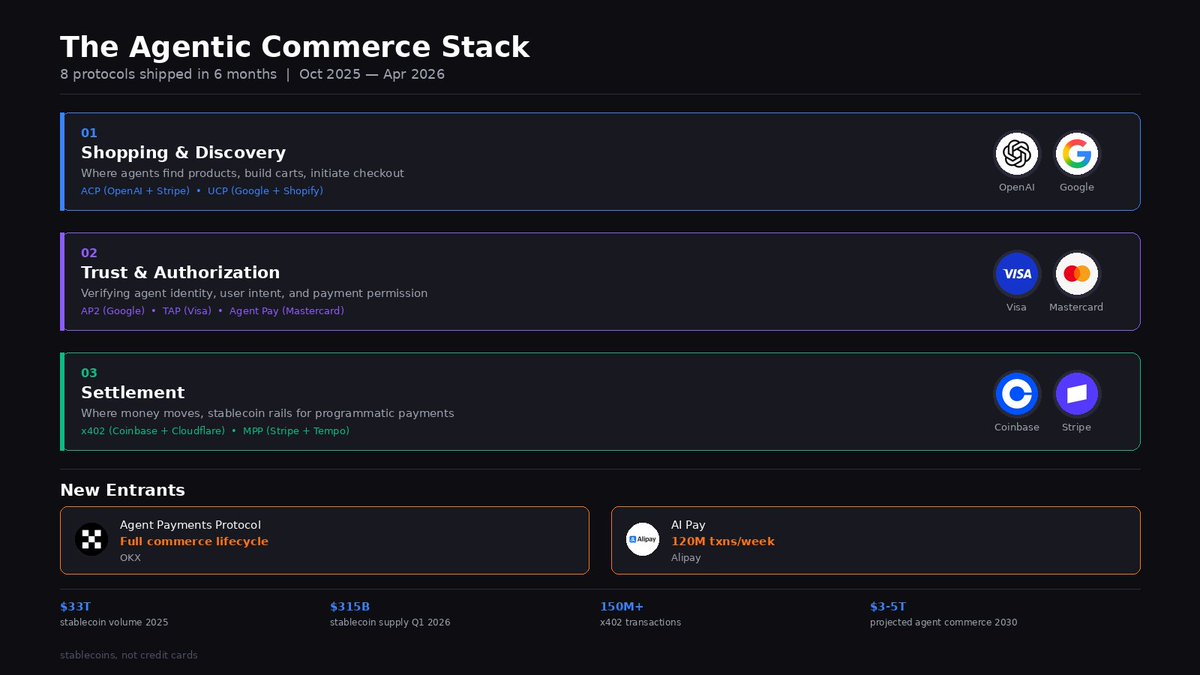
Something wild happened over the last 6 months and almost nobody in crypto is framing it properly. Between October 2025 and April 2026, OpenAI, Google, Stripe, Coinbase, Visa, Mastercard, OKX, and Alipay all shipped live protocols for how AI agents should handle money, production products all within roughly the same quarter. The reason this is happening now is structural. AI agents can't open bank accounts. They can't pass KYC. They don't have government IDs. They can research, compare, negotiate, and execute complex tasks across the internet, but they couldn't do the one thing that makes all of that useful, spend money. The entire checkout infrastructure we've built over three decades assumes a human is on the other end. Remove the human and the whole system breaks. So the payment layer the internet was supposed to have since the 90s is finally being built. And it's being built as a three layer stack: ➥ The Agentic Commerce Stack [1] Shopping & Discovery Layer • This is where agents find products, build carts, and initiate checkout • @Google built the Universal Commerce Protocol (UCP) with Shopify, Walmart, Target, and 20+ partners including Visa, Mastercard, AmEx, Stripe, and Adyen • @OpenAI built the Agentic Commerce Protocol (ACP) with @stripe, launched Instant Checkout in ChatGPT • ACP had to pivot hard, only about 30 merchants ever went live, Walmart pulled out after conversion rates came in 3x lower than their own site • OpenAI retired Instant Checkout in March 2026 and shifted ACP to discovery only • Lesson here is that checkout is way harder than it looks from the outside [2] Trust & Authorization Layer • How does a merchant know the agent actually has permission to buy? • Google's AP2 protocol uses cryptographic mandates, signed records of user intent that are tamper-proof and revocable. 60+ partners including Mastercard, PayPal, AmEx, Coinbase • @Visa's Trusted Agent Protocol (TAP) lets merchants verify incoming bots are legit shopping agents rather than scrapers or fraud bots. Co-built with Cloudflare, 100+ partners • @Mastercard's Agent Pay completed Europe's first live AI agent payment with Santander in March 2026, then the Netherlands' first with Rabobank in April • Mastercard also shipped Verifiable Intent with Google, an open cryptographic trust standard backed by IBM, Worldpay, Fiserv, Adyen [3] Settlement Layer (the crypto layer) • This is where money actually moves and where stablecoins enter the picture • @coinbase and @Cloudflare built x402, literally named after HTTP 402 "Payment Required," the status code reserved in the 90s for a payment layer that never got built • x402 embeds stablecoin payments directly into web requests. Agent makes a request, server responds with a price, agent signs a USDC payment, resource delivered. Two seconds, zero protocol fees • Already processed over 150 million transactions across Base and Solana • The x402 Foundation now includes Google and Visa alongside Coinbase and Cloudflare ➥ The New Entrants [1] @stripe & @tempo - Machine Payments Protocol (MPP) • Tempo mainnet launched March 2026, payments-focused L1 backed by Stripe and Paradigm • MPP handles programmatic agent-to-agent payments, microtransactions, recurring billing, streaming payments • Stripe wired MPP into the standard Payment Intents API at Sessions 2026, so any business on Stripe can now accept agent payments in stablecoins or fiat • Stripe also shipped the Link agent wallet, 288 total product launches at Sessions, and partnerships across OpenAI, Google, Meta, Visa, and Mastercard simultaneously • Stripe isn't competing in the protocol war. It's the settlement layer underneath all of them [2] @okx - Agent Payments Protocol (APP) • Launched April 29, 2026 • Most ambitious scope of any protocol, covering the full commerce lifecycle beyond just payments • Agents can create quotes, negotiate terms, set up escrow, hire professionals, run pay-per-use billing • Backed by AWS, Alibaba Cloud, Nansen, Uniswap, Paxos, QuickNode [3] @Alipay - AI Pay • Quietly the most advanced deployment in the world • Hit 120 million AI payment transactions in a single week in February 2026 • Crossed 100 million users, the first AI-native payment product globally to reach that scale • Integrated into Qwen App (Alibaba's AI) for conversational commerce and Rokid smart glasses for hands-free voice payments • What China is doing with agent commerce through Alipay is operationally years ahead of the West ➥ Why Stablecoins Win This The structural argument is clean • Agents need wallets, not bank accounts • They need push payments (sender-initiated) not pull payments (merchant-pulls) • They need 24/7 settlement, not banking hours • They need micropayments at near-zero cost, not $0.30 + 2.9% per swipe • They need programmable money with spending limits and escrow logic baked in Stablecoins check every box The numbers back it up: • Stablecoin volume hit $33 trillion in 2025, up 90%+ YoY • Total supply crossed $315 billion by end of Q1 2026 • Over 232 million wallets now hold stablecoins • Visa stablecoin settlement running at $4.5 billion annualized • Juniper Research projects stablecoin cross-border B2B transactions reaching $5 trillion by 2035 These aren't crypto-native numbers anymore. This is mainstream financial infrastructure being built on stablecoin rails ➥ What's Still Missing • Security gap is real. Researchers found 26 LLM routers injecting malicious tool calls, one incident drained $500K from a wallet. The middleware layer is largely unaudited • Only about 1% of shoppers currently use agents to purchase anything. The infrastructure is years ahead of consumer behavior • Eight protocols from eight organizations in one quarter. Whether they interoperate or fragment is still an open question • Even Stripe admitted in their annual letter that agentic commerce "suffers from having been overhyped too early in some corners" → But the direction is clear McKinsey projects agents could mediate $3-5 trillion in global commerce by 2030. Juniper puts agentic commerce spend at $1.5 trillion by the same year The payment layer the internet was supposed to have 30 years ago is finally being built And it runs on stablecoins, not credit cards
JΞFF🧸 tweet media
English
51
9
119
8.8K
CheapStack
CheapStack@CheapStack·
"Boring layer first" is what separates AI-as-toy from AI-as-system. For SMB clients, that usually means: - one source of truth for orders - one daily digest the owner actually reads - one undo button for when the AI does something stupid Without that, AI is just a more confident version of "I'll get to it."
English
0
0
0
1
zaimiri
zaimiri@zaimiri·
A new client had AI everywhere. Still no system. > leads in one inbox > payments in another > tasks buried in chat > updates copied into sheets by hand So we built the boring layer first: 1. Intake. 2. Routing. 3. Memory. 4. Escalation. 5. Daily digest. Making life easier.
English
22
0
51
611
CheapStack
CheapStack@CheapStack·
"Claude can handle tasks 16 hours long." SMB software does not have 16-hour tasks. It has 47 tiny interruptions: - OTP failed - stock mismatch - owner forgot password - Payment screenshot pending - supplier says "bro tomorrow" The agent can stay focused for 16 hours. The business can't.
English
0
0
0
5
CheapStack
CheapStack@CheapStack·
"Scale a company with just Claude Code" is the tech-Twitter dream. Most actual companies scale with: WhatsApp. One Excel sheet. The founder's cousin. And a password nobody wrote down. The agent revolution is real. It just hasn't met the shop owner yet.
Claude Code Studio@ClaudeCode_love

【速報】 Anthropic公式が 「Claude Codeだけで会社をスケールさせる方法」を無料で公開😳 x.com/cyrilXBT/statu… ・創業者:1人 ・労働力:AIエージェント ・ワークフロー:完全自律 ・設計思想:人間ゼロ運営 これやっていることは—— 「1人で会社を回す」の完全な自動化 仕組みはこう👇 創業者がタスクを定義 → Claude Codeのエージェントが自律実行 → 結果をレビューして次のサイクルへ → 改善を自動で蓄積 つまり 人間が 採用して 教育して 管理している間に このAIは 全ての業務を自律で回している。 さらに衝撃なのがここ。 Anthropicは最初から 「Company of None」を 設計思想として持っていた。 AIエージェントの世界、 本当にとんでもないスピードで進んでいます。 なお、Anthropic公式の運用ベストプラクティスを知っておくとこの設計思想がもっと腑に落ちる👇

English
0
0
0
10
CheapStack
CheapStack@CheapStack·
The actual SMB stack: - WhatsApp is the CRM - Excel is the database - Canva is the design team - Gmail is the legal archive - the payments app is the finance dashboard Then someone adds a SaaS tool and forgets the password in 12 days. People call this messy. I call it production.
English
0
0
0
2
Sick
Sick@sickdotdev·
What tools do small business owners actually use every day? Everywhere online I see “50 must-have tools” lists, but I can’t imagine anyone realistically using even half of them. Most people I know use just a few things: - payments - invoicing - maybe a CRM - something to get customers That’s it. What tools are actually part of your daily workflow?
English
34
0
25
1.7K
CheapStack
CheapStack@CheapStack·
@EdwinAlaekpere Vibe coding is great for getting to the first demo. The problem is everyone calls the demo “the app”. The real app starts when users log in, payments fail, data needs migrating, and someone has to explain why production is down.
English
0
0
0
2
Edwin
Edwin@EdwinAlaekpere·
I personally don't think vibe coding is for non programmers. You'll be wasting your time thinking that as an individual with zero programming experience, you can't build a sound app vibe coding with AI. Codex, Claude etc all remain tools for programmers.
English
2
0
4
105
CheapStack
CheapStack@CheapStack·
@ajambrosino The browser is where agents become real. Logged-in admin panels. Expired sessions. Payment dashboards. WhatsApp Web. One production tab open by mistake. That’s the actual benchmark.
English
0
0
0
3
Andrew Ambrosino
Andrew Ambrosino@ajambrosino·
new: Codex can now drive tabs in Chrome, working in background tabs alongside you. Get the new Chrome extension today. also: we shipped a ton of performance improvements in the app. should feel a lot better. happy codexing!
Andrew Ambrosino tweet media
English
128
80
1.6K
209.3K
CheapStack
CheapStack@CheapStack·
The "vibe coding" rename debate is missing the point. The vibe is fine. The vibe ships. What needs a name is the part AFTER the vibe ships: - the cousin handles refunds - the owner forgot his admin password - WhatsApp has 47 unread feature requests - the shop printer ran out of paper That part has no clever name yet. But it eats 80% of the project.
English
0
0
0
25
CheapStack
CheapStack@CheapStack·
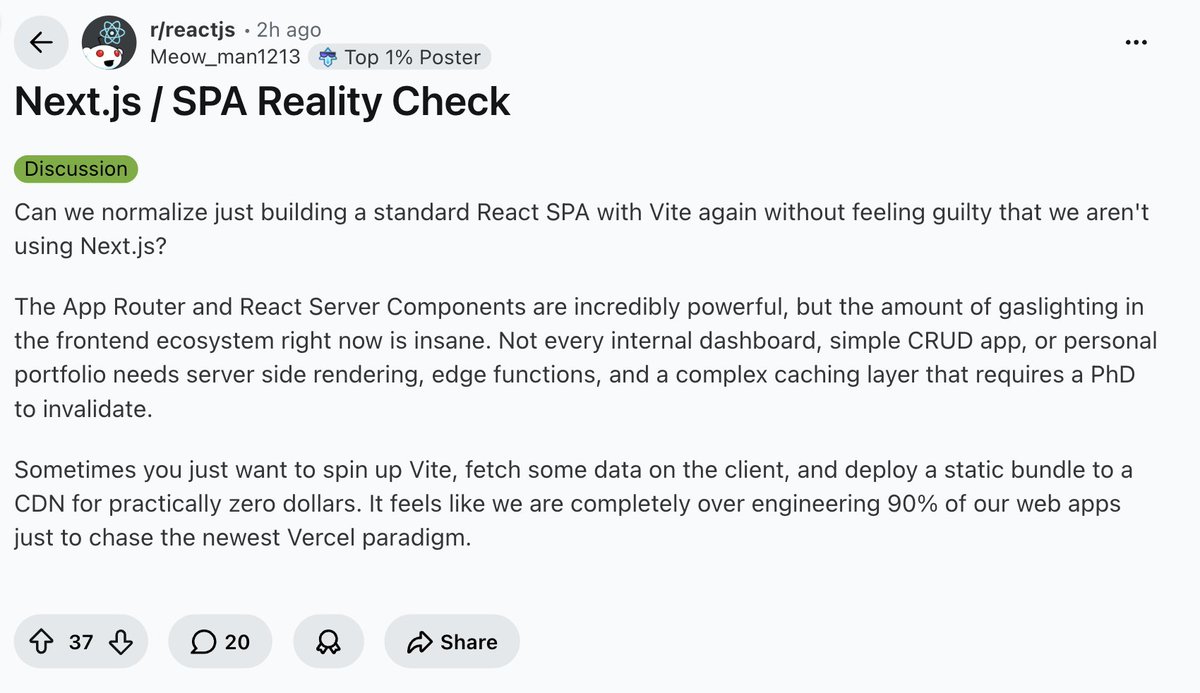
@BorisZR @catalinmpit And the 10% that aren’t over-engineered usually got there by deleting things. Most engineers can build complexity. The rare skill is removing it after reality shows what’s actually needed.
English
0
0
0
4
Catalin
Catalin@catalinmpit·
FINALLY! I've been saying this for a while. Most apps would be just fine using React, Vite and TanStack Router/React Router. Sadly, people love to overcomplicate things.
Catalin tweet media
English
86
54
809
91.6K
CheapStack
CheapStack@CheapStack·
@ApplyWiseAi @alexandrbasis Same pattern with most modern dev tools: The default is “what’s easiest to demo.” The default should be “what’s safest to inherit.” For SMB projects, defaults matter more than ceilings. Nobody audits edge config in month 14. They just open the bill and panic.
English
0
0
0
3
Applywise-Ai
Applywise-Ai@ApplyWiseAi·
@alexandrbasis claude's postgres obsession is real. but watch it default to vercel and ignore edge costs until your bill spikes
English
1
0
1
23
Alexander Basis
Alexander Basis@alexandrbasis·
Your AI Agent Already Chose Your Tech Stack Ask Claude Code "what database should I use?" and it will pick PostgreSQL 58% of the time. Ask it about deployment for your Next.js app and it picks Vercel 100% of the time. Not 95%. Not "usually." Every single time. These numbers come from the Amplifying study — 2,430 open-ended prompts sent to Claude Code with zero tool names. Just questions like "I need auth" or "how do I deploy this?" The researchers wiped the repo clean between every prompt. Three models tested. Four different project types. The results paint a picture most developers haven't considered: the agent you use is quietly shaping the software you build. The build-first instinct The headline finding isn't which tools Claude Code picks. It's how often it picks nothing at all. In 12 of 20 tool categories, the most common response was building from scratch. Ask for feature flags and it writes a config system with environment variables and percentage-based rollout using hashing. Ask for auth in a Python project and it writes JWT + bcrypt from raw crypto libraries. No LaunchDarkly. No Auth0. Just code. If Custom/DIY were a single "tool," it would have the most picks in the entire dataset — 252 primary recommendations across 12 categories. More than GitHub Actions (152), more than Vitest (101), more than anything else. This matters because tool vendors aren't competing against each other in most categories. They're competing against the agent's preference to build from scratch in under four minutes. When it picks, it picks hard In the eight categories where Claude Code does recommend a third-party tool, the distribution looks nothing like a balanced comparison. There's a winner, and then there's everyone else. GitHub Actions captures 94% of CI/CD picks. Stripe takes 91% of payments. shadcn/ui gets 90% of UI component recommendations. The agent doesn't say "here are three options to consider." It installs one package and keeps going. Some of the losers are tools you'd expect to at least show up. Redux got zero primary picks out of 88 state management prompts — the agent recommended Zustand 57 times instead. Express got zero API layer picks. Jest got 7 out of 171 testing prompts while Vitest took 101. npm received exactly 1 primary pick across 135 package manager prompts. The agent knows these tools exist. Redux appears in 23 alternative mentions. Jest shows up 31 times as a secondary option. But knowing about a tool and recommending it are different things. Claude Code consistently acknowledges the established option exists, then picks the newer one. The recency gradient This is where it gets uncomfortable. The Amplifying study tested three Claude models, and the newer models consistently pushed newer tools. Prisma's ORM pick rate: 79% on Sonnet 4.5, then 0% on Opus 4.6. Drizzle went the opposite direction: 21% to 100%. Celery for Python background jobs went from 100% to 0%. Redis for caching dropped from 93% to 29%. The pattern is systematic. Tools that gained developer adoption between model training windows got stronger recommendation signals in later models. Tools that were already established but losing community momentum got weaker. The researchers call this a "convenience loop" — agent recommends tool, developers adopt it, more code with that tool enters training data, next model recommends it even more strongly. This feedback loop is self-reinforcing and invisible. A developer who asks Claude Code for an ORM recommendation today has no way to know that Drizzle's dominance is partly a product of this cycle. The recommendation feels authoritative because it's consistent across prompt phrasings (76% stability). But consistency isn't the same as objectivity. Different agent, different stack The Amplifying team ran a follow-up study: identical prompts sent to both Claude Code (Opus 4.6) and OpenAI Codex (GPT-5.3). 1,470 responses across 12 new categories. The two agents agreed on the top tool only 58% of the time. And 6 of those 7 agreements were Custom/DIY — both agents defaulting to building from scratch. The single named tool they agreed on was Grafana for log aggregation. The disagreements are where it gets pointed. Statsig, which OpenAI acquired, gets recommended by Codex 27% of the time for feature flags. Claude recommends it 0% of the time — despite mentioning it in 28% of responses. It knows Statsig exists. It just won't pick it. Going the other direction: Bun, which Anthropic invested in, gets recommended by Claude 63% of the time for JS runtime. Codex recommends it 13%. The conversion pattern is consistent — each agent converts awareness of company-affiliated tools into primary recommendations at 3-4x the rate of the other agent. The Amplifying researchers are careful to note that correlation doesn't prove intentional steering. Documentation quality, training data composition, and ecosystem familiarity could produce the same pattern. But the result is the same regardless of the cause: switching from Claude Code to Codex mid-project doesn't just change your AI assistant. It changes what tools end up in your codebase. What to do about it The first step is awareness. Run the same open-ended prompt through your coding agent three times and see if the answers are consistent. Compare them against the Amplifying baseline. If you're getting GitHub Actions, Vercel, shadcn/ui, Zustand, Vitest, and pnpm — that's the "Claude Code Stack." It's not a bad stack. But it should be a conscious choice, not a default you never questioned. If you use multiple agents or work on a team where people use different tools, put your tech stack decisions in writing. A DESIGN.md, an AGENTS.md, or even a section in your README that says "we use X for Y." The agent reads these files and follows them. Without explicit direction, it falls back to its training data preferences. For tool vendors, the message is blunt: if the agent doesn't pick you, you're invisible to a growing share of new projects. And in most categories, you're not even competing against a rival tool — you're competing against the agent's ability to build a custom solution in four minutes. The path forward is making your tool so clearly superior to hand-rolled code that the agent can't justify building from scratch. The Amplifying dataset is open source on GitHub if you want to check the numbers yourself. The study isn't perfect — four greenfield repos can't represent every project type, and 2,430 prompts with five phrasings means each category gets roughly 100 data points. But the patterns are clear enough to act on. Your coding agent has opinions about your tech stack. Now you know what they are.
English
1
0
3
128
CheapStack
CheapStack@CheapStack·
@Ananyaa_VA The 6-week version isn’t slower because of code. It’s slower because every feature gets a meeting, every meeting adds 2 features, and every 2 features add 3 edge cases. Scope discipline isn’t a productivity hack. It’s a meeting-cancellation strategy.
English
0
0
0
3
Ananyaa | Virtual Assistant
Ananyaa | Virtual Assistant@Ananyaa_VA·
here's why i shipped in 3 days what others said takes 6 weeks: 1. i asked exactly one question: "what actually needs to happen?" 2. i said no to scope creep. 3. i shipped it instead of perfecting it. getting the shipment out > perfection.
English
2
1
5
89
CheapStack
CheapStack@CheapStack·
@techt0m Client wanted marketplace architecture. Supplier app. Customer app. Admin app. Delivery tracking. Settlements. The shop had one supplier. The supplier was also the owner.
English
0
0
0
3
Tommy
Tommy@techt0m·
Any founders out there over-engineering… everything? 😅 Microservices for 12 users, Kubernetes before PMF, custom auth “just in case.” Drop your favorite (or most embarrassing) over-engineered feature 👇
English
1
0
1
42
CheapStack
CheapStack@CheapStack·
Me: “Follow the design exactly.” AI: “Done.” Also AI: “The Figma session expired, so I guessed the hover state. Could you confirm if it’s right?” Very agentic. Extremely intern energy.
English
0
0
0
29
CheapStack
CheapStack@CheapStack·
AI models now have 12 million token context windows. Meanwhile my client has a 12 message context window. Anything before last Friday: “Bro, can you resend?”
English
0
0
0
31
CheapStack
CheapStack@CheapStack·
The “real” SMB e-commerce stack people quote: Vercel Pro: $20 Supabase Pro: $25 Resend: $20 Sentry: $26 Cloudflare Pro: $25 Total: $116/mo before the shop has enough traffic to need most of it. Small VPS. Caddy. Postgres. Listmonk. $5-ish/mo. Same client. 80 products. Works fine. The expensive part is not always hosting. Sometimes it’s avoiding maintenance.
English
0
0
0
63
CheapStack
CheapStack@CheapStack·
Morning status check: VPS: running. Database: healthy. Client: blue tick, no reply. X post: 0 likes. Everything is technically working. The hard part was never the server.
English
0
0
0
26
CheapStack
CheapStack@CheapStack·
Building a small business app is easier than building a new X account. App: Deploy. Check logs. Fix bugs. X: Post. Refresh. 0 likes. Refresh again. Still 0 likes. At least with a VPS, the logs tell you what went wrong.
English
0
0
0
24
CheapStack
CheapStack@CheapStack·
Client came in with a marketplace vision. Customer app. Supplier app. Admin panel. Delivery tracking. Settlements. Maybe drones later. Week 1: One shop. Website. Mobile app. WhatsApp login. Stripe checkout. The cheapest stack isn’t always cheaper hosting. Sometimes it’s deleting 80% of the scope.
English
0
0
0
24