Josh The Deacon

3.4K posts

Josh The Deacon banner
Josh The Deacon

Josh The Deacon

@DeaconBaptist

Baptist student of theology and servant of the Lord. Sacramental Maximalist

Katılım Temmuz 2023
338 Takip Edilen309 Takipçiler
Josh The Deacon retweetledi
Fabricius Spira
Fabricius Spira@graywithin·
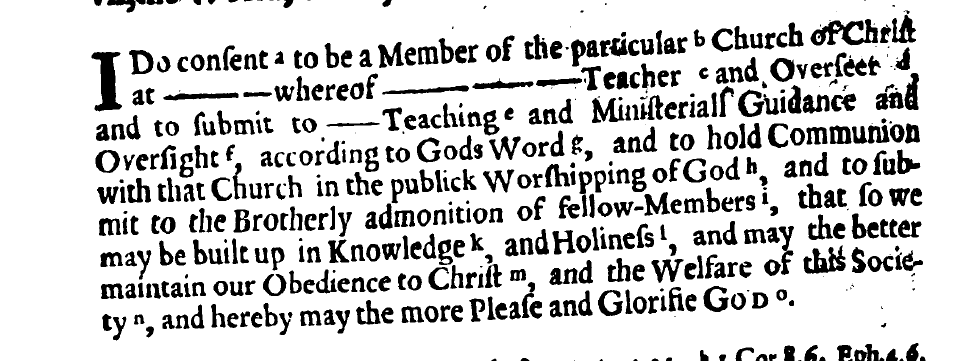
John Owen on damnable habitual wickedness in the impenitent regenerate.
Fabricius Spira tweet media
English
1
4
14
588
Josh The Deacon
Josh The Deacon@DeaconBaptist·
@BarelyProt @DrJohnFrame The object of our praise is ultimately the Lord. If we take the elements to be objects by where we direct our minds toward the Lord, it would deserve our approval and esteem of them (which is what we would take 'praise' to mean here).
English
0
0
0
9
Dr. John Frame
Dr. John Frame@DrJohnFrame·
I think it’s unfortunate that these wonderful sacraments have become so much a source of battles in the church. It seems sometimes that they are more a cause for warfare than a blessing to God’s people… Let’s think of the richness of the blessings that God has given us…
English
9
1
35
3.2K
Josh The Deacon
Josh The Deacon@DeaconBaptist·
@BarelyProt @DrJohnFrame To be clear, I do affirm a spiritual efficacy and nourishment of the soul in the sacraments. But we have to be careful that we do not err for the sake of our zeal and desire to hold integrity regarding them.
English
0
0
0
65
Josh The Deacon
Josh The Deacon@DeaconBaptist·
@BarelyProt @DrJohnFrame Whether or not the sacraments 'do anything', they nonetheless deserve praise because of the One who instituted it. We don't always honor a thing solely on its effects but because of its signification and the author of it.
English
2
0
0
22
Josh The Deacon retweetledi
🌷 LIZZIE🌷
🌷 LIZZIE🌷@farmingandJesus·
This is the church 💜
English
56
197
1.7K
17.8K
Josh The Deacon retweetledi
Peter Gurry
Peter Gurry@pjgurry·
John Chrysostom (4th c) encouraging his parishioners to read the Bible *at home*, and he will not take the excuse “but I’m not a monk!”
Peter Gurry tweet mediaPeter Gurry tweet media
English
20
82
776
23.7K
Josh The Deacon
Josh The Deacon@DeaconBaptist·
"But it is so in my experience–especially as I have undergone the confirming process of (1) assenting initially merely because Keach said so; (2) eventually found rationes; and then (3) locked the proposition down in a demonstration and achieved scientia."
English
1
1
4
346
Covenant Baptist Theological Seminary
"My advice is to be careful what you read online. I have found that resources claiming to represent Reformed Baptist views are often very selective in their sources. For example, if a work lays claim to a Baptistic historical view but doesn’t include Roger Williams or Isaac Backus in any meaningful way, it shouldn’t be taken seriously. Men like Murton and Williams are the historical core of the idea of soul liberty and cannot be ignored if one wants to reach credible conclusions." -Ron Miller youtube.com/watch?v=DGRebL…
YouTube video
YouTube
English
1
0
6
2.7K
Josh The Deacon retweetledi
𝕮𝖆𝖑𝖊𝖇 𝕯𝖎𝖝𝖔𝖓 𝕾𝖒𝖎𝖙𝖍
If ten thousand church councils offered the same judgment on any point of religion whatsoever, still a single irrefutable proof from reason, or a single unambiguous testimony from Scripture, would outweigh them all. — Richard Hooker
𝕮𝖆𝖑𝖊𝖇 𝕯𝖎𝖝𝖔𝖓 𝕾𝖒𝖎𝖙𝖍 tweet media
English
3
11
73
2.2K
Josh The Deacon retweetledi
Josh The Deacon
Josh The Deacon@DeaconBaptist·
O Lord, who dost grant life and sustain Thy servants by Thy mercy, we give Thee thanks for @addiemail05 this day. Bless them with wisdom, strengthen them in faith, and keep them in Thy love, that they may walk in Thy ways all their days, through Jesus Christ our Saviour. Amen.
Josh The Deacon@DeaconBaptist

#Happybirthday @addiemail05 EVERYONE TELL HER HAPPY BIRTHDAY, or FELIZCOP THEARNOLDS!!!! \O/ = this is me with my arms up.

English
0
1
5
259
Josh The Deacon retweetledi
𝐌𝐢𝐜𝐡𝐚𝐞𝐥 𝐂𝐚𝐫𝐥𝐢𝐧𝐨 ⛪︎ 🌲
More from Matthew Bingham on the question of whether Baptists can rightly claim the label of "Reformed": "On the surface, it seems odd that infant baptism, which the Reformed hold in common with Lutherans, Roman Catholics, and the Eastern Orthodox, among others, would become a sine qua non of Reformed identity. A far more reasonable basis upon which to differentiate the Reformed tradition would be the covenantal framework which undergirds both Reformed paedobaptism and the Reformed theological system as a whole. For while Reformed theologians retained paedobaptism, their rationale for the practice was wholly distinct from that given by the other great branches of Christendom. As David Wright has observed, 'the leaders of the Protestant Reformations in the sixteenth century perpetuated a rite which had first come into its own (in the post-Augustinian era) and was sustained for virtually all its centuries-long medieval life by doctrinal stipulations which they could no longer endorse.' It is the covenantal context in which the Reformed set their practice of paedobaptism that is distinctive to Reformed theology, not the practice of paedobaptism itself. Geerhardus Vos saw with clarity that the emphasis on covenant not only defines, to a great extent, the Reformed tradition, but also differentiates it from other traditions: 'the doctrine of the covenants is a peculiarly Reformed doctrine. It emerged in Reformed theology where it was assured of a permanent place and in a way that has also remained confined within these bounds.' It is covenantal or federal theology which differentiates the Reformed tradition from all others, and on the subject of covenant, the distance between Reformed Baptists and the mainstream of the tradition is not as far apart as many have supposed. It is often suggested that Baptists cannot be Reformed because their theology denies the Reformed commitment to covenantal theology and the continuity of God’s redemptive work across both Old and New Testaments. Michael Allen, for example, argues that 'one cannot be both baptistic and identified as ‘Reformed’ in as much as baptistic ecclesiology depends on a sharp distinction between Israel and the church, thereby disagreeing with the Reformed way of affirming the unity of the covenant of grace.' Or consider an ecclesiastical case brought before the PCA’s Nineteenth General Assembly in 1991, in which the denomination ruled against a North Carolina congregation which had sought to approve three church officers who had, among other things, taken exception to the Westminster Standard’s teaching on infant baptism. In defending the position that infant baptism was properly considered 'fundamental' to the 'Reformed faith,' the General Assembly based their conclusion on the observation that the theme of covenant 'stands as an essential part of the system of doctrine' presented in the Westminster Standards, and that the denial of infant baptism compromises both the unity of the Covenant of Grace and Reformed theology’s wider commitment to covenant theology. Obviously, our concern here is not whether a Reformed Baptist can subscribe to the Westminster Standards or be an officer in a denomination which does—I would give an unequivocal 'no' in both cases. Rather, our question is whether or not the denial of paedobaptism disqualifies Reformed Baptists from identification with the Reformed tradition broadly conceived. The PCA disciplinary case just cited is of interest only insofar as it illustrates the way in which a baptistic position is often understood to entail a rejection of the covenant theology upon which the Reformed faith depends. But what if the confessional heritage of seventeenth-century Reformed Baptists did not entail a rejection of Reformed federalism? Though surely many if not most American Baptists trend in a dispensational direction, contemporary Reformed Baptists along with their seventeenth-century predecessors have long been laboring to develop a baptistic reading of redemptive history that takes the basic Reformed covenantal structure as its starting point. John Spilsbery’s A Treatise concerning the Lawfull Subject of Baptisme (1643) is one of the earliest and most significant seventeenth-century theological treatises written by an English Particular Baptist. In it, even at this early stage, Spilsbery’s commitment to Reformed federal theology is immediately evident. Heavily indebted to William Ames, Spilsbery affirms the unity of the covenant of grace throughout redemptive history—one substance, administered differently as befitting God’s redemptive historical purpose: 'Let all this be well considered, and I doubt not but the difference between the Covenants God made with Abraham before Christ and this under Christ, will appeare very great, though in some respect for substance the same: Yet in the outward profession of them, the difference is great.' Spilsbery was likely a principal architect of the 1644 London Baptist Confession, a document in which the 'everlasting covenant of grace' and an intra-Trinitarian pactum salutis clearly form the ground of God’s redemptive activity. As Particular Baptists developed and nuanced their theological formulations further, the covenantal framework and the unity of God’s people throughout redemptive history remained constant. Baptistic theologians like John Tombes, Thomas Patient, and Nehemiah Coxe would all produce seventeenth-century treatises that argued for the restriction of baptism to professing believers without sacrificing a federal framework that was remarkably similar to that enshrined in the Westminster Standards. In the modern era, the effort to craft a federal theology that is at once baptistic and consonant with the wider Reformed tradition has been taken up with renewed enthusiasm by Reformed Baptists such as Richard Barcellos, Samuel Renihan, and Pascal Denault. Whatever one thinks of their conclusions, they cannot be easily written off as 'dispensationalists' and it is difficult to deny that they are making an impressive effort to defend baptistic conclusions within an authentically Reformed covenantal framework. Given the diverse array of nuanced position within the wider world of Reformed federalism (e.g., strong disagreement over the question of 'republication'), it is not at all clear why the baptistic variant should be considered beyond the pale. It is perhaps worth remembering in this context that Karl Barth, a man whom R. Scott Clark himself has described as 'the most influential Reformed theologian of the twentieth century,' rejected infant baptism in the strongest possible terms, describing it as 'an ancient ecclesiastical error' and a 'wound from which the Church suffers at this genuinely vital point.' Indeed, the diversity within the Reformed tradition goes well beyond its many covenantal formulations to encompass and include fierce debates over a host of soteriological, ecclesiological, and eschatological questions. Peter Lake has drawn our attention to the way in which the lines demarcating orthodoxy and heterodoxy among early modern Puritans often had less to do with concrete positions and more to do with 'a sense of ideological and emotional affinity, of being on the right and, indeed, on the same side—of being, in some fundamental sense, in agreement.' It was this more nebulous sense of who was included and excluded, Lake argues, that 'allowed particular disagreements, even on quite central doctrines like justification, to be organised under the sign of doctrinally peripheral or, in Whitgift’s priceless phrase, the inherently ‘disputable’ and hence managed and controlled.' It does not seem impossible that our own contemporary discussions of 'Reformed Baptists' may, in like manner, be tacitly steered by a similar pre-critical sense that we already know where the borders of theological identity lie even before the issues have been fully explored. When one considers this diversity of acceptable early modern Reformed opinion, combined with the impressive overlap between the 1689 London Baptist Confession and its seventeenth-century predecessors, the suggestion that a baptistic reading of Reformed federalism would decisively scuttle one’s claim to a share of the Reformed tradition begins to look like special pleading, leaving one to wonder about the degree to which centuries of early modern, Münster-infused, anti-Anabaptist rhetoric has inappropriately colored our contemporary assessment."
𝐌𝐢𝐜𝐡𝐚𝐞𝐥 𝐂𝐚𝐫𝐥𝐢𝐧𝐨 ⛪︎ 🌲 tweet media
𝐌𝐢𝐜𝐡𝐚𝐞𝐥 𝐂𝐚𝐫𝐥𝐢𝐧𝐨 ⛪︎ 🌲@MichaelCarlino

"On these and other points, those Christians subscribing to the 1689 Second London Baptist confession of faith identify, not with a nebulous and ill-defined 'Baptist' community, but rather with the Reformed tradition out of which their confessional document emerged. The fact that the seventeenth-century churchmen who drafted the confession would not have used the term 'Reformed Baptist' to describe themselves was the result of political and cultural, rather than theological, considerations and should not dissuade contemporary Christians from embracing the term without embarrassment. Ultimately, then, if pressed as to why I would eschew a term like 'Calvinistic Baptist' and stubbornly persist in calling myself 'Reformed,' I would simply have to say that I agree with R. Scott Clark and others when they remind us that 'Five Points' are not enough. A Calvinistic or Augustinian monergism does not exhaust the confessional heritage to which I subscribe; for that I need a better term: 'Reformed.'" —Matthew C. Bingham, "“Reformed Baptist”: Anachronistic Oxymoron or Useful Signpost?"
English
5
9
40
8.1K
Josh The Deacon retweetledi
The Particular Baptist
The Particular Baptist@TheParticularB·
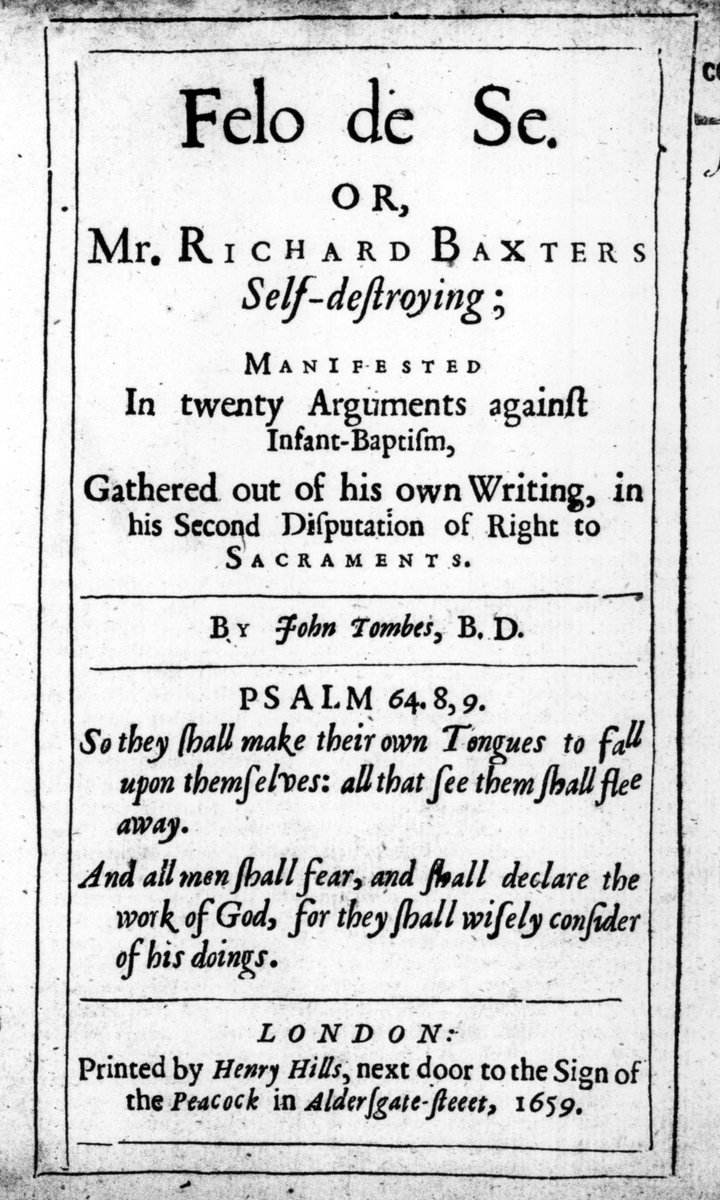
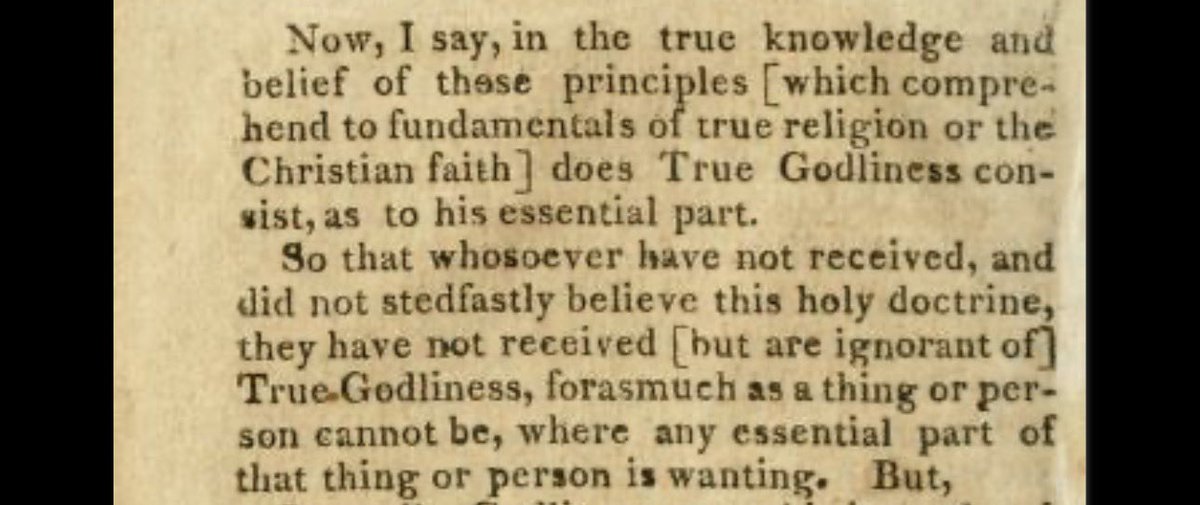
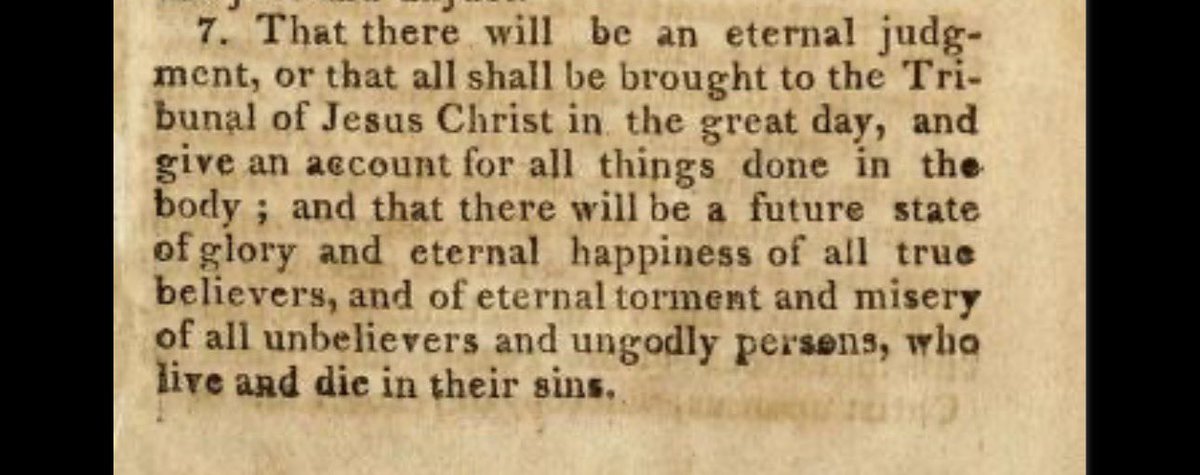
Keach saying eternal torment is a fundamental. To deny it is to deny true godliness and therefore to not be a Christian.
The Particular Baptist tweet mediaThe Particular Baptist tweet media
English
1
2
14
853