Dr. Michael Moeller, ND

938 posts

Dr. Michael Moeller, ND banner
Dr. Michael Moeller, ND

Dr. Michael Moeller, ND

@DoctaMoe

☦️ John 8:36 Doctor in SoCal & Idaho Telehealth for Optimization and Longevity Testosterone & Peptides

Katılım Mart 2021
177 Takip Edilen558 Takipçiler
Sabitlenmiş Tweet
Dr. Michael Moeller, ND
One thing I think people are massively missing in the GLP-1 / retatrutide debate: The populations in these studies are usually: -older -severely overweight or obese -metabolically unhealthy -often sedentary -low protein intake -not resistance training -on multiple cardiometabolic medications Then people in the biohacker / fitness space who are already 12–20% body fat, resistance training 4–6x/week, eating high protein, optimized hormones, good sleep, etc try to directly apply those outcomes to themselves. That’s where a lot of the confusion comes from. People keep making blanket statements like: “Look how much muscle loss happens on GLP-1s.” But in my clinical experience, younger healthier metabolically optimized patients often preserve muscle VERY well especially when: -protein is adequate -resistance training is present -weight loss is gradual -hormones are optimized -sleep/recovery are good Taking a 40-year-old lifter from 20% body fat → 15% body fat is NOT the same physiological situation as taking a 72-year-old sedentary diabetic from 38% body fat → 25%. Those are completely different humans with completely different metabolic environments. This is why individualized medicine matters. The real nuance isn’t: “Tirzepatide vs Retatrutide” or “GLP-1s are good/bad” The real nuance is: -Who is the patient? -What is their starting point? -What are their goals? -What are they doing with training, protein, hormones, sleep, and lifestyle while using these tools?
English
28
16
261
33.5K
Dr. Michael Moeller, ND
7 years ago, a good friend of mine, 32 years old, working full-time while raising 2 special needs children, came to me with every symptom of low testosterone. He told me: “Moe, I can either: 1) Work out in the morning 2) Show up great at work 3) Play with my special needs kids 4) Have energy for intimacy with my wife Most days I can do two. Some days three. But I can never do all four.” I told him to get tested. His testosterone came back at 232 ng/dL. Insurance required a second test. It came back at 254 ng/dL. He was told he was still in the “normal range” and denied treatment. So he went to a cash-pay clinic. They optimized his testosterone to ~800 ng/dL.7 years later: He’s in the best shape of his life Thriving at work Fully present for his children His marriage is stronger than ever He does all four now. Every day. A number on a lab sheet almost robbed a family of their husband and father. Medicine should treat patients not just reference ranges.
Dr. Alex Tatem@DrAlexTatem

A man with a testosterone level of 298 can qualify for TRT. A man with a testosterone level of 312 often can't. Same symptoms. Same risks. Completely different outcomes. The problem isn't testosterone. The problem is how we're diagnosing it. In this video, I break down why current low testosterone guidelines may be failing millions of men, the ongoing decline in testosterone levels across the population, and why the future of hormone optimization could look very different than it does today. Plus, I'm taking you inside the Enhanced Games to explore one of the most controversial questions in modern medicine: What happens when we stop limiting human performance? Watch the full video below 👇 #TRT #Testosterone #MensHealth #HormoneOptimization #LowTestosterone #Biohacking #EnhancedGames

English
0
0
2
110
Dr. Michael Moeller, ND
I'm truly sorry you went through that, and I'm glad you're still here. I have patients with depression and suicidal ideation whose lives were turned around by hormone and peptide optimization. Individual responses are real, in both directions. That's exactly why patient-centered, monitored care matters. Not one-size-fits-all prescribing. I hope you keep doing well.
English
1
0
0
37
Christian Hawk
Christian Hawk@ChristianHawk·
“It blows my mind I have to defend GLP-1 and peptides” as a naturopath 😂 Yeah, defending the same drugs that gave me two rounds of suicidal depression so severe I wanted to die every day. Stopped = never came back. 11 months later? Invasive melanoma + new thyroid tumor as parting gift. You share concerns but wave away pancreatitis and thyroid cancer with “rodent data” and industry RCTs while FDA scrubbed the suicide warning in 2026. America is getting sicker because of people like you pushing the next Big Pharma subscription. Medical records available upon request. #GLP1Scam #PharmaLies
English
2
0
0
53
Dr. Michael Moeller, ND
It absolutely blows my mind that as a naturopathic doctor I’ve had to defend TWO things endlessly in my career: 1. Testosterone Replacement Therapy 2. Now = GLP-1 meds and other peptides Meanwhile America keeps getting sicker. Patients stacking meds likes it out of Pez dispenser. I’d rather see the right patient on low-dose tirzepatide or retatrutide long-term than on: -blood pressure meds -diabetes drugs -pain meds and the list goes on. Same with TRT. The evidence is clear for properly selected patients, yet people still act shocked a naturopathic doctor would use hormones. Do I still think diet, lifestyle, sleep, exercise, stress reduction, and root-cause medicine matter? Absolutely. But pretending severely metabolically unhealthy patients are all going to meditate, meal prep deadlift, and colon cleanse their way out of disease is not reality. The GLP-1 data is still evolving and I’ll change my position if the evidence changes. But right now, the benefits for many patients appear to outweigh the risks by a long shot. Medicine should be about outcomes, nuance, and risk vs risk.
English
3
3
20
663
Dr. Michael Moeller, ND
I share many of your concerns and have seen similar things clinically. The pancreatitis data cited comes from flawed observational studies. The SUSTAIN & LEADER trials actual RCTs showed no significant signal. Thyroid cancer risk? Rodent C-cell data that hasn't translated to humans in any clinical trial. Gallbladder issues are real. I tell every patient that. Muscle loss is real and manageable with adequate protein, resistance training, and hormone optimization. Nuance matters when patients are making treatment decisions.
English
1
0
0
27
Matt Cook
Matt Cook@CookResearcher·
@DoctaMoe if only people would listen to you and they could enjoy muscle loss, higher chances of thyroid, pancreatic cancer, gallbladder problems, SIBO and possibly colorectal cancer. Pancreatitis is 9X more prevalent with these drugs. And that leads to cancer quite often.
English
1
0
0
29
Sara Stein MD
Sara Stein MD@sarasteinmd·
They were mild chronic. average age was 54, Severe illness, advanced age, frailty all exclusion criteria. Baseline Metabolic Profile BMI: Ranged from ~30.2 kg/m² (ELIXA) to ~32.3 kg/m² (REWIND, PIONEER 6) across the CVOTs  HbA1c: Ranged from 7.3% (REWIND, a lower-risk population) to 8.8% (HARMONY), with most trials enrolling patients with HbA1c between 7.7% and 8.8%  Baseline metformin use: 51–81% across trials Cardiovascular and Renal History The enrolled populations were heavily enriched for cardiovascular risk. Key comorbidities included: Prior cardiovascular disease (CVD): Ranged from 31% (REWIND) to 100% (ELIXA, HARMONY). ELIXA uniquely enrolled patients with a recent acute coronary event within 180 days.  Heart failure: Present in 9–24% of trial participants, with SUSTAIN-6 having the highest proportion (~24%)  Chronic kidney disease (eGFR <60 mL/min/1.73 m²): Present in 18–28.5% of participants; mean baseline eGFR was approximately 74–79 mL/min/1.73 m² across trials
English
1
0
1
531
Dr. Michael Moeller, ND
One thing I think people are massively missing in the GLP-1 / retatrutide debate: The populations in these studies are usually: -older -severely overweight or obese -metabolically unhealthy -often sedentary -low protein intake -not resistance training -on multiple cardiometabolic medications Then people in the biohacker / fitness space who are already 12–20% body fat, resistance training 4–6x/week, eating high protein, optimized hormones, good sleep, etc try to directly apply those outcomes to themselves. That’s where a lot of the confusion comes from. People keep making blanket statements like: “Look how much muscle loss happens on GLP-1s.” But in my clinical experience, younger healthier metabolically optimized patients often preserve muscle VERY well especially when: -protein is adequate -resistance training is present -weight loss is gradual -hormones are optimized -sleep/recovery are good Taking a 40-year-old lifter from 20% body fat → 15% body fat is NOT the same physiological situation as taking a 72-year-old sedentary diabetic from 38% body fat → 25%. Those are completely different humans with completely different metabolic environments. This is why individualized medicine matters. The real nuance isn’t: “Tirzepatide vs Retatrutide” or “GLP-1s are good/bad” The real nuance is: -Who is the patient? -What is their starting point? -What are their goals? -What are they doing with training, protein, hormones, sleep, and lifestyle while using these tools?
English
28
16
261
33.5K
Dr. Michael Moeller, ND
@S1561778S @SBakerMD Thanks for the love. My opinion, a Dr job is to walk each individual patient through all therapies and help them lay out the risk versus the reward.
English
1
0
3
97
Dr Shawn Baker 🥩
Dr Shawn Baker 🥩@SBakerMD·
If you go on a weight loss drug such as a GLP-1 or similar just to shed a few pounds, you will likely become psychologically dependent upon these drugs for life. If you stop and regain the weight, which almost all do, you will find it extremely difficult to lose the weight again without the drugs. You then will be forever dependent on these drugs, something you may not have considered, The folks that “hop on a cycle of Reta” to get lean for the summer are going to be stuck on these drugs for life, or at least the vast majority will. Just watch it play out!
English
237
54
641
1.5M
Alex Aaron
Alex Aaron@alexaaronlab·
Am I the only mf on this app with a rhr under 48 on over 4 mgs Reta?
English
29
1
59
13.6K
Dr. Michael Moeller, ND
What’s also crazy is I see all the biohacking bros dropping affiliate peptide links underneath videos like this… then turning around furious when Eli Lilly runs a commercial during a football game. THEY ONLY CARE ABOUT MONEY!!! Let’s at least be honest that incentives exist on both sides. I actually agree with Robert more than people probably think. I’ve had plenty of patients use “research purposes only” peptides and thankfully most did completely fine. I also understand why people get frustrated paying 2–5x more for compounded medications. But let’s not pretend the ONLY variable is price. The raw powder itself is often relatively cheap. Water is cheap too yet people still pay for bottled water because sourcing, filtration, transport, storage, and quality control matter. Same principle here. The real questions are: • Was it manufactured in a sterile environment? • Was it tested properly? • Is the COA legitimate? • Was it transported/stored correctly? ----------->IF SOMETHING GOES WRONG… WHO IS ACTUALLY ACCOUNTABLE?<----------- That matters when you’re injecting something under your skin. Not all research peptide companies are the same either. Some may genuinely try to do things well. Others are literally middlemen importing bulk powder and rebottling it with almost no oversight. And this is the part many biohackers ignore: As a physician, I legally and ethically cannot tell patients to buy injectable products from random overseas websites. If something goes wrong, I’m responsible. I could lose my license or get sued. Meanwhile, influencers can promote affiliate peptide links all day long with essentially zero medical liability while making tens of thousands per month doing it. That doesn’t automatically make them shaddy however let’s stop pretending there’s no financial incentive there too. I’m also against price gouging. I understand why people seek cheaper options. People travel overseas for cheaper surgeries and dental work all the time. Some have incredible outcomes. Some end up with disasters. You can hire unlicensed contractors to renovate your house for 70% less too. Sometimes it works perfectly. Sometimes it becomes a nightmare. From a pure risk-management standpoint, I still believe compounded/manufactured medications generally carry a lower probability of contamination, sterility issues, dosing inconsistencies, or quality-control problems than the average “research only” source.
English
0
0
2
332
Robert ₿reedlove
Robert ₿reedlove@Breedlove22·
I compared prescription peptides to research peptides. Here is what I noticed after testing both:
English
16
7
119
33.4K
🐊ZK For Tre🐊
🐊ZK For Tre🐊@ZKForTre·
@DoctaMoe Apologies on my end— this wasn’t meant as a criticism of you… more of a jumping off point. Sorry for the confusion.
English
1
0
0
300
🐊ZK For Tre🐊
🐊ZK For Tre🐊@ZKForTre·
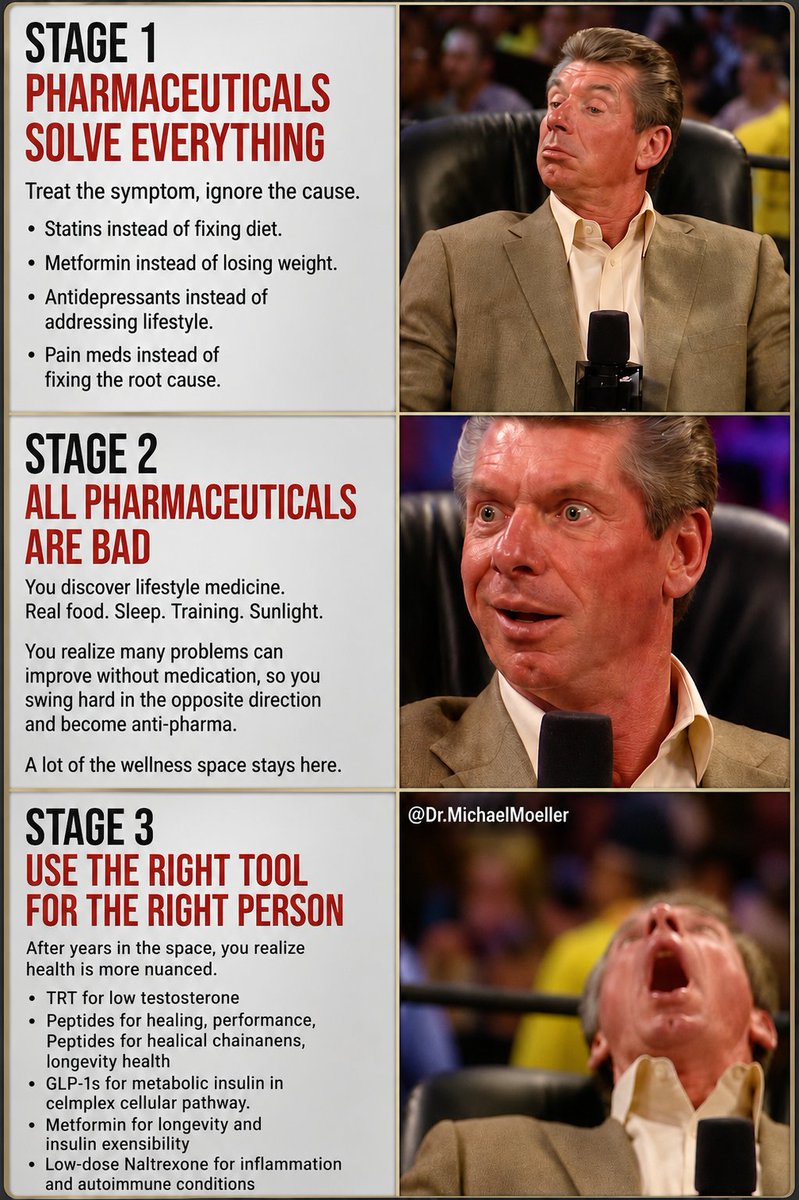
It remains baffling to me that the biohacker crowd is actively choosing Reta over tirzepatide. Human psych continues to baffle.
Dr. Michael Moeller, ND@DoctaMoe

One thing I think people are massively missing in the GLP-1 / retatrutide debate: The populations in these studies are usually: -older -severely overweight or obese -metabolically unhealthy -often sedentary -low protein intake -not resistance training -on multiple cardiometabolic medications Then people in the biohacker / fitness space who are already 12–20% body fat, resistance training 4–6x/week, eating high protein, optimized hormones, good sleep, etc try to directly apply those outcomes to themselves. That’s where a lot of the confusion comes from. People keep making blanket statements like: “Look how much muscle loss happens on GLP-1s.” But in my clinical experience, younger healthier metabolically optimized patients often preserve muscle VERY well especially when: -protein is adequate -resistance training is present -weight loss is gradual -hormones are optimized -sleep/recovery are good Taking a 40-year-old lifter from 20% body fat → 15% body fat is NOT the same physiological situation as taking a 72-year-old sedentary diabetic from 38% body fat → 25%. Those are completely different humans with completely different metabolic environments. This is why individualized medicine matters. The real nuance isn’t: “Tirzepatide vs Retatrutide” or “GLP-1s are good/bad” The real nuance is: -Who is the patient? -What is their starting point? -What are their goals? -What are they doing with training, protein, hormones, sleep, and lifestyle while using these tools?

English
7
1
16
8K
Ez-Peptides LLC
Ez-Peptides LLC@ez_peptides·
Well articulated, @DrMichaelMoeller — this is exactly the right framing. Chronic obesity carries well-documented long-term risks: sustained inflammation, insulin resistance, hypertension, sleep apnea, increased cancer incidence, and elevated cardiovascular mortality. These are not theoretical — they’re measurable drivers of reduced lifespan and quality of life. GLP-1 receptor agonists are not risk-free (GI side effects, muscle loss concerns, unknown very long-term effects), but for many patients they represent a meaningful reduction in overall risk profile compared to untreated severe obesity. The data continues to show: - Clear cardiovascular benefit (SELECT trial) - Improved metabolic parameters - Emerging observational signals on cancer outcomes Medicine has always been about risk vs. risk, not risk vs. zero risk. The key is proper patient selection, realistic expectations, lifestyle support, and ongoing monitoring. #GLP1 #ObesityMedicine #RiskBenefit #MetabolicHealth #EvidenceBased
English
1
0
3
53
Joe Patterson
Joe Patterson@Patterdude·
@DoctaMoe It’s honestly just a dumb debate. Anyone arguing the negative consequences of a GLP1 for a morbidly obese person is either stupid or has a financial interest in bariatric surgery.
English
1
0
4
197
MICROPLASTICS #1 💯💯💯
@DoctaMoe I am moderately overweight but lift and exercise consistently with genetically high cholesterol. After two months of retatrude my cholesterol dropped by 100 points only losing 5 lbs
English
2
0
19
1.6K
Dr. Michael Moeller, ND
I get what you're saying… I always prefer diet and lifestyle. With that being said, you can call them whatever scary chemical nickname you want, the obesity epidemic isn’t exactly winning safety awards either. Even dihydrogen monoxide becomes dangerous in high enough amounts. Medicine is risk vs risk, not risk vs magical perfection.
English
1
1
2
81
Dr. Michael Moeller, ND
Hey brother, I think your math might be off a bit Waist reduction is also going to vary based on: baseline body fat % starting waist size how obese the population was trial design/duration dosing/escalation diet/training differences I actually really like tirzepatide too, probably more than retatrutide overall right now from a tolerability standpoint. But I don’t think it’s accurate to say all the extra weight loss on reta is ‘definitely muscle.’ Rapid weight loss from ANY GLP-1/GIP drug causes some lean mass loss. That’s not unique to reta. The bigger question is body composition, visceral fat reduction, metabolic improvements, and how much functional muscle people retain while losing 60–80+ pounds.
English
0
0
3
380
Dr. Michael Moeller, ND
“People will regain the weight when they stop.” Yeah... and many people regain the weight when they stop any chronic intervention. The real question is: What carries the greater long-term risk? • Being 40–80 lbs overweight for 20–30 years • Insulin resistance, sleep apnea, hypertension, fatty liver, inflammation, joint degeneration, cardiovascular disease OR • Staying on a low-dose GLP-1 / retatrutide long term under medical supervision As a doctor, I absolutely prefer diet, exercise, sleep, stress management, muscle building, and lifestyle first. But after treating real humans, you also learn something important: Most people struggle to sustain massive lifestyle change long term. --->We have to meet patients where they are, not where we wish they were. And for many people, losing 30–80 lbs becomes the catalyst that finally allows them to: • exercise without pain • improve confidence • reduce emotional eating • sleep better • improve metabolic health • become more active with their kids/family • actually stick to healthier habits Could some people stay on these medications long term? Probably. But we already accept long-term interventions all the time: • caffeine • blood pressure meds • TRT • caffeine • CPAP machines Obesity itself is a chronic disease with massive downstream consequences. Also, not everyone can afford: • organic grass-fed everything • personal trainers • saunas • luxury wellness protocols • 90 minutes/day in the gym Sometimes medicine helps bridge the gap between ideal health and real life. The goal shouldn’t be ideological purity. The goal should be improving human health outcomes and quality of life.
English
0
0
0
24
Dr. Michael Moeller, ND
@hubermanlab They did the same thing with HCG. Restrict access. Create shortages. Triple the price. Put it on backorder. I had a patient quoted almost $10,000 for ONE vial! And people still think this system is primarily designed around patient access? Follow the incentives.
English
0
0
7
893
Andrew D. Huberman, Ph.D.
“39 is not 40” is the vernacular of peptide-positive & coded response to Pharma wanting to hold patents longer & charge more for say, retatrutide. (If it’s 39 amino acids it’s a synthetic not a biologic & that = less $ for Lilly over time). If >40aa it’s $$$$ for much longer.
English
41
153
751
139.5K