Edaw
21 posts


@walterkirn I always read your name as Walter Kim. Maybe it's poor vision. You can imagine the problem. I will leave it at that.
English

In 2023 I was contacted by a frightened-sounding anonymous caller who identified herself as a pharma insider and who spent 90 minutes on the phone explaining that a new pandemic was being prepared and would be launched in "a couple of years," possibly before an election. She did not know the specific pathogen involved but said it would have a high mortality rate and be spread through human contact, though it was not known in the past to spread easily through human contact. It would cause a terrible panic.
She knew all this, she said, by reading various signals available to insiders in the vaccine development world. She said these sort of signals had allowed her to know that Covid was coming years before it did. I asked her why whistleblowers had not alerted us first,
"You don't understand this business," she said. "It would be the end of your career. Or worse."
I could not verify her claims, of course, though various facts in her presentation did check out, and she called on a randomly generated number. I feared I was being punked and did not know what to do afterwards to pursue the matter.
English
Edaw retweetledi

Try the Grok Imagine agent mode beta!
Grok Imagine@imagine
Your entire creative workflow just collapsed into one infinite canvas. In @imagine Agent Mode, you can brainstorm, write, generate and edit images, then turn them into videos without leaving the page. Try it at grok.com/imagine, on desktop.
English


It's for graded net making and net repair.
Core physical facts:
- 12 faces with different hole diameters (≈4–25 mm range)
- Sizes are structured but not linear → fit a ~1.2× geometric progression
- Knobs allow grip and keep holes unobstructed
- Cast in leaded bronze → precise, durable, low-wear edges
- Found mainly in NW Europe (river/coastal fishing regions)
- Often deliberately deposited, not discarded tools
Why this matches net-making:
1) Mesh sizing requirement
- Nets depend on consistent loop size
- Effective sizing must scale proportionally, not linearly
- The observed ~1.2× progression gives usable, non-redundant size steps
2) Functional use
- Each hole acts as a mesh gauge: wrap cord → tie knot → remove → consistent loop
- Multiple holes = multiple mesh sizes in one tool
3) Unique advantages over standard gauges
- Rapid switching between sizes (rotate object, no tool swap)
- Enables graded nets (large mesh → small mesh transitions)
- Excellent for repair work (match unknown mesh sizes on the fly)
- Durable vs typical wooden gauges
4) Geometry supports use
- 3D form = easy handling in wet conditions
- Knobs = grip + prevent surface interference
- Distributed faces = clear separation of size “settings”
Supporting context:
- Found in regions with intensive fishing (river + coastal)
- Fiber crafts (including nets) were economically essential
- Lack of markings fits a tactile, non-numeric sizing system
Bottom line:
The objects most plausibly function as multi-size mesh gauges based on a geometric scaling system, and net-making; especially graded construction and repair - is one of the strongest, most practical use cases consistent with both the physical design and regional context.
English

Good attempt, but that's not it
The mysterious Roman dodecahedrons are stamps... or at least what's left of them. The frame that you see is a snap-fit stamp holder... and a smart one, too.
The balls are used to keep the stampface from spinning, and the circle keeps the stamp from sliding in any direction. The grooves ensure the stamp doesnt "wobble" when pressed, and the corner balls help with that.
Each stampface would be a soft material the shape of a Pentagon with a round insert on the backside. This shape allows for 12 different stamps, and you could carry additional stampfaces is in your bag. This is why these dodecahedrons are always found in small bags, often with Roman coins. They were a business tool.
The varying shape of the hole is based on the size of the stamp impression required, which is why they sometimes vary, sometimes don't.
Whether these were for wax impressions or an actual ink stamp is unknown, however a sea sponge could be shoved into the body of the stamp and used to hold ink, then a soft wood face would secrete the ink as needed.
Notably, because of the size of the balls, there's a small gap between adjacent stamp faces which stops ink bleed from adjacent faces when you press the stamp down.
I can't stress enough how good of a design this is. It's really fantastic. There's nothing I would optimize.
I've posted about this before, but I didn't have any followers at the time. One of these days, I'll make a functional demo to show you all how it works.
J. Michael Straczynski@straczynski
I may have figured this out. The shape is perfect for carrying thread before spindles. One dodecahedron could carry a ton of thread in a very compact form and one bag could hold many colors, easily spooled out then tied off when done. The holes kept it from being too heavy.
English

@WallStreetMav I'm a great CEO, I'm innovative enough, and dogegone it, my companies like me!
English

Elon at his annual performance review:
"You are doing awesome"
Kalshi@Kalshi
JUST IN: Only Elon Musk can fire Elon Musk from SpaceX
English

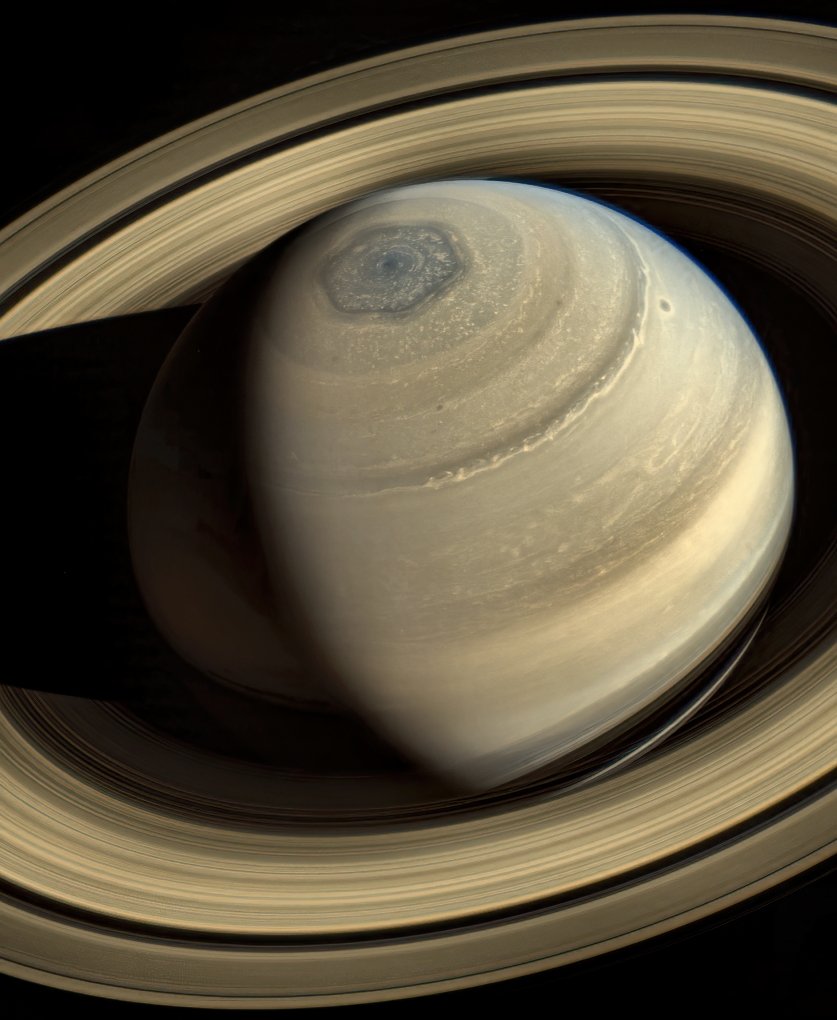
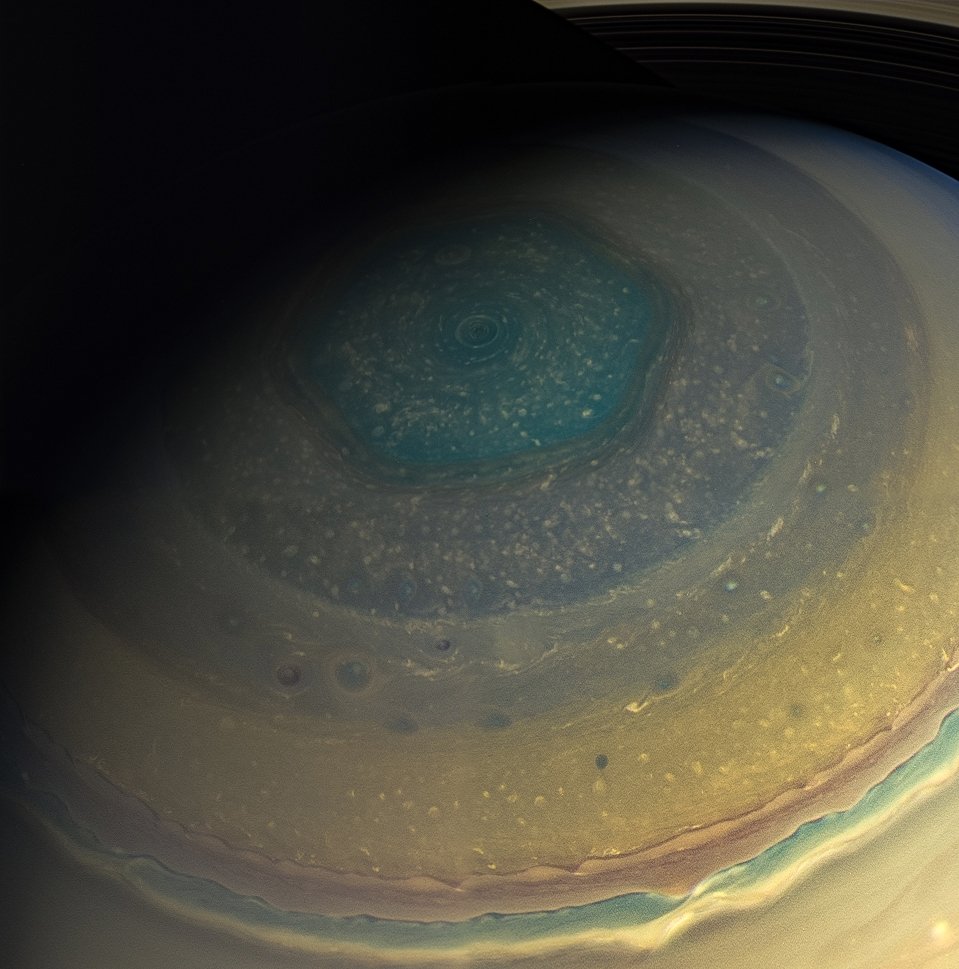
@CuriosityonX The hexagon rotates at exactly the same period as Saturn’s internal radio emissions (Saturn Kilometric Radiation, or SKR) - 10 hours, 39 minutes, and 24 seconds. 👽
English

🚨: Saturn has a giant hexagon at its north pole. And nobody fully understands why.
This isn't a glitch. It's not a trick of the light.
It's a six-sided storm system, perfectly geometric, swirling at the top of a gas giant 1.4 billion kilometers away.
It is 15,000 miles wide. You could drop two entire Earths side-by-side inside this storm and they would be swallowed whole.
And it doesn't just sit on the surface. The vortex drills 300 kilometers straight down into Saturn's atmosphere, churning with winds that would shred anything we've ever built.
No other planet in our solar system has anything like it. Just Saturn. Just the north pole. Just this impossibly clean shape that nature somehow decided to draw at the top of the world.
Space doesn't do straight lines. Until it does.


English

President Trump Agrees To 2-Week Iran Ceasefire (If Strait Is Opened Immediately) zerohedge.com/energy/75-gulf…
English

@DrBrianKeating Systems across scales may be governed by a universal instability toward short-term optimization over long-term coherence.
English

Terence Tao told me something that is both clarifying and unsettling about large language models.
The mathematics underlying today’s LLMs is not especially exotic.
At its core, training and inference mostly involve linear algebra, matrix multiplication, and some calculus.
This is material a competent undergraduate could learn. In that sense, there is very little mystery about how these systems are constructed or how they run.
And yet the real mystery begins there.
What we do not understand well is why these models perform so impressively on certain tasks while failing unexpectedly on others. Even more striking, we lack reliable principles that allow us to predict this behavior in advance.
Progress in the field remains largely empirical. Researchers scale models, change datasets, run experiments, and observe what emerges.
Part of the difficulty lies in the nature of the data itself.
Pure randomness is mathematically tractable.
Perfectly structured systems are also tractable.
But natural language, like most real-world phenomena, lives in an intermediate regime. And we humans hate that liminal space!
It is neither noise nor order but a mixture of both. The mathematics for this middle ground remains comparatively underdeveloped.
So we find ourselves in a peculiar position. We understand the machinery, yet we cannot reliably explain its capabilities. We can describe the mechanisms that produce these systems, but we cannot predict when new abilities will appear or how performance will vary across tasks.
That tension, between relatively simple mathematical tools and highly unpredictable behavior, is the central puzzle of modern AI.
(Video link in comments)
English