
Hugh Naylor retweetledi

JUST IN: Sweden says France’s nicotine pouch ban is an “attack on the Swedish way of life”
English
Hugh Naylor
9K posts



It’s hard to overstate how deeply Netanyahu views this moment as a possible personal and political defeat. A U.S.–Iran agreement under Trump would be a major blow to him mainly diplomatically, but above all politically. For years, Netanyahu built his political identity around being “Mr. Iran,” the leader who insisted that only pressure, deterrence, and force could stop the Iranian regime. And now, after multiple rounds of operational successes but one resounding strategic failure, and after finally succeeding in drawing the United States into direct confrontation with Iran, he may be forced to accept an agreement that not only legitimizes the very regime he sought to weaken, but also exposes the collapse of his long-standing Iran doctrine. His approach was based on the belief that more pressure, more military power, and tighter coordination between Israel and the United States would eventually either force Iran into submission or destabilize the regime itself. Instead, the result has been a more radicalized, more resilient, and more dangerous Iran, one that even Washington now hesitates to confront militarily again. If this confrontation ends with an agreement, an even bigger strategic question emerges: what future American president would be willing to commit U.S. forces to another major Middle Eastern conflict after seeing the political and military costs of this one? Netanyahu had what may have been his greatest opportunity to prove his central strategic theory: that a close Israeli-American military partnership could fundamentally reshape Iran and perhaps even threaten the regime’s survival. By every indication, that assumption failed. Against this backdrop, reports of a tense conversation between Trump and Netanyahu become much easier to understand. They also help explain the extraordinary level of pressure now coming from Jerusalem, and the extent to which Netanyahu is trying to persuade, or pressure, the administration not to move toward a deal with Tehran. The bottom line is that a U.S.–Iran agreement would not only signal the failure of the military confrontation Netanyahu pushed for, but also the collapse of the broader strategic doctrine he has championed since entering Israeli politics, all on the eve of what could be the most critical election of his career. In that sense, the next Israel’s leadership need to learn the fundamental lessons of this war. More than ever, this conflict demonstrates the urgent need for Israel to develop a different long-term strategy for dealing with Iran and especially to understand the following: Israel’s confrontation with Iran will not bring normalization with the Arab world, nor will it resolve Israel’s most fundamental security challenges, first and foremost, the Palestinian issue. The belief that regime change in Iran would transform Israel’s position in the Middle East was always detached from reality. In fact, the consistent opposition of Gulf leaders and major Arab states to further escalation against Iran has demonstrated this repeatedly throughout the conflict. Israel will not be able to use the “Iran card” as a substitute for addressing the core political issues shaping the region. Anyone arguing that military confrontation with Iran alone can unlock normalization is mistaken and, more importantly, misleading others about the strategic reality of the Middle East. Because despite the undeniable tactical and operational achievements of the campaign, this failure may ultimately leave Israel facing a more dangerous strategic reality, one that has not fundamentally improved its position in the Middle East. #IranWar

By all accounts, Trump is very close to accepting a deal to try to open the Strait and essentially punt nuclear talks to the future. And of course, Netanyahu is working against it. I wonder if he will give a speech in Congress.


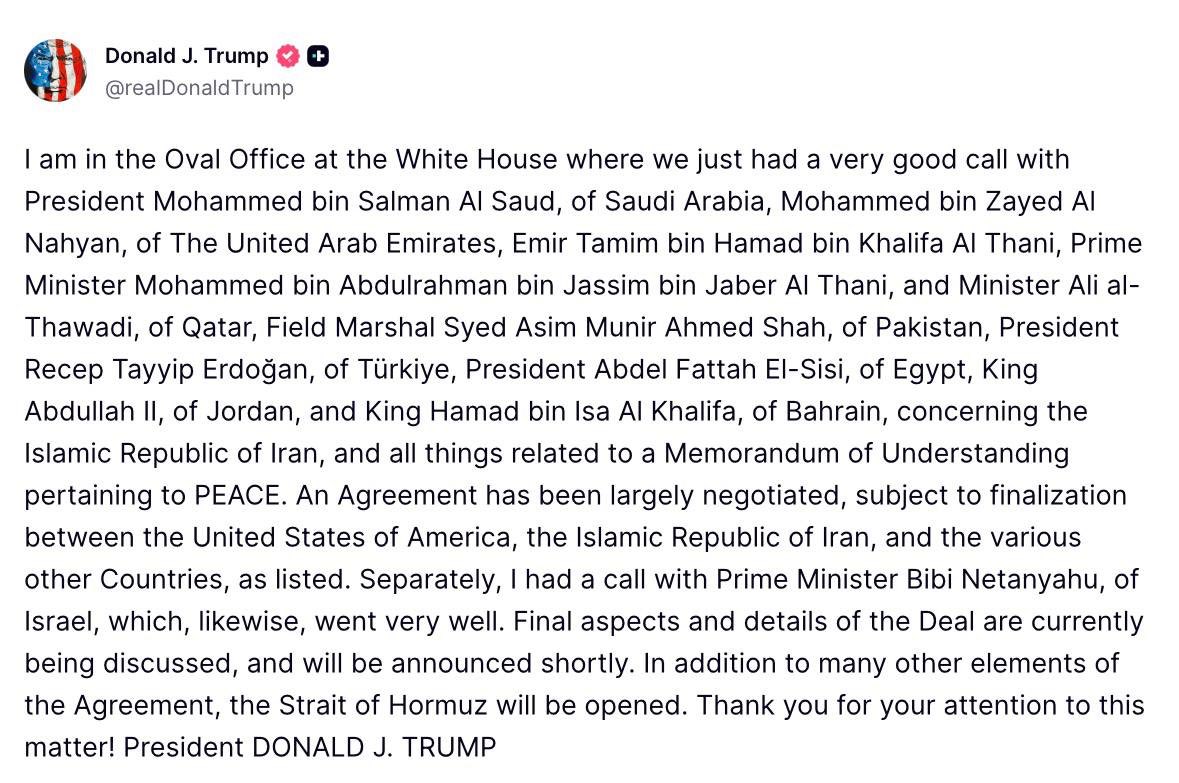
⭕️ Trump announces Iran deal “largely negotiated” 🔸President Trump posted from the Oval Office Saturday that a memorandum of understanding with Iran has been “largely negotiated, subject to finalization,” following a call with regional leaders and a separate call with Israeli Prime Minister Benjamin Netanyahu, which he said “went very well.” The leaders on the call included: ● Mohammed bin Salman, Saudi Arabia ● Mohammed bin Zayed Al Nahyan, UAE ● Emir Tamim bin Hamad Al Thani and Prime Minister Mohammed bin Abdulrahman Al Thani, Qatar ● Field Marshal Asim Munir, Pakistan ● President Recep Tayyip Erdoğan, Turkey ● President Abdel Fattah El-Sisi, Egypt ● King Abdullah II, Jordan ● King Hamad bin Isa Al Khalifa, Bahrain 🔸“An Agreement has been largely negotiated, subject to finalization between the United States of America, the Islamic Republic of Iran, and the various other Countries, as listed,” Trump wrote on Truth Social. “Final aspects and details of the Deal are currently being discussed, and will be announced shortly. In addition to many other elements of the Agreement, the Strait of Hormuz will be opened.” 🔸A source close to Iran’s negotiating team told IRGC-linked Fars News earlier Saturday that Hormuz control remains one of three unresolved sticking points — with Iran only committing to restoring ship numbers to previous levels under Iranian management and along routes determined by Tehran. 🔸Fars also reported that U.S. officials involved in the negotiations sent indirect messages to the Iranian side through intermediaries urging them to “ignore Trump’s tweets,” saying his public statements are “purely for domestic and media consumption” and that “his position at the negotiation table is completely different.” A source told Fars that Trump “has realized that Iran is not one to give concessions” and sends word through intermediaries that his statements “should not be paid attention to.”



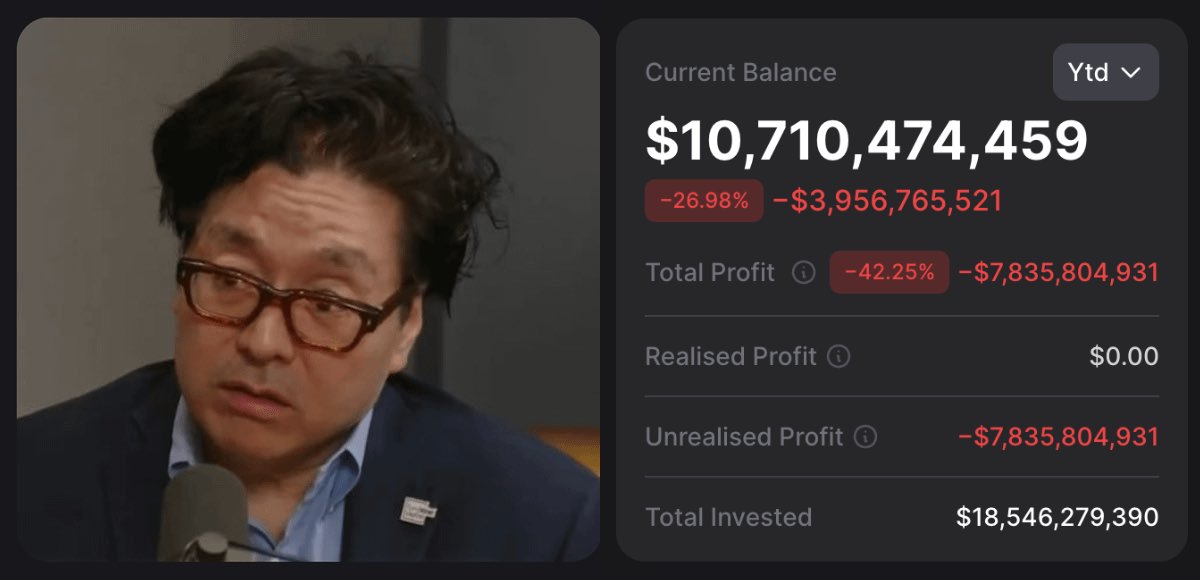



'A "win" for Keving Warsh will be if the Fed holds off hiking, not if they cut.' -- Neil Dutta of @RenMacLLC







Today, we share a breakthrough on the planar unit distance problem, a famous open question first posed by Paul Erdős in 1946. For nearly 80 years, mathematicians believed the best possible solutions looked roughly like square grids. An OpenAI model has now disproved that belief, discovering an entirely new family of constructions that performs better. This marks the first time AI has autonomously solved a prominent open problem central to a field of mathematics.
basically every form of anything has that problem, the simpsons is now written by people whose only background is in watching the simpsons, snl with snl, star wars with star wars, pop music with pop music
