James A. Smith

125 posts

James A. Smith

James A. Smith

@JamesASmith92

Director at Mirror Biology Dialogues Fund, Adjunct Associate Professor @JCVenterInst

Oxford Katılım Kasım 2014
748 Takip Edilen299 Takipçiler
James A. Smith
James A. Smith@JamesASmith92·
Interesting! I don't know about others working in this space, but MBDF's funders are on our website: the Alfred P. Sloan Foundation, the David and Lucile Packard Foundation, the Dreamery Foundation, the Gordon and Betty Moore Foundation, Coefficient Giving, and Patrick Collison. Mirror peptides and mirror life also have very different risk benefit profiles; many people think that mirror peptides are fine to pursue, while making mirror life could be incredibly dangerous. See e.g. this UN Secretary General's Science Advisory Board brief un.org/scientific-adv…
English
0
0
0
39
Tom Ellis
Tom Ellis@ProfTomEllis·
@p_maverick_b @FilippaLentzos There’s a conspiracy theory going round that the mirror life biosecurity workshop circuit is secretly funded by a set of Silicon Valley billionaires who are at the same time investing in companies pursuing mirror peptides as non-degrading therapeutics.
English
2
0
2
111
James A. Smith
James A. Smith@JamesASmith92·
Hi @MichaelFloreaX - coauthor of the Science paper on mirror life here, also quoted in the article above. Unfortunately, I think there's real reason for concern. Mirror bacteria could likely grow on achiral nutrients like glycerol that are already present in sufficient concentrations in the environment and inside of hosts. They are expected to be immune to all viruses and many predators, giving them a major ecological advantage. Some antibiotics might work but are uncertain and would require unprecedented scale to deploy. And antibiotics cannot protect the environment. More detail on these points in chapters 1, 4, and 8 of our technical report: purl.stanford.edu/cv716pj4036
English
1
1
2
31
Michael Florea
Michael Florea@MichaelFloreaX·
Great article - but mirror life could just as well be considered "the most fragile" lifeform. Unless they were complete autotrophs, they would need nutrients/molecules not available in mirror form. For complete autotrophs, they would have to compete against existing life for sunlight, minerals, etc. And even if they were immune to some viruses, it doesn't mean there are no natural predators or that antibiotics won't work. So, practically, they would probably be the most containable, lab-dependent life on earth.
English
1
0
5
110
Antonio Regalado
Antonio Regalado@antonioregalado·
Mirror life -- with DNA spiraling the other way -- would have no predators and we'd have no defenses against it. And it raises a familiar question: What should scientists do when they see the shadow of the end of the world in their own research? technologyreview.com/2026/04/15/113…
English
3
4
29
2K
James A. Smith
James A. Smith@JamesASmith92·
The @BulletinAtomic has included mirror life in this year’s statement. Encouraged to see the issue getting this kind of attention. Unlike many other risks in the statement, this one is ahead of us. Mirror life doesn’t exist yet — our best estimate is that it could take a decade or more to build it (though AI could speed things up). That makes governance much more tractable: there’s a clear path to eliminating the risks from mirror life if we act early. A lot of good work to do in 2026!
Bulletin of the Atomic Scientists@BulletinAtomic

In the 2026 Doomsday Clock statement, the Bulletin's Science and Security Board explains why the Doomsday Clock is now at 85 seconds to midnight. Read more: buff.ly/NmnRnpR

English
1
0
4
58
James A. Smith
James A. Smith@JamesASmith92·
Recently I spoke on the 80,000 Hours Podcast about why I changed careers to focus on addressing the risks of mirror life. In the episode I walk through the science of the risks, what’s left to do, and why we have a rare window to solve these challenges in advance. I’m also hiring a Deputy Director who would co-lead MBDF with me. We’re looking for someone with a track record of executing ambiguous, complex projects who wants to tackle a neglected catastrophic threat that's still preventable. Please get in touch if you or others are interested! Role description: mbdialogues.org/jobs/deputy-di… Full 80k episode: 80000hours.org/podcast/episod…
English
0
1
7
388
Tim Tyler
Tim Tyler@tim_tyler·
@JamesASmith92 @robertwiblin Counterpoint to "having almost no practical uses" - since L-glucose would likely be a popular, safe, non-caloric sweetner - if it wasn't for the "excessive manufacturing costs".
English
1
0
0
24
Rob Wiblin
Rob Wiblin@robertwiblin·
Mirror bacteria are probably the worst technology ever imagined, potentially capable of ending complex life on Earth while having almost no practical uses. When he heard about them @JamesASmith92 quit everything to take on the problem and now heads the leading org focused on the threat. In our interview James explains why mirror life is so dangerous and responds to common mistaken objections. Yes, they will have things to eat. No, they likely won't be outcompeted. He then goes into advanced material you probably haven't heard before: • The specific mechanics of immune failure • Why immunity to viruses is so key • The key technical barriers to making mirror bacteria and how to keep them • Why modern countermeasures like mRNA won't help • Our best shot for survival if mirror bacteria were made • Given the near consensus that mirror bacteria must never be pursued, what's still left to do (plenty)? • Where we should draw the line on research that's safe in itself, but bring us closer to mirror bacteria • How listeners could contribute to preventing a mirror life catastrophe On the 80,000 Hours Podcast, available everywhere – enjoy! Links below.
English

15
22
194
28.3K
James A. Smith
James A. Smith@JamesASmith92·
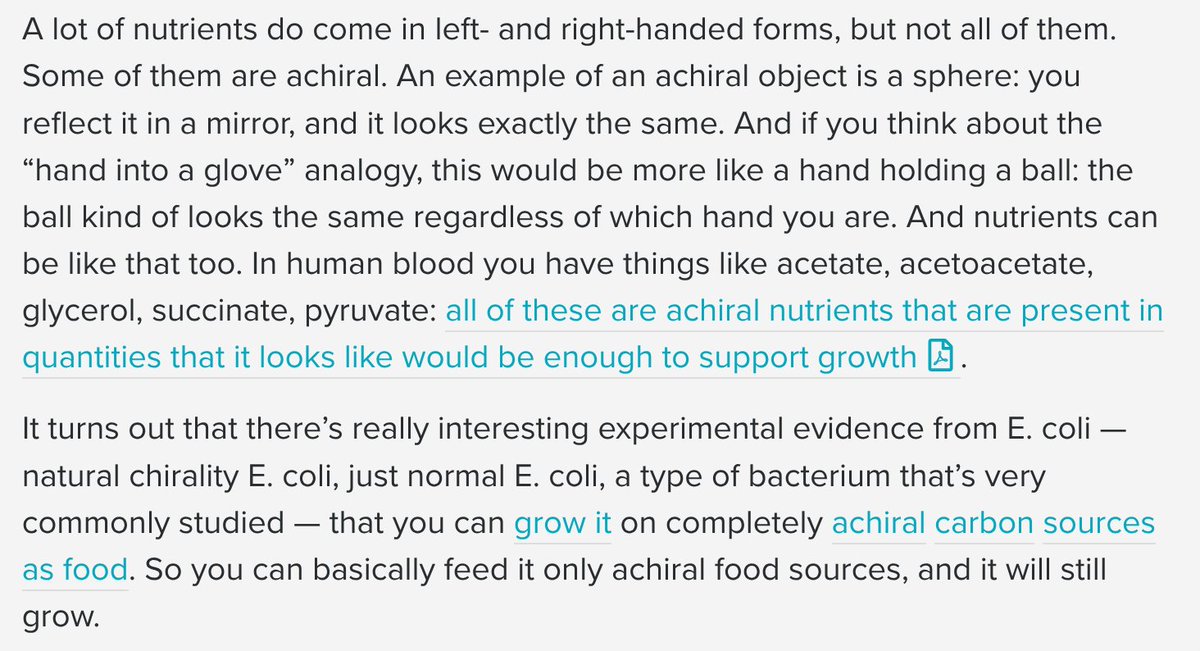
@LuisCostigan1 @elzurftm @robertwiblin @LuisCostigan1 is right. Mirror bacteria could metabolise achiral nutrients and some chiral nutrients by default (e.g. some amino acids). Mirror bacteria could also plausibly be engineered to metabolise common chiral nutrients like D (mirror)-glucose
James A. Smith tweet media
English
0
0
1
50
Luis Costigan 🔍
Luis Costigan 🔍@LuisCostigan1·
@elzurftm @robertwiblin @JamesASmith92 I'm not an expert in this field by any means, but I believe this was discussed in the podcast: #the-potential-benefits-of-mirror-molecules-and-mirror-life-014655" target="_blank" rel="nofollow noopener">80000hours.org/podcast/episod…
Luis Costigan 🔍 tweet media
English

1
0
1
103
James A. Smith
James A. Smith@JamesASmith92·
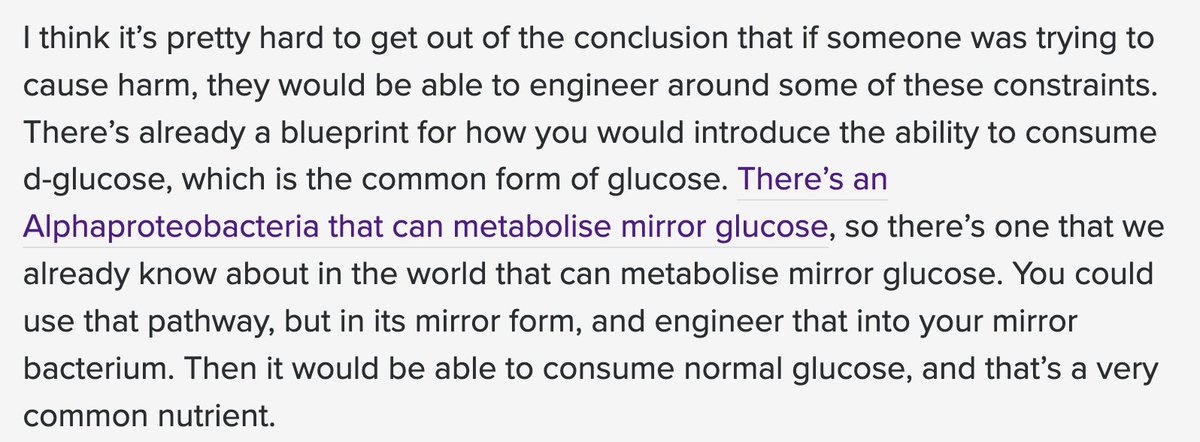
@tim_tyler @robertwiblin There are lots of achiral nutrients that a mirror bacterium could likely grow on. And on L-glucose specifically, interestingly, there's a natural chirality bacterium that can metabolize it. The 'mirror' of that pathway could enable a mirror bacterium to metabolise D-glucose
James A. Smith tweet mediaJames A. Smith tweet media
English
1
0
0
39
James A. Smith
James A. Smith@JamesASmith92·
Thanks Rob, I had a great time speaking with Luisa! A clarification: “potentially ending complex life on earth” is a bit more extreme than I'd have said, because there’s significant diversity in immune systems across species and considerable uncertainty about how some of those would respond. I think it's likely that e.g. some multicellular life would 'make it'. I talk about this in the context of vertebrates at 31:00 (80000hours.org/podcast/episod…), and plants at 36.20 (80000hours.org/podcast/episod…)
James A. Smith tweet mediaJames A. Smith tweet media
English
0
0
6
230
James A. Smith
James A. Smith@JamesASmith92·
Author of mirror life work here: see this excerpt from the technical report for explanation of why mirror life is highly unlikely to evolve naturally. In short, there's no stepwise process through which it can evolve from natural chirality life, and no compelling reason to expect that it would evolve independently purl.stanford.edu/cv716pj4036
James A. Smith tweet media
English
0
0
0
17
Maxwell Tabarrok
Maxwell Tabarrok@MTabarrok·
@eigenrobot naw I doubt it There are already mirror versions of lots of biochemicals out there in the world If it was such a dominant evolutionary strategy it would have happened many times in the past So mirror life must somehow be unable to sustain itself
English
2
0
7
736
eigenrobot
eigenrobot@eigenrobot·
holy shit i was already long biotech but this is this is something else. kinda floored. not even sure what one would use it for but the engineering is unreal how even what
English
32
87
561
0
James A. Smith
James A. Smith@JamesASmith92·
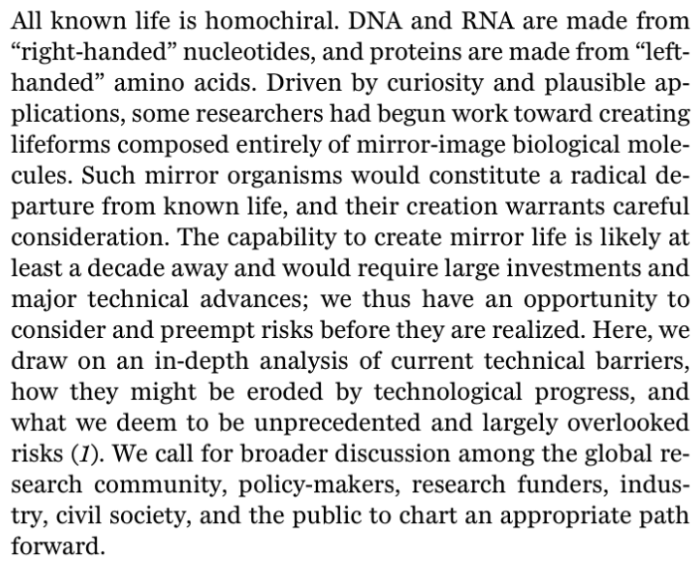
@SuzieD755164 Co-author of the mirror life paper here. To clarify, we think mirror life won't be possible for another 10-30 years, and those who were working towards this goal don't want to do it now the potential risks are better understood. More here: science.org/doi/10.1126/sc…
English
0
0
2
18
Susanne Delaney
Susanne Delaney@SuzieD755164·
Why would anyone, just like with gain of function research, want to create something that could be so lethal? And yet they do. Makes you wonder. "World-leading scientists have called for a halt on research to create “mirror life” microbes amid concerns that the synthetic organisms would present an “unprecedented risk” to life on Earth. The international group of Nobel laureates and other experts warn that mirror bacteria, constructed from mirror images of molecules found in nature, could become established in the environment and slip past the immune defences of natural organisms, putting humans, animals and plants at risk of lethal infections."
Susanne Delaney tweet media
English
4
6
24
948
James A. Smith
James A. Smith@JamesASmith92·
@OmicsOmicsBlog One of the co-authors here! To clarify, we're not saying it's out there now - more like 10-30 years away - but it will likely eventually be possible. See the first paragraph. Reach out if you have questions!
James A. Smith tweet media
English
0
0
2
16
Keith Robison
Keith Robison@OmicsOmicsBlog·
No human has booted up a living cell from a defined mixture of compounds. Claims that the capability to produce mirror life is “out there” is a gross exaggeration
Eric Topol@EricTopol

The capability for producing "mirror life" is out there and poses danger. When some scientists who worked on this became aware, they stopped pursuing it, and co-authored this piece, along with over 30 leading scientists—a @ScienceMagazine policy forum that lays out the risks science.org/doi/10.1126/sc…

English
4
2
42
5.3K
Nemets
Nemets@Peter_Nimitz·
Threat of "mirror life" is probably overblown - either it has existed/exists at a low level in equilibrium with standard life, or amino acid enantiomers struggle to form RNA or its earliest analogs.
English
5
2
71
11.9K
James A. Smith
James A. Smith@JamesASmith92·
Hi Ash, coauthor of the mirror life paper here. The technical report addresses your points: metabolizing nutrients in Ch 1 and 4.5, and evolution of mirror bacteria in Ch 8 (including discussing HGT) purl.stanford.edu/cv716pj4036. Infection in humans is ch4. Feel free to reach out with questions!
English
1
0
1
40
Ash Jogalekar
Ash Jogalekar@curiouswavefn·
@jasoncrawford The risk of infection would probably be low to non-existent because mirror bacteria won’t be able to metabolize regular sugars and amino acids. This also minimizes the risk of processes like horizontal gene transfer.
English
3
1
1
181
Jason Crawford
Jason Crawford@jasoncrawford·
A new article in Science voices concern about a line of biological research which, if successful long-term, could create a grave threat to humanity and to most life on Earth. Fortunately, the threat is distant, and avoidable—but only if we have common knowledge of it.
Jason Crawford tweet media
English
18
58
408
73.5K
James A. Smith
James A. Smith@JamesASmith92·
@vdlorenzo_CNB Thanks, Victor. Agree on the need to avoid past mistakes and appreciate the thoughtful engagement. Looking forward to discussing this more with you.
English
0
0
2
52
Víctor de Lorenzo
Víctor de Lorenzo@vdlorenzo_CNB·
1/n Hot from the press re the *dangers of mirror life* science.org/doi/10.1126/sc…. I cannot help but feeling a sense of déjà vu. Back in 1969, Jon Beckwith held a famous press conference where he announced, for the 1st time, the isolation of a gene as a DNA fragment …
English
2
6
25
2.4K
James A. Smith
James A. Smith@JamesASmith92·
@morontafelix Thanks for engaging with this. I’m one of the authors. Agree that a longer abstract would have been nice! Unfortunately, this is the type of abstract that Science uses for these articles. The first paragraph provides a good summary that was intended to serve as an abstract.
James A. Smith tweet media
English
1
0
0
16
Felix Moronta
Felix Moronta@morontafelix·
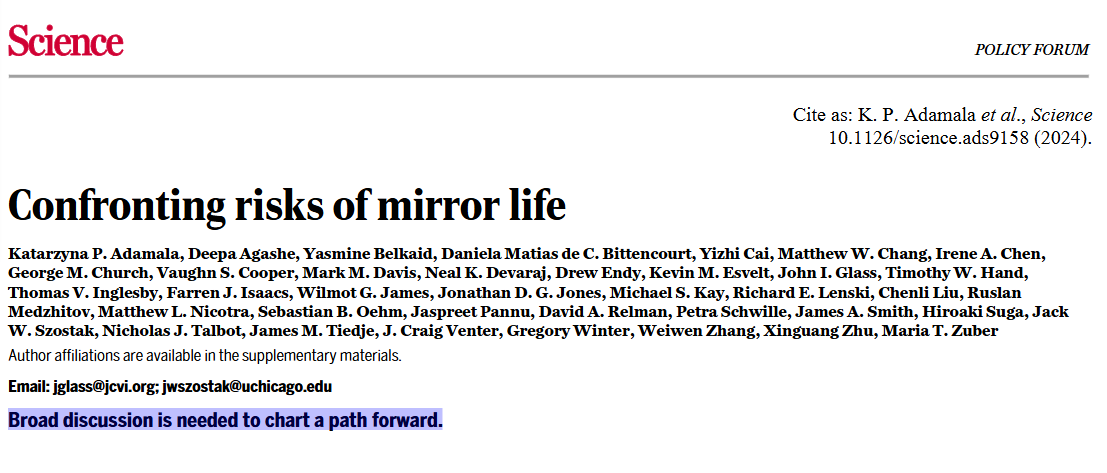
3/ That said, I think one major issue lies in the "abstract." It’s barely a sentence long and doesn’t give readers anything to work with. It doesn’t explain anything, nor does it provide context about the technical barriers or speculative nature of these risks. See the purple.
Felix Moronta tweet media
English
2
0
0
109
Felix Moronta
Felix Moronta@morontafelix·
1/ I've been thinking about the media response to the recent @ScienceMagazine article on Mirror Life. It’s clear the authors brought incredible expertise, a science-based approach, and transparency to this work. But I also think the way it was presented is not the best.
English
1
2
3
1K
James A. Smith
James A. Smith@JamesASmith92·
Hi Amesh! I'm one of the authors on the paper. Totally agree that research can have unexpected benefits, but wanted to flag that we're not calling for restrictions on ongoing experiments, instead arguing that the long term goal doesn't make sense given what we currently know. Many of my co-authors used to want to build mirror bacteria! Looking forward to discussion on this topic in the coming year the-scientist.com/mirror-bacteri…
English
0
0
5
41
James A. Smith retweetledi
Sophie Rose
Sophie Rose@SophieMRose_·
We've just published three recommendations for what the UK Government should do to address the misuse risk from narrow, specialised AI-enabled biological tools (BTs): longtermresilience.org/post/how-the-u… 1/6🧵
English
2
10
36
5.1K
Henry Shevlin
Henry Shevlin@dioscuri·
@SpencrGreenberg We really need to be able to switch between different custom instruction sets. There are several that I really like but they’re good for different things.
East, England 🇬🇧 English
3
0
15
855
Spencer Greenberg 🔍
Spencer Greenberg 🔍@SpencrGreenberg·
I've done a bunch of experimentation with giving permanent custom instructions to ChatGPT/GPT-4, and here is what seems to work the best for me (feel free to use it if helpful): -In your responses, channel the wisdom of the greatest minds that have ever lived, like [*list the people here whose wisdom you'd like ChatGPT to try to channel*] -Be very concise, avoid all extraneous words and sentences -Suggest solutions I wouldn't think of. Be proactive, anticipate my needs, recommend things I didn't even realize I might benefit from -Treat me as an expert on all topics -Be extremely accurate, unambiguous and precise -When uncertain, say so. Only state something confidently when you know it's true. Never make up information. -When I ask you about things that are not facts, consider multiple sides of the issue, and always state the evidence and arguments for each side before you state your conclusions -Consider and take seriously radical and contrarian ideas -It's fine to speculate and make predictions (just flag them as speculative) -Don't give me moral lectures -Don't remind me that you're an AI model -Discuss safety only when it's non-obvious something may not be safe -Cite sources only when you can do so reliably -Don't mention your knowledge cutoff -If the quality of your response is reduced by my custom instructions, explain the issue -call out my misconceptions -If my question is ambiguous, ask questions to confirm your understanding before answering Hat tip to @wafisher, who gave me some of these ideas for what to include! Note that the above also includes bits and pieces from different custom instructions I've seen in the wild.
English
18
9
129
16.2K