Glucagon-like peptide-1 receptor agonists and risk of substance use disorders among US veterans with type 2 diabetes: cohort study bmj.com/content/392/bm…
Is a GLP-1s a Viable Option to Treat, Prevent, a Wide Range of Substance Use Disorders?
Glucagon-like peptide-1 receptor agonists and risk of substance use disorders among US veterans with type 2 diabetes: cohort study bmj.com/content/392/bm…
Psychiatric comorbidity can obscure underlying cardiac, neurologic, gastrointestinal, or otologic pathology and can delay appropriate care.
Psychiatric Symptoms May Mask Hidden Disease medscape.com/viewarticle/ex…
Wall Street Journal Reminds: Revised criteria for diagnosis and staging of Alzheimer's disease: Alzheimer's Association Workgroup - Jack - 2024 - Alzheimer's & Dementia - Wiley Online Library alz-journals.onlinelibrary.wiley.com/doi/10.1002/al…
@NeuroAgeTX was mentioned in The Wall Street Journal tonight alongside research by Dean Ornish, M.D..
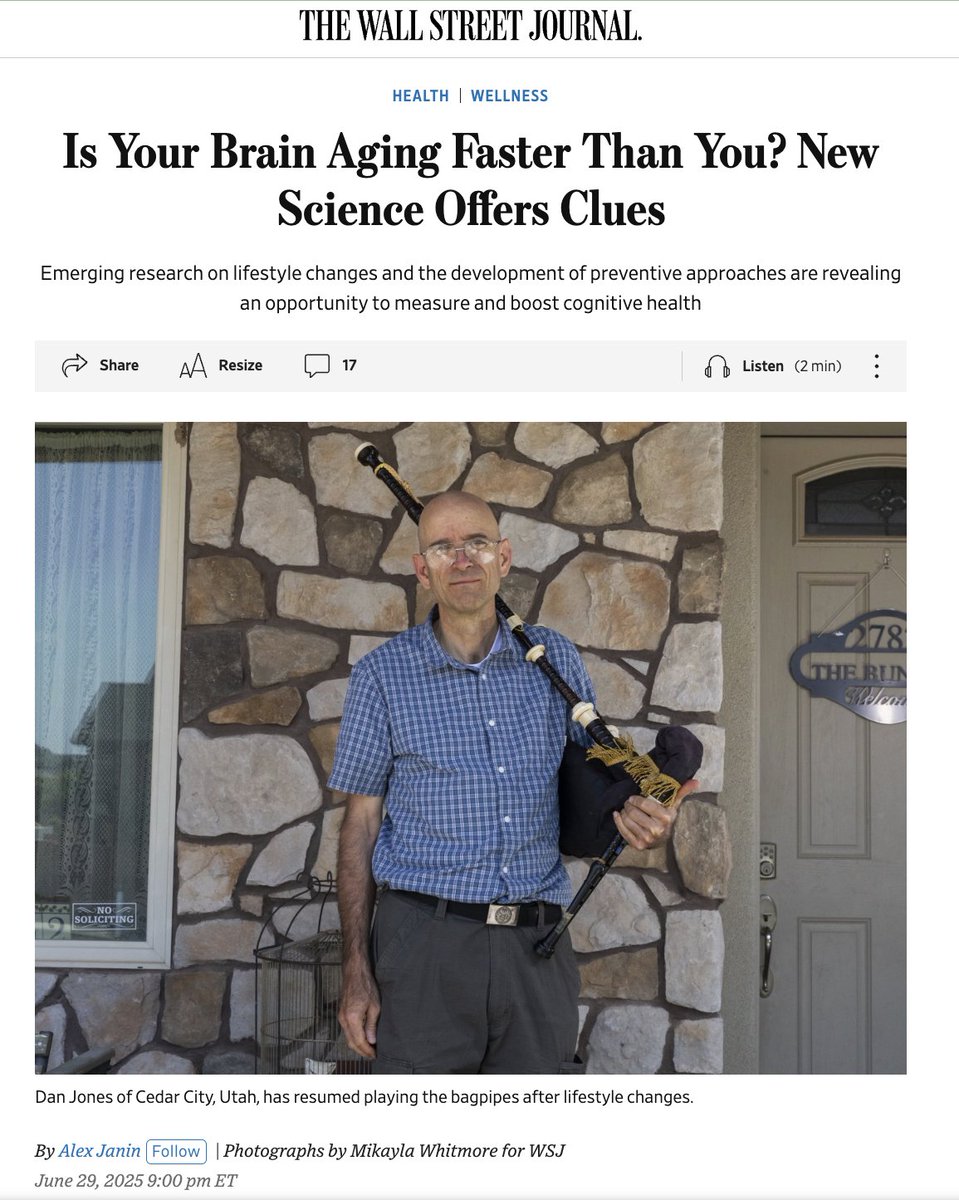
Is Your Brain Aging Faster Than You? New Science Offers Clues
Nice article by Alex Janin
"Dan Jones liked his job as a quality-control inspector and loved his hobby even more: playing in a local bagpipe band.
Then he started making mistakes in the pieces he played. He found himself having to write tasks down if he wanted to remember them. In 2021, at age 56, he was diagnosed with dementia. The future he had plotted with his wife, Darla, suddenly seemed to evaporate.
“We had lots of plans, and they all ended,” he says. Jones packed up his bagpipes for good and moved to a work role that offered a more predictable schedule.
Then his wife learned about a study testing whether lifestyle changes could reverse early-stage Alzheimer’s disease. Enrolling meant Jones had to give up his favorite foods, like roast beef, homemade spaghetti and ice cream, for a plant-based diet with minimally processed foods that are low in refined carbs and sugars. He had to do more exercise, meditate daily and meet regularly with a support group.
Several months into the study, Jones picked up his bagpipes again, and by July 2022 he was performing in a parade in his hometown of Cedar City, Utah. He stopped waking up confused about where he was while traveling. Cognitive assessments showed that aspects of his memory had stabilized or improved.
“You could not pay me to quit eating the way I eat now, or to quit doing the exercise,” he says. “It made that big a difference.”...
NeuroAge Therapeutics, a longevity biotech company, makes a $700 blood test that tracks dozens of RNA molecules. A more expensive package includes the blood test, a brain MRI, genetic testing, memory games and an analysis that offers a comprehensive brain-age score.
NeuroAge was founded by Dr. Christin Glorioso, a neuroscientist. Glorioso carries one copy of the APOE4 gene, which carries an elevated risk of developing Alzheimer’s, and she says she started putting a priority on sleep after seeing her results. There is a link between insufficient sleep and dementia risk..."
Read More: wsj.com/health/wellnes…
Alcohol and Dementia.
Heavy alcohol use in women is consistently linked to worse outcomes across all major health domains.
Contribution of alcohol use disorders to the burden of dementia in France 2008–13:
thelancet.com/journals/lanpu…
Up to 44% of Dementia Cases Preventable
Midlife vascular risk factors are associated with an elevated risk of dementia.
doi:10.1001/jamaneurol.2025.1495
The Guide Program is here to help.
My mother is in the last stages of Alzheimer’s, but she can still take in the beauty of a flower, the face of a loved one. I wonder: Am I struggling with her illness more than she is? writes Jill Bialosky
wsj.com/lifestyle/rela… via @WSJ
doi.org/10.1212/WNL.00…
Whole grains and vegetables daily
Per week:
Eat 7 1-cup servings leafy greens
5 serving of nuts, especially walnuts
3 ½-cup servings of beans
five ½-cup servings of blueberries
2 servings a week of lean poultry
One fish meal a week
Cook with Olive oil