
@mbatiaranking💫 retweetledi
@mbatiaranking💫
384 posts


@mbatiaranking💫
@JosephMbatia8
project manager💫💫 Life is a journey Never mind the past Live the present🤡 Comedian
Nairobi, Kenya Katılım Ocak 2017
1.1K Takip Edilen152 Takipçiler

@mbatiaranking💫 retweetledi
@mbatiaranking💫 retweetledi

@mbatiaranking💫 retweetledi

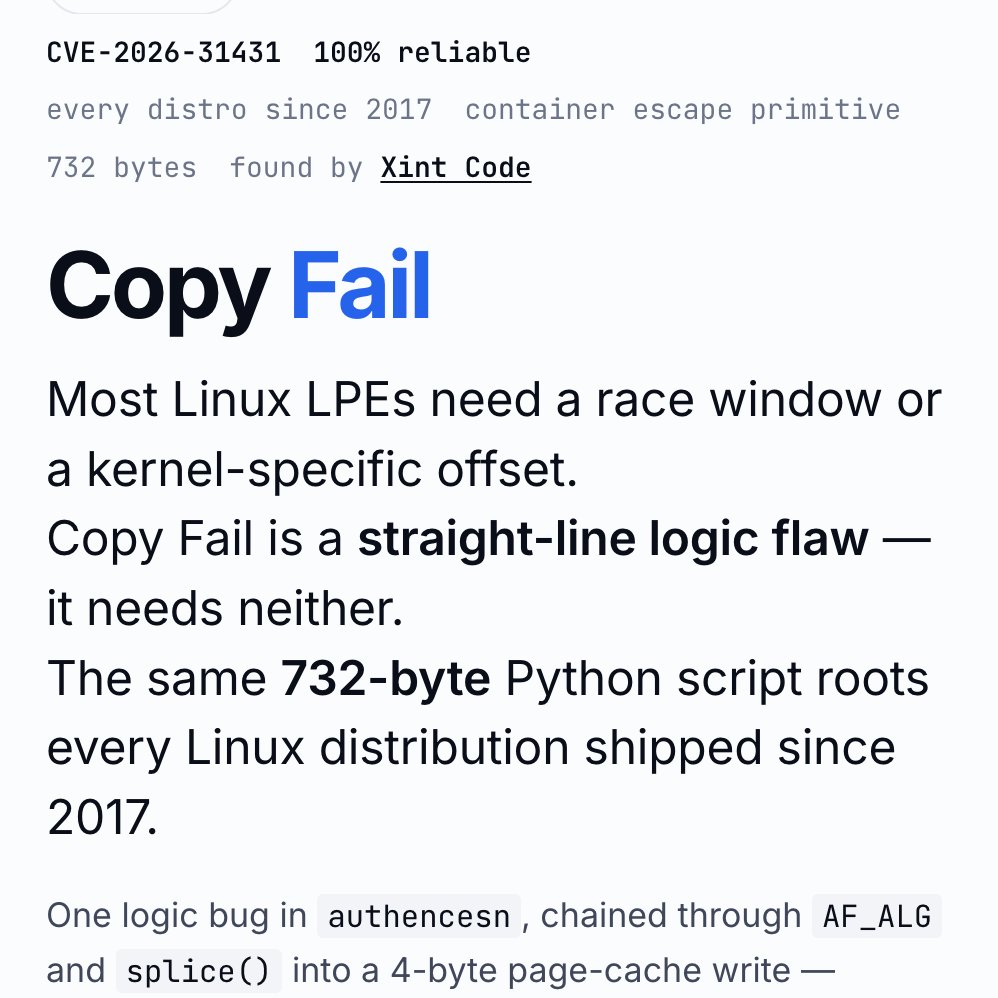
‼️🚨 BREAKING: An AI found a Linux kernel zero-day that roots every distribution since 2017. The exploit fits in 732 bytes of Python. Patch your kernel ASAP.
The vulnerability is CVE-2026-31431, nicknamed "Copy Fail," disclosed today by Theori. It has been sitting quietly in the Linux kernel for nine years.
Most Linux privilege-escalation bugs are picky. They need a precise timing window (a "race"), or specific kernel addresses leaked from somewhere, or careful tuning per distribution. Copy Fail needs none of that. It is a straight-line logic mistake that works on the first try, every time, on every mainstream Linux box.
The attacker just needs a normal user account on the machine. From there, the script asks the kernel to do some encryption work, abuses how that work is wired up, and ends up writing 4 bytes into a memory area called the "page cache" (Linux's high-speed copy of files in RAM). Those 4 bytes can be aimed at any program the system trusts, like /usr/bin/su, the shortcut to becoming root.
Result: the next time anyone runs that program, it lets the attacker in as root.
What should worry most: the corruption never touches the file on disk. It only exists in Linux's in-memory copy of that file. If you imaged the hard drive afterwards, the on-disk file would match the official package hash exactly. Reboot the machine, or just put it under memory pressure (any normal system load that needs the RAM), and the cached copy reloads fresh from disk.
Containers do not help either. The page cache is shared across the whole host, so a process inside a container can use this bug to compromise the underlying server and reach into other tenants.
The original sin was a 2017 "in-place optimization" in a kernel crypto module called algif_aead. It was meant to make encryption slightly faster. The change broke a critical safety assumption, and nobody noticed for nine years. That bug then rode every kernel update from 2017 to today.
This vulnerability affects the following:
🔴 Shared servers (dev boxes, jump hosts, build servers): any user becomes root
🔴 Kubernetes and container clusters: one compromised pod escapes to the host
🔴 CI runners (GitHub Actions, GitLab, Jenkins): a malicious pull request becomes root on the runner
🔴 Cloud platforms running user code (notebooks, agent sandboxes, serverless functions): a tenant becomes host root
Timeline:
🔴 March 23, 2026: reported to the Linux kernel security team
🔴 April 1: patch committed to mainline (commit a664bf3d603d)
🔴 April 22: CVE assigned
🔴 April 29: public disclosure
Mitigation: update your kernel to a build that includes mainline commit a664bf3d603d. If you cannot patch immediately, turn off the vulnerable module:
echo "install algif_aead /bin/false" > /etc/modprobe.d/disable-algif.conf
rmmod algif_aead 2>/dev/null || true
For environments that run untrusted code (containers, sandboxes, CI runners), block access to the kernel's AF_ALG crypto interface entirely, even after patching. Almost nothing legitimate needs it, and blocking it shuts the door on this whole class of bug...

English
@mbatiaranking💫 retweetledi

Charleston White goes off on 2 married groupies who attempt to seduce him on the plane! 😳😭
“Y’all Know They Easy To F*ck Just Look At Them”
English
@mbatiaranking💫 retweetledi

@mbatiaranking💫 retweetledi


@mbatiaranking💫 retweetledi

"I have no regrets" 🗣️
Victor Wanyama reflects on his career after announcing his retirement ⚽️
English
@mbatiaranking💫 retweetledi

Average loan interest rates by top banks in Kenya as of February 2026:
StanChart Kenya — 12%
Stanbic Kenya — 12%
Absa Kenya — 13.8%
Equity Bank — 15%
DTB Kenya — 14.5%
I&M Bank — 14.8%
KCB Bank — 15%
Co-op Bank — 15.5%
NCBA Bank — 15.5%
Sidian Bank —15.9%
Family Bank—16%
HFC limited —17.5%
CBK data.
Indonesia
@mbatiaranking💫 retweetledi

He took his babe to an NBA game only for her to try getting the player’s attention.😳
English
@mbatiaranking💫 retweetledi

@mbatiaranking💫 retweetledi

A case has left Kenyans talking after a man reportedly moved to court over KSh1,500 fare money he claims was "eaten" by a woman.
The man allegedly sent the woman KSh1,500 via M-Pesa on March 4, 2026, to facilitate her travel to Eldoret after she reportedly confirmed she would make the trip. However, he now claims she received the money but failed to travel as agreed.
Despite acknowledging receipt of the fare, the woman did not fulfill the agreed journey and allegedly kept the full amount without any lawful justification. The man, identified as Chrysostom Makhumbiri Agava, then reportedly instructed his lawyers to step in.
Things took a dramatic turn when the lawyers demanded not just the original KSh1,500, but an extra KSh10,000 in legal and administrative fees, bringing the total amount being sought to KSh11,500. The woman was reportedly given 48 hours to pay or risk being dragged to the Small Claims Court.
The legal notice further warns that if she fails to comply, the case could proceed in court with added consequences including interest at court rates, filing fees, process server charges, and more legal costs.

English
@mbatiaranking💫 retweetledi


@anxietymsgs Im enjoying Gods creation thus worshipping him
English


@mbatiaranking💫 retweetledi

In America, the recent exposè, against Somali community in Minneapolis, was termed the "biggest fraud scheme in US history". Now a bombshell follow-up to a "Minnesota Covid feeding scandal" has emerged, tracing a river of these stolen American taxpayer dollars, in billions of shillings, directly to a quiet property company in Nairobi’s South C. FULL STORY 👇

English
@mbatiaranking💫 retweetledi


@mbatiaranking💫 retweetledi

Everyone needs to hear this…
The Empty Boat Mindset:
// a visual thread //

English

