@BreannaMarque15@KernCMC@Mathgarden I definitely agree! Students should find purpose and make connections. It will help them stay motivated and eager to learn more.
@KernCMC@Mathgarden We should always try to connect our curriculum with the lives and stories of our students so that they are able to find purpose in what they are learning and be able to make the connection to their lives.
#EDEL5200
@KernCMC@Mathgarden We all have a math story and in order to help our students succeed we should learn theirs. It will allow us as educators to reflect on why that student feels a specific way about math, leading us to help them make connections to what they are learning.
@mrstafoya17@KernCMC@Mathgarden I completely agree Mia! We also have to ask ourselves if the students earning those A’s are actually understanding what is being taught.
@KernCMC@Mathgarden These practices are not useful in creating a positive learning environment. Grades place students in rankings and collaboration is not fully practiced. Grading on a curve halts productive struggle since the goal is to do well enough, not to truly learn & grow. #EDEL5200
Q2: Grades, rankings, & grading on the curve are traditions heavily embedded in the U.S. Are these practices useful when creating a positive learning environment where collaboration, growth, & productive struggle exist? #kerncmc#KernMathRecess#EDEL5200#MathRecess@Mathgarden
@KernCMC@Mathgarden These practices don’t create a positive learning environment. They simply shift our students’ focus from wanting to learn to finding ways to avoid getting an F. They should be able to realize that when they struggle they aren’t failing, but actually learning.
@Jessica53868217@KernCMC@Mathgarden I agree! Patience is definitely crucial when learning math. However, if math is made fun our students will be engaged and patient while learning.
@KernCMC@Mathgarden Math can help shape the person we become through patience. Patience is a big part of math. Through solving math problems a person can learn patience due to how long and concentrated it takes to just solve a math problem. It can allow for the person to be creative in how it solved
@KernCMC@Mathgarden Playing with math shapes the person we become because it teaches us “mental and physical freedom”. As educators we must allow our students to explore math problems and see what strategies they use to find the solution. This helps them explore and have a growth mindset.
@Amelia67562984@KernCMC@Mathgarden Struggling means that you are actually engaged and learning & failing definitely does not mean that you aren’t successful! This was something that stood out to me.
@KernCMC@Mathgarden#MathRecess states there are no shortcuts in learning mathematics. Everyone struggles with math in their own unique way. Failure doesn’t mean you aren’t successful, it is a part of your success. “Struggle is the only way” #EDEL5200
@HangingwithMrJ@KernCMC@WrightMath314 Yes, I agree with you Marshall. We need to encourage our students and push them to reach their goals. Speed tests don’t help them.
@KernCMC@WrightMath314 Including different methods and visuals for all students regardless of levels. Encourage effort and patience and not speed. Eliminate speed test. #MathRecess#EDEL5200
Q2: How do we ensure inclusion of every learner in our maths classrooms? What role do the four P’s serve in this goal? #kerncmc#KernMathRecess#EDEL5200
“Schools, teachers, and parents have always wanted their students to be good ‘at’ math”- this is an expectation that determines whether a child likes or dislikes math. #kernmathrecess#edel5200#MathRecess
@KernCMC@Mathgarden It is important to replace them with play because we need to engage our students and allow them to be able to see that there are many ways to solve a problem.
The four P’s (Projects, Peers, Passion, and Play) are crucial components to making math a fun and enjoyable subject! #MathRecess#edel5200#kernmathrecess
@KernCMC We can ensure inclusion of every learner in our math classroom by incorporating different approaches and techniques. For example, visuals and hands on activities. The four P’s play a huge role because they are what will change students’ perspective on math.
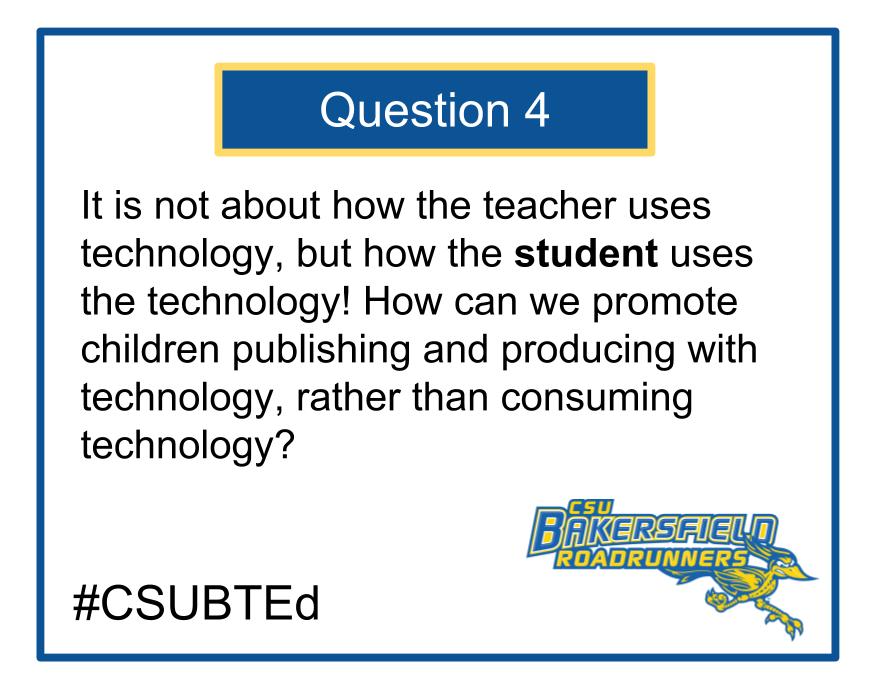
@teachsci8@EddiesClass@Tech_Buddha@Doctor2pi@Ststansberry A4) I think that you need to promote the use of technology for learning purposes and make it fun so that the students want to engage in using technology to produce projects. We need to make projects technology friendly and fun so that kids are encouraged! #csubted#csubedte4200
@teachsci8@EddiesClass@Tech_Buddha@Doctor2pi@Ststansberry 4A) I believe that children should know what is expected of them to do. They should also be trained with the technology and given examples, rather than just verbally saying what is expected because then the child will be confused. #CSUBTEd
@drtfulenwider@EddiesClass Wow this sounds like so much fun! This type of project can sure bring out the creativity in a student that they themselves don't realize they have! #CSUBTEd
@Ststansberry@EddiesClass@Doctor2pi@teachsci8@Tech_Buddha A2) My favorite memory is one from high school. My high school math teacher grouped us and we have to do a video incorporating a math lesson. Then we had to teach it to the class. It made it fun and engaging. #CSUBTEd
@Doctor2pi@EddiesClass@teachsci8@Tech_Buddha@Ststansberry A1) My favorite technology resource is Google Drive. At first it was confusing and I struggled to use it, but after a while I realized how easy and convenient it is! You can share work with others and multiple people can work on an assignment at the same time. #CSUBTEd