$oji

6K posts

$oji banner
$oji

$oji

@Olamitisoji

@cornell mba 2x-founder fúcktose intolerant | pressure-testing ideas, people, and systems

nyc Katılım Nisan 2011
219 Takip Edilen824 Takipçiler
$oji retweetledi
Somto Okonkwo
Somto Okonkwo@General_Somto·
“A Retired Nigerian Police Officer Flew From Toronto To Abuja In February 2026… But What Happened To His Suitcase Afterwards Has Left Many Shocked 👀..The Baggage Swap Scam Has Now Reached Nigeria And Hardly Anyone Is Talking About It. Even The Media Is Silent.”
English
35
411
815
70.1K
$oji retweetledi
Dr Ahmad Rehan Khan
Dr Ahmad Rehan Khan@AhmadRehanKhan·
Trump on Green Card: Highly talented INT graduates should not be forced to leave America after earning U.S. degrees. Keeping skilled immigrants means more innovation, stronger healthcare, more jobs, & $ billion companies built in America, not overseas.
Goshen, NY 🇺🇸 English
342
318
2.4K
823.3K
$oji retweetledi
Boring_Business
Boring_Business@BoringBiz_·
Maybe I will get crucified for saying this but I fundamentally believe that private equity is a force for good in our society You always hear stories of the companies that go wrong, but you never hear about the trillions in dollars in value and millions of jobs that private equity has created A lot more businesses in America would go bankrupt or be shut down if private equity didn’t exist because the owners simply have no interest in running the company anymore In simple words, more jobs would be lost every single year without private equity There are a thousand examples of this, and not a single one receives the same level of press coverage As private equity backed companies scale and grow, they hire more people. Capital gets allocated more efficiently across parts of the economy that deserve it. Business owners who have worked hard and broken their backs their entire lives to build their business get to retire off the fruits of their labor because of private equity
Elizabeth Warren@SenWarren

How private equity gutted local malls: Joann Fabrics, Red Lobster, Claire's, and more.

English
99
56
1.1K
220.5K
$oji retweetledi
Boring_Business
Boring_Business@BoringBiz_·
The uncomfortable truth that more young people need to hear Focusing on increasing your income by building new skills and relationships will earn you a lot more money than optimizing your stock portfolio
English
29
45
693
17.7K
$oji retweetledi
OpenAI Developers
OpenAI Developers@OpenAIDevs·
Share plugins in Codex across teams. Teams can now distribute custom plugins, reuse internal tools, and manage what’s available across their workspace. Available now to Business users. Enterprises can reach out to enable early access.
English
14
23
527
91K
$oji retweetledi
Nikita Bier
Nikita Bier@nikitabier·
Over the past month, we have identified a number of large accounts that have been programmatically reuploading content from smaller accounts to game the revenue share program and circumvent crediting the original author. We are now identifying these posts and allocating the impressions entirely to the creator. If you have insightful commentary about a post, we recommend using the Share Video or Quote feature to ensure your posts are properly attributed.
English
2.5K
3.9K
38.3K
3.2M
$oji
$oji@Olamitisoji·
@Lumi_rexx Congratulations 🎈🎊🎉
English
0
0
1
21
$oji retweetledi
Greg Brockman
the model alone is no longer the product
English
688
479
7.4K
1.1M
$oji retweetledi
Sam Altman
Sam Altman@sama·
what problem do you most hope AI will solve in the future? maybe we can help!
English
14.9K
733
12.6K
3.5M
$oji retweetledi
Zeb Evans
Zeb Evans@DJ_CURFEW·
Today we reduced headcount by 22%. The business is the strongest it's ever been. So I think it's important to be direct about what I'm seeing and why. First, I made this decision and I own it. I did it because the way to operate at the highest level of productivity is changing, and to win the future, ClickUp needs to change with it. Second, this wasn't about cutting costs. Most savings from this change will flow directly back into the people who stay. We'll be introducing million-dollar salary bands. If you create outsized impact using AI, you'll be paid outside of traditional bands. Most importantly, I have the deepest gratitude for those affected. We're doing this from a position of strength specifically so we can take care of people properly. Everyone affected receives a package aimed at honoring their contributions and easing the transition. I only see two options: wait for this to play out gradually in the market or be honest about what I'm seeing and act proactively. THE 100X ORGANIZATION The primary change is that we're restructuring around what I call 100x org. The goal is 100x output. The roles required to build at the highest level are fundamentally different than they were a year ago. Incremental improvements to existing systems won't get us there. We need new ones. That means creating enough disruption to rebuild rather than iterate on what's already broken. The common narrative is that AI makes everyone more productive. It doesn't. Many of the workflows of today, if left unchanged, create bottlenecks in AI systems. These roles will evolve. But waiting for that to happen naturally means falling behind now. The 100x org is actually heavily dependent on people - infinitely more than today. This is only possible with 10x people that have embraced and adopted new ways of working. THE BUILDERS, AGENT MANAGERS, AND FRONT-LINERS — THE BUILDERS: 10X ENGINEERS I don't think most companies have internalized what's actually happening with AI in engineering. The common narrative is that AI makes all engineers more productive. That may be true in isolation, but at an organization level - that is the farthest thing from reality. Here's what we've validated recently at ClickUp: the great engineers, the ones who can orchestrate, architect, and review, are becoming 100x engineers. They're not writing code. They're directing agents that write code. The skill is judgment. AI makes the best engineers wildly more productive, and everyone else using AI slows these engineers down. Think about it - the bottlenecks are (1) orchestration - telling AI what to do, and (2) reviewing - what AI did. Everything is leapfrogged and no longer needed. So who do you want orchestrating and reviewing code? And how do you want your best engineers to spend their time? If your best engineers are spending time reviewing other people's code, then this is inherently an inefficient bottleneck. These engineers can review their agent's code much faster than reviewing human code. The new world is about enabling your 10x engineers to become 100x. The wrong strategy is to push every engineer to use infinite tokens. Companies doing this are celebrating 500% more pull requests. But customer outcomes don't match the volume of code being generated. I call this the great reckoning of AI coding, and every company will face this soon if not already. More code is just another bottleneck to the best engineers, and ultimately to your company's impact as well. — THE BUILDERS: 10X PRODUCT MANAGERS Product management and design roles are merging. Designers that have customer focus, become more like product managers. And product managers that have intuition for UX become more like designers. The bottleneck of user research is gone. It takes us just one mention of an agent to kickoff research and analyze results. The bottleneck of product <> design iteration is also gone. The product builder iterates on their own, along with agents and skills that ensure alignment with quality and strategy. Also controversial today - I believe that the wrong strategy is to have your PMs shipping code - that just introduces another bottleneck that the best engineers will waste their time on. To be clear, PMs should be coding but they should do this in a playground to iterate, validate, and scope. That code should not go to production. Everything outside of managing systems, orchestrating AI, and reviewing output becomes a bottleneck. That's why the other roles that are critical along with these are the systems managers (to reduce bottlenecks) along with a bottleneck you can't replace - customer meeting time. — THE SYSTEM MANAGERS Ironically, the people that automate their jobs with AI will always have a job. They become owners of the AI systems - agent managers. We have many examples of these people at ClickUp. The underlying systems in which we operate are absolutely critical to get right. I think most companies are delusional to think they can iterate on existing systems and compete in this new world. You must create enough disruption so that old systems are deprecated entirely. If there's any definition for 'AI native' that's what it is. — THE FRONT-LINERS In a world that will become saturated with AI communication, the human touch will matter more than anything to customers. This is a bottleneck that you shouldn't replace - even when agents are high enough quality to do video meetings. One-on-one meeting time with customers is something that shouldn't be automated. The systems around the meetings should be - so that front-liners spend nearly 100% of their time with customers. REWARDING 100X IMPACT In a world where companies are able to do so much more with less, where does that excess money go? In our case, much of the savings in this new operating model will flow directly back to those that enabled it. We must reward people that create productivity accordingly. This aligns incentives on both sides. Plus, in a world where your best people create 100x impact, you can't afford to lose them. You should aim to retain these employees for decades. The context they have and their ability to efficiently orchestrate and review will be nearly impossible to replace. Compensation bands of today should be thrown out the door. We're introducing $1 million cash/year salary bands with a path available to nearly everyone in the company if they produce 100x impact by creating or managing AI systems. THE FUTURE Nearly every company will make changes like these. The ones that do it proactively will define what comes next. The future is not fewer people. It's different work, new roles, and better rewards for those who embrace it. We're already seeing entirely new roles emerge, like Agent Managers, that didn't exist a year ago. ClickUp is positioning to lead this shift, not just internally, but for our customers too. I've never been more certain about where we're headed.
English
1.6K
5.9K
12.5K
9M
$oji retweetledi
Lenny Rachitsky
Lenny Rachitsky@lennysan·
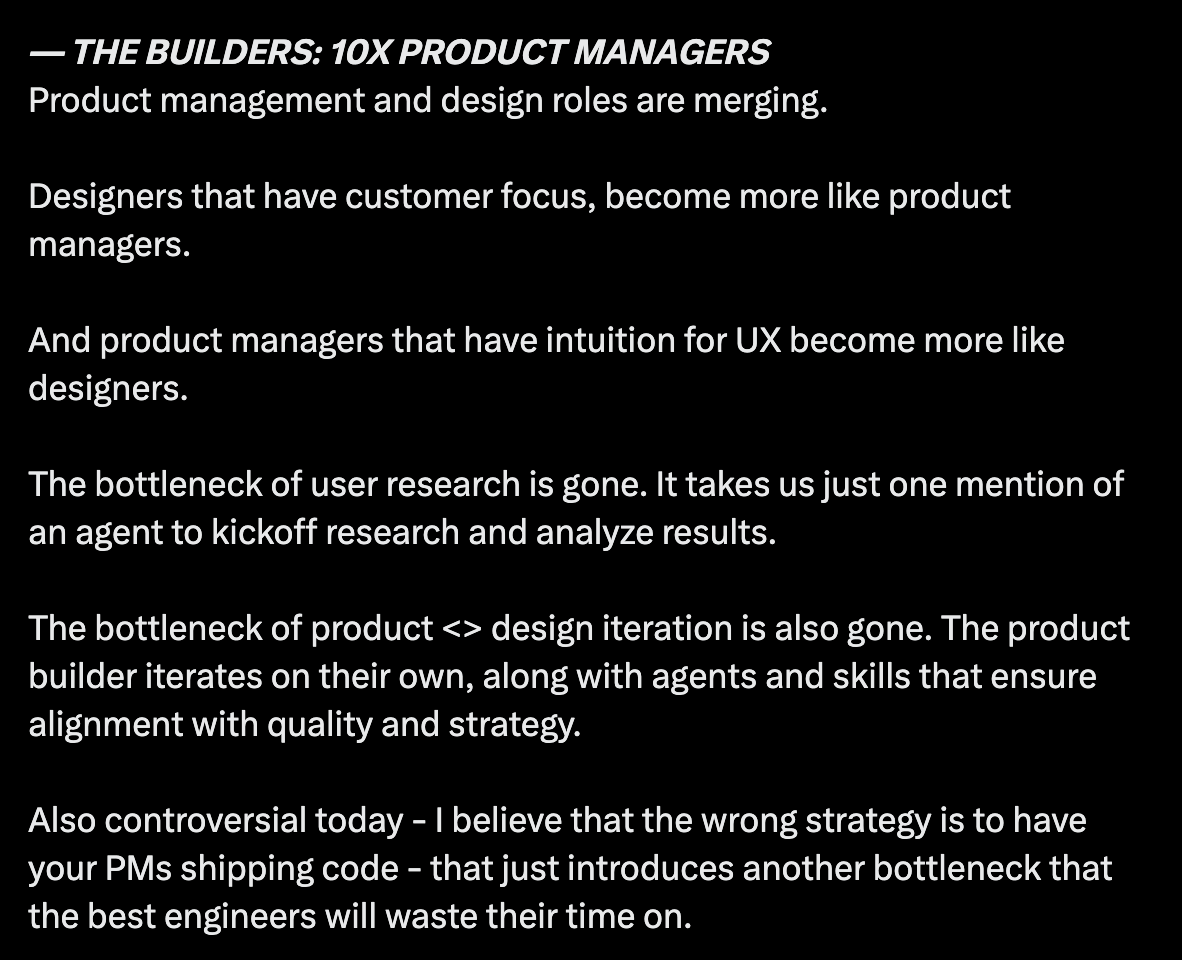
Important read
Lenny Rachitsky tweet media
Zeb Evans@DJ_CURFEW

Today we reduced headcount by 22%. The business is the strongest it's ever been. So I think it's important to be direct about what I'm seeing and why. First, I made this decision and I own it. I did it because the way to operate at the highest level of productivity is changing, and to win the future, ClickUp needs to change with it. Second, this wasn't about cutting costs. Most savings from this change will flow directly back into the people who stay. We'll be introducing million-dollar salary bands. If you create outsized impact using AI, you'll be paid outside of traditional bands. Most importantly, I have the deepest gratitude for those affected. We're doing this from a position of strength specifically so we can take care of people properly. Everyone affected receives a package aimed at honoring their contributions and easing the transition. I only see two options: wait for this to play out gradually in the market or be honest about what I'm seeing and act proactively. THE 100X ORGANIZATION The primary change is that we're restructuring around what I call 100x org. The goal is 100x output. The roles required to build at the highest level are fundamentally different than they were a year ago. Incremental improvements to existing systems won't get us there. We need new ones. That means creating enough disruption to rebuild rather than iterate on what's already broken. The common narrative is that AI makes everyone more productive. It doesn't. Many of the workflows of today, if left unchanged, create bottlenecks in AI systems. These roles will evolve. But waiting for that to happen naturally means falling behind now. The 100x org is actually heavily dependent on people - infinitely more than today. This is only possible with 10x people that have embraced and adopted new ways of working. THE BUILDERS, AGENT MANAGERS, AND FRONT-LINERS — THE BUILDERS: 10X ENGINEERS I don't think most companies have internalized what's actually happening with AI in engineering. The common narrative is that AI makes all engineers more productive. That may be true in isolation, but at an organization level - that is the farthest thing from reality. Here's what we've validated recently at ClickUp: the great engineers, the ones who can orchestrate, architect, and review, are becoming 100x engineers. They're not writing code. They're directing agents that write code. The skill is judgment. AI makes the best engineers wildly more productive, and everyone else using AI slows these engineers down. Think about it - the bottlenecks are (1) orchestration - telling AI what to do, and (2) reviewing - what AI did. Everything is leapfrogged and no longer needed. So who do you want orchestrating and reviewing code? And how do you want your best engineers to spend their time? If your best engineers are spending time reviewing other people's code, then this is inherently an inefficient bottleneck. These engineers can review their agent's code much faster than reviewing human code. The new world is about enabling your 10x engineers to become 100x. The wrong strategy is to push every engineer to use infinite tokens. Companies doing this are celebrating 500% more pull requests. But customer outcomes don't match the volume of code being generated. I call this the great reckoning of AI coding, and every company will face this soon if not already. More code is just another bottleneck to the best engineers, and ultimately to your company's impact as well. — THE BUILDERS: 10X PRODUCT MANAGERS Product management and design roles are merging. Designers that have customer focus, become more like product managers. And product managers that have intuition for UX become more like designers. The bottleneck of user research is gone. It takes us just one mention of an agent to kickoff research and analyze results. The bottleneck of product <> design iteration is also gone. The product builder iterates on their own, along with agents and skills that ensure alignment with quality and strategy. Also controversial today - I believe that the wrong strategy is to have your PMs shipping code - that just introduces another bottleneck that the best engineers will waste their time on. To be clear, PMs should be coding but they should do this in a playground to iterate, validate, and scope. That code should not go to production. Everything outside of managing systems, orchestrating AI, and reviewing output becomes a bottleneck. That's why the other roles that are critical along with these are the systems managers (to reduce bottlenecks) along with a bottleneck you can't replace - customer meeting time. — THE SYSTEM MANAGERS Ironically, the people that automate their jobs with AI will always have a job. They become owners of the AI systems - agent managers. We have many examples of these people at ClickUp. The underlying systems in which we operate are absolutely critical to get right. I think most companies are delusional to think they can iterate on existing systems and compete in this new world. You must create enough disruption so that old systems are deprecated entirely. If there's any definition for 'AI native' that's what it is. — THE FRONT-LINERS In a world that will become saturated with AI communication, the human touch will matter more than anything to customers. This is a bottleneck that you shouldn't replace - even when agents are high enough quality to do video meetings. One-on-one meeting time with customers is something that shouldn't be automated. The systems around the meetings should be - so that front-liners spend nearly 100% of their time with customers. REWARDING 100X IMPACT In a world where companies are able to do so much more with less, where does that excess money go? In our case, much of the savings in this new operating model will flow directly back to those that enabled it. We must reward people that create productivity accordingly. This aligns incentives on both sides. Plus, in a world where your best people create 100x impact, you can't afford to lose them. You should aim to retain these employees for decades. The context they have and their ability to efficiently orchestrate and review will be nearly impossible to replace. Compensation bands of today should be thrown out the door. We're introducing $1 million cash/year salary bands with a path available to nearly everyone in the company if they produce 100x impact by creating or managing AI systems. THE FUTURE Nearly every company will make changes like these. The ones that do it proactively will define what comes next. The future is not fewer people. It's different work, new roles, and better rewards for those who embrace it. We're already seeing entirely new roles emerge, like Agent Managers, that didn't exist a year ago. ClickUp is positioning to lead this shift, not just internally, but for our customers too. I've never been more certain about where we're headed.


English
41
55
758
147.6K
$oji retweetledi
WOLF
WOLF@WOLF_Financial·
JEFF BEZOS WAS ASKED ABOUT THE CLAIM THAT "YOU CAN'T EARN A BILLION DOLLARS" His entire response was a burger joint: "Let's say you start a burger joint with 10 employees. People love your burgers, so you open a second outlet. Then a third. By the time you've opened 1,000 outlets, you are a billionaire." "This is a real life story. It happens all the time. In-N-Out Burger. Raising Cane's. At what point did that money all of a sudden become unethical? It didn't." His point: "If you create a service that people love and millions of people choose it, you're going to end up with $1 billion." Do you agree?
English
195
316
5.9K
706K
$oji
$oji@Olamitisoji·
Dangote’s refinery shows what local capital and entrepreneurial goodwill can do, but it also shows the limit of relying on goodwill alone. If we want more projects like this, local banks need better government-backed ways to de-risk serious industrial bets. One Dangote is impressive; the real goal is building the financing architecture that can produce many more.
English
0
0
0
276
-valar morghulis-
-valar morghulis-@eldivine·
It is instructive that if Dangote had taken project finance from international banks or borrowed from Wall Street, this refinery would either not have seen the light of day (due to the 5 year delays) or he would own a much smaller chunk of it. Instead this was largely financed via Afriexim, local banks (with heavy collateral from his cement businesses) and internal balance sheet. The cement monopolies made this possible.
English
23
146
851
44.1K
$oji
$oji@Olamitisoji·
Really a big fan of you, but Bezos did make some good points here. The question is why a city already spending this much per student still struggles to turn that spending into classroom outcomes. More revenue sounds good, but without fixing allocation, admin bloat, and accountability, it just becomes another way to fund the same system people are already complaining about.
English
0
0
1
853
$oji
$oji@Olamitisoji·
friendships like this >>>>
TheCable@thecableng

.@realFemiOtedola: I’ve appealed to Aliko Dangote to allocate shares worth $100m to me in the private placement of the refinery

English
0
0
0
171
$oji retweetledi
@jason
@jason@Jason·
Bezos is gonna run
Latviešu
211
123
3.7K
176.8K
$oji retweetledi
Paul Graham
Paul Graham@paulg·
Another related fallacy is to think that you have to start a startup now because there's a boom happening now, and if you wait too long all the good ideas will have been done. I've been hearing this line for 20 years and it has never been true.
English
40
44
1K
48K