
Yale ReiSoleil, Jr. retweetledi
Yale ReiSoleil, Jr.
246 posts

Yale ReiSoleil, Jr.
@ReiSoleilJr
Co-founder & CTO @untradingOrg ~ Why shouldn't you be a polymath?
Katılım Haziran 2024
128 Takip Edilen663 Takipçiler

Yale ReiSoleil, Jr. retweetledi

I get the overall vibe, but Ethereum isn't even friendly to developers as a protocol.
We had an EIP-665 (eips.ethereum.org/EIPS/eip-665), which was implemented in every client to add ed25519 precompiles.
However instead of doing the simple thing, someone proposed to generalize it (ethereum-magicians.org/t/precompile-f…); make it work for all curves.
So as a result the former was abandoned and closed and then the latter was also abandoned and closed.
The net result is that 8 years later, we still only have secpk1 and bn128 precompiles instead of at least also having ed25519, which everyone agrees is just better.
So I get why people complain that this looks not focused enough on actual users, sure. But god the problem is that this is also not focused on any protocol user.
There are a bunch of super low hanging fruits (like freaking precompiles) that would make deploying privacy tech 10x easier, but we haven't managed to improve the core protocol a single bit on that front for the last 8 years.
Ethereum Foundation@ethereumfndn
Today, the Foundation’s Board released the EF Mandate. This document, which was first intended for EF members, reaffirms the promise of Ethereum, and the role of EF within this ecosystem.
English
Yale ReiSoleil, Jr. retweetledi

@rootslashbin Categorically incorrect.
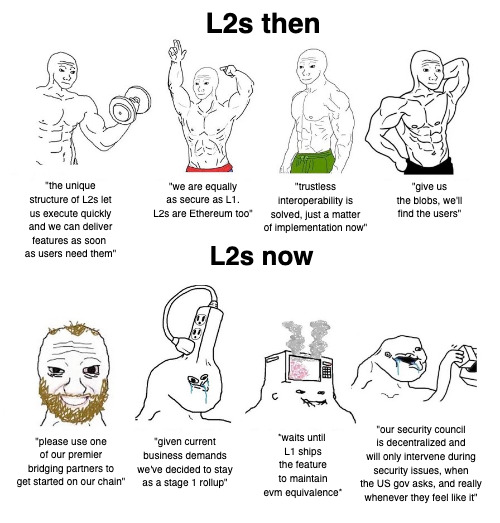
The thing with rollups is we haven't reached escape velocity.
Once Stage 2 is achieved the system becomes uninfluenced by any "evil", because if it arises you can easily leave.
No perfect world needed.
English

“communism works in a perfect world” vibes
Yale ReiSoleil, Jr.@ReiSoleilJr
@_Enoch Precisely, if all rollups followed faithfully in their philosophical footsteps we would be walking a different road right now. Funny to think the only Stage 2 rollups we got were from so many years ago. It will eventually still happen, just long overdue.
English
Yale ReiSoleil, Jr. retweetledi

when the L2 architecture was first launched for Ethereum
we didn’t have the tech to hyper-scale L1 without sacrificing censorship-resistance, etc.
now with the latest frontier zk technology, we do
so we will hyper-scale L1, while also supporting a robust ecosystem of L2s around Ethereum, continuing to do things and make tradeoffs where L1 can’t
win-win
English
Yale ReiSoleil, Jr. retweetledi

@DCinvestor And we will kill every trustful L2 in the process inshallah.
English
@_Enoch Precisely, if all rollups followed faithfully in their philosophical footsteps we would be walking a different road right now.
Funny to think the only Stage 2 rollups we got were from so many years ago.
It will eventually still happen, just long overdue.
English
> Rollups were not a waste of time or useless, rather corporations took over in place of cypherpunks. When we become the very thing we despise, of course it won't work and that is precisely why this narrative shift makes sense.
Very well said. When the rollup-centric roadmap was pursued I think we saw products like ZK Money v1 and dydx v3 faithfully deliver the trustlessness that ought to be. This trustlessness simply did not materialize in any timely fashion anywhere else.
English
I believe most people are grossly misinterpreting this either due to not having much reading comprehension, general ignorance, and/or cognitive dissonance.
Firstly, paths change and this plasticity is imperative. Were it not for this there would be no innovations. Ethereum's combined dynamism and diversity of opinions are invaluable. ETH is anti-stubborn.
I also believe there is confusion in the understanding of what "scaling" is actually defined as. In this context of ETH scaling, it can be broken down into TX cost, finality, and throughput.
L2s were originally envisioned with the intent of drastically reducing the TX cost and throughput (the latency of txs is also "reduced" to the end-user, but the finality is extended as there is a larger window before the batch of txs is finalized on ETH, that is the whole concept of a "rollup") without sacrifices to decentralization or security. This they actually do (particularly ZK-Rollups using ETH blobs), at least in theory, however, they have not in practice.
Instead, as @_Enoch (first vocal name that came to mind) and several others have been emphasizing for years, we have not seen an "actual" L2 with a proper exit window, no security council, and smooth interop.
So since L2s have been failing to advance and properly serve their users and the Ethereum community, they do not fit the former "Sharded Ethereum" vision. We do not have any mature Stage 2 L2s, and that is a major executional blunder. Scaling ETH via L1 vs L2s isn't inherently flawed in theoretical differences, but rather executional differences.
And since the L1 is scaling, that means that L2s will be mostly irrelevant for scaling (aside from hyper fast and scaled rollups and the tradeoffs that ensue), though rollups have more value than scale itself, so this is not the death of rollups themselves, but definitely many of the rollups today if they don't evolve.
That is not to say the rollup-centric vision was all a waste of time and effort. There have been countless advances and developments around both ZKPs and rollup designs as a result of this former vision.
Without diving too deep, Rollups and ZKPs are useful beyond scaling. We have seen alt-VMs (like @SwayLang FuelVM), privacy layers (like @aztecnetwork and @RAILGUN_Project), function specific appchains (@LC), and much more. The point being, rollups themselves are useful for purposes beyond scaling which would unlikely be explored were it not for having ventured down the rollup-centric roadmap. And when implemented properly, with the guarantees and inheritance of ETH, they will still play a vital role in the ETH ecosystem; a crucial part of The World Computer.
More centralized and fallible systems will continue to exist on Ethereum, but only where they make sense, rather than blanketing the current L2s we have as the only way forward for ETH.
And finally to dispel some naysayers:
To the people which were blindly touting "scaling the L1 like Solana" several years ago, blind L1 "scaling" is just centralization. Solana is unreliable, it goes down, it is centralized, and does not have any of the strong guarantees that Ethereum has. If ETH sacrificed everything in favor of chasing "Solana-level scale", ETH would be valueless, and not The World Computer.
Additionally, why do you think in face of this rollup centric vision was the L1 able to scale? This is because of the decentralization of the long-term Ethereum vision, roadmap, and workforce. There is no unified view held by everyone, development happens based on different opinionated directions simultaneously, and that is beautiful.
Just have a look at ethresear.ch and you will be able to determine why ETH is different. I think people are so accustomed to the common practice that development only happens by a few individuals in a centralized corporate entity, that such a decentralized novel collaborative structure is entirely alien.
Rollups were not a waste of time or useless, rather corporations took over in place of cypherpunks. When we become the very thing we despise, of course it won't work and that is precisely why this narrative shift makes sense.
Death to centralization larping as decentralization, insecurity larping security, and corpos larping as cypherpunks.
vitalik.eth@VitalikButerin
There have recently been some discussions on the ongoing role of L2s in the Ethereum ecosystem, especially in the face of two facts: * L2s' progress to stage 2 (and, secondarily, on interop) has been far slower and more difficult than originally expected * L1 itself is scaling, fees are very low, and gaslimits are projected to increase greatly in 2026 Both of these facts, for their own separate reasons, mean that the original vision of L2s and their role in Ethereum no longer makes sense, and we need a new path. First, let us recap the original vision. Ethereum needs to scale. The definition of "Ethereum scaling" is the existence of large quantities of block space that is backed by the full faith and credit of Ethereum - that is, block space where, if you do things (including with ETH) inside that block space, your activities are guaranteed to be valid, uncensored, unreverted, untouched, as long as Ethereum itself functions. If you create a 10000 TPS EVM where its connection to L1 is mediated by a multisig bridge, then you are not scaling Ethereum. This vision no longer makes sense. L1 does not need L2s to be "branded shards", because L1 is itself scaling. And L2s are not able or willing to satisfy the properties that a true "branded shard" would require. I've even seen at least one explicitly saying that they may never want to go beyond stage 1, not just for technical reasons around ZK-EVM safety, but also because their customers' regulatory needs require them to have ultimate control. This may be doing the right thing for your customers. But it should be obvious that if you are doing this, then you are not "scaling Ethereum" in the sense meant by the rollup-centric roadmap. But that's fine! it's fine because Ethereum itself is now scaling directly on L1, with large planned increases to its gas limit this year and the years ahead. We should stop thinking about L2s as literally being "branded shards" of Ethereum, with the social status and responsibilities that this entails. Instead, we can think of L2s as being a full spectrum, which includes both chains backed by the full faith and credit of Ethereum with various unique properties (eg. not just EVM), as well as a whole array of options at different levels of connection to Ethereum, that each person (or bot) is free to care about or not care about depending on their needs. What would I do today if I were an L2? * Identify a value add other than "scaling". Examples: (i) non-EVM specialized features/VMs around privacy, (ii) efficiency specialized around a particular application, (iii) truly extreme levels of scaling that even a greatly expanded L1 will not do, (iv) a totally different design for non-financial applications, eg. social, identity, AI, (v) ultra-low-latency and other sequencing properties, (vi) maybe built-in oracles or decentralized dispute resolution or other "non-computationally-verifiable" features * Be stage 1 at the minimum (otherwise you really are just a separate L1 with a bridge, and you should just call yourself that) if you're doing things with ETH or other ethereum-issued assets * Support maximum interoperability with Ethereum, though this will differ for each one (eg. what if you're not EVM, or even not financial?) From Ethereum's side, over the past few months I've become more convinced of the value of the native rollup precompile, particuarly once we have enshrined ZK-EVM proofs that we need anyway to scale L1. This is a precompile that verifies a ZK-EVM proof, and it's "part of Ethereum", so (i) it auto-upgrades along with Ethereum, and (ii) if the precompile has a bug, Ethereum will hard-fork to fix the bug. The native rollup precompile would make full, security-council-free, EVM verification accessible. We should spend much more time working out how to design it in such a way that if your L2 is "EVM plus other stuff", then the native rollup precompile would verify the EVM, and you only have to bring your own prover for the "other stuff" (eg. Stylus). This might involve a canonical way of exposing a lookup table between contract call inputs and outputs, and letting you provide your own values to the lookup table (that you would prove separately). This would make it easy to have safe, strong, trustless interoperability with Ethereum. It also enables synchronous composability (see: ethresear.ch/t/combining-pr… and ethresear.ch/t/synchronous-… ). And from there, it's each L2's choice exactly what they want to build. Don't just "extend L1", figure out something new to add. This of course means that some will add things that are trust-dependent, or backdoored, or otherwise insecure; this is unavoidable in a permissionless ecosystem where developers have freedom. Our job should make to make it clear to users what guarantees they have, and to build up the strongest Ethereum that we can.
English
@ddimitrovv22 Each line and assumption must be accounted for and validated, lest someone else do the work for you.
Most contracts are secure, their effects, however, aren't.
The blind spot often occurs on a developer level, if the code wasn't written by them, then they don't think about it.
English

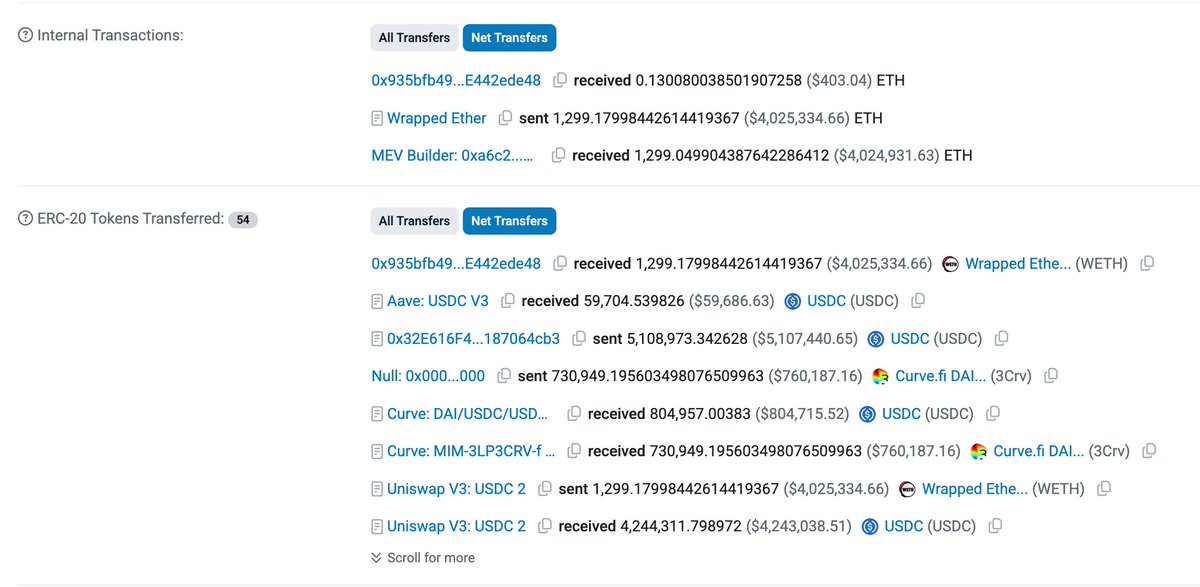
The third full week of January and we see another million-dollar hack.
Makina was exploited and lost ~$5M on theid DUSD/USDC Curve pool.
The project underwent 4 audits from different teams and some of them flagged only informational findings.
tx: etherscan.io/tx/0x569733b80…
English
Yale ReiSoleil, Jr. retweetledi

classic
EigenCloud@eigencloud
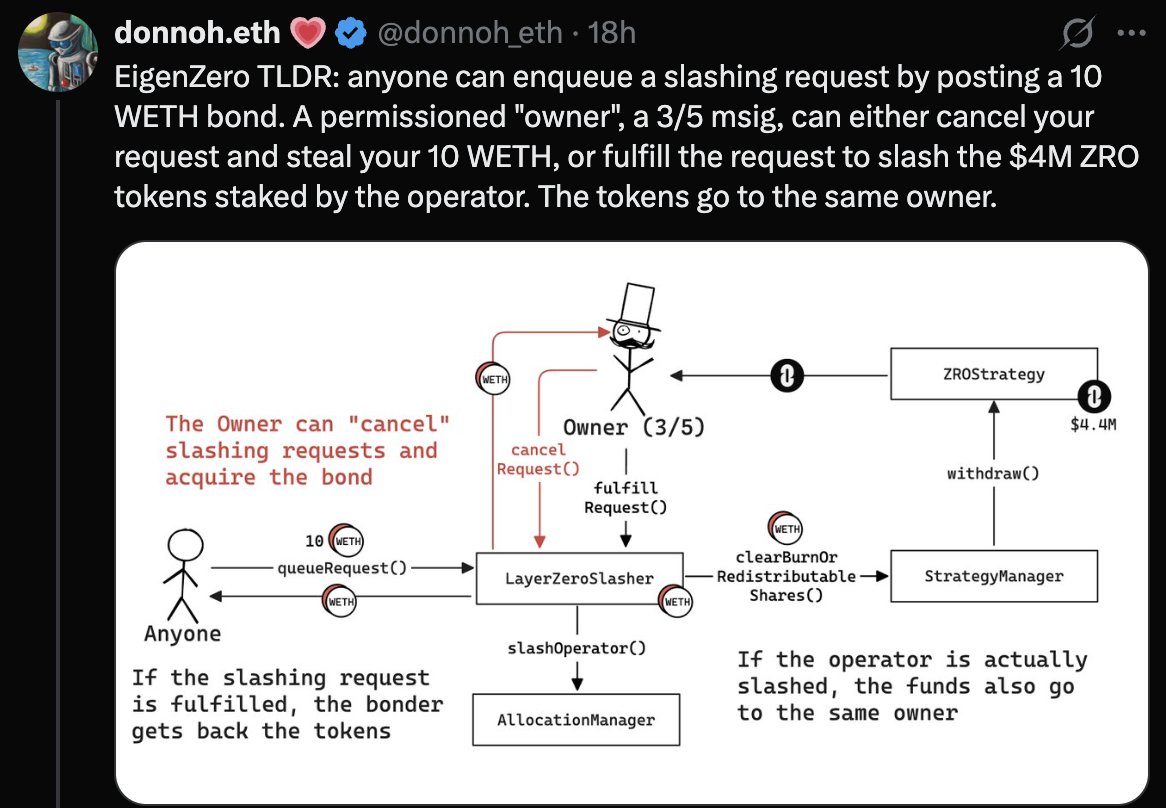
EigenZero is here! We’re thrilled to partner with @LayerZero_Core to launch EigenZero, first implementation of the CryptoEconomic Decentralized Verifier Network (DVN) Framework. Powered by EigenCloud’s slashing infrastructure and backed by $5M in ZRO stake. With EigenZero, correctness is economically enforced, if verification fails, stake is slashed, and users are compensated. Learn more ⬇️ 🧵
English
On the less visible side we do have some cool additions like the secp256r1 precompile (which is the wallet UX mentioned here, but has uses beyond that), CLZ opcode (big for ZK and general efficiency), and obviously the blob upgrade and major gas limit increase. Very nice fork.
rip.eth@ripeth
ethereum's fusaka upgrade drops next week cheaper fees, higher TPS & smoother UX. scale blobs → 20x more capacity with PeerDAS scale L1 → 33% more throughput with 60M gas limit improve UX → native passkeys support going live december 3rd
English


It is categorically false and potentially malicious to imply that Hyperliquid represents the paragon of crypto.
They are no different from Binance or FTX apart from the fact they don't directly deal with fiat and thus don't require KYC.
An entirely centralized "alt-L1" where you wholeheartedly trust the Hyperliquid team with all your token deposits, directly to their private keys, just as you would a CEX.
To call it decentralized or a DEX is an insult to the space. It is marginally more transparent, and has no reason to exist as an alt-L1 apart from ensuring the users have no control over their assets once they're in HL's control, because unlike a proper L2/L3 there is no exit window, escape hatch, or anything similar that would inspire confidence.
There are far better ways to go about achieving the general functionality of HL that they intentionally did not utilize. So it would either be foolish or disingenuous to claim that they're the poster child of crypto, setting a standard for the entire space.
I see HL as a nominally better Binance, and Aster as identical to HL in every discernable way. Both aren't in it for the long run.
You should expect and demand better.

aaalex.hl@aaalexhl
Hyperliquid was born from the mistakes of FTX and Binance The same Binance that liquidates the market whenever they feel like, sells off every major on a daily basis, and has been accused of back room deals for years This is the first DEX in Crypto that actually scales and rivals tier 1 centralized exchanges It's proven time and time again it's a viable replacement, and this industry has begged for something like this for a decade They don't sell assets on the side, every aspect of the protocol is transparent, and Jeff doesn't tweet bullshit If Hyperliquid fails (it won't), you should accept what Crypto has become and decide whether or not that's the future you want to participate in
English
We have the tech for creating this as an L2/L3 on ETH due to ZK advancements, yet we are still to this day attempting to launch more alt L1s.
And for what reason? It introduces significantly more centralization, decreases security, and has no reason to exist apart from greed.
Tempo@tempo
Introducing Tempo: a payments-first blockchain incubated by Stripe and Paradigm. As stablecoins go mainstream, there’s a need for optimized infrastructure. Tempo is purpose-built for stablecoins and real-world payments, born from Stripe’s experience in global payments and Paradigm’s expertise in crypto. To ensure Tempo serves a broad array of needs, we’re excited to be working with a group of initial design partners, including: Anthropic, Coupang, Deutsche Bank, DoorDash, Lead Bank, Mercury, Nubank, OpenAI, Revolut, Shopify, Standard Chartered, Visa, and more. Tempo’s payment-first design includes: • Predictable low fees • Payments/gas in any stablecoin via enshrined AMM • Payments-first UX (dedicated payments lane, memos, access lists, etc) • Opt-in privacy • Scale (100K+ TPS, sub-second finality) • EVM-compatible, built on Reth Tempo eases the path to bringing real-world flows onchain, such as: • Global payouts, payins, and payroll • Embedded financial accounts • Fast and cheap remittances • Tokenized deposits for 24/7 settlement • Microtransactions • Agentic payments We’re building Tempo with core principles of decentralization and neutrality. Tempo will be a neutral platform with respect to stablecoins, allowing users to make transfers and pay gas fees in any stablecoin. The blockchain will be secured by an independent and diverse validator set, with a roadmap toward permissionless validators. We’re partnering with builders across fintech, banking, ecommerce, agentic finance, and more — if you’d like to build with us, get in touch at partners@tempo.xyz
English
My stance on this is I see both sides and I respect both people. However, I agree with Laurence here.
I do agree, that in the ideal world everything would be done selflessly and freely available to everyone. Though, that is not the real world, you need to secure your business and make money in order to provide your app in the first place. And when you have a protocol like Wildcat, that when forked would have the same functionality as it doesn't rest on any other components backing it, then yes, you can at least in the early stages, opt for a source-available license. You still have transparency and still technically allow for some "inspiration" though you won't be outright replaced by someone forking you with some VC money.
You need money to build and grow apps, people can't all just do FOSS. And when people do end up doing FOSS you can end up in Wordpress scenario if you aren't careful. Look forward to when Wildcat is fully open source however, as with any other protocol that is currently "locked".
In general, if as a builder you can do FOSS and sustain business simultaneously, I will cheer you on every step of the way, however if you have to opt for source-available I can also see why. Though, even as source-available unethical actors can still exploit the system.
Also as @z0r0zzz says, there are bigger problems in our ecosystem, and pointing fingers at one of its builders, is probably not very productive.
English

I will speak freely here, because Tim - who is both someone with standing within the Ethereum Foundation and someone I consider a good friend - is doing so too.
It is puritanism taken too far to call me a coward on main for leading a team that built and coordinated the deployment of code on Ethereum mainnet that is under a license rather than being FOSS (even though the spark of initial wave of complaint was that Wildcat has agreed to deploy on a chain that will not inherit all of Ethereum's security). It is, unironically, just business.
The reason that Wildcat code is source-available is as the mildest preventative bulwark against a rogue entity spinning up a copy and facilitating hypercrime given the unsecured nature of contracts produced by the Wildcat market factory. Its codebase is something that I would like to ultimately see converted into FOSS once the appropriate network effects are in place: I am aligned with the Ethereum Foundation's mission of supporting defipunk, but bluntly find it gross that I must smile through attacks on this front from on high, despite being told that the EF wishes to support the app layer.
I will not apologise for making such decisions in the early development of a protocol that the financial markets surrounding Ethereum benefit from. I think most people interested in capital leverage effects and the mission of creating a parallel financial system would agree that it is better that Wildcat exists than it doesn't, whatever form the underlying code takes or where it is deployed.
I have spent eight years working on both open-source libraries and protocols for Ethereum, and I will not sit here and smile through strays on my character by leading figures in the ecosystem - who people respect and listen to - for design choices made on code for the would-be World Computer.
I am tired, boss.
tim-clancy.eth@_Enoch
The context for this one is that Wildcat is unFree Software due to Laurence's cowardice. It uses some crappy visible-source-only license very much at odds with the ethos of Ethereum. Therefore I recommended interacting with it through an AGPL-licensed intermediary contract as act of protest.
English
It actually would be pretty awesome to do online/phone voting. Estonia does it. It works because it could be coupled with a strong cryptographic proof of one's ID; this is how a lot of the ZK passport stuff in Ethereumland works. You can do anonymous voting but more important prove that your vote was counted and counted correctly. I'd certainly trust that a lot more than the random ballot drop-offs.
English


Speedrun losing >$200k by trusting central custody. 🚫🔑=🚫💰
Sheel Mohnot@pitdesi
Coinbase One Card: 4% back on everything card as long as you hold >$200k at Coinbase. $50 annual fee for Coinbase One. If they roll this out widely, it’ll be a great top of wallet card
English