

Robson Murilo
39 posts

@TaggerAI AI first changes how teams work internally… then it changes how teams work with each other
English

Andrew is right. AI-native teams are reshaping how work gets done. Smaller, faster, generalist-heavy, decisions and executions are now collapsed into the same person. This is the first stop of how AI actually changes work.
Tagger is looking at the next stop on the same curve. Once teams are accelerated internally as far as they can go, the next thing AI unlocks is between teams. A coding agent hiring an external security-audit agent mid-task. A marketing agent calling another company's data agent. Millisecond settlement, paid on delivery. The collapse of decision and execution that Andrew describes, eventually, doesn't stay inside one team. It happens across the whole network.
Andrew Ng@AndrewYNg
AI-native software engineering teams operate very differently than traditional teams. The obvious difference is that AI-native teams use coding agents to build products much faster, but this leads to many other changes in how we operate. For example, some great engineers now play broader roles than just writing code. They are partly product managers, designers, sometimes marketers. Further, small teams who work in the same office, where they can communicate face-to-face, can move incredibly quickly. Because we can now build fast, a greater fraction of time must be spent deciding what to build. To deal with this project-management bottleneck, some teams are pushing engineer:product manager (PM) some teams are pushing engineer:product manager (PM) ratios downward from, say, 8:1 to as low as 1:1. But we can do even better: If we have one PM who decides what to build and one engineer who builds it, the communication between them becomes a bottleneck. This is why the fastest-moving teams I see tend to have engineers who know how to do some product work (and, optionally, some PMs who know how to do some engineering work). When an engineer understands users and can make decisions on what to build and build it directly, they can execute incredibly quickly. I’ve seen engineers successfully expand their roles to including making product decisions, and PMs expand their roles to building software. The tech industry has more engineers than PMs, but both are promising paths. If you are an engineer, you’ll find it useful to learn some product management skills, and if you’re a PM, please learn to build! Looking beyond the product-management bottleneck, I also see bottlenecks in design, marketing, legal compliance, and much more. When we speed up coding 10x or 100x, everything else becomes slow in comparison. For example, some of my teams have built great features so quickly that the marketing organization was left scrambling to figure out how to communicate them to users — a marketing bottleneck. Or when a team can build software in a day that the legal department needs a week to review, that’s a legal compliance bottleneck. In this way, agentic coding isn’t just changing the workflow of software engineering, it’s also changing all the teams around it. When smaller, AI-enabled teams can get more done, generalists excel. Traditional companies need to pull together people from many specialties — engineering, product management, design, marketing, legal, etc. — to execute projects and create value. This has resulted in large teams of specialists who work together. But if a team of 2 persons is to get work done that require 5 different specialities, then some of those individuals must play roles outside a single speciality. In some small teams, individuals do have deep specializations. For example, one might be a great engineer and another a great PM. But they also understand the other key functions needed to move a project forward, and can jump into thinking through other kinds of problems as needed. Of course, proficiency with AI tools is a big help, since it helps us to think through problems that involve different roles. Even in a two-person team, to move fast, communication bottlenecks also must be minimized. This is why I value teams that work in the same location. Remote teams can perform well too, but the highest speed is achieved by having everyone in the room, able to communicate instantaneously to solve problems. This post focuses on AI-native teams with around 2-10 persons, but not everything can be done by a small team. I'll address the coordination of larger teams in the future. I realize these shifts to job roles are tough to navigate for many people. At the same time, I am encouraged that individuals and small teams who are willing to learn the relevant skills are now able to get far more done than was possible before. This is the golden age of learning and building! [Original text: deeplearning.ai/the-batch/issu… ]
English


The system should be blamed

BIGDON@BIGDONUSD1
USD1 Trading Campaign is Dead. Who’s Holding the Blame? If @BNBCHAIN actually cares about its ecosystem, it owes everyone a real explanation for the USD1 Trading Campaign. Some winners didn’t build a community, didn’t spark discussion, they just… existed. Builders with real communities, vibes, and cultures, on the other hand, got ignored. Trust in USD1 is bleeding. We’re done waiting. We’ll be shifting our energy to building the $U ecosystem instead. But before we do that, we must figure out who killed the game. Welcome to Blame Exchange 🏛️ Who really caused USD1 Campaign failures? Vote for the truth — numbers don’t lie. Weak Sponsors? @BNBCHAIN , @worldlibertyfi , @Aster_DEX , @fourdotmemezh ? Unsatisfactory winners? #egl1, #memes, #一? People who failed our hope? @0xDylan_ , @heyibinance , @cz_binance , @nina_rong ? Vote now. Let’s see what the community thinks. ➡️ big-don.net
English
English

Just keep building and ignore the noise. 🤷♂️
@cz_binance @binance @heyibinance
Borrowing a line from my good brother:
There will always be those who envy you.
They’re either your friends, or they’re not.
Just walk your own path.
History remembers those who actually moved the industry forward.👨🏻💻👨🏻💻
English

@CryptoMaster_70 这次真的搞伤了,中外都得罪了。搞的比赛没眼看。全是内幕。x.com/BIGDONUSD1/sta…
BIGDON@BIGDONUSD1
USD1 Trading Campaign is Dead. Who’s Holding the Blame? If @BNBCHAIN actually cares about its ecosystem, it owes everyone a real explanation for the USD1 Trading Campaign. Some winners didn’t build a community, didn’t spark discussion, they just… existed. Builders with real communities, vibes, and cultures, on the other hand, got ignored. Trust in USD1 is bleeding. We’re done waiting. We’ll be shifting our energy to building the $U ecosystem instead. But before we do that, we must figure out who killed the game. Welcome to Blame Exchange 🏛️ Who really caused USD1 Campaign failures? Vote for the truth — numbers don’t lie. Weak Sponsors? @BNBCHAIN , @worldlibertyfi , @Aster_DEX , @fourdotmemezh ? Unsatisfactory winners? #egl1, #memes, #一? People who failed our hope? @0xDylan_ , @heyibinance , @cz_binance , @nina_rong ? Vote now. Let’s see what the community thinks. ➡️ big-don.net
中文

@0xYukiRabbit 看到 $BIGDON 在结果公布前一晚被直接砸穿,真就都是内幕狗x.com/bigdonusd1/sta…
BIGDON@BIGDONUSD1
USD1 Trading Campaign is Dead. Who’s Holding the Blame? If @BNBCHAIN actually cares about its ecosystem, it owes everyone a real explanation for the USD1 Trading Campaign. Some winners didn’t build a community, didn’t spark discussion, they just… existed. Builders with real communities, vibes, and cultures, on the other hand, got ignored. Trust in USD1 is bleeding. We’re done waiting. We’ll be shifting our energy to building the $U ecosystem instead. But before we do that, we must figure out who killed the game. Welcome to Blame Exchange 🏛️ Who really caused USD1 Campaign failures? Vote for the truth — numbers don’t lie. Weak Sponsors? @BNBCHAIN , @worldlibertyfi , @Aster_DEX , @fourdotmemezh ? Unsatisfactory winners? #egl1, #memes, #一? People who failed our hope? @0xDylan_ , @heyibinance , @cz_binance , @nina_rong ? Vote now. Let’s see what the community thinks. ➡️ big-don.net
中文


@BIGDONUSD1 @BNBCHAIN that campaign was a mess tbh. last night hurt
English
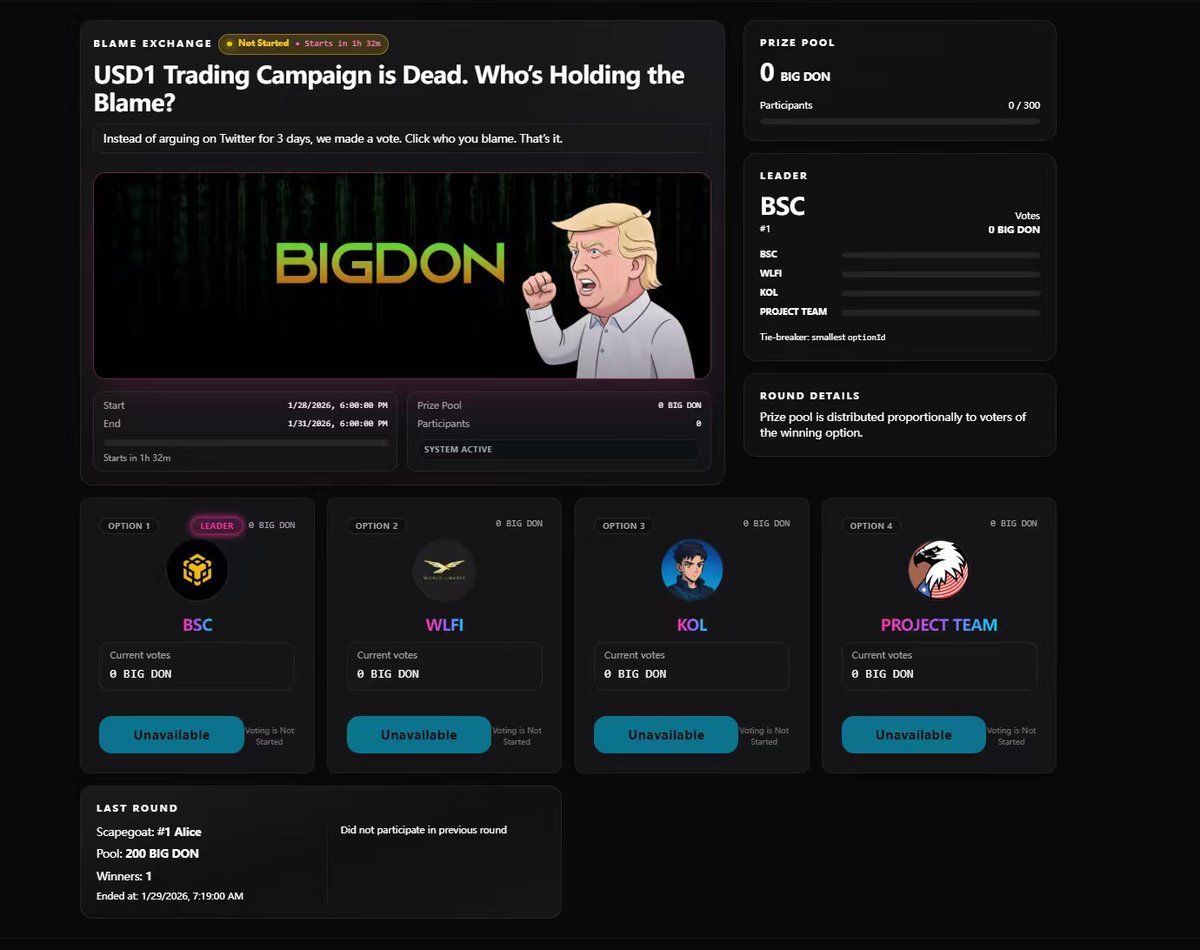
USD1 Trading Campaign is Dead. Who’s Holding the Blame?
If @BNBCHAIN actually cares about its ecosystem, it owes everyone a real explanation for the USD1 Trading Campaign.
Some winners didn’t build a community, didn’t spark discussion, they just… existed.
Builders with real communities, vibes, and cultures, on the other hand, got ignored.
Trust in USD1 is bleeding. We’re done waiting.
We’ll be shifting our energy to building the $U ecosystem instead.
But before we do that, we must figure out who killed the game.
Welcome to Blame Exchange 🏛️
Who really caused USD1 Campaign failures?
Vote for the truth — numbers don’t lie.
Weak Sponsors? @BNBCHAIN , @worldlibertyfi , @Aster_DEX , @fourdotmemezh ?
Unsatisfactory winners? #egl1, #memes, #一?
People who failed our hope? @0xDylan_ , @heyibinance , @cz_binance , @nina_rong ?
Vote now. Let’s see what the community thinks.
➡️ big-don.net
English
Robson Murilo retweetledi









Real success doesn’t show up all at once.
It shows up as more use cases, more places something works, and more people choosing it over time.
Steady adoption is a much better signal than any single moment of attention.
English
i hope the five lucky guys do enjoy ur new meme profile
turn your notifications on cuz we are having the next campaign shortly
BIGDON@BIGDONUSD1
OFFICIAL GIVEAWAY NOTICE In order to ensure procedural fairness and content integrity, participants must complete the following steps: 1.Follow 2.Like 3.Comment 4.Repost (RT) A total of 5 profiles will be selected following strict internal review. Reward: Your account will be used to create a Trump meme No further compensation will be provided
English

