Pablo García

12.3K posts

Pablo García banner
Pablo García

Pablo García

@SimitrioG

(no sé si fue tan así.)

México DF Katılım Haziran 2009
510 Takip Edilen549 Takipçiler
Pablo García retweetledi
Ugo Ramella
Ugo Ramella@RamellaUgo·
Hieronymus Bosch Le tentazioni di Sant'Antonio particolare
Ugo Ramella tweet media
Italiano
0
5
18
469
Pablo García retweetledi
daniel molina
daniel molina@rayovirtual·
Me parece una buena explicación de por qué ha bajado la fertilidad humana y de lo poco que en realidad influyen los celulares y las redes sociales (aunque algo influyen). Hasta ahora es lo que mejor explica la nueva demografía planetaria.
Jesús Fernández-Villaverde@JesusFerna7026

Smartphones are not the explanation for the recent decline in fertility. Instead, they are an accelerator of deeper forces already at work. Let’s start with the facts. Fertility is falling almost everywhere: in rich, middle-income, and poor countries; in secular and religious countries; and in countries with high and low levels of gender equality. The decline accelerated around 2014. So, no country-specific explanation will work unless you are willing to believe that 200 distinct country-specific explanations arrived at roughly the same time. Smartphones look like the obvious candidate: the first iPhone was released in 2007, and global adoption has been astonishingly fast. Economists understand the first major decline in fertility in advanced economies, from 6 or 7 children per woman throughout most of human history to about 1.8, that occurred between the early 1800s and roughly 1970, well before smartphones. The main drivers were a sharp fall in child mortality (effective fertility was rarely above 3 and often close to 2) and the shift from a low-skill, rural agrarian economy to a high-skill, urban industrial one. We have quantitative models that fit these facts well. Country-specific factors mattered too, of course. Proximity to low-fertility neighbors accelerated Hungary’s decline, while fragmented landowning structures accelerated France’s. But these were second-order mechanisms. This is also why most economists long considered Paul Ehrlich’s doom scenarios implausible. We forecast that fertility in middle- and low-income economies would follow the same path as in the rich, probably faster, because reductions in child mortality reached India or Africa at lower income levels (medical technology is nearly universal, and most gains come from handwashing and cheap antibiotics, not Mayo Clinic-level care). Much of what we see in Africa or parts of Latin America today is still that old story. But in the 1980s, a new pattern appeared. Japan and Italy fell below 1.8, the level we had thought was the new floor. By 1990, Japan was at 1.54 and Italy at 1.36. This second fertility decline began in Japan and Italy earlier than elsewhere, driven by country-specific factors, but the underlying dynamics were widespread: secularization, an education arms race, expensive housing, the dissolution of old social networks, and the shift to a service economy in which women’s bargaining power within the household is higher. The U.S. lagged because secularization came later, suburban housing remained relatively cheap, and African American fertility was still high. U.S. demographic patterns are exceptional and skew how academics (most of whom are in the U.S.) and the New York Times see the world. My best guess is that, without smartphones, Italy’s 2025 fertility rate would be about 1.24 rather than 1.14. I doubt anyone will document an effect larger than 0.1-0.2. Italy was at 1.19 in 1995, not far from today’s 1.14. The TFR is cyclical due to tempo effects, so I do not read too much into the rise between 1995 and 2007 or the decline from 1.27 in 2019 to 1.14 today. The direct effect of smartphones is not zero, but it is not, by itself, that large. Where social media, in general, and smartphones, in particular, matter is in the diffusion of social norms. What would have taken 25 years now happens in 10. Social media are not the cause of fertility decline; modernity is. But they are a very fast accelerator. That is why social media are a major part of the story behind Guatemala (yes, Guatemala) going from 3.8 children per woman in 2005 to 1.9 in 2025. Without them, Guatemala would also have reached 1.9, just 20 years later. Modernity, in its current form, is incompatible with replacement-level fertility. By modernity, I do not mean capitalism: fertility fell earlier and faster in socialist economies than in market economies. Socialist Hungary fell below replacement in 1960, and socialist Czechoslovakia in 1966 (both experienced small, short-lived baby booms in the mid-1970s). By modernity, I mean a society organized around rational, large-scale systems and formalized knowledge. Countries will not converge to the same fertility rate. East Asia is likely stuck near 1, possibly below, given its unbalanced gender norms and toxic education systems. Latin America faces the same gender problem plus weak growth prospects, so I expect something around 1.2. Northern Europe has more egalitarian family structures and might hold near 1.5. The very religious societies are probably the only ones that will sustain 1.8. All of this could change with AI or changes in population composition. We will see. But on the current evidence, deep sub-replacement fertility is the “new new normal.” Unless we reorganize our societies, better learn to handle it as best we can.

Español
2
5
16
1.5K
Pablo García retweetledi
Jennifer  Avila
Jennifer Avila@jenalear·
Cuando los medios replican sin dudar ni un poco, minan su credibilidad. En estos tiempos de viralidad y de IA, nosotras decidimos seguir haciendo periodismo, seguir dudando y preguntando. Aquí un ejemplo de esto 👇🏽 contracorriente.red/2026/05/16/hon…
Español
7
39
104
30.8K
Pablo García retweetledi
Steven Hyden
Steven Hyden@Steven_Hyden·
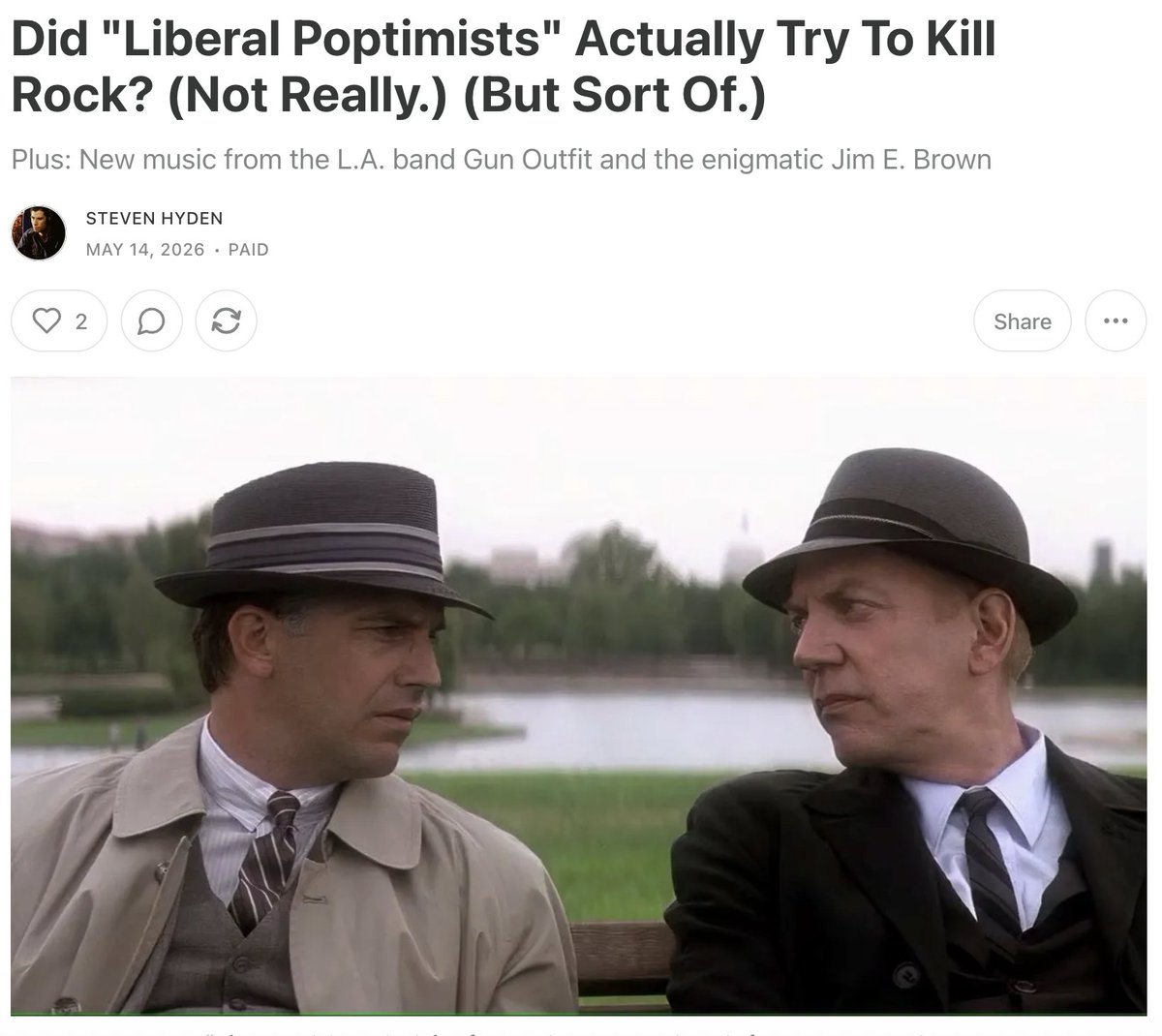
I wrote a (long) response to a recent Jacobin article about whether “liberal poptimists tried to kill rock.” I also addressed that viral NYT video about their songwriters list. A “state of rock music” AND a “state of music criticism” piece combined! tinyurl.com/yeyjs7ex
Steven Hyden tweet media
English
5
12
82
33.9K
Pablo García retweetledi
Aurelio Asiain🗣️
Aurelio Asiain🗣️@aasiain·
Annus Mirabilis Philip Larkin Sexual intercourse began In nineteen sixty-three (which was rather late for me) — Between the end of the "Chatterley" ban And the Beatles' first LP. Up to then there'd only been A sort of bargaining, A wrangle for the ring, A shame that started at sixteen And spread to everything. Then all at once the quarrel sank: Everyone felt the same, And every life became A brilliant breaking of the bank, A quite unlosable game. So life was never better than In nineteen sixty-three (Though just too late for me) — Between the end of the "Chatterley" ban And the Beatles' first LP. Philip Larkin: 'Annus Mirabilis' read by Harold Pinter youtube.com/watch?v=aHDbUm…
YouTube video
YouTube
English
0
7
12
2.2K
Pablo García retweetledi
Juana Peña
Juana Peña@Chris_Montz·
En 1956, hace 70 años, la genialidad de Arsenio Rodríguez convirtió un momento de angustia urbana en uno de los episodios más memorables de la música afrocubana, dando pie al clásico ‘Fuego en el 23’. El incidente ocurrió una mañana, mientras Arsenio descansaba en el edificio donde residía, ubicado en el 23 West 65th Street, en Manhattan. Un conato de incendio, provocado según se cuenta por una bombilla que explotó en uno de los apartamentos, activó la alarma del edificio y desató el pánico entre los vecinos, que gritaban despavoridos sin saber con certeza en qué parte del inmueble se originaba el fuego. Sobre lo sucedido existen dos versiones. Según el testimonio del músico Israel Berríos Castro, recogido en el libro ‘Arsenio Rodríguez: El Ciego Maravilloso’ de Jairo Grijalba Ruiz, mientras los vecinos pedían desesperados que sacaran a Arsenio del edificio debido a su ceguera, el compositor ya había salido y se encontraba a salvo en la acera. Sin embargo, otras crónicas señalan que fue el vocalista de su conjunto, Luis ‘Güito’ Kortright, quien lo ayudó a salir y lo puso a buen recaudo. Aunque el hecho ocurrió en la calle 65, la versión de La Sonora Ponceña trasladó la escena a la 110, en referencia a la esquina de la Calle 110 con Lenox Avenue, dentro del imaginario del Harlem latino, manteniendo vivo el relato en otro punto emblemático de la ciudad. Así, ese episodio que pudo terminar en una tragedia quedó inmortalizado en el cancionero popular latinoamericano, convertido hoy en todo un clásico de la salsa. [Vídeo referencial]
Español
16
261
799
23.2K
Pablo García retweetledi
Los Árboles Mágicos ®️, (by Oscar Gaitan)
Hoy quiero felicitar a todos los trabajadores. Pero especialmente a quienes trabajan con lo vivo, a los jardineros de verdad. A los que saben que un jardín no se “mantiene”. El mantenimiento es propio de lo estático. Un jardín cambia, crece, envejece y responde a las estaciones. No se puede mantener, solo se puede cuidar. Y esto importa, porque cada vez es más habitual un modelo de jardinería basado en cortar, desbrozar y uniformar sin criterio. Un enfoque casi brutalista que trata plantas y árboles como si fueran elementos inertes. Frente a eso, estáis vosotros. Los que conocéis las especies, entendéis los ciclos y sabéis que cada intervención tiene consecuencias. Los que no trabajáis para dejarlo “limpio” en el momento, sino para que funcione en el tiempo. Eso no es mantenimiento. Es oficio. Y exige conocimiento, criterio y responsabilidad. Porque las manos sucias suelen ser sinónimo de dinero limpio. Feliz Día del Trabajador.
Los Árboles Mágicos ®️, (by Oscar Gaitan) tweet media
Español
13
143
501
8.6K
Pablo García retweetledi
Hidrogenesse
Hidrogenesse@hidrogenesse·
¡Nueva entrevista a Álvaro Pombo, que no solo va a seguir publicando relatos sino que está escribiendo otra novela! Y las fotos de Pablo Zamora son preciosas elpais.com/icon/2026-05-0…
Español
2
10
60
5.2K
Pablo García retweetledi
María Cob 🐝
María Cob 🐝@rosariomelusina·
me molesta muchísimo el desdén a lo cursi
Español
0
4
15
593
Pablo García retweetledi
ferNaNda
ferNaNda@vanityfer·
los vientos serán localmente dañinos esta tarde
Español
0
1
2
187
Pablo García retweetledi
Gatopardo
Gatopardo@Gatopardocom·
“Mientras en el cruel invierno se me prohíbe eso que se conoce como patria —una categoría que de todas formas hay de deshacer, pues niega la pluralidad de historias, territorios y luchas—, y cada día que no puedo regresar pienso que el amor en todas sus formas es lo que me cobija, llega la temporada de la esperanza.” “Cuatro estaciones, un exilio”, de @yubelkamendozag gatopardo.com/articulos/cuat…
Español
0
5
1
657