The Dow Theory

1.3K posts

The Dow Theory banner
The Dow Theory

The Dow Theory

@TheDowTheory

Offering Market Timing Wisdom to Help Individual Investors Achieve Personal Financial Success

Katılım Ağustos 2011
102 Takip Edilen1K Takipçiler
Sabitlenmiş Tweet
The Dow Theory
The Dow Theory@TheDowTheory·
Update: All Dow Theory & market analysis now on @ManuelBlay3 This account remains for official announcements, newsletters, and resources. Thanks.
English
0
0
3
283
The Dow Theory retweetledi
Manuel Blay
Manuel Blay@ManuelBlay3·
Finally, bond yields succumbed to inflationary pressures, and, according to the Dow Theory, a bear market in bonds was signaled on 5/19/26. Get the details in my latest article below. thedowtheory.com/dow-theory-sig…
Manuel Blay tweet media
English
0
1
7
820
The Dow Theory
The Dow Theory@TheDowTheory·
@Quant_Kurtis Now with a level playing field, only the mental fortitude (discipline) remains: pull the trigger and endure the inevitable drawdowns. Our own psychology will be what will separate the winners from the losers.
English
0
0
0
132
Kurtis The Quant
Kurtis The Quant@Quant_Kurtis·
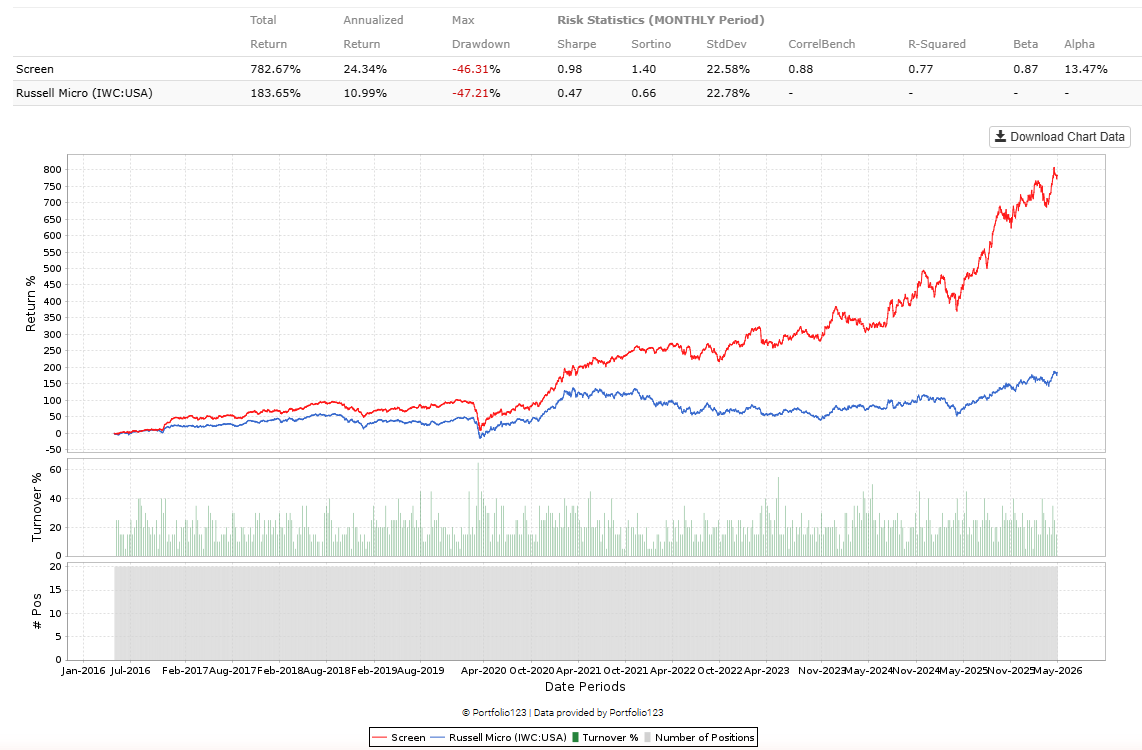
For the last 2 months it has been all about Claude. Today I asked ChatGPT to develop a novel stock ranking system... and it genuinely surprised me. I uploaded a couple of files so it could learn the syntax. Then I asked it to search for something novel in an overcrowded space. This is what it suggested and then it gave me the exact xml code to use. --Core idea: Find companies improving faster than the market expects --Edge: Earnings revisions + growth acceleration (before analysts fully catch up) --Smart value: Focus on cash flow (FCF/EV, forward earnings yield), not cheap junk --Quality filter: Strong profitability + efficient use of capital --Momentum (done right): Industry-relative, not crowded price chasing --Stability layer: Favor consistent businesses with improving margins Avoids: Classic value traps + noisy, overfit factors The system was to be for the S&P 500. And it worked okay there. But when I moved it into a semi-liquid microcap space it really started to pop. I might have to start giving ChatGPT a little more attention. Hmmm....
Kurtis The Quant tweet media
English
6
13
101
14.4K
The Dow Theory
The Dow Theory@TheDowTheory·
Update: All Dow Theory & market analysis now on @ManuelBlay3 This account remains for official announcements, newsletters, and resources. Thanks.
English
0
0
3
229
The Dow Theory
The Dow Theory@TheDowTheory·
Master these 4 questions and you change everything: when to buy, what to buy, when to sell, and what to sell. That is the real edge behind consistent outperformance. The first episode of our stock picking and market timing course is already live.
English
0
0
6
244
The Dow Theory
The Dow Theory@TheDowTheory·
S&P500 November closing low (11/20) was violated today. Not good. Another bearish factor. In my next April 1st Letter, I will spell out the consequences.
The Dow Theory tweet media
English
0
0
7
337
The Dow Theory
The Dow Theory@TheDowTheory·
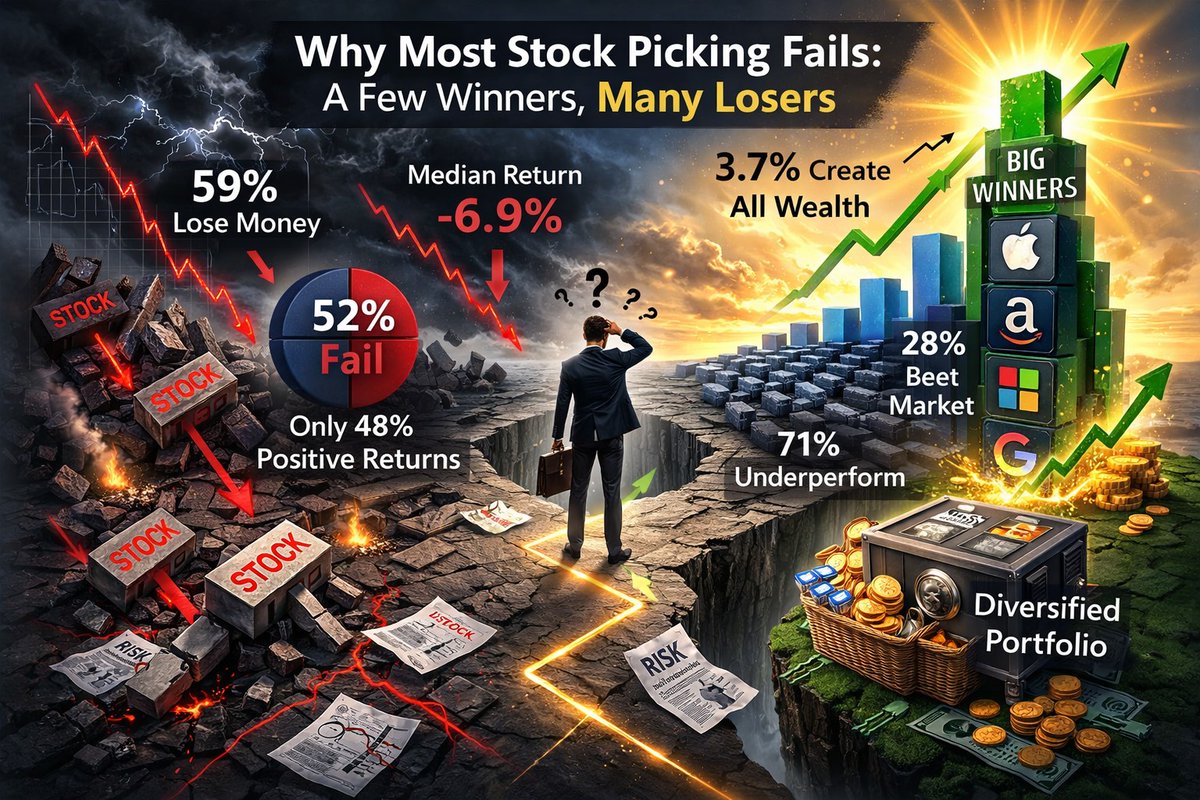
Stock picker: Beware of fairy tales! Hendrick Bessembinder article "One Hundred Years in the U.S. Stock Markets" is eye-opening. Stock picking is a minefield for most investors. Here is the link: papers.ssrn.com/sol3/papers.cf… And here the AI-generated executive summary, which I have reviewed: The central insight of the study is both striking and uncomfortable: most individual stocks are poor investments, and investors who rely on stock picking are statistically likely to fail. At first glance, the stock market appears highly rewarding. Over the past century, U.S. equities generated enormous wealth, with total shareholder wealth creation reaching about $91 trillion. The overall market compounded at roughly 10 percent annually, reinforcing the idea that investing in stocks is broadly profitable. However, these impressive aggregate results mask a deeply uneven reality beneath the surface. The key issue lies in how returns are distributed across individual stocks. While the average return is very high, the median return is negative. In fact, the median buy and hold return across nearly 30,000 stocks was about minus 6.9 percent . This means that more than half of all stocks failed to create value for investors over their lifetimes. This gap between average and median outcomes is driven by extreme skewness. A small number of stocks generate enormous gains, while the majority deliver mediocre or negative results. Because gains have no upper limit but losses are capped, a handful of exceptional winners dominate long term performance. These few stocks pull the average upward, even though most stocks underperform. The data confirms how difficult stock picking really is. Only about 48 percent of stocks produced positive lifetime returns, and just 41 percent outperformed Treasury bills . Even more striking, only about 28 percent beat the overall market. In other words, nearly three out of four stocks underperform a simple diversified benchmark. For investors, this creates a major challenge. Stock picking is essentially an attempt to identify a very small group of extreme winners in advance. Yet these winners are rare and hard to recognize early. Their success usually comes not from spectacular short term gains, but from moderately strong returns sustained over long periods. This makes them difficult to distinguish from the broader universe of stocks at the time of purchase. Compounding adds another layer of difficulty. Small differences in annual returns can lead to massive differences in long term outcomes, but only over decades. Meanwhile, the median stock remains listed for less than seven years , meaning many investments end before meaningful compounding can occur. The extent of wealth destruction further explains investor failure. Around 59 percent of firms reduced shareholder wealth relative to Treasury bills , making much of the stock universe a drag on performance. Most importantly, wealth creation is highly concentrated. Just 3.7 percent of firms account for all net wealth created in the market . The remaining majority collectively adds no value beyond risk free alternatives. This explains why diversification works and stock picking struggles. A diversified portfolio captures the rare winners that drive returns, while concentrated portfolios are more likely to be dominated by underperformers. In summary, investors fail at stock picking because success depends on identifying a tiny number of exceptional stocks in advance. Most stocks underperform, many destroy wealth, and only a few generate the gains that drive the market.
The Dow Theory tweet media
English
0
0
3
261
BitcoinSapiens ⚡️
BitcoinSapiens ⚡️@BitcoinSapiens·
MICHAEL SAYLOR: When Bitcoin hits $950,000, many will wait for it to drop to $700,000 before buying. By then, it could skyrocket to $8,000,000. Soon...🚀
BitcoinSapiens ⚡️ tweet mediaBitcoinSapiens ⚡️ tweet media
English
60
134
1K
32.2K
Tekee
Tekee@Tekeee·
Gold is crashing. Silver is crashing. Crypto is crashing. Stocks are crashing. The dollar is crashing. Real talk what should we buy now?
English
11.6K
1.9K
25.1K
2.7M
The Dow Theory
The Dow Theory@TheDowTheory·
AI is compressing decades into years. Steam took 80 years. Electricity 40. The internet 30. AI? ~3 years to mass adoption. That changes everything for investors. This is no longer just about what you own… but when you own it. Market timing is shifting from optional to essential. Full analysis below by George Morton, PhD 👇 thedowtheory.com/the-four-indus…
English
0
0
4
184
The Dow Theory
The Dow Theory@TheDowTheory·
The Dow Theory for the 21st Century is not about guessing. It is about having a framework that gives you multiple opportunities to act with clarity. In the latest video, I walk through a “bonus” Sell signal. This is now the fourth signal in our market timing toolkit. No noise. No opinions. Just rules, discipline, and a proven process. If you want to see exactly how it works in real time, watch the full video via the link in the comments.
English
1
0
6
217
Portfolio123
Portfolio123@P123Finance·
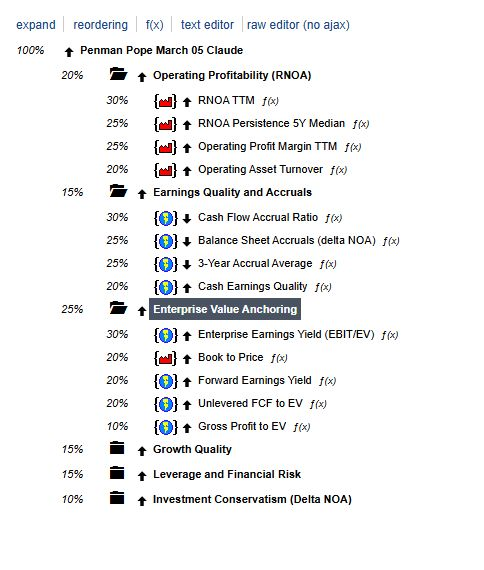
People are now using Claude with Portfolio123 and it has changed everything. You can now tell it to research the value philosophy and style of Stephen Penman and Peter Pope. And to research factors and formulas they use. And to build a ranking system in the script Portfolio123 uses so you can copy and paste. Or, you can give it API access to your account so it can directly create the ranking system, simulation, run robustness checks and potentially improve anything you've created in the past. How do you do this? @Quant_Morales has taken the Portfolio123 knowledge base and turned it into a set of Claude skills. And he is giving them away at no cost. Our recommendation is to DM him simply ask for a copy of the Claude P123 skills. This feels like a major turning point in history.
Portfolio123 tweet media
English
5
5
80
6.6K
The Dow Theory
The Dow Theory@TheDowTheory·
@TrendingBitcoin And if it went to $10K, how would they feel then? Such bravado is pointless. Less testosterone, more independent thinking.
English
0
0
1
117
Trending Bitcoin
Trending Bitcoin@TrendingBitcoin·
SAYLOR ISSUES WARNING TO BITCOIN COMMUNITY: "IF BITCOIN WENT TO $10 MILLION DOLLARS TOMORROW I WANT YOU TO THINK ABOUT HOW YOU'D FEEL."
English
49
52
482
31K
The Dow Theory
The Dow Theory@TheDowTheory·
Respectfully, I beg to disagree with Stanley Druckenmiller. There is not just one way to succeed in markets. What works for exceptionally talented investors may not work for most people. Not everyone can find the 2–3 asymmetric home runs, much less stomach the brutal losses when they turn into flops. For those who are neither so gifted nor have the stomach for that volatility, another path exists: rotate and time a broad set of assets. Fifty mediocre assets, properly managed, can still deliver strong returns with smaller drawdowns. Jim Simons became rich by diversifying widely and not worrying whether each asset was great or merely average.
Steve Burns@SJosephBurns

“You don’t get rich by diversifying into 50 mediocre assets. You get rich by finding 2 or 3 asymmetric home runs.” — Stanley Druckenmiller


English
0
0
6
615
The Dow Theory
The Dow Theory@TheDowTheory·
Yes, the issue is that not all mortals have the ability to find the 2 or 3 asymmetric home runs, much less the ability to withstand the horrific loss if, instead of a home run, one gets a flop. On the other hand, 50 mediocre assets, when rotated and timed properly, may deliver high performance (30% p.a.) and mitigate drawdowns. Jim Simons got rich by diversifying big and not caring about whether an asset was mediocre or good.
English
0
0
1
905
Steve Burns
Steve Burns@SJosephBurns·
“You don’t get rich by diversifying into 50 mediocre assets. You get rich by finding 2 or 3 asymmetric home runs.” — Stanley Druckenmiller
Steve Burns tweet media
English
238
1K
9.6K
1.1M