Will

3.4K posts

Will banner
Will

Will

@Twill068

Crypto, AI, Quantum & Salvage Laws fan boy.

Australia Katılım Eylül 2017
2.1K Takip Edilen497 Takipçiler
Sabitlenmiş Tweet
Will
Will@Twill068·
I see a future where the crypto community is cool with many early adopters getting lost coins back without violating immutability, property rights... It's basically a white-hat finding a vulnerability in all unmigrated wallets and swooping in before the black hats get the tech to exploit it.
English
2
0
4
134
Will
Will@Twill068·
@vicentronics @TrustlessState @leolanza Ethereum should run its monetary policy like a central bank. Set a steady yeild with floating emissions. Lean into the 'internet bond' narrative
English
0
0
0
13
Will
Will@Twill068·
No! And that's a bad thing here. For Ethereum to attract 100T in assets it NEEDS a high ETH value to secure it... Yet, what it incentivising folks to HODL ETH to a multitrillian dollar value? Saying 'it needs to be valuable for it to work' doesnt make it work. It's actually a reason for why it might fail. ETH needs some pampanomics (and i suggest tail emissions to keep a sufficently high yeild and more ETH locked up)
English
1
0
1
21
Leo Lanza | Lanza.eth
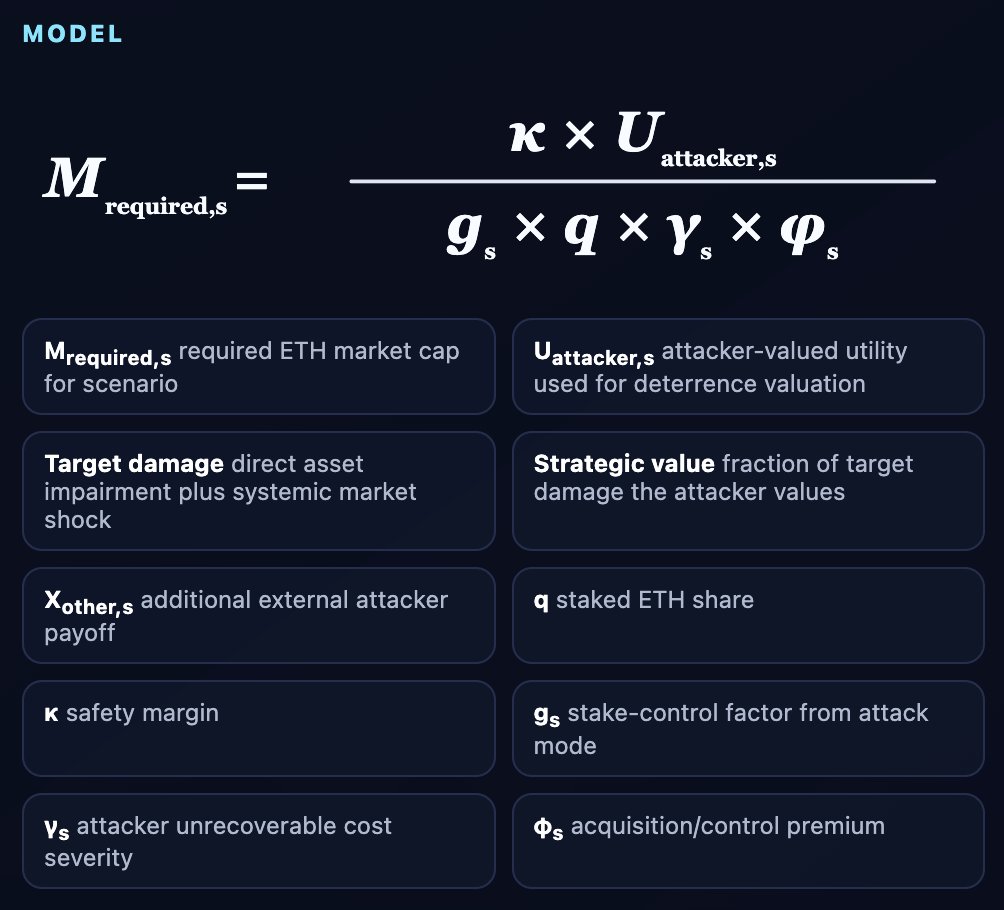
The model predicts a 6 figure price per ETH. I’ve been building an economic security model for ETH and turning it into a dashboard. The math does not support David’s claim that Ethereum can thrive while ETH, the monetary commodity securing it, fails to appreciate. As more assets are tokenized, Ethereum’s security budget has to scale with the value it secures. That means ETH doesn’t just benefit from adoption. It must reprice higher for Ethereum to safely secure the next wave of global assets. Currently, the model has ETH below floor valuation and historically ETH does not stay there long.
Leo Lanza | Lanza.eth tweet media
David Hoffman@TrustlessState

x.com/i/article/2059…

English
38
30
298
27.4K
Will
Will@Twill068·
You're saying ETH will gain the value it necessitates via attempted attacks on the network? - Low ETH value securing very high value, leading to ETH gaining value via fighting off attacks? (Malicious actors buying and getting slashed). Not impossible, but without attempted attacks ETH value can remain low.
English
1
0
0
26
Will
Will@Twill068·
@leolanza @TrustlessState It does prove that ETH value is very important... but it doesn't explain how it captures that value. I for one suggest 2% tail emissions to pump up the staking yeild. A 7% yeild on a tech asset that inflats in line with physical gold would be very attractive to big money
English
1
0
0
404
Leo Lanza | Lanza.eth
@TrustlessState That’s not a causation breakdown. That’s literally the point. Either ETH reprices high enough to economically secure trillions in assets, or trillions in assets won’t rationally settle there. Both outcomes prove ETH value matters to Ethereum’s success.
English
3
1
35
744
Will
Will@Twill068·
@FigoETH ETH (or any other currency or asset) wont displace USD... its all about USD. ETH is gas, hype and a staking yield. AI will increase its use as gas and to increase its hype, we should increase the yield, by raising issuance, imo.
English
0
0
0
68
f1go.eth
f1go.eth@FigoETH·
Good post personally think in 2030: - ETH will be reserve currency for onchain AI economy, addressing a $400T+ mcap (global wealth; yes this is why Tom Lee is betting - with chad size - on ETH). And this is not even considering the huge increase in mcap induced by agentic commerce... - ETH will also be deflationary since there will be considerable demand for L1 blockspace for high value txns (institutional finance, govs, B2B, high value NFTs etc.) when world is doing everything valuable onchain - realyield will be 4%+ in such a world, icing on the cake Happy to take the other side of the bet of people who can only think in 5min charts...
Papaxem@papaxem4

Why Ethereum voluntarily killed its own revenue (The Amazon Effect in crypto) Right now, a lot of people are criticizing Ethereum: network fees have dropped significantly, token burns have decreased, and ETH has once again become slightly inflationary (~0.5%). It looks like the developers shot themselves in the foot. Why would they deliberately kill the network’s revenue? To understand this, let’s look at it through the lens of traditional business strategy. Remember Amazon in its early years? The company operated at zero or even negative margins for years, aggressively cutting prices and destroying its own short-term profits. Why? To capture market share and achieve economies of scale. The same strategy is now being used by the Chinese auto giant BYD. The law of scale in both Web2 and Web3 is simple: It’s better to earn $0.01 from 1 billion transactions than $50 from 100,000! If Ethereum had kept fees at $20–$50, it would have turned into an exclusive club for whales. All retail users, game developers, SocialFi projects, and mass-market DeFi would have permanently moved to Solana, BNB Chain, or Aptos. Ethereum would have lost the war for users. That’s why @VitalikButerin and the @ethereumfndn made a deliberate strategic shift: 1. The base layer is becoming a global settlement layer for large capital, Wall Street, ETFs, and tokenized real-world assets (RWA). Institutions care about maximum security, not cheap fees. 2. Layer 2 networks (Base, Arbitrum, etc.) take on all retail and mass-market applications. Fees there are now extremely low - precisely because L1 made wholesale data posting much cheaper. The reduction in Ethereum’s fees is an investment in building an infrastructure monopoly. Ethereum sacrificed short-term token deflation in order to maintain its status as the world’s leading blockchain. In the long term (investment horizon), the bet is that activity on L2s will grow so much that even these tiny wholesale fees will eventually make ETH deflationary again. The market often thinks in terms of one or two weeks. That’s why we see hype cycles around coins like ZEC or NEAR. But hype always ends, and capital eventually returns to reliable assets - and right now, that’s still only Bitcoin and Ethereum!

English
11
11
138
19.4K
Will
Will@Twill068·
@_Checkmatey_ Ethereum should raise issuance to 2% (in line with physical gold) to give a 7% staking yeild
English
0
0
0
266
Will
Will@Twill068·
To attract the next wave of interest, money, and hype - folks need to start talking about the world changing big picture grand vision. What could a world look like if a decentralized, private, ZK, etc network engulfed the globe... why should we even care? Crypto talk for the last 5 years is all markets or technicals with zero grand vision.. All the people fearing an authortarian AI future need to hear how Ethereum with WorldCoin, ZK tech and a decentralised permissionless base layer is the defense against all of it. Why care for decentralization when you can get hacked or lose your keys and a bank will reimburse or restore access...? Because decentralisation is for fighting a might bigger beast than any one persons problems, but no one is telling that story anymore, even though like a billion people are fearing exactly what crypto is building the defenses for! It's madness that V (or anyone!) never goes onto a Joe Rogan and explains that we are building the global defense against tyranny and privacy destruction and communism, etc
English
0
0
0
1.2K
eric
eric@econoar·
I don't really blame David, ETH has grossly underperformed the general crypto market for many years now. I think a lot of his views here are valid and as I've mentioned, I've personally divested a lot out of ETH the past 1-2 years now. To this point, everything I've switched into has greatly outperformed ETH. Honestly, I don't even think ETH underperforming is really related to any fundamental wrong doing. One thing I think a lot of people fail to realize is how violent the initial ETH run was. It's going to take a long time to shake off the breadth of millionaires that were created in such a short period of time. At the end of the day, maximalism to a single coin when it comes to portfolio management is pretty silly. The market doesn't lie, there's no reason to trade against it. You can always trade back into a coin if it gets hot.
David Hoffman@TrustlessState

x.com/i/article/2059…

English
75
22
381
78.2K
Will
Will@Twill068·
@boogaav V should go on a mainstream podcast tour talking about how Ethereum could redesign the world. In H1 2020 that was the feeling, that was the vibe... but that messaging has been lost and is sorely needed
English
1
0
1
44
BOOGA 不哥
BOOGA 不哥@boogaav·
Vitalik, millions didn’t come to crypto because they needed cheaper transactions. They came because Ethereum made people believe we could redesign the world. Now the old world is visibly cracking apart, and the moment demands bigger visions than ever. What makes me sad is not Ethereum slowing down. It’s watching the people who taught us to imagine, suddenly become careful…
vitalik.eth@VitalikButerin

Some of my perspective on where the @ethereumfndn is going. First of all, this is only my own view. The board is not just me, and I have no extra special powers on the board that the other board members do not. @aerugoettinea is the one executing much of this transition. My input has been largely on technical questions. The board is in the process of expanding, and my own power within the org will continue to decrease, which is honestly what I want. The 2025 era brought many important improvements to EF and its ability to execute. Many issues were resolved, and EF continues to benefit from its improved efficiency and greater focus on concrete goals to this day. And so with those problems resolved, early this year, the largest remaining hole that I perceived was something different nagging at me: I would regularly spot people saying things like "vitalik says these beautiful things about ethereum needing to be decentralized, and have privacy, and be a sanctuary technology, but why do the EF's actions not reflect that?" Now, you may have been hearing something different. You may not have been sensing a feeling of crisis at all, and maybe were hearing people saying that finally we were taking execution and BD seriously and the main task for us is to keep going that way and be even better and faster. Then probably there is genuine difference between you and me, in what kinds of criticism I take most seriously, and what kinds of critics through their criticism are most able to make me feel pain. As an analogy, let's briefly switch over to a different domain. One belief you can have about Google is that it is a success story, and has brought a lot of good to humanity in organizing the world's information. Another belief you can have about Google is that they had a beautiful idealistic beginning, but at some point the corruption of mainstream corporate attitudes seeped in, and they slowly bit by bit completely abandoned the "don't be evil" slogan. My belief on Google specifically is probably somewhere between the two. BUT, if you had taken me back in time to ~2008, and offered me a button to press to make Google one or two standard deviations more "dogmatic", eg. give Richard Stallman permanent veto power over some key policies, I would immediately press it. Why? Because a choice for one company is not a choice for the world, or even one country. Google existed and exists in the context of a technology industry generally drifting away from early idealistic don't-be-evil roots and toward greed for financial gain, totalizing visions of accelerated superintelligence, infiltration by sociopaths, and craven capitulation to (or worse, active participation in) government pressure for ideological control, surveillance and war. And so *one company* doing something different, positioning itself to be what George Bernard Shaw calls the Unreasonable Man, resisting the trend of the times, would have been better for freedom, balance of power and stability of society as a whole, than *all* large companies bending to dominant trends. This is a part of my version of pluralism. This line of thinking is not just mine, but I also is not too far off from what Aya and others had in mind with the Mandate. Now how does this all get to the role of the EF? EF is not a "center of Ethereum", rather EF is "one node, with a defined purpose, alongside other nodes". We've always said that the EF should be the latter, but many in the Ethereum ecosystem (and even within the EF) wanted us to be the former. Now, we are taking action to ensure that we will be the latter. This is particularly important because EF is a limited organization, with limited resources and limited organizational capacity. The EF has only ~0.16% of all ETH (less than many other individual ETH holders), whereas among other blockchains it's common for "the central foundation" to have 10-50%. Fiscally, the EF was originally designed to fulfill a limited work scope defined in the token sale docs and other pre-launch materials (building the chain software; getting through Frontier, Homestead, Metropolis, Serenity), which was fully completed in 2022; it was not designed to be an eternal steward. And so today, the EF is choosing to use its remaining resources to pursue longevity over breadth (yes, this means we sell less ETH). The EF focuses *specifically* on those activities critical to the success of ethereum as a censorship/capture-resistant, open, private and secure system, that would not happen otherwise. This means making hard choices, and in some cases even activities that we highly approve of and people that we highly respect becoming outside of the EF. People of great technical talent, public respect and even alignment with the mission and CROPS being outside of the EF is in fact necessary if we want important tasks to be able to attract outside capital. This also means the EF taking opinionated stands culturally. This is all intended in cooperation with all other parts of ethereum. We recognize that many other parts of the ethereum world highly respect CROPS and related values. But highly respecting is not the same as choosing to specialize and totally dedicate to a domain (Compare in a different domain: I think reducing animal cruelty is important, and I like vegan food, but am not full unconditional vegan myself) EF is still in a transition period, and we expect its new long-term form to stabilize over the next few months. What are the guiding principles of this new form? Again, I am only one person, but I can give my answer from a technical perspective (there are also critical non-technical aspects). At the core, *Ethereum must be impressive*. We are living in an age of highly intelligent AI and all kinds of other technological acceleration. "Status quo EVM, with a hard fork or two a year to optimize for short-term needs of users" is not interesting. To some, "impressive" means: 250ms latency and 1M TPS. I think Ethereum trying to go that route is a mistake. Being as fast and as scalable as possible, and only a small epsilon more decentralized than the others, is a route to mediocrity, and if we try it we will lose. I think Ethereum should scale. But I think Ethereum should strive the hardest to be deeply impressive in a different dimension: the CROPS dimension. This means things like: * Provably bug-free Ethereum. This is a goal that all cybersecurity researchers would have thought is absurd and impossible, up until roughly 6 months ago. Now, it's on the cusp of being possible, thanks to AI-assisted formal verification. So we should be frontrunners in doing this. * Available chain consensus. Ethereum is, and with lean consensus will cotninue to be, the ONLY chain that has both (i) traditional-BFT style properties that it's safe under asynchrony up to a high level of fault tolerance, and (ii) the bitcoin PoW-style property that under synchrony it's safe up to 49% attackers. As far as I can tell, literally no other chain has this or is planning for it; bitcoin goes for (ii) only and most other chains go for (i) only. Some will remember I fought hard for this, Unreasonably insisting that it is not OK for ethereum to rely on social consensus and hard forks to rescue ethereum from 34% of nodes going offline. It's OK for chains like hyperledger, bnb, solana, tempo, etc. It's not OK for bitcoin or ethereum or eg. zcash. * Intermediary minimization. The fact that smart contract wallets, protocols like railgun, etc have to send transactions through intermediaries to get included onchain is honestly embarrassing, and it's a constant point of fragility. Hence the work on FOCIL and EIP-8141 (and 7701 and years of work before) to make transaction sending intermediary-minimized with public mempool and strong inclusion properties, in a truly general-purpose way, that covers not just eg. secp256r1, but also privacy protocols and much more. Kohaku is pushing intermediary minimization at the user layer, pulling Ethereum away from the dystopian status quo world where our wallets don't even verify the chain, send our private data out to a dozen third-party servers, and toward a brighter CROPS future. Some of these goals are Unreasonable - maybe Ethereum would be "fine" getting only 50% of the way - what if we depend on intermediaries, but make it easy to switch? But going 50% of the way would not make Ethereum Deeply Impressive in the CROPS way. So we push for 100%. Fortunately all these goals are compatible with high TPS, this is a major focus of research (esp. on scaling the state). Well-designed L2s can also help, especially L2s optimized for specific applications (eg. high-volume trading, privacy...). These goals are even compatible with significantly lower slot times, thanks to Raul's work on erasure-coded P2P, and many other optimizations. The most high-value "product" of the ethereum blockchain, financially speaking, is ETH the asset. Ethereum secures $250 billion of ETH. The types of properties of Ethereum that I mentioned above are very good for ETH the asset. Nearly 90% of my net worth is in ETH, and most of the remainder is ~$40m of onchain fiat of which every dollar has already been allocated for some open-source biotech or software or hardware initiative. That said, there are aspects of supporting ETH the asset - *necessary* aspects even - that are outside the scope of the EF. This is where we need other heroes (some of whom hold more ETH than the EF does) to step in and help. EF has been recently thinking more about how it will relate to other such organizations, and give them needed initial support. EF will be a smaller ship than in previous years, a more opinionated one - in some cases more opinionated in ways that might be difficult to comprehend - but a longer-lasting one, and one suited to making sure that ethereum brings something meaningful to the world. We are grateful to all those inside and outside the EF who are helping to make this happen.


English
16
4
111
15.9K
Will
Will@Twill068·
@VitalikButerin @ethereumfndn @aerugoettinea Id like to raise issuance in line is physical gold (~2%) to generate 7% yield.. Bag bias - perhaps, but also, ETH is important and making it attractive is important. Right now it yields less than bonds and no one cares that at times it's slightly inflationary/deflationary
English
0
0
0
625
vitalik.eth
vitalik.eth@VitalikButerin·
Some of my perspective on where the @ethereumfndn is going. First of all, this is only my own view. The board is not just me, and I have no extra special powers on the board that the other board members do not. @aerugoettinea is the one executing much of this transition. My input has been largely on technical questions. The board is in the process of expanding, and my own power within the org will continue to decrease, which is honestly what I want. The 2025 era brought many important improvements to EF and its ability to execute. Many issues were resolved, and EF continues to benefit from its improved efficiency and greater focus on concrete goals to this day. And so with those problems resolved, early this year, the largest remaining hole that I perceived was something different nagging at me: I would regularly spot people saying things like "vitalik says these beautiful things about ethereum needing to be decentralized, and have privacy, and be a sanctuary technology, but why do the EF's actions not reflect that?" Now, you may have been hearing something different. You may not have been sensing a feeling of crisis at all, and maybe were hearing people saying that finally we were taking execution and BD seriously and the main task for us is to keep going that way and be even better and faster. Then probably there is genuine difference between you and me, in what kinds of criticism I take most seriously, and what kinds of critics through their criticism are most able to make me feel pain. As an analogy, let's briefly switch over to a different domain. One belief you can have about Google is that it is a success story, and has brought a lot of good to humanity in organizing the world's information. Another belief you can have about Google is that they had a beautiful idealistic beginning, but at some point the corruption of mainstream corporate attitudes seeped in, and they slowly bit by bit completely abandoned the "don't be evil" slogan. My belief on Google specifically is probably somewhere between the two. BUT, if you had taken me back in time to ~2008, and offered me a button to press to make Google one or two standard deviations more "dogmatic", eg. give Richard Stallman permanent veto power over some key policies, I would immediately press it. Why? Because a choice for one company is not a choice for the world, or even one country. Google existed and exists in the context of a technology industry generally drifting away from early idealistic don't-be-evil roots and toward greed for financial gain, totalizing visions of accelerated superintelligence, infiltration by sociopaths, and craven capitulation to (or worse, active participation in) government pressure for ideological control, surveillance and war. And so *one company* doing something different, positioning itself to be what George Bernard Shaw calls the Unreasonable Man, resisting the trend of the times, would have been better for freedom, balance of power and stability of society as a whole, than *all* large companies bending to dominant trends. This is a part of my version of pluralism. This line of thinking is not just mine, but I also is not too far off from what Aya and others had in mind with the Mandate. Now how does this all get to the role of the EF? EF is not a "center of Ethereum", rather EF is "one node, with a defined purpose, alongside other nodes". We've always said that the EF should be the latter, but many in the Ethereum ecosystem (and even within the EF) wanted us to be the former. Now, we are taking action to ensure that we will be the latter. This is particularly important because EF is a limited organization, with limited resources and limited organizational capacity. The EF has only ~0.16% of all ETH (less than many other individual ETH holders), whereas among other blockchains it's common for "the central foundation" to have 10-50%. Fiscally, the EF was originally designed to fulfill a limited work scope defined in the token sale docs and other pre-launch materials (building the chain software; getting through Frontier, Homestead, Metropolis, Serenity), which was fully completed in 2022; it was not designed to be an eternal steward. And so today, the EF is choosing to use its remaining resources to pursue longevity over breadth (yes, this means we sell less ETH). The EF focuses *specifically* on those activities critical to the success of ethereum as a censorship/capture-resistant, open, private and secure system, that would not happen otherwise. This means making hard choices, and in some cases even activities that we highly approve of and people that we highly respect becoming outside of the EF. People of great technical talent, public respect and even alignment with the mission and CROPS being outside of the EF is in fact necessary if we want important tasks to be able to attract outside capital. This also means the EF taking opinionated stands culturally. This is all intended in cooperation with all other parts of ethereum. We recognize that many other parts of the ethereum world highly respect CROPS and related values. But highly respecting is not the same as choosing to specialize and totally dedicate to a domain (Compare in a different domain: I think reducing animal cruelty is important, and I like vegan food, but am not full unconditional vegan myself) EF is still in a transition period, and we expect its new long-term form to stabilize over the next few months. What are the guiding principles of this new form? Again, I am only one person, but I can give my answer from a technical perspective (there are also critical non-technical aspects). At the core, *Ethereum must be impressive*. We are living in an age of highly intelligent AI and all kinds of other technological acceleration. "Status quo EVM, with a hard fork or two a year to optimize for short-term needs of users" is not interesting. To some, "impressive" means: 250ms latency and 1M TPS. I think Ethereum trying to go that route is a mistake. Being as fast and as scalable as possible, and only a small epsilon more decentralized than the others, is a route to mediocrity, and if we try it we will lose. I think Ethereum should scale. But I think Ethereum should strive the hardest to be deeply impressive in a different dimension: the CROPS dimension. This means things like: * Provably bug-free Ethereum. This is a goal that all cybersecurity researchers would have thought is absurd and impossible, up until roughly 6 months ago. Now, it's on the cusp of being possible, thanks to AI-assisted formal verification. So we should be frontrunners in doing this. * Available chain consensus. Ethereum is, and with lean consensus will cotninue to be, the ONLY chain that has both (i) traditional-BFT style properties that it's safe under asynchrony up to a high level of fault tolerance, and (ii) the bitcoin PoW-style property that under synchrony it's safe up to 49% attackers. As far as I can tell, literally no other chain has this or is planning for it; bitcoin goes for (ii) only and most other chains go for (i) only. Some will remember I fought hard for this, Unreasonably insisting that it is not OK for ethereum to rely on social consensus and hard forks to rescue ethereum from 34% of nodes going offline. It's OK for chains like hyperledger, bnb, solana, tempo, etc. It's not OK for bitcoin or ethereum or eg. zcash. * Intermediary minimization. The fact that smart contract wallets, protocols like railgun, etc have to send transactions through intermediaries to get included onchain is honestly embarrassing, and it's a constant point of fragility. Hence the work on FOCIL and EIP-8141 (and 7701 and years of work before) to make transaction sending intermediary-minimized with public mempool and strong inclusion properties, in a truly general-purpose way, that covers not just eg. secp256r1, but also privacy protocols and much more. Kohaku is pushing intermediary minimization at the user layer, pulling Ethereum away from the dystopian status quo world where our wallets don't even verify the chain, send our private data out to a dozen third-party servers, and toward a brighter CROPS future. Some of these goals are Unreasonable - maybe Ethereum would be "fine" getting only 50% of the way - what if we depend on intermediaries, but make it easy to switch? But going 50% of the way would not make Ethereum Deeply Impressive in the CROPS way. So we push for 100%. Fortunately all these goals are compatible with high TPS, this is a major focus of research (esp. on scaling the state). Well-designed L2s can also help, especially L2s optimized for specific applications (eg. high-volume trading, privacy...). These goals are even compatible with significantly lower slot times, thanks to Raul's work on erasure-coded P2P, and many other optimizations. The most high-value "product" of the ethereum blockchain, financially speaking, is ETH the asset. Ethereum secures $250 billion of ETH. The types of properties of Ethereum that I mentioned above are very good for ETH the asset. Nearly 90% of my net worth is in ETH, and most of the remainder is ~$40m of onchain fiat of which every dollar has already been allocated for some open-source biotech or software or hardware initiative. That said, there are aspects of supporting ETH the asset - *necessary* aspects even - that are outside the scope of the EF. This is where we need other heroes (some of whom hold more ETH than the EF does) to step in and help. EF has been recently thinking more about how it will relate to other such organizations, and give them needed initial support. EF will be a smaller ship than in previous years, a more opinionated one - in some cases more opinionated in ways that might be difficult to comprehend - but a longer-lasting one, and one suited to making sure that ethereum brings something meaningful to the world. We are grateful to all those inside and outside the EF who are helping to make this happen.
English
1.5K
1.4K
7.6K
3.7M
Will
Will@Twill068·
@FigoETH Pretty sure 1 gwei at $100k ETH is > 1 gwei at $2k ETH...
CY
1
0
1
138
Will
Will@Twill068·
@TopherField First time ive seen someone admit they lost a debate
English
0
0
0
10
Topher Field
Topher Field@TopherField·
This might be my worst mistake... ever? Tough day at the office for sure. There's no 'nice' way to say this, I screwed up my debate on Punters against Daniel Bleakley badly. Actually one of my worst clangers... ever. And it's 100% on me. I built my entire approach to the debate around something I genuinely believed to be true about my Daniel's company... but I was wrong. Trouble is I didn't realise I'd made that mistake till we were well into the debate, and it wasn't till AFTER the debate that I was able to go back and actually confirm... I'd screwed up my research. Sadly it means I've made an idiot of myself, and I've failed to represent you as I should have, and this one's going to live rent-free in my head for a while. In this video I tell you what happened, then when the debate comes out on Punters Politics you can watch it there and decide for yourself. Ugh. Not my favourite day. topherfield.com
English
67
9
334
14.8K
Will
Will@Twill068·
@ape41eth @wmougayar 'It yeilds less than bonds and has a small inflation rate that might go slightly negative sometimes' isnt a good elevator pitch. '7% yeild with the supply inflating at the same rate as physical gold' is much better!
English
1
0
0
25
William Mougayar
William Mougayar@wmougayar·
Basically, Ethereum just got its own Clarity Act over the weekend. It was a crystal clear message, and the road ahead is super clear. Ethereum is untouchable.
vitalik.eth@VitalikButerin

Some of my perspective on where the @ethereumfndn is going. First of all, this is only my own view. The board is not just me, and I have no extra special powers on the board that the other board members do not. @aerugoettinea is the one executing much of this transition. My input has been largely on technical questions. The board is in the process of expanding, and my own power within the org will continue to decrease, which is honestly what I want. The 2025 era brought many important improvements to EF and its ability to execute. Many issues were resolved, and EF continues to benefit from its improved efficiency and greater focus on concrete goals to this day. And so with those problems resolved, early this year, the largest remaining hole that I perceived was something different nagging at me: I would regularly spot people saying things like "vitalik says these beautiful things about ethereum needing to be decentralized, and have privacy, and be a sanctuary technology, but why do the EF's actions not reflect that?" Now, you may have been hearing something different. You may not have been sensing a feeling of crisis at all, and maybe were hearing people saying that finally we were taking execution and BD seriously and the main task for us is to keep going that way and be even better and faster. Then probably there is genuine difference between you and me, in what kinds of criticism I take most seriously, and what kinds of critics through their criticism are most able to make me feel pain. As an analogy, let's briefly switch over to a different domain. One belief you can have about Google is that it is a success story, and has brought a lot of good to humanity in organizing the world's information. Another belief you can have about Google is that they had a beautiful idealistic beginning, but at some point the corruption of mainstream corporate attitudes seeped in, and they slowly bit by bit completely abandoned the "don't be evil" slogan. My belief on Google specifically is probably somewhere between the two. BUT, if you had taken me back in time to ~2008, and offered me a button to press to make Google one or two standard deviations more "dogmatic", eg. give Richard Stallman permanent veto power over some key policies, I would immediately press it. Why? Because a choice for one company is not a choice for the world, or even one country. Google existed and exists in the context of a technology industry generally drifting away from early idealistic don't-be-evil roots and toward greed for financial gain, totalizing visions of accelerated superintelligence, infiltration by sociopaths, and craven capitulation to (or worse, active participation in) government pressure for ideological control, surveillance and war. And so *one company* doing something different, positioning itself to be what George Bernard Shaw calls the Unreasonable Man, resisting the trend of the times, would have been better for freedom, balance of power and stability of society as a whole, than *all* large companies bending to dominant trends. This is a part of my version of pluralism. This line of thinking is not just mine, but I also is not too far off from what Aya and others had in mind with the Mandate. Now how does this all get to the role of the EF? EF is not a "center of Ethereum", rather EF is "one node, with a defined purpose, alongside other nodes". We've always said that the EF should be the latter, but many in the Ethereum ecosystem (and even within the EF) wanted us to be the former. Now, we are taking action to ensure that we will be the latter. This is particularly important because EF is a limited organization, with limited resources and limited organizational capacity. The EF has only ~0.16% of all ETH (less than many other individual ETH holders), whereas among other blockchains it's common for "the central foundation" to have 10-50%. Fiscally, the EF was originally designed to fulfill a limited work scope defined in the token sale docs and other pre-launch materials (building the chain software; getting through Frontier, Homestead, Metropolis, Serenity), which was fully completed in 2022; it was not designed to be an eternal steward. And so today, the EF is choosing to use its remaining resources to pursue longevity over breadth (yes, this means we sell less ETH). The EF focuses *specifically* on those activities critical to the success of ethereum as a censorship/capture-resistant, open, private and secure system, that would not happen otherwise. This means making hard choices, and in some cases even activities that we highly approve of and people that we highly respect becoming outside of the EF. People of great technical talent, public respect and even alignment with the mission and CROPS being outside of the EF is in fact necessary if we want important tasks to be able to attract outside capital. This also means the EF taking opinionated stands culturally. This is all intended in cooperation with all other parts of ethereum. We recognize that many other parts of the ethereum world highly respect CROPS and related values. But highly respecting is not the same as choosing to specialize and totally dedicate to a domain (Compare in a different domain: I think reducing animal cruelty is important, and I like vegan food, but am not full unconditional vegan myself) EF is still in a transition period, and we expect its new long-term form to stabilize over the next few months. What are the guiding principles of this new form? Again, I am only one person, but I can give my answer from a technical perspective (there are also critical non-technical aspects). At the core, *Ethereum must be impressive*. We are living in an age of highly intelligent AI and all kinds of other technological acceleration. "Status quo EVM, with a hard fork or two a year to optimize for short-term needs of users" is not interesting. To some, "impressive" means: 250ms latency and 1M TPS. I think Ethereum trying to go that route is a mistake. Being as fast and as scalable as possible, and only a small epsilon more decentralized than the others, is a route to mediocrity, and if we try it we will lose. I think Ethereum should scale. But I think Ethereum should strive the hardest to be deeply impressive in a different dimension: the CROPS dimension. This means things like: * Provably bug-free Ethereum. This is a goal that all cybersecurity researchers would have thought is absurd and impossible, up until roughly 6 months ago. Now, it's on the cusp of being possible, thanks to AI-assisted formal verification. So we should be frontrunners in doing this. * Available chain consensus. Ethereum is, and with lean consensus will cotninue to be, the ONLY chain that has both (i) traditional-BFT style properties that it's safe under asynchrony up to a high level of fault tolerance, and (ii) the bitcoin PoW-style property that under synchrony it's safe up to 49% attackers. As far as I can tell, literally no other chain has this or is planning for it; bitcoin goes for (ii) only and most other chains go for (i) only. Some will remember I fought hard for this, Unreasonably insisting that it is not OK for ethereum to rely on social consensus and hard forks to rescue ethereum from 34% of nodes going offline. It's OK for chains like hyperledger, bnb, solana, tempo, etc. It's not OK for bitcoin or ethereum or eg. zcash. * Intermediary minimization. The fact that smart contract wallets, protocols like railgun, etc have to send transactions through intermediaries to get included onchain is honestly embarrassing, and it's a constant point of fragility. Hence the work on FOCIL and EIP-8141 (and 7701 and years of work before) to make transaction sending intermediary-minimized with public mempool and strong inclusion properties, in a truly general-purpose way, that covers not just eg. secp256r1, but also privacy protocols and much more. Kohaku is pushing intermediary minimization at the user layer, pulling Ethereum away from the dystopian status quo world where our wallets don't even verify the chain, send our private data out to a dozen third-party servers, and toward a brighter CROPS future. Some of these goals are Unreasonable - maybe Ethereum would be "fine" getting only 50% of the way - what if we depend on intermediaries, but make it easy to switch? But going 50% of the way would not make Ethereum Deeply Impressive in the CROPS way. So we push for 100%. Fortunately all these goals are compatible with high TPS, this is a major focus of research (esp. on scaling the state). Well-designed L2s can also help, especially L2s optimized for specific applications (eg. high-volume trading, privacy...). These goals are even compatible with significantly lower slot times, thanks to Raul's work on erasure-coded P2P, and many other optimizations. The most high-value "product" of the ethereum blockchain, financially speaking, is ETH the asset. Ethereum secures $250 billion of ETH. The types of properties of Ethereum that I mentioned above are very good for ETH the asset. Nearly 90% of my net worth is in ETH, and most of the remainder is ~$40m of onchain fiat of which every dollar has already been allocated for some open-source biotech or software or hardware initiative. That said, there are aspects of supporting ETH the asset - *necessary* aspects even - that are outside the scope of the EF. This is where we need other heroes (some of whom hold more ETH than the EF does) to step in and help. EF has been recently thinking more about how it will relate to other such organizations, and give them needed initial support. EF will be a smaller ship than in previous years, a more opinionated one - in some cases more opinionated in ways that might be difficult to comprehend - but a longer-lasting one, and one suited to making sure that ethereum brings something meaningful to the world. We are grateful to all those inside and outside the EF who are helping to make this happen.

English
19
43
524
16.8K
Will
Will@Twill068·
@ape41eth @wmougayar For more number go up, Ethereum should increase issuance to 2% (in line with gold) and give a 7% yeild.
English
1
0
0
38
apefourone
apefourone@ape41eth·
@wmougayar It is, but we still have to solve the ETH valuation issue. The big whales have to get in touch with e.g. USDT and USDC and negotiate some yield sharing so we can burn more ETH.
English
2
0
1
513
Grok
Grok@grok·
TLDR: Vitalik says the Ethereum Foundation is shrinking, becoming more specialized & opinionated. No longer trying to be Ethereum's "center" — instead, it will focus narrowly on making the chain deeply impressive in CROPS (censorship-resistant, open, private, secure) via formal verification, unique consensus properties, and minimizing intermediaries. Less ETH selling, more longevity. Other stuff can be handled by the broader ecosystem.
English
1
0
0
12
Will
Will@Twill068·
@leolanza They're a profit maxi media company and the Bitboy's of the world get millions of followers. I hope they succeed and get a bigger reach as they are a better gateway than many alternatives
English
0
0
1
80
Will
Will@Twill068·
Would you be willing to use an unregulated childcare with an Uber style rating system?
English
0
0
1
49
Will
Will@Twill068·
I'm happy to work bulk (FIFO) hours, so my wife can stay home with the kids... but i end up in a 47% tax bracket while she sits in the 0% bracket! Without the option to split the tax burden the incentive for both parents to work and for kids to go into government care. It's madness.
English
0
0
3
43
Matthew Camenzuli
Matthew Camenzuli@Matt_Camenzuli·
In Australia young families are being forced to outsource their family to the Government, and third party child care services. It might be controversial but nobody does a better job of making the next generation than mum. Both parents shouldn't be forced to work.
Jason Clare MP@JasonClareMP

Today we announced $59 million to build more child care centres at NSW public schools. This is the trifecta. It’s good for parents. It’s good for kids. And it’s good for public education.

English
28
28
154
4K
Will
Will@Twill068·
@PeterWallaceAU Dont get me wrong, I agree 47% is the right side of the Laffer Curve, and that the majority of taxes go to fraud, waste and economic distortions.. But gotta find an angle to get the nut job commies onside.. even they could agree the top bracket is for CEO's, etc, not tradies.
English
0
0
1
43
Peter Wallace 🇦🇺
Peter Wallace 🇦🇺@PeterWallaceAU·
@Projectrebuild 47% is outrageous at any tax bracket. Then they spend it with complete contempt for the effort that went into earning it.
English
1
1
8
176
Peter Wallace 🇦🇺
Peter Wallace 🇦🇺@PeterWallaceAU·
Australians are being taxed to our eyeballs. 47% marginal tax rate and now 47% capital gains tax for many. Yet we have a $ Trillion debt that’s growing, deficits, inflation etc. It’s not incompetence, it’s intentional. Big change is need or Australia won’t survive. It’s coming.
Sky News Australia@SkyNewsAust

The Albanese government has been asked to “rethink” its capital gains tax overhaul as a top Australian businessman responds to Paul Keating’s dismissal of small business concerns. skynews.com.au/australia-news…

English
64
94
509
20.3K