

Gene A. Watson
2.2K posts

Gene A. Watson
@WatsonGeneA
Dir. of Player Personnel/Chicago White Sox. 2 X World Champion. PBSF “Legends in Scouting” award winner. Here Come The Irish ☘️. Joshua 1:9. Be authentic.
Montgomery, Texas Katılım Kasım 2019
591 Takip Edilen1.7K Takipçiler
@chelaxIndustry @coachvint Lived it. My son played D1 baseball and 6 years of pro ball. And you’re correct, context is EVERYTHING. But you don’t have to do it to be successful. The memories do last a lifetime. 👊🏼
English
@coachvint @WatsonGeneA It’s not always the money. It’s the time w/ your son. New adventures. New cities. Life lessons. Learning how to pack, carry on bags, grabbing a rental, finding food, hydrating, understanding different communities, listening to dad snore, late games, early mornings - competing! 🇺🇸
English
Gene A. Watson retweetledi

I talked a dad who told me he spent $10k a year on travel baseball between tourneys, travel, and gear for his son. He got a partial scholarship to D-2 school. If he had put the $10k in a mutual fund each year, he would have had about $190,000. The scholarship was $5k a year.
English
If you can play, we will find you. Get back into your communities and pour into each other. Teach your young players to become great leaders, husbands, and fathers. There is NOTHING more important than this!
Lenore Skenazy@FreeRangeKids
Sandlot it ain't. Youth sports now $40 B industry: "Teenagers on travel teams are rolling into weekend tournaments wearing a few thousand dollars of apparel, equipment & swag. Avg family spending on baseball increased nearly 70% between 2019 and 2024." wsj.com/business/retai…
English
Gene A. Watson retweetledi

Proud of our son. He works so hard and is a great human being. ⚾️💙
News-Sun Sports@LCNewsSunSport
Nazareth’s Landon Thome, son of Baseball Hall of Famer Jim Thome, plays “under a microscope.” Scouts see a gem. Steve Reaven has the story for #TribSuburbanSports and @Pioneer_Press. chicagotribune.com/2026/05/22/hig…
English
Gene A. Watson retweetledi

18 years old.
You sign your first contract and want to reward yourself...
You buy the Escalade for $120,000 instead of the Tahoe for $75,000.
(They are essentially the same car with different finishes)
But before you pull the trigger, just understand the opportunity cost.
Remember, your greatest superpower is the time you have to let your money compound.
That extra $45,000 invested earning 10% annually for 40 years turns into... ~ $2,040,000.
The thing to understand is that wealth is built on small decisions.
So for my athletes out there, just remember, with every decision we make, there is an opportunity cost.
It doesn't mean you shouldn't buy the Escalade, but you should understand the math.

English
Gene A. Watson retweetledi
How I'd Handle
A $5.5M Signing Bonus If I Got Drafted TODAY
Link to the full video in the comments 👇

English
Gene A. Watson retweetledi

𝗧𝗵𝗲 𝗦𝗰𝗼𝘂𝘁'𝘀 𝗖𝗹𝗮𝘀𝘀𝗿𝗼𝗼𝗺  
Most fans watch the ball, then the result.
Scouts watch everything else.
The body.
The actions.
The swing.
The arm.
The feet.
The instincts.
The reactions after failure.
After 20 years as a full-time MLB scout, I’ve seen what separates players who look good from players who actually project.
This page is going to become a scouting learning center for fans, parents, players, and coaches who want to understand the game through a scout’s eyes.
This will be in addition to my content of promoting amateur players and long story form articles from my scouting career, that you’ve seen and that you’ve become accustomed to.
If you want to learn how scouts really evaluate players, follow along. Enjoy!
#BehindTheRadarGun 🔎
English
Gene A. Watson retweetledi
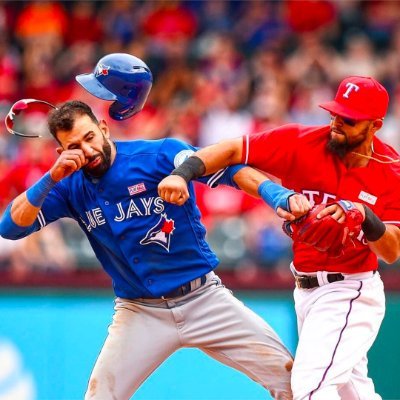
Derek Jeter giving advice on how to deal with failure
English
Gene A. Watson retweetledi

The most expensive sentence in the MiLB Standard Uniform Player Contract isn’t about money.
It’s about what happens if the player quits.
It’s called the abandonment clause.
What it means:
If the player walks away from baseball, the team can claw back part of the signing bonus.
Sounds like a routine fairness mechanism.
It’s not.
That single clause changes how the IRS treats the money.
With abandonment language in the contract, the bonus loses its “true signing bonus” status for tax purposes. And that matters more than the clawback itself.
Here’s why.
A true signing bonus is taxed only in the state where the player is legitimately domiciled at the time of signing.
Every MLB team holds spring training in either Florida or Arizona.
Florida has no state income tax.
Arizona’s is 2.5%.
California’s 13.3%.
Establish residency that matches the team that drafts you usually where their Spring Training facility is located, and the savings can stretch into six or seven figures.
On a $2M bonus, that gap is roughly $208,000 in California state tax. On $5M, it’s over $600,000.
If you’re heading into the MLB draft, or you’re working with a player who is, let’s connect.

English
Gene A. Watson retweetledi

I never saw @realbenmcdonald or Paul Skenes yelling at opponents and saying stuff like “Fucking dumb ass, sit down” or “Fucking by you” or “Come on fuck you”
I’m pretty sure this dude couldn’t hold their jocks!
This behavior is an embarrassment to @LSUbaseball and himself!
Any coach that allows his players to act this way should be ashamed!
What happens when he gets out in the real world and has a real job?
Remember when coaches were LEADERS who commanded respect and mentored young men and prepared them for life?
None of that is happening here and it’s a shame!
#shegone
@notgaetti @BobFile @twuench @billdubs @iamrags @artofhitting @hittingguru7 @slider_sinker @SliderDom @low_and_outside @TheRealJHair @DMEASrecruiting @VandyonTigers @mikepiazza31 @SalMarinello @RVGDag @AMBS_Kernan
English
Gene A. Watson retweetledi
One in three first round MLB picks never plays a single day in the big leagues.
The other contract numbers everyone obsesses over don't matter if you're in that group.
After round one, those odds get much worse.
Of the players who do make it to a single day in the majors, only about 25% will ever reach free agency.
That's six years of service time. The rung where the headline contracts live.
So every nine-figure deal you see hit the news is a player who survived four cuts that 90% of his draft class did not.
Here's what that ladder actually looks like.
Signing bonus on draft night, paid 50/50 over two years.
Then $30,000 a year in the minor leagues while the team controls your rights for five seasons.
Make the 40-man roster and you get to roughly $63,600.
Crack the active roster and league minimum jumps to $780,000.
For most players, the signing bonus is the largest single check they ever see in baseball. Everything that comes after it depends on what they did with the first one.
This is the part fans never think about. The contracts that make ESPN are written for the 10% who climb all the way up.
But the financial decisions that determine an entire family's future tend to get made when the player is 18, sitting in a hotel room the night of the draft.
That's the moment that matters. Not free agency. Not the extension. The first check.
If you're a top MLB Draft prospect, or the parent of one, the team you build before draft night will matter more than the bonus on it.

English
Gene A. Watson retweetledi
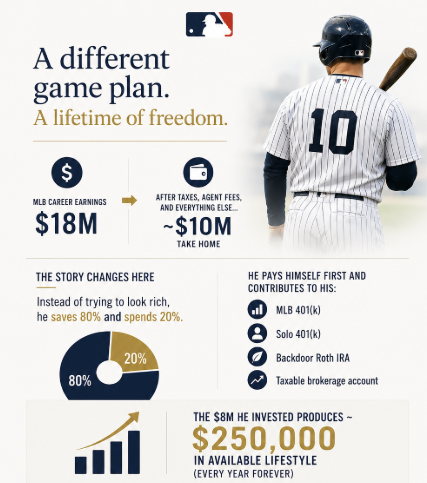
An MLB player earns $18M during his career.
After taxes, agent fees, and everything else…he keeps roughly $10M.
Now here is where the story changes: Instead of trying to look rich, he saves 80% and spends 20%.
He pays himself first and contributes to his:
*MLB 401(k)
*Solo 401(k)
*Backdoor Roth IRA
*Taxable brokerage account
The $8M he invested produces ~ $250,000 in available lifestyle (every year forever).
Add in the MLB pension (which you can access as early as age 45) and you can see how done right, this creates incredible flexibility.
My friends, the average career lasts less than 3 years.
We get one shot to do this right.
Start now.
English
👇
𝐉𝐞𝐟𝐟 𝐒𝐜𝐡𝐨𝐥𝐳𝐞𝐧@utahscout1219
The Scouting Classroom #8 Velocity Gets Attention. ∙ Pitchability Gets Remembered. The radar gun matters, trust me… scouts notice velocity immediately. When a pitcher lights up the gun, heads turn. But here’s what many fans, parents, and young players miss: Velocity gets you noticed, Pitch-ability determines whether scouts keep coming back. Because after the first "wow" moment from the radar gun wears off…the evaluation actually begins. Scouts start asking questions: Does the fastball have life? Can he command it? Can he throw strikes when he needs to? Can he pitch inside? Can he change speeds? Can he repeat his delivery? Does the arm action work? Can he create deception? How does the body move? Can he control tempo? How does he respond after giving up a double? Can he make adjustments? Can he get hitters out multiple ways? Those things matter, a lot! Over 20 years in professional baseball, I saw plenty of pitchers light up a radar gun. 95-96 or even higher! And some of them couldn't actually pitch, their velocity covered up flaws at younger levels. But as hitters got better, the separation happened. Meanwhile… I saw pitchers with less velocity — or simply pitchers with more ingredients — continue climbing. One of the best examples for me was and is now, current Washington Nationals reliever Paxton Schultz. When I signed Paxton out of Utah Valley U as a 14th Rd pick, he had stuff. He was generally 91–95. The velocity was there. But what stood out wasn't just the radar gun. There were ingredients. You could see flashes of pitch-ability. And he did it against WAC, MWC and SEC schools! You could see body control. You could see feel. You could see a pitcher that wasn't simply throwing. He was learning how to get hitters out. And here's the interesting part: Paxton wasn't the prospect headline guy. He never landed on any Org Top 10 prospect lists. He never received the attention that some others got, and he wasn't handed a fast track. He wasn't sitting on a 40-man roster spot early, his first 40 man was getting called up! He simply kept pitching, and climbed each and every level through professional baseball, quietly and steadily. And along the way, he evolved. Today he's still around 93–95. But he added a cutter he didn't have in college. He continued building a toolbox, and continued making adjustments, while continuing to become more complete. And now he's in the Major Leagues having success and it wasn't by accident. Because stuff gets attention, but learning how to pitch keeps opening doors. That's today’s lesson. Pitchability isn't static. It's developed. It's learned. It's refined. And sometimes the pitchers that keep evolving are the ones still standing years later. Young pitchers: Don't chase only mph, learn sequencing, command, disruption. Learn how hitters think. Learn how to evolve. Because radar guns create attention. Pitch-ability creates careers. (𝙎𝙖𝙫𝙚 𝙩𝙝𝙞𝙨 𝙜𝙧𝙖𝙥𝙝𝙞𝙘 𝙖𝙨 𝙖 𝙧𝙚𝙢𝙞𝙣𝙙𝙚𝙧 𝙘𝙖𝙧𝙙, 𝙩𝙤 𝙧𝙚𝙛𝙚𝙧 𝙗𝙖𝙘𝙠 𝙩𝙤...) #BehindTheRadarGun 🔎
ART
Man this breaks my heart but I’m so incredibly happy for you and know God has bigger things ahead. 🙏
Ryan Harris@RyanHarris_68
🏈 I will be moving on from Notre Dame Football Radio this year 🎙️
English
35 years ago today, we watched greatness. Nollie threw #7. Here I am hovering over Bobby V’s right shoulder. What a night!


English
Every high school left-hander in the state of Texas wanted to be just like @GregSwindell, especially me. The legend.
College Baseball Archives@collegeplayers9
Greg Swindell takes the mound at Rosenblatt for the Longhorns during the 1985 College World Series
English