Sabitlenmiş Tweet
🔶
91 posts


🔶 retweetledi
🔶 retweetledi

🔶 retweetledi

🔶 retweetledi

🔶 retweetledi

Every day $40 million dollars of Bitcoin is dumped on the market to secure Proof-of-Work mining. That cost adds up to $14.6 billion dollars per year. That's the equivalent of throwing a top ten coins entire market cap into the trash every year. I have solved this problem.
English
🔶 retweetledi

🔶 retweetledi

🔶 retweetledi

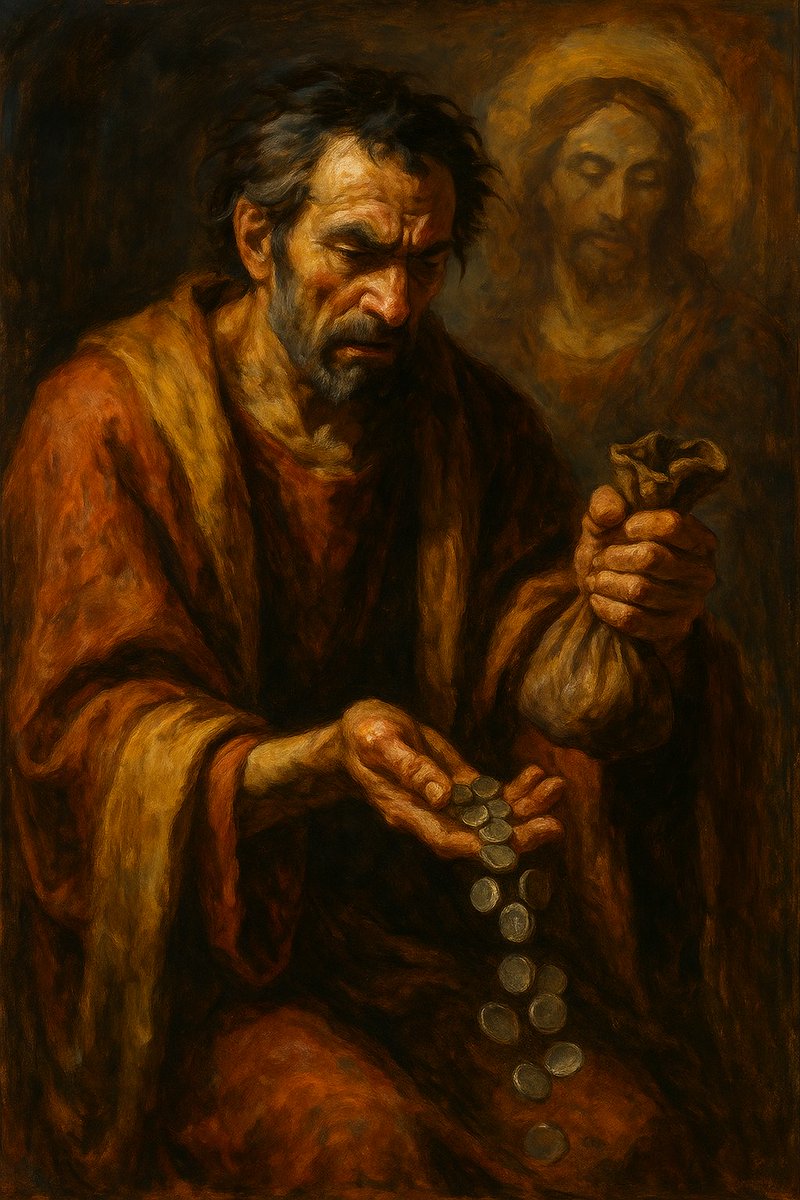
There is a special cowardice reserved for those who sell their convictions not under duress, not in fear of the gallows, but because someone shakes a purse in their direction. It is an old sin, older than states, older than scripture, older even than coinage. And it repeats because the price of a man’s integrity is almost always lower than he imagines.
Judas stands at the centre of this gallery, not because his betrayal was the first, but because it was perfect. Here was a man who had walked beside his teacher, witnessed miracles, shared bread, shared purpose—and he traded all of it for thirty pieces of silver. A petty sum. A bureaucrat’s wage. A pittance that shows the true scale of the betrayer: not grand, not Machiavellian, not complex, but small. The deed was vast; the reward was trivial. That is the mathematics of treachery. Those who betray for money always calculate in coppers while destroying fortunes immeasurable.
Another figure rises beside him—Benedict Arnold, the soldier who wrapped his ambition in nationalism until he found a higher bidder. He had distinction, reputation, the makings of a legacy carved in granite. Yet he sold his cause for a commission and a pension. He attempted to surrender a fortress in exchange for comfort. His name lives on as an insult because his price was small and his treachery large. He traded the founding of a new nation for a monthly stipend. His betrayal was not cunning; it was pathetic.
And then Vidkun Quisling—who prostituted an entire country to foreign boots for the promise of being a puppet king. He did not merely betray a friend or a fortress; he betrayed Norway itself. The scale of the betrayal was national; the motive was pitifully personal.
Power.
A title.
A delusion of grandeur purchased at the cost of every life lived under occupation. His legacy is so foul that his name became a noun for traitor, used only in contempt. A traitor’s immortality.
These are not anomalies. They are warnings. Men who sell out for money always imagine themselves shrewd. They always imagine themselves clever. They always imagine they have outwitted the age. Yet history strips the façade and records only the truth: they sacrificed principle for scraps, and the scraps never lasted.
Now look at the modern iteration of this old, miserable pattern. Look at BTC, and the men who dismembered the promise of digital cash because silver jingled before them.
The original design was simple and hard-edged: a scalable system for daily trade, a digital cash rail capable of clearing world commerce without permission, without bottleneck, without sanctified scarcity. It was a tool of utility, not an idol of speculation. It was built for builders.
But builders are inconvenient to those who covet unearned wealth. Builders ask for throughput. Builders demand capacity. Builders insist on function. Builders expose fraud. So the Judas-class did what Judas-class men always do: they followed the money. They strangled the capacity of the system to secure its scarcity. They throttled the throughput to inflate its mystique. They turned a cash protocol into a shrine—five transactions a second, a fossil marketed as destiny—because a fossil can be hoarded and a destiny can be sold.
They gave up the future of digital cash for their pieces of silver.
Some received them early.
Most received them in noise.
All of them received less than they surrendered.
They talk now of “store of value,” of “number go up,” of “digital gold,” as if these mantras could hide the treachery. They sold the world a bottleneck that cannot serve as money, cannot serve as commerce, cannot serve as anything except a vehicle for speculative transfer. They turned a tool into a superstition. They took the promise of economic freedom and swapped it for an asset that functions like a vacuum: sucking value from the productive economy into the wallets of those who came first.
This is not innovation.
It is extraction.
Not creation.
Consumption.
They preach scarcity as virtue because their wealth depends on keeping the system crippled. They call throughput heresy because throughput dissolves their rents. They present hoarding as wisdom because hoarding is the only act their crippled system rewards.
They have the gall to call this “freedom,” while advocating a monetary structure that—if ever universally adopted—would freeze the world into a caste system of early aristocrats, late serfs, and no production to speak of.
History has seen this pattern before. Every betrayal hides behind rhetoric. Every sellout recites a creed to justify his cowardice. Judas blamed destiny. Arnold blamed ingratitude. Quisling blamed ideology. The modern traitors blame “security” and “decentralisation” as they smother the very cash system that could have liberated the many.
But the truth is plain enough that even an honest fool can see it: those who sold out the dream of digital cash for a speculative altar are not pioneers. They are not visionaries. They are not defenders of monetary virtue.
They are Judas with better branding.
Arnold with a Twitter account.
Quisling with a conference badge.
And like all their predecessors, they will be remembered not for what they gained, but for what they destroyed. They took a tool that could have raised civilisation and gutted it for temporary profit. They sold freedom for a rally. They traded a system of real economic use for a hollow lottery ticket. They did it willingly. They did it knowingly. And they did it cheaply.
The silver jingled.
They reached for it.
And in the reaching, they damned their legacy.
English
🔶 retweetledi

🔶 retweetledi
Integrate crypto directly into your app or website with Metal Pay Connect - built to your specs.
Stay Compliant, Connect to TDBN.
metalpay.com/metal-pay-conn…
English
🔶 retweetledi

🔶 retweetledi


@rand_longevity You are prudent if you believe the chances of you being born are higher than living in a simulation.
English
🔶 retweetledi
It’s time to put the US Treasury on-chain with KYG (Know-Your-Government). All expenses tracked real-time, unalterable and fully transparent to the public. Each government office having their own verified digital identity that can be held accountable via the United States DAO
English
🔶 retweetledi