@lilyraynyc Are these informational sites? Big authority domains, I guess?
And what do you mean by "all human-written content"? Do they principally avoid AI for writing?)
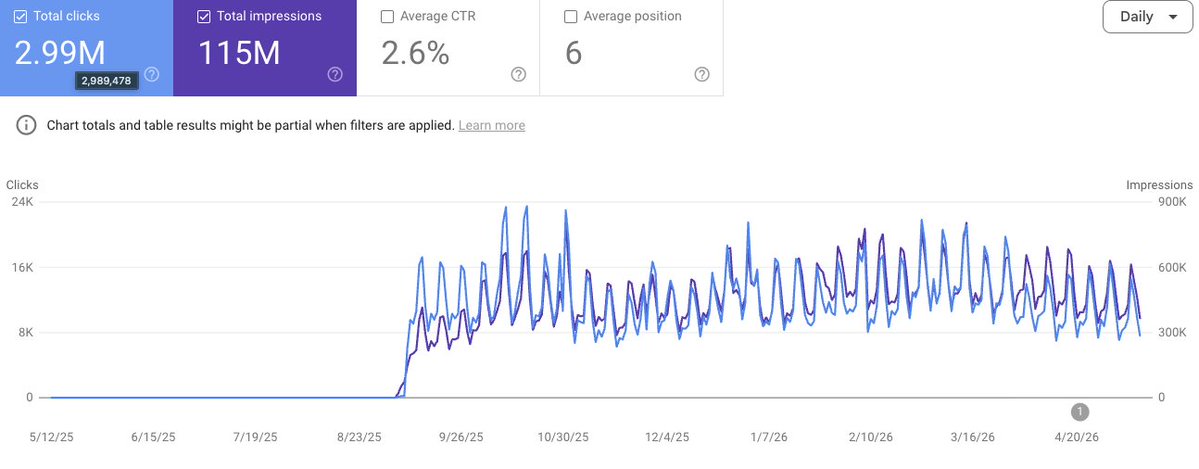
Not all publisher sites are seeing declines in organic traffic YOY... these are 2 sites I audited a little over a year ago - both have actually improved in traffic in the past ~6 months despite AI Overviews ramping up.
All human-written, expert content focused on a specific niche. They're doing well in Discover too. Cool to see, and pretty rare right now 😩
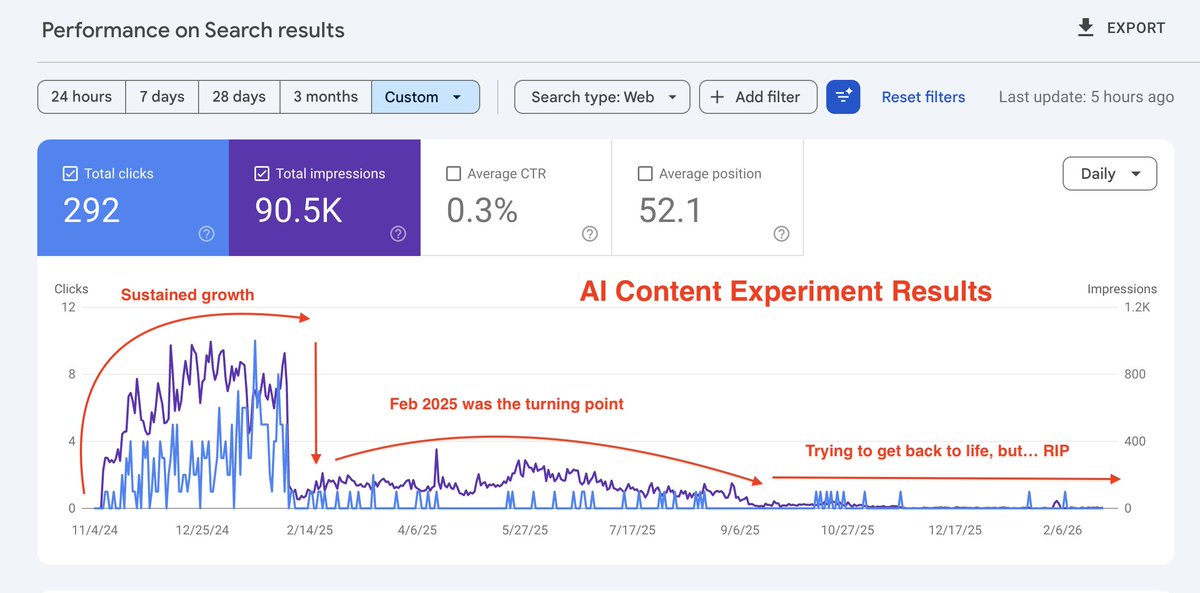
Could AI-generated content rank? Yes. And it may last about three months.
We built 20 new domains and published 2,000 articles with no human input.
In 36 days:
- 71% got indexed
- 8 sites ranked for 1,000+ keywords
- 122K impressions
3 months in: completely gone.
Was AI content the problem?
Not exactly.
The problem was publishing AI content with no strategy and no SEO behind it.
These were new sites with no backlinks, no authority. Once Google picked up on that, the rankings dropped.
And we’ve also seen the opposite: when AI-generated content is reviewed by a human and published on a strong domain, it can keep ranking and drive clicks.
📌 Read the full experiment: seranking.com/blog/ai-conten…
We’re running new experiments now, and we’ll be sharing the results along the way. If you want us to test your theories too, drop them in the comments 👇
@searchmartin And are your keyword clusters not covered by AI Overviews? What's your opinion on AI Overviews? Is it still possible to generate a lot of free traffic from informational keywords?
@Zhandosweb I only do SEO for large USA well known brands, and massive companies (Fortune 100 type clients).
Previously worked on Expedia, Orbitz, Uber, Ticketmaster, Pepsi, Renault etc.
PSEO DONE RIGHT!
Your questions, answered: some people had questions, that were worth addressing:
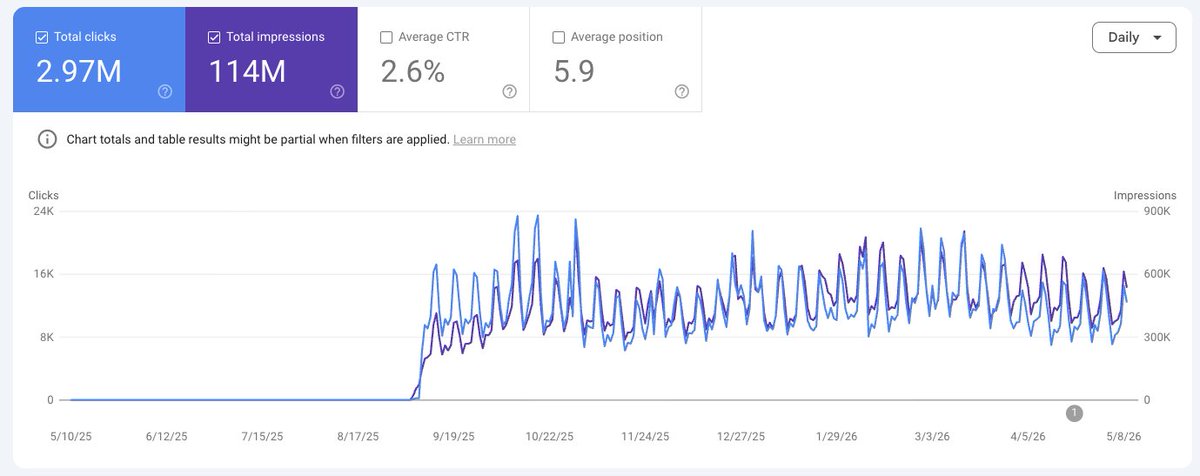
(3 million visits in just over half a year, and stable) 🧵
@searchmartin Understood, thank you for the answer! 2000 pages isn't that many, even if you published them all at once or in the first week. I thought we were talking about tens of thousands of pages.
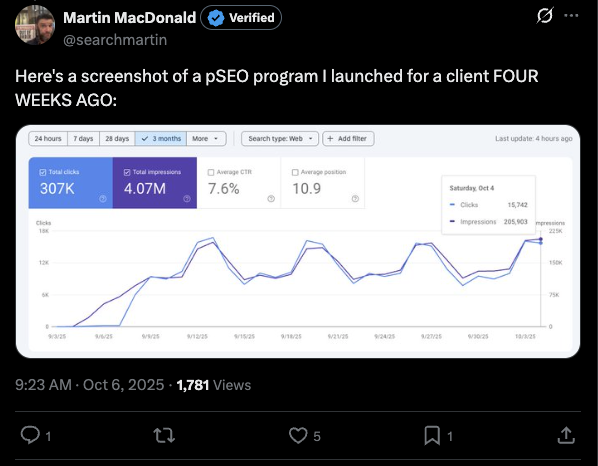
@Zhandosweb Good question. About 2000ish total, four templates/page types. Hierarchical with more refined information at each depth. Will check indexing % for n the morning but think its around 90-95%.
PSEO DONE RIGHT.
How it started (oct '25), vs how its going (May '26):
Programmatic SEO doesn't need to be spam, but 100% of other threads here, are just that. Sorry not sorry.
@asaio87 Nah, 800 total clicks in 3 months? That's like 10 clicks a day, man, come on... Google is dead as a traffic source now (other search engines provide much higher CTR and more clicks).
@AlinDragu Do you write texts for yourself or for clients? How do you compete with AI now that everyone is replacing copywriters with AI? Is it still worth writing articles yourself if you can just generate text in a minute with AI?
After 15 years working with WordPress, we finally moved our own agency website away from it.
Old setup:
WordPress + Elementor + plugins
New setup:
Astro + Tailwind CSS + clean static architecture
The difference is massive:
- faster loading
- cleaner code
- less maintenance
- better Core Web Vitals
- no plugin bloat
- no Elementor drag
- AI controlled
This is the standard now.
If your business website feels slow, bloated, or impossible to improve, it probably doesn’t need another plugin.
It needs a rebuild.
Want to see what kind of content your competitors are bullish on right now?
Go to Google and type: "site:[competitor].com after:2026-01-01"
You'll see all indexed pages published since January.
@gaetano_nyc Do you think Google understands which content is original and expertise, and which is AI generated where expertise is just simulated? If not, it's not worth trying to write expert content if you can just simulate it with AI.
If we are being honest about what's happening in SEO and broader content marketing in general.
There are very few people producing original, differentiated, first-hand experience based content.
It's all fake. It's all ghost written. It's all just being done for SEO/GEO.
Like G2 with their copywriting tricks. All they are doing is writing in first-person language, but not actually testing and reviewing these tools.
To be fair -- no one is. It's all fake. And it's always going to be fake.
We're just going to continue seeing more of the same.
Not necessarily "slop" but generic and uninteresting content at scale.
SourceCraft CLI — новое консольное приложение Яндекса с ИИ-агентом внутри. Можно управлять репозиториями и ставить задачи на естественном языке — агент сам разберётся в логике проекта и поможет с кодом.
Подробнее: yandex.cloud/ru/blog/source…
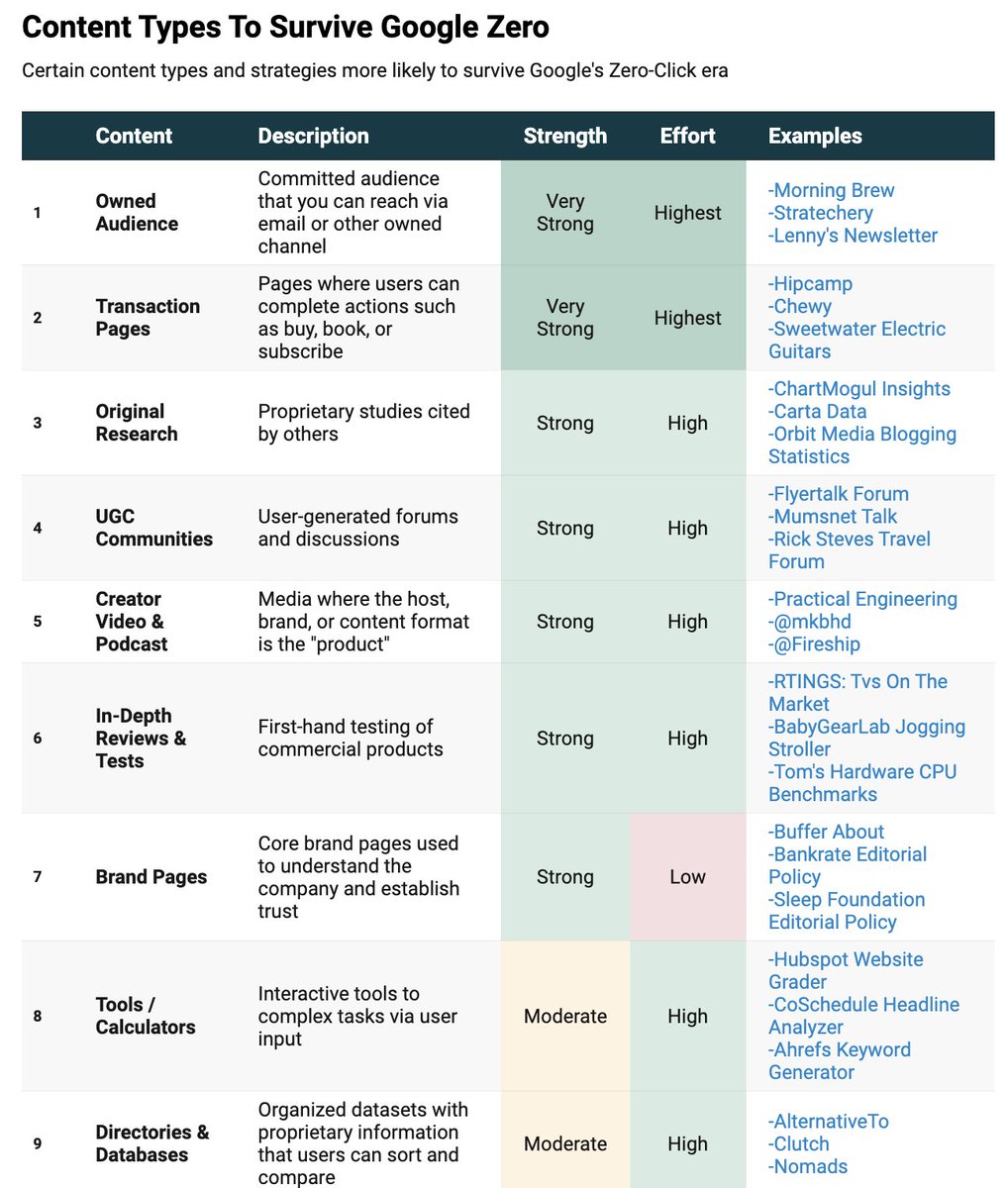
17 Content Types to Survive Google’s Zero-Click Future - Excellent research by @CyrusShepard
We know that Google favors different types of sites now. Winning content tends to be proprietary, unique, and solves problems beyond providing information.
Here are 17 content types that currently perform decently-to-excellent in the AI era when properly executed:
signal.zyppy.com/p/content-goog…
@GaelBreton So basically, you're writing articles about topics where you have no experience and using AI to simulate expertise. This means that human expertise doesn't matter anymore. Back in the day, we used to say "Content is King", but now SEO content marketing is practically dead.
Every AI article generator just rewrites the top 10 Google results.
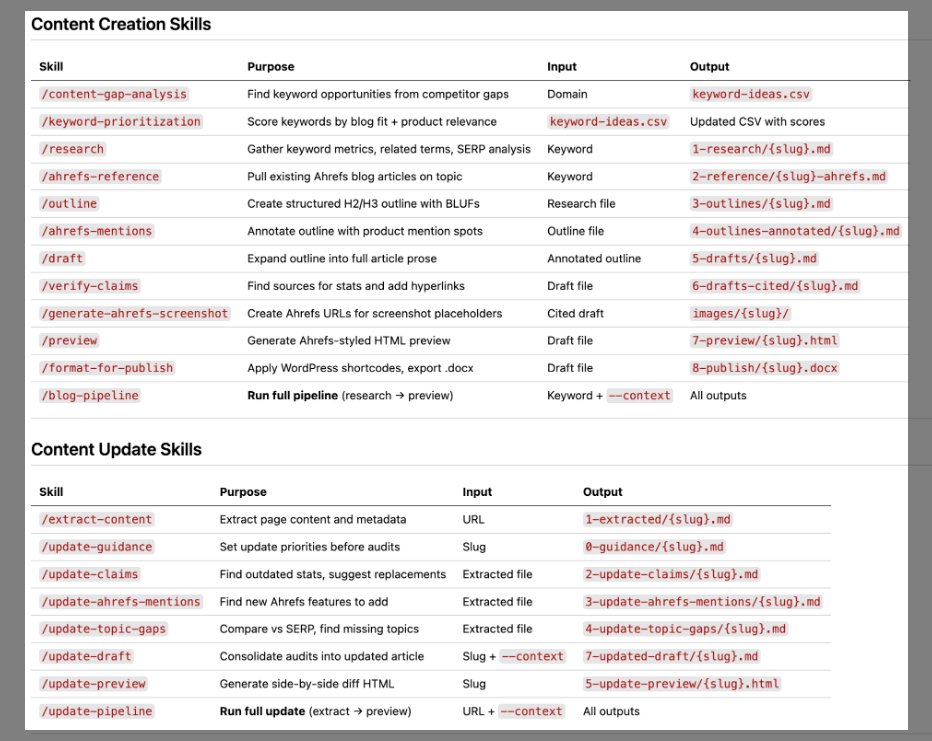
So I built one that reads them and gets frustrated instead.
A sub-agent literally roleplays as someone who just googled your keyword, read every result on page one, and thinks... "ok but what am I STILL missing?"
Then a research agent goes to Reddit, YouTube, Twitter (using @apify) to find those answers.
For a Meta ads article, it found this "2-campaign loop" approach... run a test campaign, find winners, scale them separately.
That's the kind of advice you only hear at conferences from people who actually scale ad budgets.
An AI found it buried in a Reddit thread.
We've spent almost two decades trying to make content that's actually better than what's already ranking.
Turns out the trick was teaching AI to be disappointed in Google first.