Aaron

11.3K posts

Aaron banner
Aaron

Aaron

@aaronfromATX

Texan living in the Pacific Northwest. Husband and father. ☧ Tweets mostly about culture, markets and Jesus. Opinions are mine. Vaya con Dios.

USA Katılım Nisan 2011
749 Takip Edilen1.1K Takipçiler
Aaron retweetledi
Yet another commodity guy
I estimate at least for crude about 2.8 billions barrels of linefill and tank bottoms. This is from known pipeline infrastructure and measurable inventories. That inventory is unavailable for commerce and can't be drawn. This is from GEM data and @Kayrros
Yet another commodity guy tweet mediaYet another commodity guy tweet mediaYet another commodity guy tweet media
English
16
161
769
401.2K
Aaron retweetledi
Mario Nawfal
Mario Nawfal@MarioNawfal·
A Lithuanian farmer discovered a church bell buried for 82 years while working his field. Cast in 1908, locals buried it in 1942 to protect it from Soviet forces who melted church bells into weapons. It came out of the ground perfectly preserved.
English
814
10.9K
86.5K
2.8M
Aaron retweetledi
Rory Johnston
Rory Johnston@Rory_Johnston·
A brief [updated] history of presidential oil market jawbones through the Hormuz crisis.
Rory Johnston tweet media
English
33
156
711
55.6K
Aaron
Aaron@aaronfromATX·
@noetic_healing Basic bloodwork should also get you an idea of if cancer has spread, or at least will give you a warning sign
English
0
0
0
7
Aaron
Aaron@aaronfromATX·
@noetic_healing Definitely get the PET scan if you can. The cancer industry is a swarming with people trying to milk the system for money. Not saying this doc is, but it definitely sounds like something is off. Then if you’re really up against cancer look into methylene blue.
English
1
0
1
138
Orthodoxy Above The Clouds
Orthodoxy Above The Clouds@noetic_healing·
Update on my weird cancer diagnosis and what just happened at the doctor. Pray for me. Please watch and if you have advice let me know what you think I can do next.
English
88
26
429
8.4K
Aaron retweetledi
Energy Headline News
Energy Headline News@OilHeadlineNews·
US crude inventories (including the Strategic Petroleum Reserve) plunged by 17.8 million barrels last week - the most on record - Bloomberg
Energy Headline News tweet media
English
1
11
53
3.3K
Aaron retweetledi
Eric Nuttall
Eric Nuttall@ericnuttall·
Things are about to get very exciting over the next few weeks, and truth will become so incontrovertible that reality will finally have to be reflected in price:
Eric Nuttall tweet media
English
16
94
744
71.3K
Aaron retweetledi
Javier Blas
Javier Blas@JavierBlas·
BREAKING: US total crude inventories fell last week ~17.8 million barrels (that's commercial and SPR stocks combined). On that basis, it's the largest weekly fall since data is available starting in 1982.
Javier Blas tweet media
English
71
597
2K
369.6K
Aaron retweetledi
Energy Headline News
Energy Headline News@OilHeadlineNews·
The Oil Market Doesn't Have a Printing Press - Bloomberg
Energy Headline News tweet media
English
1
14
65
16.5K
Aaron retweetledi
Energy Headline News
Energy Headline News@OilHeadlineNews·
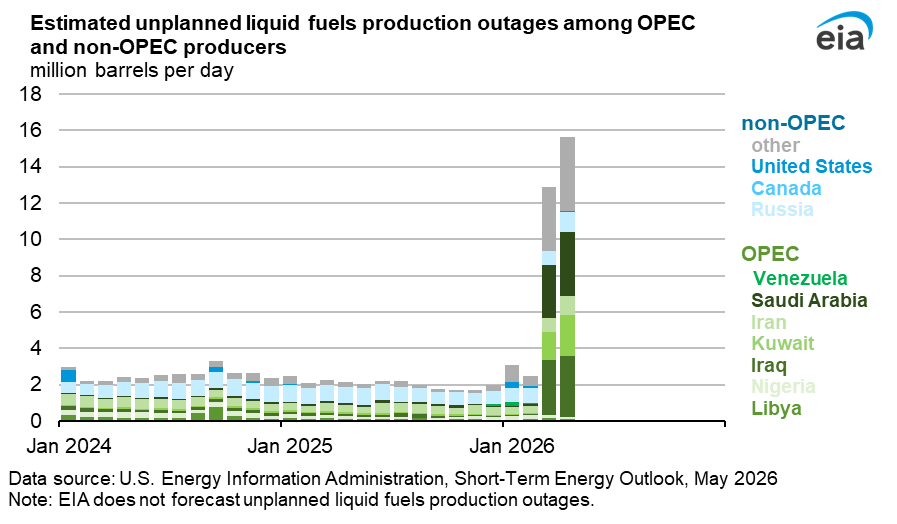
EIA estimates a total of around 15.61mbpd of supplies were offline in April versus 12.87mbpd in March
Energy Headline News tweet media
Română
2
7
38
2.9K
Aaron retweetledi
Shanaka Anslem Perera ⚡
Shanaka Anslem Perera ⚡@shanaka86·
The world is losing oil, fertilizer, and sulfuric acid simultaneously. The market priced only the oil. Per The Wall Street Journal, citing Argus pricing data and the US Geological Survey, sulfuric acid prices in China rose roughly 1,150% in May compared with two years earlier. Middle Eastern sulfur prices surged 750%. Chile, the world’s largest sulfuric acid importer, saw prices jump 230%. Sulfuric acid converts phosphate rock into fertilizer. It processes copper. It manufactures batteries. It fabricates semiconductors. The Persian Gulf supplies roughly half of global sulfur exports. The chemical that touches food, electric vehicles, and chip fabs is breaking simultaneously. Saudi Aramco CEO Amin Nasser told investors Monday this is “the largest energy supply shock the world has ever experienced.” Per CNBC, the world has lost one billion barrels of oil supply, net 880 million after east-west pipeline reroutes and strategic reserve releases. Two to five ships now pass Hormuz daily, down from seventy before the war. Around 240 ships are waiting outside. The market loses 100 million barrels per week the Strait stays closed. If disruption persists past mid-June, normalization runs “into 2027.” The Wall Street Journal reports US crude inventories including the Strategic Petroleum Reserve have fallen for four consecutive weeks and risk reaching their lowest level since 1982. Per Bloomberg, the IEA coordinated the release of 400 million barrels of emergency reserves. The United States has released only 79.7 million of the 172 million it pledged. JPMorgan head of global commodities Natasha Kaneva warned OECD oil inventories could reach “operational stress levels” by June and “fall to minimum operating thresholds by September.” This is the energy story. Per the United Nations Food and Agriculture Organization, roughly one-third of global fertilizer trade transits the Strait of Hormuz. Qatar Fertiliser Company, which supplies 14% of global urea single-handedly, has declared force majeure. Major fertilizer plants across the Gulf have reduced or suspended production. Three to four million tonnes per month of fertilizer is stalled. Per CNBC, urea FOB Egypt has risen from $400 pre-war to $700 per tonne. Per Reuters, Brazil’s urea imports have fallen 33% year over year. Bangladesh has shut four of five fertilizer factories. India has cut output at three urea plants. The United States is running 25% short of fertilizer supply for spring planting. The World Food Programme projects 45 million people could enter acute hunger within months. The 2022 Ukraine crisis pushed 70 million into hunger over 18 months. This onset is faster. This is the food story. Aluminum, helium, and sulfur markets are all in supply shock. Helium is essential to semiconductor manufacturing. Indonesia sulfur prices are up over 80%, prompting nickel producers to cut output for EV batteries. This is the industrial story. President Trump rejected Iran’s response Monday as “totally unacceptable” and “a piece of garbage.” He said the ceasefire is “on massive life support.” A US Navy Ohio-class nuclear-armed submarine arrived in Gibraltar Sunday. Trump arrives in Beijing on May 14 and 15. A 1,150% sulfuric acid move in China. A 45-million-person acute hunger projection. A US strategic reserve approaching 1982 lows. An OECD inventory cliff in June. A fertilizer famine in three months. A market at all-time high. The market priced one shock. There are three. The summit two days away decides which of them gets resolved first. open.substack.com/pub/shanakaans…
Shanaka Anslem Perera ⚡ tweet media
English
23
250
572
42.2K
Aaron retweetledi
Nick W
Nick W@Hattusilis_III·
@KarelMercx The oil market still thinks this is a temporary oil shock – but it’s a hydrocarbon shock and every extra day the strait remains closed the downside case gets stronger, broader and deeper. nickwade.substack.com/p/this-is-not-…
Nick W tweet media
English
5
18
118
8.6K
Aaron retweetledi
Giovanni Staunovo🛢
Giovanni Staunovo🛢@staunovo·
Oil inventories and emergency reserves rapidly depleting, raising risk of supply shortages Executives warn full impact of Strait of Hormuz closure not yet felt, citing lag effects Analysts expect higher prices and volatility as seasonal demand rises and buffers fade #oott reuters.com/business/energ…
English
1
13
25
3K
Aaron retweetledi
Shanaka Anslem Perera ⚡
Shanaka Anslem Perera ⚡@shanaka86·
BREAKING. S&P Global Energy published research on Tuesday May 5 2026 stating that even after the Strait of Hormuz reopens, it will take seven months minimum to fully restore upstream production, with the energy crisis potentially stretching into 2027. The market is not pricing this. Brent futures are pricing political resolution at the May 14 Trump-Xi summit. Physical cargoes are pricing the customs enforcement architecture. Both are pricing the war. Neither is pricing the aftermath. The Strait reopening is not the end of the crisis. The Strait reopening is the moment the second phase begins. Output at Iranian fields and export flows from Iraqi and lower Gulf fields have been disrupted for sixty-six days. Refinery turnaround schedules across Asia are now misaligned. Insurance markets have repriced. Shadow fleet logistics have been substantially degraded by US Treasury sanctions. None of this rebuilds in days. The political clock measures the distance to summit. The architectural clock measures the distance to functional supply restoration. The two clocks are not the same clock. Even if Trump and Xi de-escalate on May 14, S&P says the energy crisis lasts another seven months at minimum. The peace itself has a seven-month tail. open.substack.com/pub/shanakaans…
Shanaka Anslem Perera ⚡ tweet media
English
23
258
618
67.7K
Aaron retweetledi
Luke Gromen
Luke Gromen@LukeGromen·
"Professor, don't you find it curious that a new US-Iran peace deal leaks almost every time the 10y UST yield breaks 4.4% on the upside?" "Actually, if I think about it, I don't find it curious at all."
Luke Gromen tweet media
English
217
2.9K
14K
828.8K
Aaron retweetledi
Luke Gromen
Luke Gromen@LukeGromen·
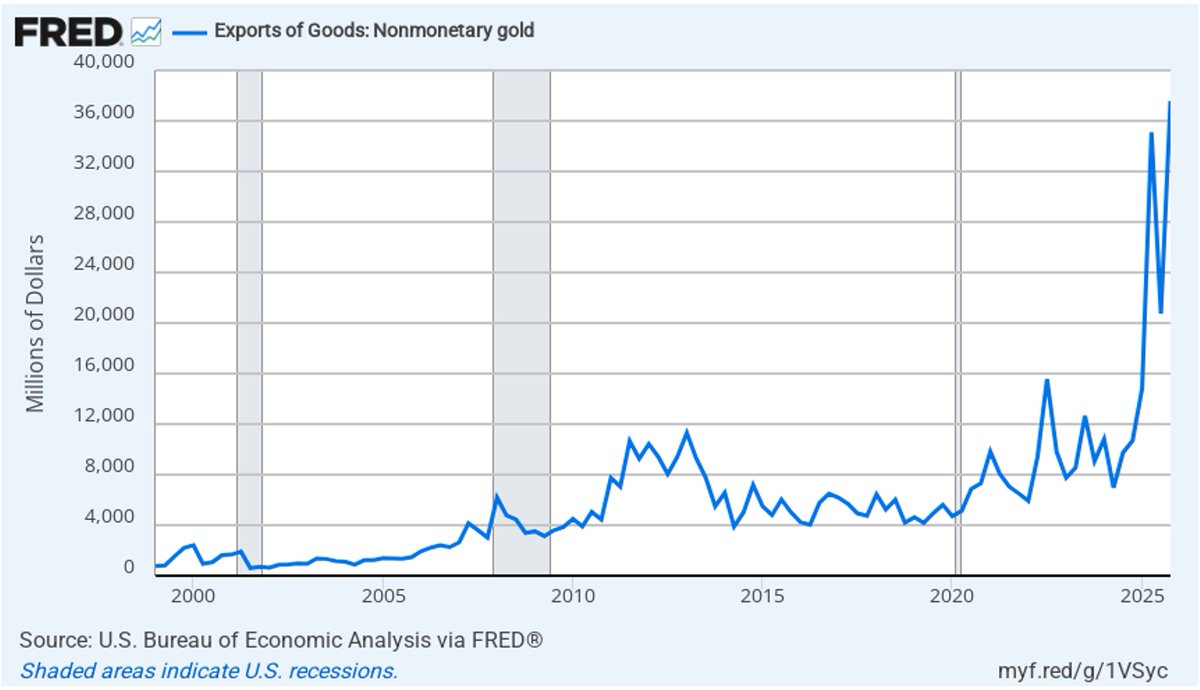
For the 5th month in the last 6, "Nonmonetary Gold" was again the single biggest export of the US in March. US gold exports were 1.7x > oil; 2x > than Rx preparations, 2.5x > aircraft engines. Biggest destination for US gold exports: China or Switzerland (& then on to China).
Luke Gromen tweet media
English
94
262
1.3K
202.8K