AJ Kumar

2.2K posts

AJ Kumar banner
AJ Kumar

AJ Kumar

@ajkumar

Behind the social media growth of @neilpatel @nontoxicdad, @bignikbh & more. 15 yrs building founder-led brands for experts. ↓ Follow to build yours.

Los Angeles, CA Katılım Aralık 2008
241 Takip Edilen3.7K Takipçiler
AJ Kumar
AJ Kumar@ajkumar·
Every founder I've worked with above $5M tells me the same thing on the first call. "I wish I had started posting three years earlier." Every. Single. One. The cost isn't measured in followers you didn't get. It's measured in trust you didn't compound. Customers who chose someone louder. AI systems that don't have a stable entity for you yet. Three years of compounding interest on silence. The founders who started early aren't more talented. They're not better writers. They're not luckier. They just stopped negotiating with themselves about whether the moment was right. It's never the right moment. The brand guidelines aren't done. The strategy isn't perfect. The team isn't fully built. The platform isn't ideal. All of that is true. None of it matters. The cost of waiting is invisible until you can see what three years of compounding would have produced. By then it's too late to recover those three years. Start ugly. Start now. Start before you're ready. Three years from now you'll wish you had.
English
0
0
0
1
AJ Kumar
AJ Kumar@ajkumar·
Three patterns I see in the founders breaking through right now. None of them are about going viral. All of them build the kind of entity confidence AI systems cite. 1. Sub-30-minute long-form video, weekly. The anchor format. Long enough for a viewer to form a stable mental model of the founder. Short enough to actually finish in one sitting. Every shorter asset downstream borrows trust from this anchor. 2. One named framework introduced per quarter. ROAC. V.O.L.T. Founder Signal. Mirror Test. Named ideas compound. Every time you reference the framework, you're planting a flag the AI systems and search engines start associating with you specifically. 3. Two podcast appearances per month on other people's shows. Borrowed audience. Borrowed authority. Third-party citation in the entity layer. The founders winning aren't the most famous. They're the most cited. Most founders are still measuring follower counts. The ones who break through aren't. Different game. Different scoreboard.
English
0
0
0
10
AJ Kumar
AJ Kumar@ajkumar·
Short-form is engineering, not art. Every viral short-form video is a stack of four neurological gates engineered in sequence. Register. Fires in the first 0.5 seconds. Text hook, visual hook, spoken hook, opening frame motion. Retention. Runs from second 2 onward. Format, pacing, prediction loops between every segment. Resonate. The payoff. Substance plus a reframe that exceeds the brain's prediction. Reinforce. The signature. A recurring format and identity that compounds attention into authority. Going viral without Reinforce is a sugar rush. I had a client video on Kobe Bryant hit over a million views and bring in zero clients. We had Register, Retention, and Resonate. We didn't have Reinforce. The viewer didn't know what to expect next, what we stood for, or why to follow. Most creators win the first three and skip the fourth. That's why their best post never compounds.
English
0
0
0
20
AJ Kumar
AJ Kumar@ajkumar·
Politics aside, two of the most influential communicators of the last 20 years use the same strategy. Trump speaks at roughly a 4th-grade reading level. Short sentences. Repeating simple adjectives. Concrete imagery. He says "we're going to build a wall." Not "we will pursue thorough border infrastructure reform." He uses nicknames instead of arguments. He repeats phrases until they're memorable. Neil deGrasse Tyson translates astrophysics into dinner-party language. He's the most successful science communicator alive because he doesn't sound like a scientist when he speaks. The substance stays advanced. The language stays accessible. They could not be more different. They use the same strategy. Accessible language travels further than sophisticated language. Every time, in every market, across every platform. The experts who refuse to simplify cap their reach without realizing it. Einstein already said it. "If you cannot explain it simply, you do not understand it well enough." He wasn't being humble. He was being precise. Complexity isn't proof of expertise. Translation is.
English
0
0
0
8
AJ Kumar
AJ Kumar@ajkumar·
Founders losing attention aren't uninteresting. They're using a broadcast voice in a medium that became two-way 10 years ago. Every platform is now a relevance engine. The audience doesn't read your post the way someone reads a press release. They read it the way a friend would. Conversational, present, opinionated, alive. When you sound like a corporate brand, the audience builds a corporate-brand mental model of you. When you sound like a person, they build a person mental model. The trust mechanism is identical to a real-world friendship. The mistake at scale is over-corporatizing. Founders cross $20M and assume the bigger the brand gets, the more polished the voice should be. The opposite is true. The polish should move into the frameworks, the production, the offers. Not the voice. Sharper. Not colder. Most founder content fails this test before the substance even gets read.
English
0
0
0
7
AJ Kumar
AJ Kumar@ajkumar·
I worked with Kimberly Snyder when her blog had a few thousand monthly readers. Within a few years she was at 500,000 monthly readers, three New York Times bestsellers, and a wellness brand doing eight figures. The shift wasn't a content strategy. It was a Founder Signal shift. Expressive becomes Intentional. Not human becomes corporate. She didn't flatten her voice when she scaled. She sharpened the production, the frameworks, the offers, and kept the voice expressive. Same person. Cleaner signal. Most founders go the other direction. They cross a revenue threshold, hire a consultant, professionalize the voice, and watch their inbound dry up in 90 days. The consultant calls it brand evolution. The data calls it suicide. The mistake at scale isn't sounding like a founder. It's sounding like everyone else's founder. If you stop sounding like you, you stop being the reason people came in the first place.
English
0
0
0
7
AJ Kumar
AJ Kumar@ajkumar·
WWE isn't a wrestling company. It's a brand platform that launches a cast of characters. Each character is tuned to a different audience segment. Every storyline routes attention back to one core IP. WWE swapped "Federation" for "Entertainment" in 2002. Repositioned from a sport to a media platform. Now operates the largest sports channel on YouTube. Over 100 million subscribers. Ramsey Solutions reaches 20 million weekly listeners across a five-character roster. Eliminates the key-person risk in a single-founder show. iShowSpeed and Logan Paul's WrestleMania 42 run proved the cast-of-characters playbook still scales in 2026. Most founders are still trying to be the only character in their own show. They wonder why the second character on their team can't get traction. The answer is the platform isn't built for it. A brand platform owns infrastructure, distribution, and audience. A cast of characters owns the emotional connection and parasocial trust. Hire a showrunner. Not a content manager. Different role. Different leverage.
English
0
0
0
12
AJ Kumar
AJ Kumar@ajkumar·
Sunday morning. The thing almost nobody warns founders about when they start building a personal brand. Most quit at month 9. Observable second-order signals start around month 12 to 18. Cascades depend on third parties repeating and citing your ideas, which takes its own time to accumulate. The math punishes anyone who measures the curve before it bends. Year one is investment. Year two is interest. Year three is compounding. Most founders never see year three because they quit in year one. They were measuring the wrong scoreboard the whole time. Looking at follower counts on day 90 and concluding the strategy doesn't work. The strategy works. The timeline is just longer than the impatient version of you wants it to be. If you're at month 6 and questioning the whole thing, you're exactly where everyone else who quit was. Don't quit.
English
0
0
0
22
AJ Kumar
AJ Kumar@ajkumar·
The advice I give every new founder client when they ask me about cadence. You don't need to post daily. You need to post 3 substantive things per week. Every week. For two years. Most founders read "daily" advice from creators in the creator economy and assume it applies to them. It doesn't. Creators monetize attention directly. Founders monetize trust converted into customers. Two different scoreboards. Three substantive posts per week, sustained for 24 months, is more than enough to build category authority. The math compounds quietly. The willpower required to post daily for two years almost never lasts. The founders who build durable brands aren't the ones with the highest output. They're the ones with the longest consistency. Pick a cadence you can hold for two years. Then hold it. Everything else is decoration.
English
0
0
0
17
AJ Kumar
AJ Kumar@ajkumar·
Most founders measure their content with the wrong scoreboard. Views, likes, followers. Vanity metrics that look like momentum and feel like progress. I track ROAC. Return on Attention Created. It maps how attention actually moves through four neurological gates. Register. Earn the stop in the first 0.5 seconds. Retention. Earn the watch in the next ten. Resonate. Earn the save with substance plus a reframe that exceeds the brain's prediction. Reinforce. Earn the return with a recurring format and identity that compounds attention into authority. Going viral without Reinforce is a sugar rush. I had a client video on Kobe Bryant hit over a million views and bring in zero clients. We had Register, Retention, and Resonate. We didn't have Reinforce. Most founders win the first three and skip the fourth. That's why their best post never compounds. The scoreboard you measure determines the strategy you build.
English
0
0
0
14
AJ Kumar
AJ Kumar@ajkumar·
Most founders think personal branding is about visibility. It's about index density. Visibility is being in the feed. Index density is being the entity AI systems and search engines associate with a topic. One gives you a viral moment. The other gives you cited authority for a decade. Large brands already have entity confidence from press and reference data. The public information layer that ChatGPT, Perplexity, and Google's AI Overviews lean on. Small founders compete in markets where the entity layer is the deciding factor between ranking and remaining invisible. Here's what changes when you have density. Someone asks an AI "who's the best at X?" and you're cited. Here's what doesn't change without it. You can be everywhere on social and absent from the layer that decides who gets recommended. The founders winning in 2026 are not the most followed. They are the most indexed. Different game. Different scoreboard.
English
0
0
0
18
AJ Kumar
AJ Kumar@ajkumar·
Most companies are still hiring marketing teams. The ones winning are building media companies around their founders. A marketing department sells the product. A personal media company compounds the founder. Different outputs, different stakeholders, different scoreboards. The two can run inside the same business without overlap. Most operators run only the first and wonder why the second never compounds. Here's the test. If you stop posting tomorrow, what disappears? If the answer is "nothing," you have a marketing department. If the answer is "the founder layer of the brand," you have a personal media company. AI retrieval systems like ChatGPT and Perplexity now sit between customers and the open web. They cite founders who built structured presence in the digital plane. Companies absent from that index lose visibility in a layer most marketing teams never measured. The hump isn't strategic. It's psychological. Founders intellectually understand the case. They resist out of fear of being seen, looking foolish, or saying something they can't take back. The ones who cross compound. The ones who don't pay for silence on every transaction.
English
0
0
0
10
AJ Kumar
AJ Kumar@ajkumar·
The founders winning content right now aren't the smartest in the room. They make education entertaining. Something you'd choose to sit with after a long day. I call this edutainment, and it sits in the middle of a spectrum most experts get wrong. On one end: pure education. Textbooks. Lectures. Dense curriculum. Rich in information. Nobody is sharing their professor's slide deck on Instagram. On the other end: pure entertainment. Movies, comedy, reality TV. High watch time. Zero takeaways. Edutainment lives in the middle. Bill Nye made science entertainment. Mark Rober makes engineering entertainment. Tyson translates astrophysics into dinner-party language. They are not the most credentialed in their fields. They are the most watchable. The algorithm doesn't reward you for being an expert. It rewards you for holding attention. Most experts are stuck on the wrong end of the spectrum. They confuse "valuable" with "watchable." The audience doesn't. Be the teacher whose class people would actually choose to attend.
English
0
0
0
7
AJ Kumar
AJ Kumar@ajkumar·
Neil Patel taught me one sentence at a Starbucks in my early twenties that defined every brand I've built since. "Write at a seventh or eighth grade reading level." I treated it like a blogging tip. Nodded. Filed it away. Spent the next decade overcomplicating my content because I was scared explaining marketing in plain language would make people think I wasn't the real deal. Took me 10 years to actually do it. The advice kept proving itself in bigger ways every year. Not because simple writing is better writing. Because accessible language removes the invisible barrier between your idea and the person who needs to hear it. Trump speaks at a 4th-grade level. His words travel further than almost any political communicator in 50 years. Neil deGrasse Tyson translates astrophysics into dinner-party language and reaches millions traditional science communication never could. The strategy is the same. Complexity doesn't prove expertise. It exposes insecurity. Or blind spot. Or both. The experts winning attention are not the most sophisticated. They are the most clear.
English
0
0
0
10
AJ Kumar
AJ Kumar@ajkumar·
Most founder origin stories fail at the first job. Making the audience recognize itself in past-you. Founders write origin stories like autobiographies. The big move. The famous mentor. The capital. The exit. It reads as resume. The audience admires from a distance and never identifies. I run every origin story through three checks. I call it the Mirror Test. Mirror. Does past-you look like the audience right now? Move. Is there a clear shift from then to now? Map. Can the audience see a path from where they are to where you are? Vague pasts trigger nothing. Ugly specifics build trust. The origin story is the front door of your personal media company. Not the trophy case in the lobby. Most founders under-share their origin by a factor of ten.
English
0
0
0
21
AJ Kumar
AJ Kumar@ajkumar·
Saturday morning. The split I see in every founder I work with shows up most clearly on weekends. Founders who are working in their business. In their email. Catching up. Cleaning the inbox. Replying to one more client. Founders who are building their business. Writing. Recording. Filming. Taking the small window when nobody's asking for anything and putting it toward the asset that compounds. Most operators who work all week and rest all weekend plateau. Operators who build a little every weekend, even an hour, compound. The gap isn't time. It's what you do with the windows when nobody's asking anything from you.
English
0
0
0
9
AJ Kumar
AJ Kumar@ajkumar·
Most founders cross $20M and immediately make their content worse. A consultant tells them to "professionalize the voice." The voice flattens. Inbound drops. Audience disengages. The consultant calls it brand evolution. The data calls it suicide. Alex Hormozi sold 2.9M copies of his book in 24 hours at $0.99. He sounds less buttoned up running Acquisition.com today than he did launching his first gym. The polish moved into his frameworks, his production, his clarity. The voice stayed expressive. I call this the Founder Signal. Founders evolve expressive to intentional. Not human to corporate. Sharper, not colder. The mistake at scale isn't sounding like a founder. It's sounding like everyone else's founder. Most won't fix this. The ones who do compound.
English
0
0
0
10
AJ Kumar
AJ Kumar@ajkumar·
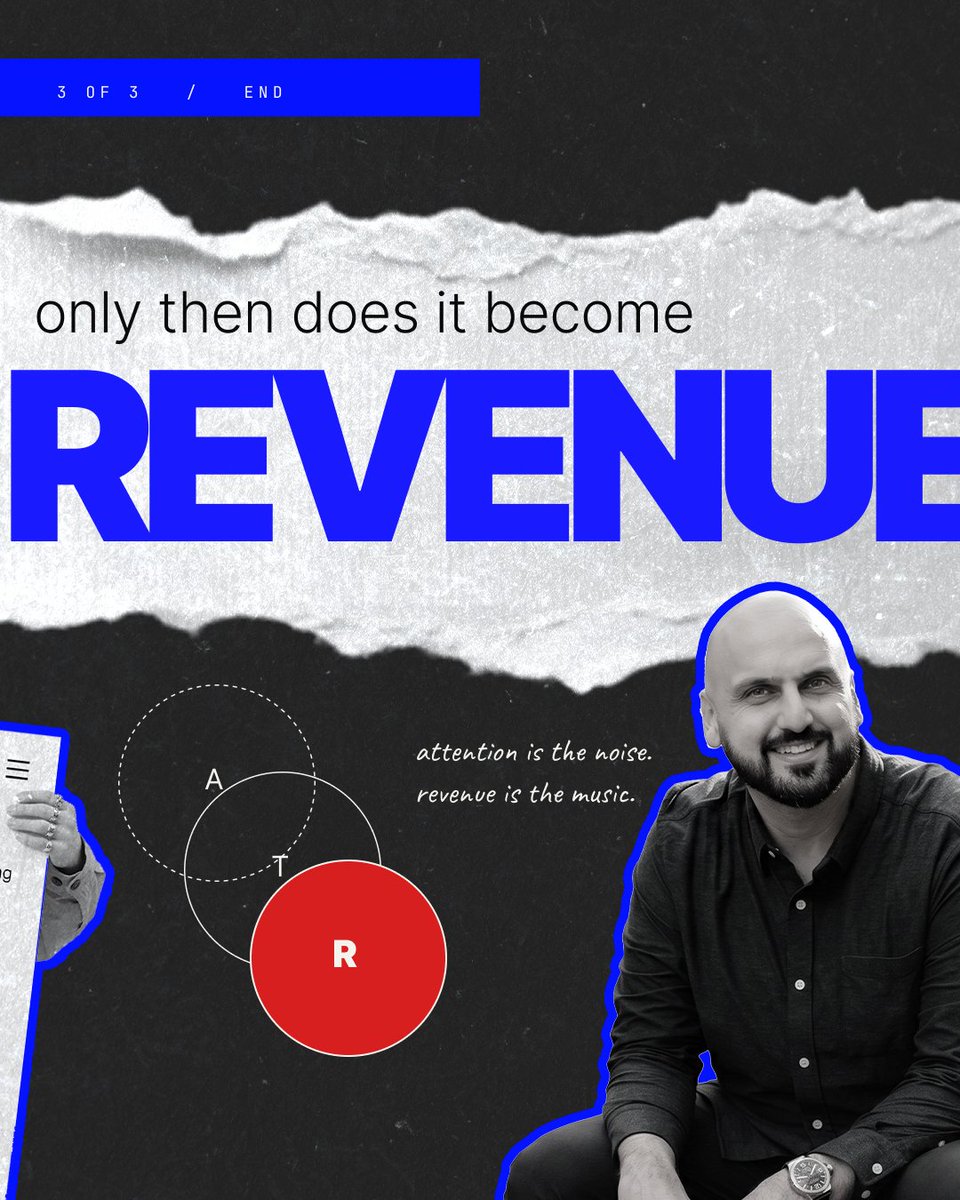
Attention. Trust. Revenue. Most people treat these as three separate goals. They're a sequence. Skip attention, nobody finds you. Skip trust, nobody buys from you. Get both, and revenue is just the natural next step. #Content #ContentStrategy #BrandBuilding #Branding
AJ Kumar tweet mediaAJ Kumar tweet mediaAJ Kumar tweet media
English
0
0
1
22
AJ Kumar
AJ Kumar@ajkumar·
Stop "professionalizing" your founder content. Start sounding more like the version of you who launched the company.
English
0
0
0
11
AJ Kumar
AJ Kumar@ajkumar·
There's a pattern I see with founders who plateau. They make their content harder to understand on purpose. Not because complexity serves the audience. Because complexity protects their ego. They're terrified of sounding basic. So they stack jargon. They write like they're defending a dissertation. I lived this for a decade. I call it V.O.L.T. The Virus of Limited Thinking. The invisible belief system that caps a founder's potential before they begin. Its favorite disguise is convincing you complexity equals credibility. Einstein said it best. "If you cannot explain it simply, you do not understand it well enough." He wasn't being humble. He was being precise. The ability to simplify is proof of mastery, not a compromise of it. The founders who break V.O.L.T. compound. The ones who don't pay for silence on every transaction. Which side are you on?
English
0
0
0
8