Angelo Huang

629 posts

Angelo Huang banner
Angelo Huang

Angelo Huang

@angeloh

Founder & CEO, Swif

Los Altos, CA Katılım Kasım 2008
156 Takip Edilen378 Takipçiler
Lance Yan
Lance Yan@lanceyyan·
delve is no longer a YC company wild
Lance Yan tweet media
English
63
30
1.5K
587.5K
Angelo Huang
Angelo Huang@angeloh·
@shravvmehtaa Shrav, we used Deleve and also got many YC founders to share the same story. I would love to share more how they did it and why they used low-grade auditors to pass the reviews.
English
0
0
0
55
Angelo Huang
Angelo Huang@angeloh·
Instead of developing better policy to work with state, enforcement using federal resources seems over eager to prove something. I wonder if more states have protests in the coming week, will national guards be everywhere. Will that be called civil wars?
English
1
0
6
469
Angelo Huang
Angelo Huang@angeloh·
Does anyone have hard numbers of those deported illegally immigrants are here to looking for work or better life vs doing criminal stuff? If it’s former, why not find those employers and warn them instead? Spent such vast amount of resources to fight illegal doesn’t save any.
English
0
0
0
338
Jude Gomila
Jude Gomila@judegomila·
Don't believe everything 'the greats' say, in fact, question all positions from first principles, even if they are billionaires, winners or published academics. Go from the very beginning.
English
1
0
13
401
Massimo
Massimo@Rainmaker1973·
What is the result?
Massimo tweet media
English
1.6K
41
543
488.6K
Angelo Huang
Angelo Huang@angeloh·
@alexisohanian As a father and entrepreneur, the benefits are plenty and most importantly time management. This is the skill everyone born with and we only start using it well when there are people who need you a lots.
English
0
0
1
10
Alexis Ohanian 🗽
Alexis Ohanian 🗽@alexisohanian·
If more future and current billionaires were more open about wanting to excel as a father as much as in business, we’d all be better off.
English
4
16
168
19.2K
Alexis Ohanian 🗽
Alexis Ohanian 🗽@alexisohanian·
I spent a couple days in the country with a few dozen next gen entrepreneurs, all dudes in their 20s/30s and it was inspiring to hear how many of them didn’t wanna (just) ask me about creating reddit, tech investing, or building sports teams — but about FATHERHOOD. Bullish.
English
25
20
529
90.7K
Angelo Huang
Angelo Huang@angeloh·
@levie AI tools are mine field for enterprises according to one of our customers. Many of them block out all AI tools used. So the data safety issue is the one IT would need to focus on not getting the work done. They want AI agents to run but not leaking the data to their competitors.
English
0
0
0
238
Aaron Levie
Aaron Levie@levie·
Coming off of meeting a couple dozen enterprises around the future of their AI strategies, here are a few notes on the state of AI in the enterprise right now. 1. The AI-first enterprise is emerging. Given AI increasingly is starting to be used across coding, customer support, marketing content creation, risk management, client onboarding, contract management, and more, it’s clear AI will touch almost every department in some way. Companies are starting to think through how entire functions get reimagined in a world of AI. 2. Enterprises want choice in their AI stack. The past couple of years have proven out that there are going to be models that perform different tasks in different ways, and enterprises increasingly want to flexibility in what they use. Further, the rate of innovation coming from the frontier model labs is so incredible that companies want to be in a position to leverage the latest breakthroughs from these players and not be stuck on a single architecture. 3. We will need more interoperability in AI. Especially as AI Agents emerge, and your software has to complete entire tasks for you just like a person would, increasingly there’s going to be a need for AI Agents from disparate systems to talk to each other. As an AI industry, we’re only in the earliest of stages of figuring out standards around this, but it’s going to have major implications on enterprise adoption. 4. Your AI stack will define who you can hire. Employees of the future are going to simply expect that the company they work for is going to enable them to be as productive as possible, and AI is going to be a core part of that. This is going to become more acute as the next generation enters the workforce. Having used AI in high school or college for years, the way they research, collaborate, and generate work product is going to be totally different. You won’t join a company that makes you work 40 hours to get 20 hours done when there’s another company that lets you get 80 hours worth of work done. This will define employee choices in the future. 5. The role of IT is continuing to change tremendously. Jensen called this out in his CES keynote, but we’re seeing a reshaping of what the IT organization will do in the future. In the past, IT has been responsible for deploying and maintaining software that enables the workforce; in a world of AI Agents, IT will increasingly be responsible for actually getting the work itself done. This has massive implications around how strategic IT becomes, and how this org more tightly coordinates with the company. 6. We’re still insanely early. What’s remarkable is that while we’ve seen a tremendous amount of growth in consumer AI, datacenter growth, GPU sales, and many initial breakthrough AI use-cases, we’re still very early. This feels eerily similar to the the first few years of cloud, where adoption is starting with the first movers inside an organization (IT teams, creative employees, etc.) and then expanding from there. Unlike the cloud, however, it’s perceived to be inevitable that every enterprise will be transformed by AI. The main hurdles to getting there are generally ones of AI quality, change management, privacy and compliance work — but not fundamental philosophy challenges, like we saw in cloud. Overall, this is the most energized I’ve seen enterprises in nearly two decades of being in enterprise software. There’s a palpable sense that we’re on the cusp of major changes to how business and work happens in the future, and it’s unbelievably exciting.
English
78
184
1.3K
251.8K
Angelo Huang
Angelo Huang@angeloh·
@cj_zZZz It worth noting that most enterprises would block such use to prevent data leaks. So this ideal world of ai agents would need a firewall zone before it is safe to use. Otherwise, no company would have any competitive advantage because agents would leak data to public or groups.
English
0
0
1
148
CJ Zafir
CJ Zafir@cjzafir·
"AI Agent" is a BUZZ word right now. The tech is not ready yet. AI agents are not possible without cheap reasoning models. Truth is, 98% AI agents are built with just IF or ELSE logic with tool calling and RAG capability. So they are not AI agents, but coded workers. Here's all you need to know about AI Agents: I worked with 40+ companies in 2024 and the most in demand product was - AI Agents. But then I explained them What is an AI agent exactly. An AI agent is a system that can think, reason, plan, execute and evaluate tasks on its own. That system won't require human input for each step. It can learn from collected data and its own mistakes over time. But is this Agent Tech available right now? Unfortunately no, it's not production ready. Because the main piece of Agent tech is missing - Reasoning LLM models. Models like GPT-4o, Sonnet 3.5, or open source models like Llama 3 are not Reasoning models, but implementation models. If you give them a detailed plan, they can execute perfectly 9/10 times but if you ask them to reason, think, plan and execute they mess up 8/10 times. OpenAI o1 model showed glimpses of smart reasoning. But it's not available to all via API (only tier 5) and also its not cheap ($15 per million input tokens and $60 per million output tokens) and lastly, it is slow (It takes 5 minutes on average to reason, think, and plan before executing and task) So as of now, we can build an AI agent that can work on its own but the accuracy of those agents are bad. They need human oversight. But in future we'll see 2 types of models: 1. Cheap and fast reasoning models 2. Ultra cheap and super fast implementation models And AI agents will use a mixture of these agents for specific tasks. How far is this AI Agent Tech? I think atleast 6 months from now. AI agents also need better framework (large context window, better system than RAG and large number of tools in their armoury) o3 model may solve reasoning issue and we also see some great open source reasoning models. Agentic system is the biggest vertical opportunity in AI Tech. Agents will learn, adapt and refine their logic on their own, and over time they'll become the best in their domain because of the collected structured data, and refined workflow. (but that will happen in future) Bottom line: AI Agent OS (operating system) is not ready yet. It requires cheap, fast and better reasoning models, large context window, and better system than RAG. It'll take some time to get there. But you can stll build: - voice to voice agents - research agents - systematic agents Build them for different b2b industries and sell them as a service or as a software. Companies are pouring money into AI innovation to get ahead of their competitors. They need AI Growth Consultants and AI Tech Devs to help them build their internal AI stack. Build these systems for them and learn about alot of different industries. I predict that AI SaaS founders will build the best AI agents! If you're not playing with AI code yet, you're losing the game. That's why I'm building @CodeGuidedev . It's turning out to be the home of AI coders. We're just 17-days old startup with 956 AI coders building projects with AI. CodeGuide 2.0 is 98% ready. (Mobile app, Community, Video Tutorials, Boilerplates, better Post-Download flows) ✨️ Join CodeGuide now and enjoy limited 30% discount on Yearly Membership. ✌️ Peace CJ
CJ Zafir tweet media
English
36
91
645
65K
Henry Shi
Henry Shi@henrythe9ths·
There's a shocking fact about AI that nobody tells you: You can catch up to the public AI research frontier in just 2 weeks. Yes, really. I've built a $150M annual revenue startup over the last 8 years and If I were to start a company today, I’d drop everything and go all-in on AI. But like many busy software builders, I felt lost—overwhelmed by the noisy, crowded and fast-moving modern AI landscape. And I wasn’t alone. So I spent my entire holiday diving deep into AI research—reading 30+ papers, watching hours of lectures, analyzing trends, and catching up to the research frontier. ✨ Here’s what I learned: - You don’t need months (or years) to catch up. - You don’t need a PhD or decades of ML experience. - You need fewer than 20 papers and 2 weeks to understand the major breakthroughs shaping AI today. It's because the technology is extremely nascent and most techniques that came before are no longer relevant: - ChatGPT is barely 2 years old and Transformers are only 7 years old. - Most game-changing discoveries happened within the last 4 years, driven by a few breakthrough ideas, scaling laws, and efficient matrix multiplication. The biggest secret? Many groundbreaking AI papers with thousands of citations are surprisingly simple and applied, like adding "let's think step by step" to the prompt, or simply asking the LLM over and over again to improve its answer (Self-Refine). I realized there are tons of founders and builders in the same boat—wanting to dive deeper into AI but unsure where to start. I've created an essential AI Guide that helped me catch up, in just 2 weeks, to the frontier of public AI research to figure out where the next opportunities and gaps were: - Curated list of only the most important papers - Simple explanations of key concepts - Clear pathway to understanding the frontier of modern AI It’s perfect for: - Founders expanding into AI - Builders wanting to innovate at the frontier of AI - Investors looking to separate the signal from the noise 👇 Want the full guide? - Like and Share this post - Comment "AI Guide" - I'll send you the complete guide (ps, I’m also teaming up with @VishalVasishth, co-founder of @obviousvc with @ev (focused on large-scale societal impact companies like Twitter, Medium, Beyond Meat), to host a small meetup to discuss what's working and needs to be solved in the AI stack in SF. Message me if you're interested)
Henry Shi tweet media
English
5.5K
2.9K
11.1K
1.1M
Angelo Huang
Angelo Huang@angeloh·
Dennis Tito house. I hope they are fine. He was my first boss and a person I respected a lot.
Angelo Huang tweet media
English
1
0
2
397
Angelo Huang
Angelo Huang@angeloh·
@judegomila DJI farming drones can be retrofitted for this purpose. It is probably the most cost efficiency. However who would pay the bills when no fire is going on? I assume this can be an insurance product which gives drone firefighter as a bonus.
English
1
0
0
93
Jude Gomila
Jude Gomila@judegomila·
I'm keen to see a massive aerial firefighting automation company be deployed i.e. what could 1000x the scale of a regular heli HyDrop drop with full automation from a 10,000 strong drone swarm fleet that can work 24/7 from a command HQ. I have not seen many practical active mass fire fighting innovations that really hit the mark re scale and cost so we seem stuck with non scaled fighting techniques that dont cut it. There is much prevention tech that needs to be deployed ie ultra early fire detection from Torch systems having sensors deployed on every fence to have TOTAL coverage of early warning + high res sat monitoring and simulation for the most tactical counter. There is also a need for a rapid drone based fire suppression for the initial stages where a single drone maybe able to suppress the fire before it gets out of hand ie in the first few mins of the fire. Another urgent tech seems to be more automated and cheaper brush cleaning bots that could shift the needle in preparation for fire season. Beyond policy based solutions that SHOULD have been done that were not and prevention tech that SHOULD have been deployed but wasn't. Another point here is places will have to move away from $ going into insurance to $ going into actual solutions for prevention and active fire management. the insurance companies are failing us and don't actual solve the root cause issue. The premiums alone are enough to have the largest ever innovation wave in this field and pay for the running costs of massive drone active fire suppression fleets. If you are working on active mass fire suppression tech, large deployable drone swarms with fire suppressant or auto brush clearing bots. Ping me.
English
2
1
16
1.5K
Angelo Huang
Angelo Huang@angeloh·
Storm from Stanford cut my research time on business topics into a few minutes. I just did a research on Drone anti weapon systems and it gave me goose bumps results.
Angelo Huang tweet media
English
0
0
1
224
Angelo Huang
Angelo Huang@angeloh·
@dr_cintas Storm can help generate business analysis very effectively. I just tried Drone based anti weapon systems and it can help summarize the modern drone anti-weapons effectively!
English
0
0
0
14
Alvaro Cintas
Alvaro Cintas@dr_cintas·
Stanford has launched an incredible research AI tool. It’s called STORM, and basically you enter a topic and it will search hundreds of websites to write an article about its major findings. Available to everyone for free!
English
161
1.3K
8.3K
975.2K
Jude Gomila
Jude Gomila@judegomila·
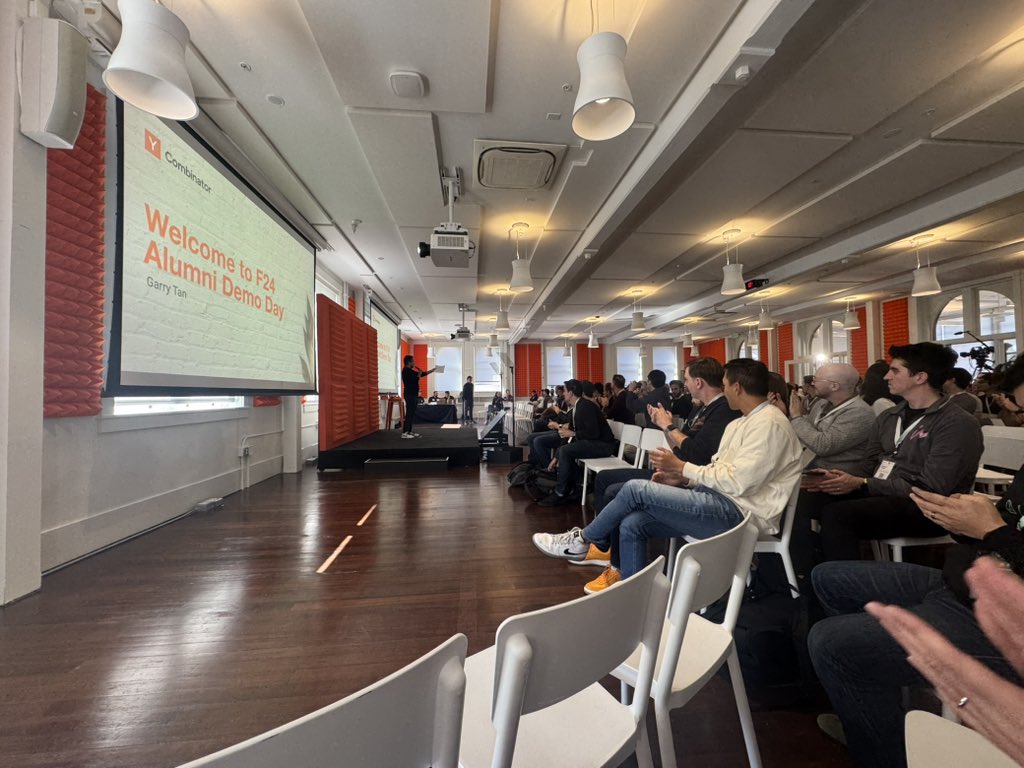
First YC in person alumni demo day for a long time. Energy is crazy good in the room.
Jude Gomila tweet media
English
4
3
83
20.4K
Angelo Huang
Angelo Huang@angeloh·
@therabbithole What a nice time to be Taiwanese American! I waited this for 20 years from people calling us Pacific Islanders to the AI super power.
English
0
0
0
20
The Rabbit Hole
The Rabbit Hole@TheRabbitHole·
Some of the most successful people in the United States are from minority groups. America is the land of opportunity 🇺🇸
The Rabbit Hole tweet media
English
2.3K
2.4K
10.4K
53.9M
andrew chen
andrew chen@andrewchen·
🚨 7 days left to apply a16z SPEEDRUN 004! 🚨 come work with me 1:1 -- I'll be coaching companies personally on everything from growth/marketing, launching, fundraising, hiring your initial team, and more. Would love to meet you. over the next week, we'll be investing $20M into founders and teams building in AI/infra, 3D tools, AR/VR, Web3 games, gamified apps and platforms, and much more. the way it works: - apply to the program (link below) - we interview you over the next week - offer within 48 hours - we wire soon after - then we hang in SF in Jan 2025!
English
38
20
243
144.7K
Angelo Huang
Angelo Huang@angeloh·
@judegomila But the video shows transparent object for some time frames. If it was a dirty spot on camera, the body color won’t change.
English
1
0
0
135
Jude Gomila
Jude Gomila@judegomila·
This is especially apparent in the 'jellyfish' UP video, which to me seems like likely bird poop stuck on the lens. Notice, there is no rotation of the object as it pans and there should be if the object was traveling in a linear path.
English
1
0
2
392
Jude Gomila
Jude Gomila@judegomila·
Unidentified Phenomena: UFO->UAP->UP In abstracting UFO to UAP there was progress to throw out assumptions that a phenomena was 'flying', however, the 'A' (aerial) comes with too much assumption baggage. It assumes the phenomena is 'aerial', which it may not be. For example, if something is stuck on the lens of a camera, is a camera artifact, lens flare, processing/compression artifact it is not aerial. Phenomena can occurs anywhere in the informational path between the phenomena and your perception of the phenomena. This stack includes the camera, lens, CCD processing, compression processing, display transformation and finally your brain (eg optical illusions). So instead of UAP, Unidentified Phenomena should be used (UP). UAP assumes around half the stages of processing and transforming a visual signal don't exist.
English
1
0
4
834
Angelo Huang
Angelo Huang@angeloh·
@aaron_epstein How to frame competitions and distribution will be an important task for every entrepreneur in the early days when it comes to challenge the status quo!
English
0
0
0
41
Aaron Epstein
Aaron Epstein@aaron_epstein·
Big entrenched incumbents never want anything to change so they can keep their moats. But change = opportunity for startups. And we’re living through a period of incredible change right now. That’s why there’s never been a better time to start a startup than now!
English
3
5
81
14.9K