

bidogold.ip
15.8K posts

bidogold.ip
@bidogold
AMB - Community Mod Encrypted at @SeismicSys @Storyprotocol Lover
Đà Nẵng, Việt Nam Katılım Mart 2019
1.2K Takip Edilen2.7K Takipçiler

Lume App: Chapter 2 of Building with Arc 👨💻
After the first week of building, testing, breaking things, and learning with Arc AppKit, I’m back with the next Lume update.
Last week, Lume was mostly about getting the core logic, UI, and early AppKit integration working properly.
This week, the app has moved from “in progress” to a much more usable DeFi flow.
After spending days refining the UX, fixing edge cases, and making the core flows stable enough, I decided it was finally time to public the website and let people try Lume themselves.
It still feels early, and there’s a lot more to improve, but I think shipping publicly is an important part of building. Real feedback always teaches more than building in isolation.
What’s new in Lume:
✅ Bridge
The bridge flow is now live inside the app.
This was one of the hardest parts to think through because bridging is not just a button. It involves chain state, wallet state, asset direction, transaction status, and making sure the user always understands what is happening.
For me, Bridge is the entry point of Lume. Before users can swap or provide liquidity, they need a simple way to move assets into the right environment.
✅ Swap
Swap is now available on Lume, running on Arc Testnet with support for assets like USDC, EURC, and cirBTC. Users can now move between stable assets and BTC liquidity directly inside the app without leaving the Arc ecosystem.
This turns the app from a static interface into something users can actually interact with directly. Connect wallet, select token, approve, swap, and track the transaction flow inside the dApp.
It sounds simple from the outside, but building a smooth swap experience means handling a lot of small details: balances, token selection, route state, approval state, pending transactions, failed transactions, and UI feedback.
✅ Pools
Pools are also now part of Lume, with contracts currently running on Arc Testnet. Current supported pools include USDC / EURC, USDC / cirBTC, and EURC / cirBTC, allowing users to provide liquidity across stable and BTC-backed assets inside the Lume ecosystem.
This is an important layer because swaps need liquidity. With pools, Lume starts to become more than a simple swap interface. It becomes a small liquidity layer where users can provide assets and support the market structure inside the app.
✅ cirBTC
Lume has also added cirBTC.
I’m especially interested in this part because bringing BTC liquidity into DeFi on Arc opens up more possibilities for future use cases. cirBTC adds another asset layer to the app and gives Lume more room to expand beyond basic token swaps.
Lume is still early, but compared to Week 1, it now has:
- Bridge.
- Swap.
- Pools.
- cirBTC support.
Next step: improving stability, polishing UX, and continuing to ship more updates.
You can try Lume here 👇
arclume.xyz
Feedback is welcome. I’ll keep building and shipping.
@arc @bobbilee @samconnerone
#buildonarc
edward.ip@Edward74470934
Lume App: Week 1 of Building with Arc 👨💻 7 days of "eating and breathing" with Arc AppKit have finally come to life with Lume App! 💡 As a developer exploring and learning within the @Arc ecosystem, I’m genuinely impressed by the deployment speed that AppKit offers. Lume is more than just a project; it’s the result of real-world "battle-testing" and optimizing user experience from the very first line of code. Lume Current Status & Roadmap: ✅ Core Logic & UI: Lean, mean, with Arc AppKit seamlessly integrated. 🚧 Bridge (In Progress): My main focus right now is the Solana ↔️ EVM bridge. Managing cross-chain states and keeping the liquidity secure across these ecosystems is a true "brain-melter," but I'm committed to getting it right. ⏳ Swap & Pools: Scheduled for the next phases to fully complete the Lume App experience. Learning never stops, and building with Arc has been an incredibly rewarding experience. Grinding through the logic is where the real growth happens. Keep an eye out for the next Lume update next week 🙌 @samconnerone #BuiltWithArc #Web3
English
bidogold.ip retweetledi

Privacy is a core part of UX in many everyday apps.
Messages.
Credentials.
Personal notes.
Selective sharing.
AI memory.
And yet, most software still struggles with sensitive data.
→ This is the exact design space that CDR is built for
→ Hackathon opens May 27th
You in?
English
bidogold.ip retweetledi
Tamil is one of the world’s oldest living languages.
▸ 80+ million speakers
▸ Over 2,000 years of recorded literary history
▸ Spoken across India, Sri Lanka, Singapore, and large global diaspora communities
And yet, high-quality Tamil voice data for AI remains surprisingly limited.

English

RLNC: The Hidden Engine Powering Crypto’s Next Era
As crypto moves toward an AI-driven economy, stablecoins processing trillions in payments, and tokenization accelerating across global markets, one question becomes unavoidable:
Can today’s blockchain network layer actually keep up?
Optimum believes the answer lies in RLNC, Random Linear Network Coding, a breakthrough pioneered more than 20 years ago by Muriel Médard and researchers at MIT, now being deployed for the onchain future.
Instead of transmitting entire blocks through traditional gossip protocols, RLNC breaks data into smaller fragments and continuously generates randomized encoded shards from them.
Mathematically, the publisher creates coded shards through linear combinations:
c_i = Σ(α_ij * v_j)
What makes RLNC fundamentally different is that nodes do not need to wait for the full message before forwarding data. Intermediate nodes can instantly recode received shards and propagate new ones in real time:
c' = Σ(β_l * c_l)
The receiver only needs any sufficient set of linearly independent shards to perfectly reconstruct the original data.
This “forward-before-complete” architecture changes everything.
Optimum implemented RLNC inside its next-generation propagation layer called mump2p.
Here’s how it works:
• Messages are shredded into smaller pieces.
• Additional coded shards are generated dynamically.
• Nodes forward shards immediately after reaching threshold conditions.
• Once decoding completes, nodes broadcast “IDONTWANT” signals to eliminate redundant traffic.
The result is dramatic:
• 6–20× faster propagation than traditional GossipSub.
• 90–95% lower bandwidth consumption.
• Better scalability as network participation increases.
• Fully decentralized operation.
Unlike Reed-Solomon or Fountain Codes, RLNC improves efficiency while simultaneously minimizing latency, the exact bottleneck becoming critical in 2026.
Kent Lin, co-founder of Optimum, recently stated that “150ms execution time” is no longer aspirational, it is becoming the minimum requirement for the next generation of onchain applications.
When AI agents execute trades autonomously, stablecoins move billions daily, and tokenized assets scale globally, network propagation speed becomes the limiting factor.
Most projects continue optimizing execution layers.
Optimum chose the harder path:
Optimizing the network layer itself, the invisible infrastructure every blockchain depends on.
The strongest part of Optimum’s architecture is that it remains chain-agnostic.
Ethereum, Solana, and virtually any blockchain can integrate mump2p as a sidecar layer without requiring protocol-level modifications.
RLNC is not simply an encoding upgrade.
It represents a paradigm shift:
from “send complete blocks” to “send flexible recombinable information flows.”
And that shift may become one of the most important infrastructure breakthroughs of the onchain decade.
150ms is becoming the new standard.
The real question is:
Will existing blockchain networks evolve fast enough to meet it?
@get_optimum
English
@Edward74470934 @get_optimum Wonderful, RLNC will become the future.
English
Optimum @get_optimum is taking an interesting route.
Not another blockchain.
Not a new consensus mechanism.
Not a full infrastructure replacement for validators.
Instead, it focuses on a deeper layer:
Data propagation.
As blockchains process more blocks, transactions, blobs, and state, the real bottleneck is not always compute or consensus.
Sometimes, it is simply how data moves across the network.
Optimum’s core message is clear:
Transmit less. Deliver more.
The key technology behind it is RLNC (Random Linear Network Coding).
Instead of repeatedly sending the same data in the traditional way, RLNC encodes data into random linear combinations.
As long as a node receives enough independent pieces, it can reconstruct the original data.
In simpler terms:
Packets do not all need to arrive perfectly.
The network does not need excessive redundancy.
Data can still be recovered faster and more efficiently.
The most relevant product today is mump2p, a propagation protocol for Ethereum blocks, transactions, and blobs.
Its main claim: validators can achieve 6–20x faster block propagation.
If that holds in real production environments, the impact is not just technical.
It becomes economic:
Fewer missed proposals.
Better attestations.
Improved MEV execution.
Lower bandwidth waste.
Latency as a competitive advantage.
What makes Optimum’s thesis strong is that it does not try to replace Ethereum.
It optimizes the layer underneath.
Consensus remains intact.
Validator operations remain largely familiar.
The data layer becomes faster.
That matters because blockchain scalability is not only about execution, DA, or consensus design.
It is also about network latency.
The main questions now are practical:
Can the 6–20x claim be validated transparently?
Can the Flexnode economic model scale?
Can large validators adopt it without meaningful operational friction?
Can it perform reliably under real mainnet conditions?
Still, the direction is clear.
As crypto becomes more modular, multi-chain, and data-heavy, the infrastructure that moves data efficiently becomes increasingly valuable.
Optimum is not positioning itself as the next chain.
It is positioning itself as a data acceleration layer for the networks that already exist.
English

Decentralization no longer means "slow." 🚀
Optimum is demonstrating that a decentralized yet high-speed blockchain network is entirely feasible thanks to Random Linear Network Coding (RLNC) technology.
Through mump2p, nodes in different regions around the world can transmit data with lower latency, regardless of infrastructure or hardware conditions. This is especially important for independent validators in APAC, Africa, or LATAM—regions often facing network connectivity disadvantages.
The key features of RLNC include:
- Recoding
- Early forwarding
- Decoding with any combination of coded shards
@get_optimum not only optimizes speed but also opens up a fairer opportunity for all node operators globally. This is a very promising direction for the future of blockchain scaling and decentralized infrastructure.
@blockchainjeff
@aqccapital
@ada_pegasus

English
bidogold.ip retweetledi
Pssst.
We’re launching a hackathon around Confidential Data Rails (CDR), Story’s new primitive for programmable private data.
▸ $3,000 prizes
▸ 1 week only
▸ Workshops in Korean + English
Existing projects welcome. Opens May 27th ↓
Story@StoryProtocol
The next wave of AI depends on data that can’t be exposed. Now with Confidential Data Rails (CDR), that constraint disappears. ▸ Data stays encrypted ▸ Access is defined upfront ▸ Secure pre-conditions held for decryption Live now on testnet.
English

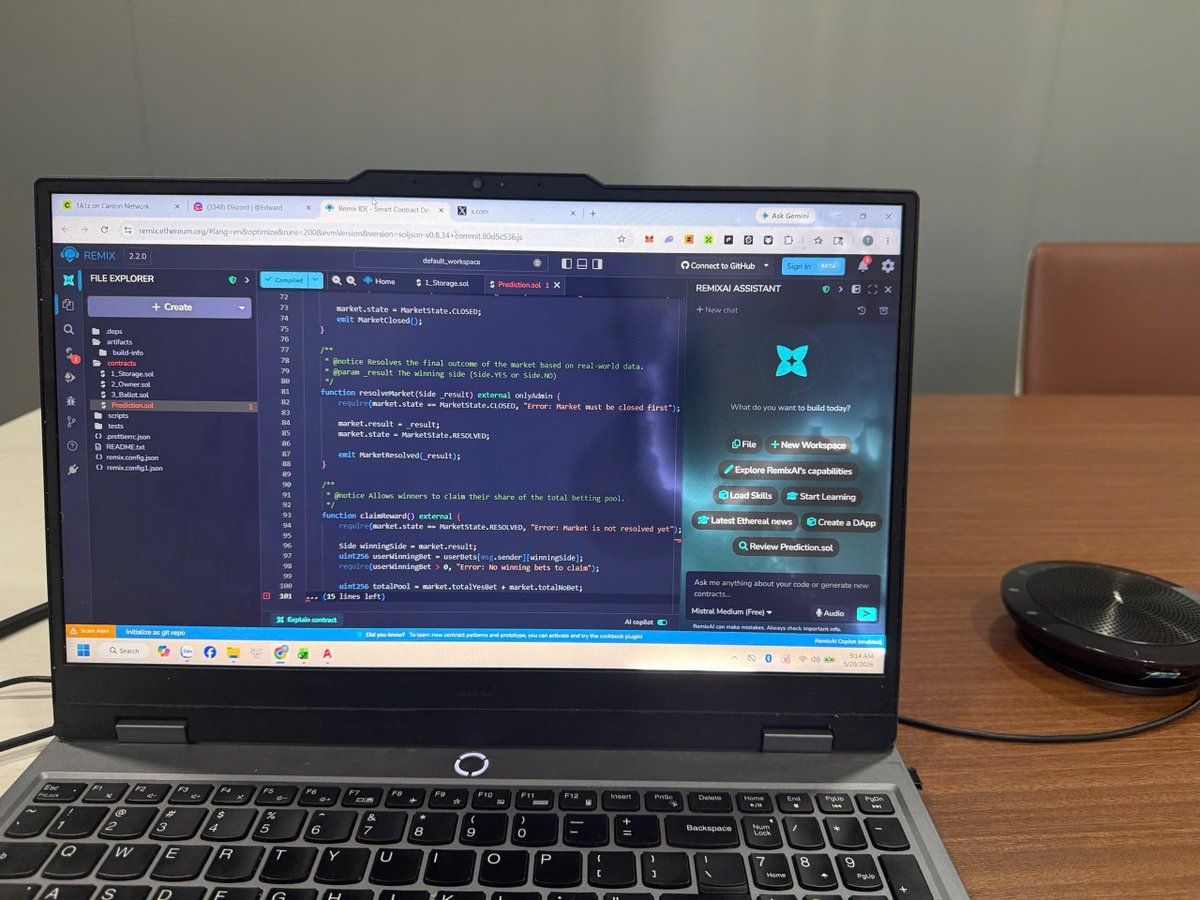
Started learning to build after spending time exploring. Realized this side of the space is actually really interesting, even though it’s not my strongest skill. And here’s my first product
Feels good knowing my web3 knowledge just gained one more new skill along the way
Let's build on @arc
English

Mushy finally unlocked main character energy !!!
One thing I really like about creating for @StoryProtocol is how every artwork can become part of a bigger IP universe.
Not just cute, but characters, stories, and ideas that people can keep building on together.
Feels like Mushy is slowly becoming a little hero of this creative world !!!
@StoryProtocol @psdnai @mushy

Tooby@TDuy240201
Mushy sitting quietly while holding his little piece of Story ✨ One reason I’ve been enjoying creating for @StoryProtocol so much is the idea behind the project itself, turning IP into something open, programmable, and truly owned by creators. It makes every artwork feel like part of a bigger creative universe instead of just a single post. Slowly building stories, one artwork at a time 🦆 @StoryProtocol @psdnai @mushy
English
bidogold.ip retweetledi

Voice AI has an evaluation problem. Models look strong on public benchmarks, then collapse on real-world audio.
Introducing sonar.psdn.ai: a recipe-driven evaluation framework for low-resource languages, real-world audio, and production failure modes.
Details ↓
English

Sau 1 tuần tích cực kết nối với cộng đồng @AbstractChain , tài khoản của mình đã có những chuyển biến rất tích cực 🚀
Không chỉ học hỏi thêm được nhiều điều mới, mà còn gặp gỡ được rất nhiều anh em chất lượng trong cộng đồng.
Cảm ơn @Abstract_Eco đã tạo ra một môi trường tuyệt vời để mọi người cùng phát triển 🤝
Hành trình vẫn còn dài, tiếp tục nào… 🔥
#abstractchain #connect #growup
X.booG@FunkPoppin50443
Happy ABS XP Day!!!! 53,444 XP on @AbstractChain! 🎉 Maybe 100k XP in nextweek
Tiếng Việt

Most ASR evaluation today still looks like LibriSpeech: clean English audiobook narration, scripted speech, single speaker, almost no real-world complexity. But human conversation was never that simple. People switch dialects, mix languages, pause mid-sentence, speak in noisy environments, and communicate in ways benchmarks rarely capture.
SONAR is pushing voice AI evaluation in a different direction. Instead of one fixed benchmark, it uses recipe-driven evaluation where teams can bring their own datasets, scoring rules, metadata slices, and normalization logic. Adding support for a new language becomes a YAML recipe instead of an engineering rewrite.
In Bengali, SONAR evaluated 8 ASR models across 6 datasets with nearly 16,000 scored predictions. The interesting part wasn’t who ranked #1. It was the discovery that no single model performed best across every environment, WER-only rankings missed semantic failures, and aggregate scores often hid demographic gaps.
The future of voice AI won’t be decided by who performs best on clean English narration. It will depend on who can understand how people actually speak. @psdnai
@mushy
@StoryProtocol

WeJin@dangtruong4421
I love sleeping surrounded by giant foods, like living inside a childhood dream I always wished for. 🍕🍩✨ This place feels fun, colorful, and strangely comforting… because whenever I get hungry, I can just reach out and grab my favorite snacks anytime. Sometimes happiness is simply being in a world filled with the things you love most, enjoying every little moment without worries. @mushy @StoryProtocol
English
Tiếng Việt

Gmic @SeismicSys
Happy weekend
I carry the Seismic logo made of yarn with me wherever I go, to help spread Seismic to people everywher
@NoxxW3 @xealistt @heathcliff_eth

Kieu Trinh@ktrinh2k3
This phone case with the @Seismic logo, I made it myself. What do you think? @NoxxW3 @xealistt @lyronctk @SeismicSys
English
bidogold.ip retweetledi
Bengali Voice Submissions
██████████ 100%
Hindi Voice Submissions
██████████ 100%
Telugu Voice Submissions
██████████ 100%
Vietnamese Voice Submissions
██████████ 100%
Contributions are still open for Tamil. Lock in ↓
Poseidon@psdnai
Hindi, Telugu, and Vietnamese all just crossed the finish line on Numo. Huge thank you to everyone who contributed and helped bring more real-world voice data into AI training. Submissions are now closed in these languages.
English
bidogold.ip retweetledi

Wake up ☀️
Check @SeismicSys missions ✅
Vibe with the community ✅
Repeat every day 😎🌊
The next smiles came from the lovely girl @xiaoqingling98 and @ThanhCraffey @aqccapital @bidogold
@NoxxW3 @xealistt @heathcliff_eth

HanBee 🔆@HangB22211
All in. Always 💪🤩 Seismic is powered by people who show up, support each other, and keep the energy fun and positive. Big ideas, bigger smiles Let’s keep building together 💗💗 @SeismicSys @NoxxW3 @xealistt @heathcliff_eth
English
@HangB22211 @SeismicSys @xiaoqingling98 @ThanhCraffey @aqccapital @NoxxW3 @xealistt @heathcliff_eth bido so cuteee 😍😍😍
Español
bidogold.ip retweetledi

