Chi Song

255 posts

Chi Song

Chi Song

@chi_s0ng

Building @CapRelayHQ, the fastest way to understand public companies

Katılım Ağustos 2023
275 Takip Edilen116 Takipçiler
Sabitlenmiş Tweet
Chi Song
Chi Song@chi_s0ng·
I spent over a decade as a professional investor at various hedge funds. There's no alpha in getting up to par with what the market already knows, and yet it still took at least a day of reading initiatings, transcripts, skimming expert calls, etc. What if that took only five minutes, so you can focus on the alpha-generating work? I co-founded CapRelay with @luyiest (co-founder of BamSEC) to make this a reality
caprelay@CapRelayHQ

Introducing CapRelay, the fastest way to find and iterate through ideas Do you want click through buy-side bull-bear debates on every US-listed company, with no load times or prompt bars? Or screen based on your qualitative investment criteria, like cos with limited competition?

English

1
0
5
625
Chi Song
Chi Song@chi_s0ng·
Self-serving plug: For qualitative data via MCP, a lot of funds use us at @CapRelayHQ. we provide everything from transcripts to buy-side bull-bear debates. our customers range from specialist single managers to trillion+ asset managers, using our data for prompts like "find me potential cyclical peaks where supply is coming"
English
0
0
4
294
TechStockFundamentals
TechStockFundamentals@TechFundies·
It's wild how much better Claude is with good data behind it. I'm using the $FDS MCP which doesn't even have qualitative data yet (transcripts, news, etc.). Will be even more game changing when that is released.
TechStockFundamentals tweet mediaTechStockFundamentals tweet media
English
15
5
110
33.4K
Chi Song
Chi Song@chi_s0ng·
We serve a lot of other investment firms, and they'd echo this -- MCPs with good data really take agents to the next level. E.g. prompts like "go through every software company and rate the AI bear case by credibility" don't work with vanilla Claude Code, but with a good MCP that provides qualitative data, you actually get good analysis on 250+ companies
English
1
1
6
321
TechStockFundamentals
TechStockFundamentals@TechFundies·
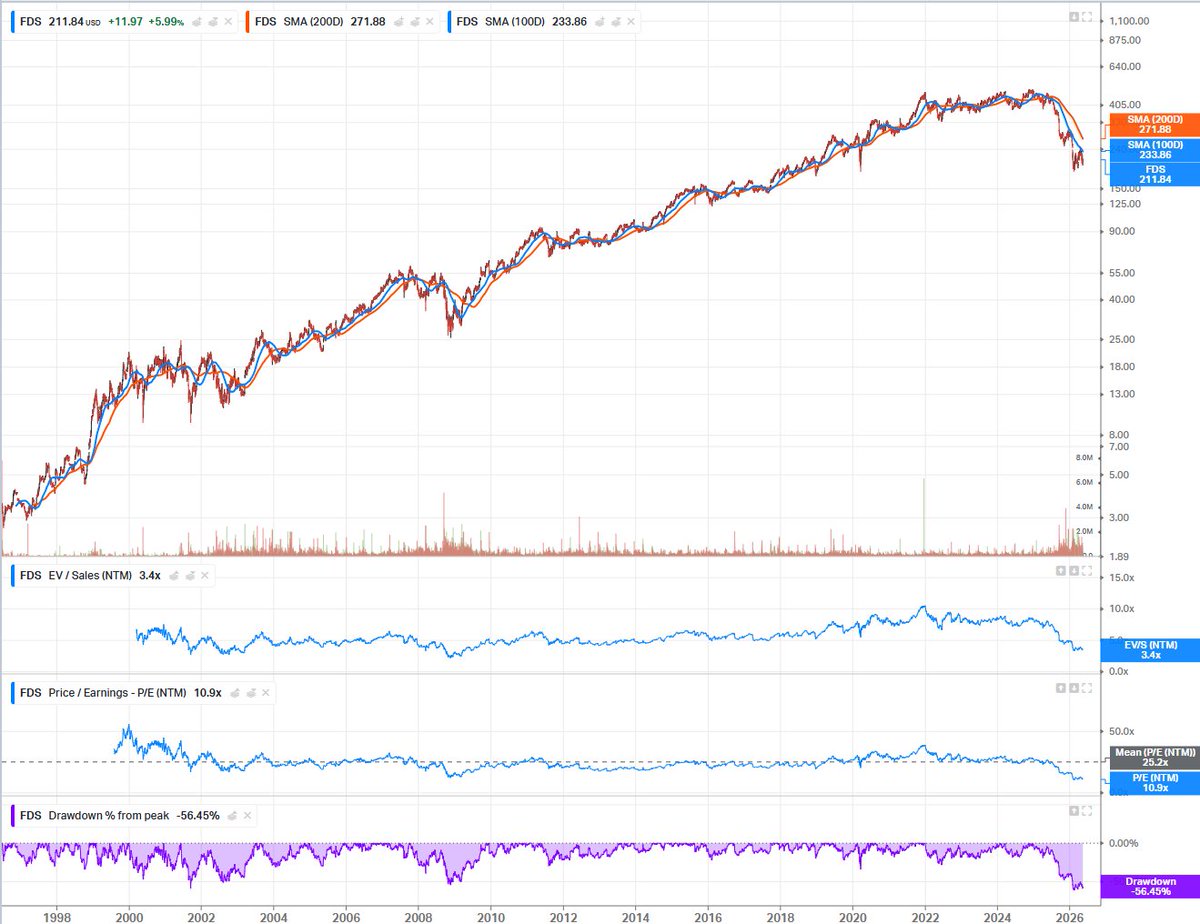
Random thoughts after connecting $FDS to Claude Chat / Cowork. My thinking is I want to approach AI as a typical user for investment advancement and use the learnings as a proxy for SaaS (as opposed to judging the impact of AI on FIG which I have never used before). Investment management likely downplays the importance of collaboration functionality in enterprise SaaS since most investment ideas are run from start to finish by a single person w/ just the end product being shared with a committee. 1. Connectors take Claude to a whole new level. By adding $FDS, I now get reliable data which takes my trust and application of AI much further. 2. Trying to replicate old, working things is frustrating. I tried to have Claude replicate my Excel quicksheet which is built with $FDS excel codes. It sort of worked but then I realized it was just very buggy and hard to get working as reliably as my spreadsheet. And then I asked myself why I was spending money and time working on rebuilding something that already works well. Same applies for $MSFT apps – can just connect to them and work on spreadsheets, emails, etc. 3. Building new stuff is easier and cool. I quickly prompted it to build an artifact that pulls the tech universe and helps me parse which businesses are accelerating. I then quickly prompted it to run the same analysis but by subsector. I think the data is likely correct and could quickly visualize the market’s enthusiasm for semis and avoidance of application software (see image). The new stuff is what I think everyone should be excited about. It’s new functionality, analysis, insights that can allow me or a business to advance and outperform competition. 4. The fastest, most efficient way to get to new functionality is via incumbent data / sw providers. I can pay more for $FDS MCP and am good to go. No change to existing processes or loss of procedure. Just ready to work on new things. I could purchase MCP from a smaller vendor but most of their data is incomplete right now. I could switch to CapIQ or Bloomberg but A) they are just as if not more expensive, B) Bloomberg doesn’t have an MCP yet, C) I would have to switch all the old stuff too / recontract which is just a waste of calories. 5. $FDS hasn’t had anything new to sell me ever. Now they do and it’s hot. Now maybe the flipside is the MCP can be swapped out for a competitor more easily which commoditizes the offering – particularly if all the old stuff moves entirely over to Claude over time but that seems very unlikely just given how people work (evidence: Bloomberg is the most legacy tech out there and has very low churn bc of habit). 6. Should I be paying more to access $FDS data via an MCP? Arguably not since it’s just another way to expose the same data and my usage of the terminal will likely lose share of time spent. But, whatever, the spend is a very low percentage of the business and not having it just seems stupid. Can you imagine meeting an investor and responding that you don’t have clean financial data in Claude because you’re too cheap (not to mention most funds expense this to the investor anyways!)? My point just being I think people are ultimately going to spend more to get more, and will be fine with it bc of the value add. I think the same thought process applies if I were starting a new firm – why would I want anything other than the most comprehensive data set to power my AI? Jeopardizing ROI to save a bit of money makes no business sense. 7. I did some market research. CapIQ said the inbound inquiries for their MCP is “through the roof, insane, etc.” w/ per seat pricing going up by 30-50%. $FDS per seat increases are probably similar to a bit less than that. 8. $FDS has been accelerating the past 3 qtrs w/ msd growth, and I would guess that continues given MCP ramp. Margins are a bit low while re-investing in product which is a sensible thing. Stock trades at 12x this year’s GAAP EPS / 12x FCF. Stock once traded down to 14x GAAP EPS in 2008 when the financial world was ending and finance professionals were being laid off. Stock has never had a worse peak-to-trough drawdown than now. And it’s never been this cheap. Please throw rocks at this.
TechStockFundamentals tweet mediaTechStockFundamentals tweet mediaTechStockFundamentals tweet media
English
13
9
105
22.7K
Chi Song
Chi Song@chi_s0ng·
@luyiest Chores = podcast time, it's actually great
English
0
0
2
19
Luyi Zhao
Luyi Zhao@luyiest·
Back in my investing days, podcasts were more of just a curiosity for investors. That's really changed over the years. There's a ton of insights being shared in exec interviews, discussions between sharp investors, etc.
caprelay@CapRelayHQ

Click a button to see relevant podcasts for any company. If you're a finance professional, you probably love podcasts as a source of information. How do you find and stay up to date on podcasts relevant for your companies and coverage universe? That's why we built this ↓↓↓

English
2
0
3
51
Chi Song
Chi Song@chi_s0ng·
click a button to see relevant podcasts, for any company in @CapRelayHQ When I was a professional investor, I loved podcasts for research. But there was no great way to find them, no easy way to figure out what was relevant for each company. That's why we built this: No more searching for each company you follow, and then again for every executive's name at those companies. No need to worry about overlooking interviews other investors found. Full demo in video below
caprelay@CapRelayHQ

Click a button to see relevant podcasts for any company. If you're a finance professional, you probably love podcasts as a source of information. How do you find and stay up to date on podcasts relevant for your companies and coverage universe? That's why we built this ↓↓↓

English
0
0
3
61
Chi Song
Chi Song@chi_s0ng·
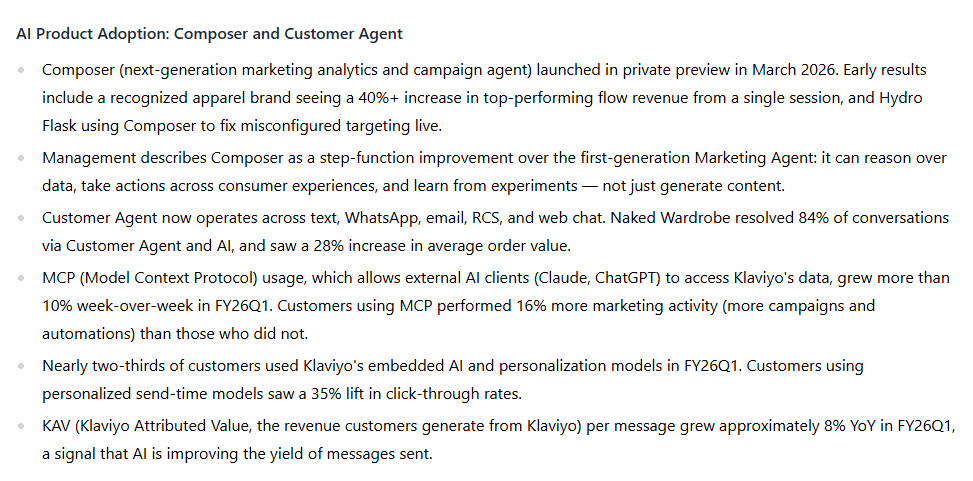
Key AI product adoption takeaways from the $KVYO call, via @CapRelayHQ
Chi Song tweet media
English
0
0
5
429
Chi Song
Chi Song@chi_s0ng·
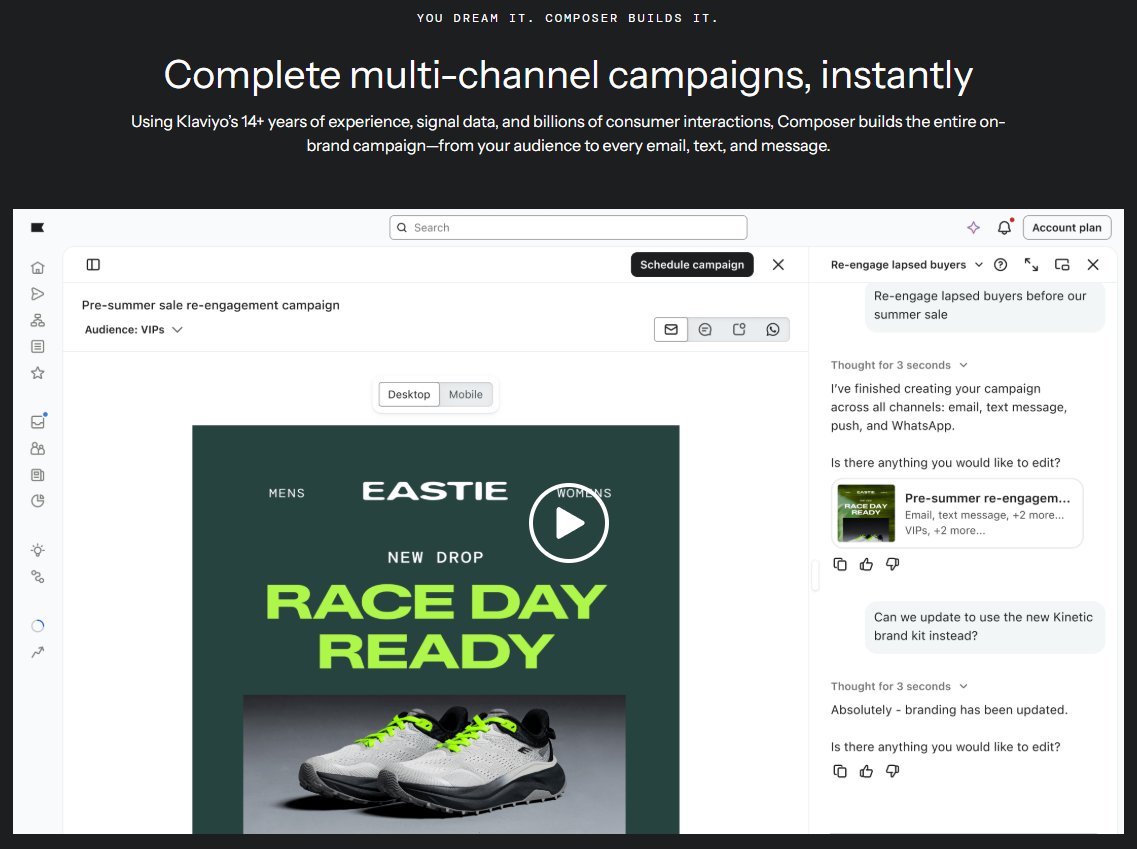
anyways this is a company that does email and text msg marketing I've always thought this was one of the most obvious AI-beneficiary parts of sw: very clear that AI can personalize messages to every single one of millions of recipients and also very clear that personalized messaging drives real uplift to marketing outcomes this is $KVYO's composer biggest knock imo is that it's still private beta, 3 years after this vision became super obvious. public sw companies all executing super slowly, except $PLTR
Chi Song tweet media
English
1
0
4
169
Chi Song
Chi Song@chi_s0ng·
$KVYO down 21% pre-market Clear signs of AI disrupting them? Nah ~2% skinnier beat than normal And passed beat into full-year outlook too
Chi Song tweet media
English
1
0
5
957
Chi Song
Chi Song@chi_s0ng·
Bull case on margins from here? Interesting operating details via @CapRelayHQ : gains come entirely from productivity and vertical integration, and the driver is project size: - As campuses grow from 100 acres to 1,000-plus acres, Sterling can leverage its equipment fleet, project management teams, and now electrical crews across a single site more efficiently. - Multi-phase projects allow Sterling to use work completed in Phase 1 to improve logistics and sequencing in Phases 2 and 3, compounding productivity across a build that can span three to five years. - Projects at the early-phase pricing level carry lower initial margins; as phases progress and productivity gains accumulate, margins expand. This means the current backlog is underearning its long-run margin potential.
English
0
0
5
77
Chi Song
Chi Song@chi_s0ng·
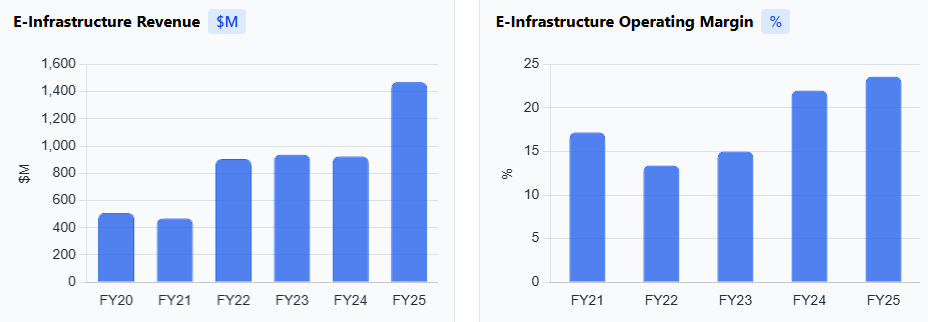
Look at that inflection! $STRL e-infra segment is their data center construction segment.
Chi Song tweet media
English
1
0
5
137
Chi Song
Chi Song@chi_s0ng·
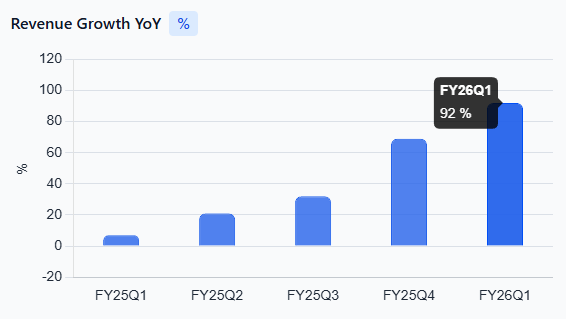
How does a large cap raise a rev guide 20%? $STRL going vertical today, numbers look comical, and yeah it's obviously AI-driven $STRL is a little under the radar -- it's a construction services company (read: they now just build data centers). Differentiation is delivering data centers on-time, which creates a premium product that's super in-demand right now. Demand accelerating: Total work pool now approaches $6.5B: $3.8B signed backlog (+78% YoY), $5.15B combined backlog (+131%), plus $1.3B+ in future phase opportunities. That pool grew ~$2B in Q1 alone. Book-to-burn: 2.1x signed, 3.5x combined. It's data centers: 75-80% of E-Infra backlog is data centers, E-Infra drives essentially all of STRL's earnings growth. Margins accelerating, already above long-term means, but in a world where on-time means more, they go higher. CEO Cutillo on the margin debate: "If you consider margins going higher than they are now, then they are not at a peak." The biggest new development: $STRL was awarded the first phase of a semiconductor fabrication campus in the Northeast. Phase 1 exceeds $500M, executed via JV, expected to complete late 2027/early 2028. CEO Cutillo: "there was no one else in the room that was going to have a chance at this." The semi fab is a new end market for STRL, adding to data centers (~75-80% of E-Infra backlog) and e-commerce distribution. Management doesn't expect the big wave of chip plant construction until 2029-2030, but this win positions STRL as the likely site development partner for future U.S. fabs. Labor is the bottleneck. "If I had 2,000 or 3,000 more electricians, we would grow it even faster." Levers: apprenticeship pipeline (4 years), attracting electricians from smaller shops with longer assignments, acquisitions, and tripling CEC's modular prefab facility to 300k+ sq ft to reduce field electrician hours per dollar of revenue.
Chi Song tweet mediaChi Song tweet media
English
1
0
5
607
Chi Song
Chi Song@chi_s0ng·
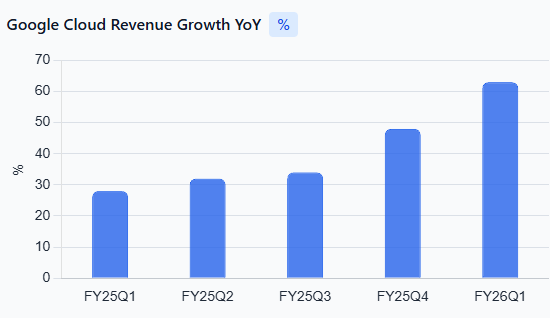
Most vertical looking chart of the day goes to $GOOG Cloud
Chi Song tweet media
English
0
0
1
58
Chi Song
Chi Song@chi_s0ng·
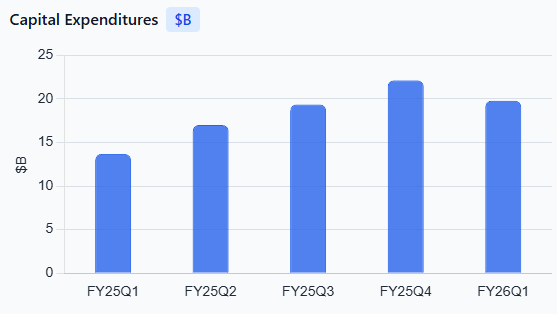
$META capex
Chi Song tweet media
Español
1
0
1
92
Chi Song
Chi Song@chi_s0ng·
interesting but less covered tidbits from megacap earnings: $AMZN Amazon's chips business (Trainium, Graviton, Nitro combined) exceeded a $20B annualized revenue run rate, with $225B of Trainium commits. $NVDA data center biz at $200B+ run rate $AMZN says power still the primary bottleneck $AMZN Perishable sales grew over 40x yoy (yes they said 40x). Amazon's grocery now 2nd largest U.S. grocer $META Meta AI sessions per user increased in the double-digit percentage range following the broad rollout of Muse Spark (way better model than Llama) $META on Instagram, ranking improvements in FY26Q1 drove a 10% lift in Reels time spent $META over half a billion users on each of Facebook and Instagram are now watching AI-translated videos weekly... wonder when this becomes AI-generated videos? $GOOG Revenue from products built on Gemini models grew nearly 800% YoY in FY26Q1 -- pretty sure this is undergrowing the industry. 330 Google Cloud customers each processed over 1T tokens in the LTM, which is like a $500k spend on Gemini-Flash, not really that much $GOOG also benefitting from TPU sales, tho didn't quantify as well as $AMZN $MSFT said FY26Q3 as the fastest seat growth in M365 Copilot since launch $MSFT moving GitHub Copilot to usage-based pricing. Previously widely known in dev circles that GH Copilot was under-pricing Anthropic models, and plenty exploited this pricing mechanism while it lasted $MSFT Over 300 customers are on track to process more than 1 trillion tokens on Foundry this yr, compare to similar disclosure of 330 Gemini custs processing 1T+ tokens LTM
English
1
0
4
332
Chi Song
Chi Song@chi_s0ng·
"which commodity industries have added a lot of supply in the past 1-3 years?" --> with Claude Code + @CapRelayHQ : "lithium supply from Chile, Australia, China, Argentina, Africa, etc. overwhelmed demand after the 2021-2022 boom; nickel has been hit by Indonesian supply. CapRelay shows SQM lithium sales volumes rising roughly 4x from 2020 to 2025, while BHP suspended WA Nickel and Vale took a nickel impairment tied to oversupply."
English
0
0
3
64
Luyi Zhao
Luyi Zhao@luyiest·
Fun fact - AI agents are now 30%+ of all of CapRelay's usage! In the video ⬇️, my CapRelay co-founder @chi_s0ng demonstrates how you can use Claude Code with CapRelay to generate high-quality summaries of the AI-specific bear cases for all $2B+ market cap software companies:
English
2
0
5
311
Chi Song
Chi Song@chi_s0ng·
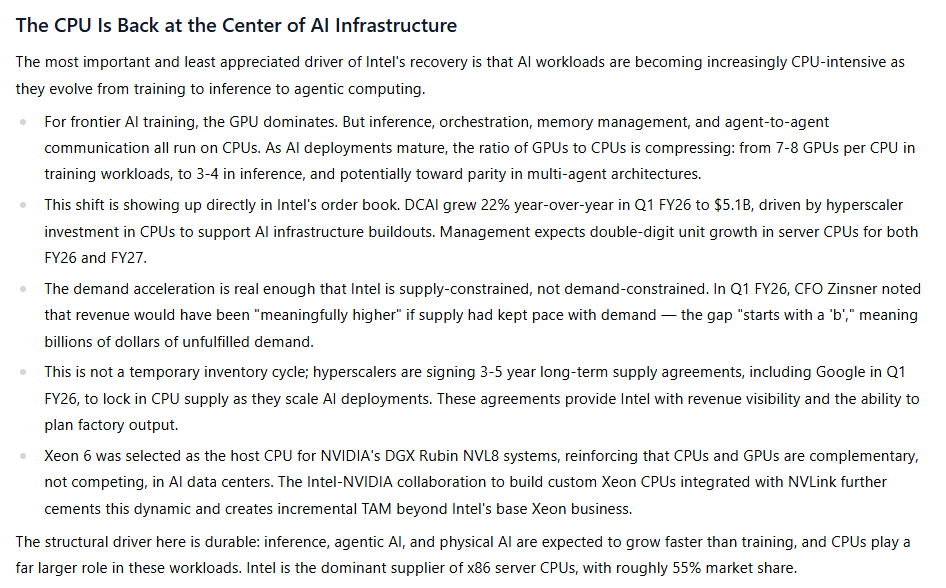
The core thesis from here: CPU + AI "the ratio of GPUs to CPUs is compressing: from 7-8 GPUs per CPU in training workloads, to 3-4 in inference" Bull case from @caprelayhq
Chi Song tweet media
English
0
0
2
59
Chi Song
Chi Song@chi_s0ng·
$INTC up 23% intraday after Q1 FY26: revenue $13.6B (+7% YoY), non-GAAP gross margin 41% (~650 bps above guidance), non-GAAP EPS $0.29 vs. $0.00 guided. Sixth consecutive quarter above the high end of guidance. AI tailwinds seem just be flowing from place to place in tech The central theme: INTC's CPU franchise also benefits from AI infrastructure. CEO Tan: "For the last few years, the story around high performance computing was almost exclusively about GPUs. In recent months, we have seen clear signs that the CPU is reinserting itself as the indispensable foundation of the AI era." The quantitative framework behind that: CPU-to-GPU ratios are compressing from ~1:8 in training to ~1:4 in inference, with potential for parity or better in agentic workloads. DCAI grew 22% YoY to $5.1B, supply-constrained, not demand-constrained. CFO Zinsner on unfilled demand: "It starts with a 'b'." Intel is leaving billions in revenue on the table because it can't build fast enough. Multiple long-term supply agreements signed in Q1, including Google (Xeon 6 deployment + co-development of custom ASICs). Others signed but not announced at customer request. These are 3-5 year contracts with volume and pricing commitments, providing revenue visibility into FY27. Xeon 6 was also selected as the host CPU for NVIDIA's DGX Rubin NVL8 systems. CPUs and GPUs are complementary, not competing, in AI data centers, according to INTC (but not Jensen). Intel 18A yields are running ahead of internal targets. Zinsner: Intel will likely hit its year-end yield goal around mid-year, ~two quarters ahead of schedule. Panther Lake volumes are up 6-7x in Q2 vs. Q1, making it the fastest product ramp in five years. 18A is still below corporate average margin, which is why Q2 gross margin is guided at 39% despite revenue growing to $13.8-14.8B. The path to sustained 40%+ requires yield improvement through mid-year plus moderating input cost headwinds (memory [lol], substrates). ASIC business nearly doubled YoY in Q1, up 30%+ sequentially, and is running at a $1B+ annualized run rate. Networking silicon for AI infrastructure is the primary driver. Tan sees this as a multi-year, fast-growing opportunity given Intel's unique combination of CPU IP, advanced packaging, and manufacturing. Advanced packaging demand is coming in larger than expected. Zinsner: "I naively thought these opportunities would come in the hundreds of millions of dollars level, but what we are seeing is demand in the billions of dollars per year kind of level." PC TAM is now guided down low double-digit percent for full-year FY26, concentrated in H2, driven by tariff-related caution, component shortages, and macro uncertainty. Intel expects CCG revenue to be roughly flat from Q2 through year-end on customer inventory replenishment, so the revenue impact is dampened — for now. Intel 14A is tracking ahead of 18A at a comparable stage of development in yield and performance. PDK 0.5 released. Tan expects "earlier design commitments beginning in 2026, expanding into 2027." TeraFab partnership with SpaceX, xAI, and Tesla announced, though commercial terms are undefined. Critically, Intel has disclosed that it may "pause or discontinue" 14A if no significant external customer commits, a decision it calls "potentially effectively irreversible." External foundry revenue was $174M in Q1. Clock is running. Balance sheet: Intel bought out Apollo's 49% stake in Fab 34 (Ireland) for $14.2B ($7.7B cash + $6.5B new debt). Management calls it "highly accretive", eliminates ~$1.1B/yr in NCI charges from that fab starting FY27. But total debt now exceeds $53B and Q1 adjusted FCF was -$2B. CapEx guide raised from flat-to-down to flat YoY (~$18B). Tool spend up ~25% YoY to grow wafer starts across Intel 7, Intel 3, and 18A. Space spend down materially. More output per dollar, and management says it will only commit incremental capacity for 14A against firm customer orders. Bull case: CPU-centric AI TAM is real and durable, 18A yields are ahead of plan, ASIC and advanced packaging are growing fast, and Intel has visibility from LTAs into FY27. Bear case: 14A customer commitment window is closing with nothing firm, gross margin recovery will take all of FY26 at minimum, PC TAM weakening in H2, SMT gap vs. AMD isn't fixed until Coral Rapids, and the balance sheet just got heavier.
Chi Song tweet media
English
1
0
1
116