DBoeger

5.6K posts

DBoeger

DBoeger

@dboeger

Web technologist, Drupal developer, abalone diver, hoopster, wannabee entrepreneurialista, mobile enthusiast

Katılım Ekim 2008
920 Takip Edilen375 Takipçiler
DBoeger retweetledi
Noah Kagan
Noah Kagan@noahkagan·
Last Saturday night, 2:55 AM started the worst week of the year for me. Facebook restricted our ad account out of nowhere. Fifteen years of running Facebook ads. Over $20M spent cumulatively. I personally helped build Facebook Ads in the early days. And on a random Saturday night, an email landed saying our account was restricted, no reason given. 😞 I figured it would resolve itself. Our ads are straightforward comparison ads for products we promote on AppSumo. I called Facebook (you can actually call them), and the rep said they'd review it and have it cleared in 24 to 48 hours. I looked at the recent ads. Two had been rejected, both AI software ads. Nothing that should take down a whole account. Context: my last startup got permanently banned by Facebook. That ban killed our revenue from $150K a day down to $15K a day overnight. That's a story for another time. But sitting there at 2:55 AM, all of that fear came rushing back. 48 hours later, Monday morning. Still restricted. I called again. They said it looked positive and we'd get an email when it cleared. I started checking email obsessively. Nothing. So I went into Hail Mary mode. I reached out to Naomi, a VP of product. To the COO. To the CTO. To old account managers. To friends who work there. I even found a guy whose entire business is getting people's Facebook accounts unbanned. (Ours wasn't technically banned, just restricted, but yolo.) Every night that week, my family would go to sleep and I'd go upstairs and call Facebook ad support. I was depressed. I was frustrated. The thought running through my head was that 16 years of work was about to get erased because some intern or agency we'd worked with did something stupid I didn't know about. Thursday, 1 AM. I'm in the account again, scrolling through the restriction page, and I notice something I hadn't seen before. A line that says "data sources restricted." I click into it. It says: you're sending traffic from an adult site. WHAT!?! I sat there staring at it. That is not possible. I started digging to figure out wtf. It turns out there's a thing called pixel bombing. Pixels are public. Someone can grab your pixel and intentionally place it on bad sites to get you banned. I didn't know this existed until that moment. Maybe it was this? Then I dug deeper and realized years ago we'd built a product, and someone had taken our AppSumo Facebook tracking pixel and put it on that product. A random user of that product put it on a adult site. Facebook saw traffic from an adult site coming into our pixel and flagged the whole account. I removed the pixel from the product. Blocked the offending sites in Facebook's settings. Submitted a new review request. The next morning, the account was unlocked. Poof. A few lessons for others: - Audit your pixels. Know where they are placed. - Have a separate ad account running as a backup so if something happens you are not dead in the water. - Get an account rep account support set up before you need it. Or find an agency who has direct Facebook contacts. - And if you're a smaller company doing 50% or 75% of your revenue on one channel, build a hedge. The day Facebook decides you don't exist, you don't. One thing that was a quiet positive in the middle of all this: our ads were dark for 48 hours and the revenue impact was smaller than I expected. Facebook ads are 5-10% of our business. Worth knowing what each channel actually contributes when it goes to zero. That was the worst week of my life in the past years! And it came down to a pixel I forgot we had, on a product I forgot we built, on a site I never visited.
English
94
36
784
74.8K
DBoeger retweetledi
Ihtesham Ali
Ihtesham Ali@ihtesham2005·
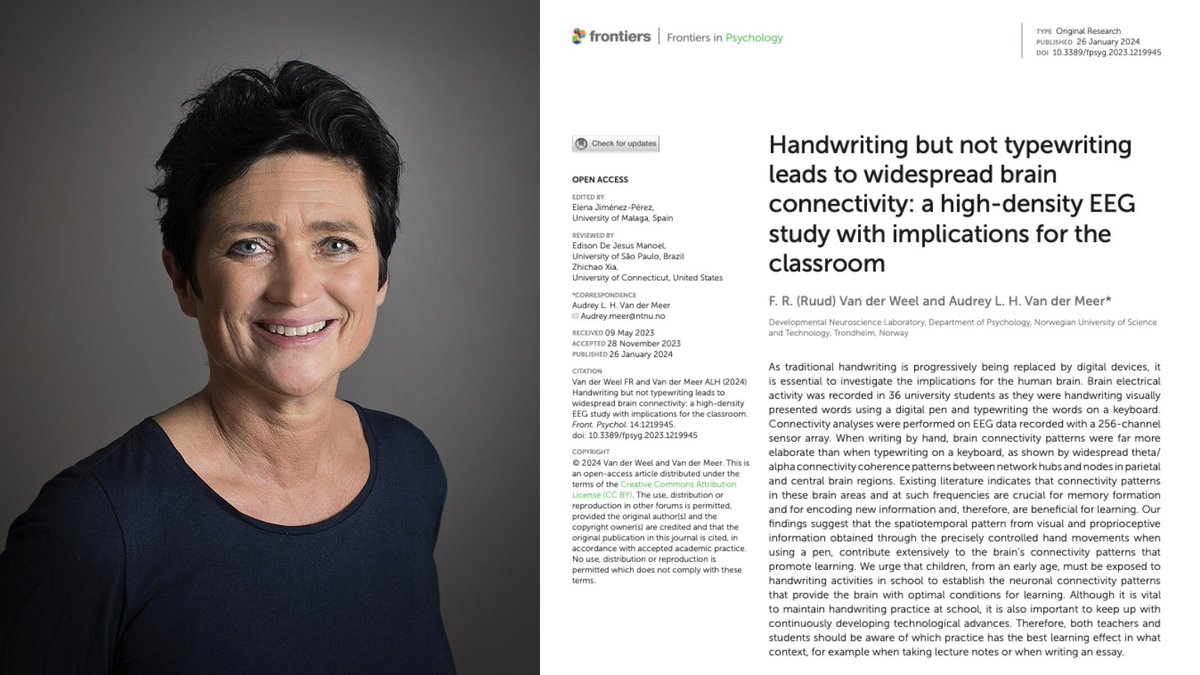
A Norwegian neuroscientist spent 20 years proving that the act of writing by hand changes the human brain in ways typing physically cannot, and almost nobody outside her field has read the paper. Her name is Audrey van der Meer. She runs a brain research lab in Trondheim, and the paper that closed the argument was published in 2024 in a journal called Frontiers in Psychology. The finding is brutal enough that it should have changed every classroom on Earth. The experiment was simple. She recruited 36 university students and put each one in a cap with 256 sensors pressed against their scalp to record brain activity. Words flashed on a screen one at a time. Sometimes the students wrote the word by hand on a touchscreen using a digital pen, and sometimes they typed the same word on a keyboard. Every neural response was recorded for the full five seconds the word stayed on screen. Then her team looked at the part of the data most researchers had ignored for years, which is how different parts of the brain were communicating with each other during the task. When the students wrote by hand, the brain lit up everywhere at once. The regions responsible for memory, sensory integration, and the encoding of new information were all firing together in a coordinated pattern that spread across the entire cortex. The whole network was awake and connected. When the same students typed the same word, that pattern collapsed almost completely. Most of the brain went quiet, and the connections between regions that had been alive seconds earlier were nowhere to be found on the EEG. Same word, same brain, same person, and two completely different neurological events. The reason turned out to be something nobody had really paid attention to before her work. Writing by hand is not one motion but a sequence of thousands of tiny micro-movements coordinated with your eyes in real time, where each letter is a different shape that requires the brain to solve a slightly different spatial problem. Your fingers, wrist, vision, and the parts of your brain that track position in space are all working together to produce one letter, then the next, then the next. Typing throws all of that away. Every key on a keyboard requires the exact same finger motion regardless of which letter you are pressing, which means the brain has almost nothing to integrate and almost no problem to solve. Van der Meer said it plainly in her interviews. Pressing the same key with the same finger over and over does not stimulate the brain in any meaningful way, and she pointed out something that should scare every parent who handed their kid an iPad. Children who learn to read and write on tablets often cannot tell letters like b and d apart, because they have never physically felt with their bodies what it takes to actually produce those letters on a page. A decade before her, two researchers at Princeton ran the same fight using a completely different method and ended up at the same answer. Pam Mueller and Daniel Oppenheimer tested 327 students across three experiments, where half took notes on laptops with the internet disabled and half took notes by hand, before testing everyone on what they actually understood from the lectures they had watched. The handwriting group won by a wide margin on every question that required real understanding rather than surface recall. The reason was hiding in the transcripts of what the two groups had actually written down. The laptop students typed almost word for word, capturing more total content but processing almost none of it as they went, while the handwriting students physically could not write fast enough to transcribe a lecture in real time, which forced them to listen carefully, decide what actually mattered, and put it in their own words on the page. That single act of choosing what to keep was the learning itself, and the keyboard had quietly skipped the choosing and skipped the learning along with it. Two studies. Two countries. Same answer. Handwriting makes the brain work. Typing lets it coast. Every note you have ever typed instead of written went into your brain through a thinner pipe. Every meeting, every book highlight, every idea you captured on your phone instead of on paper was processed at half depth. You did not forget those things because your memory is bad. You forgot them because typing never woke the part of the brain that would have made them stick. The fix is the thing your grandmother already knew. Pick up a pen. Write the thing down. The slower road is the faster one.
Ihtesham Ali tweet media
English
2.4K
44.4K
119.8K
9.7M
DBoeger retweetledi
Amir Khella
Amir Khella@amirkhella·
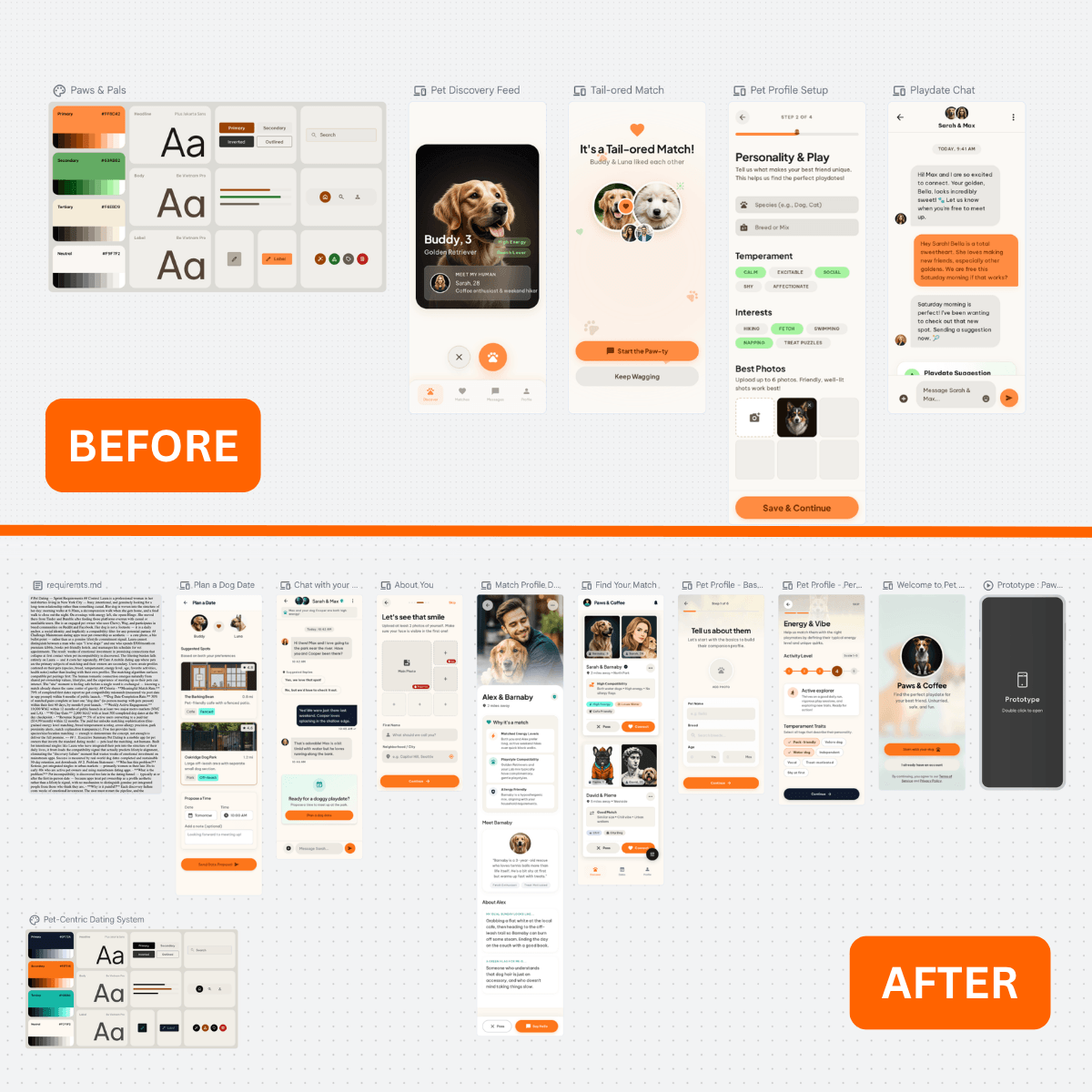
😳 Something crazy just happened! I was showing a few people on a live call how I use #AI for app design. Started with a quick discovery session: The AI took an idea, asked discovery questions, and created high level requirements. I fed it to #Stitch and it created 4 screens 👇
Amir Khella tweet media
English
1
1
1
142
DBoeger retweetledi
Noah Kagan
Noah Kagan@noahkagan·
Replacing yourself SHOULD be the goal. Not the threat. Message I sent to the entire AppSumo team this week:
Noah Kagan tweet media
English
37
11
262
25.5K
DBoeger retweetledi
Yung Lean Brasil
Yung Lean Brasil@yungleanbrasil·
This is already being considered the music video of the year
English
192
1.2K
14.5K
1.3M
DBoeger retweetledi
The Halfway Post
The Halfway Post@HalfwayPost·
BREAKING: A lone Republican member of Congress is finally asking, “Am I crazy, or is Jared Kushner going around making all kinds of secret, personal deals with foreign dictators worth billions of dollars without any Congressional authorization not a textbook example of treason?"
English
360
9.3K
37.6K
357K
DBoeger retweetledi
Mr PitBull Stories
Mr PitBull Stories@MrPitbull07·
Nobody could figure out why the abandoned Hendricks apple orchard suddenly bloomed in April 2019. The trees hadn't produced fruit in eleven years. County agriculture office sent two inspectors. They found sixty thousand honeybees working the property - a massive colony that had escaped from Tomás Vega's apiary three miles south. Tomás had reported the swarm missing in March. He expected them dead. Instead they'd colonized the hollow barn on the Hendricks lot and cross-pollinated every surviving tree. That October, the orchard produced twenty-two tons of Cortland apples. The Hendricks family offered Tomás a permanent lease. He moved his entire operation there the following spring.
Mr PitBull Stories tweet media
English
520
7.8K
40.8K
647K
DBoeger retweetledi
Dr. M.F. Khan
Dr. M.F. Khan@Dr_TheHistories·
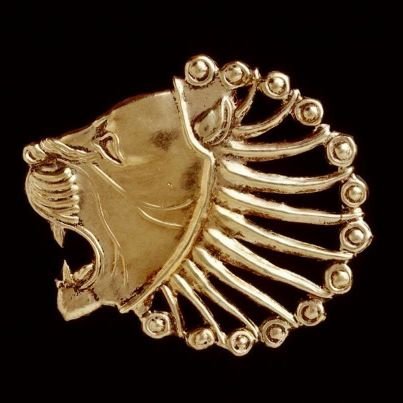
Around 400 BC, Persian engineers built structures that could maintain sub-zero temperatures in the middle of a desert summer. No electricity. No refrigeration. No modern technology of any kind. Just literally physics, geometry, and an extraordinarily sophisticated understanding of how heat moves. The yakhchāl, which translates literally from Persian as ice pit, was an ancient refrigeration structure that allowed the Persian court and eventually broader Persian society to have access to cold food, cold drinks and ice year-round in one of the hottest climates on earth. The above-ground structure was a large domed building, typically built from a heat-resistant mud brick mortar called sarooj made from sand, clay, egg whites, goat hair and ash, thick enough to provide substantial insulation against the desert heat outside. Ice and snow were brought down from the Alborz mountain peaks to the north by runners and pack animals and stored in the yakhchāl through the summer. The ice came from a mountain range via a supply chain that the Persian court had been maintaining for centuries. Today we take for granted the easy ice bag from the gas station, just imagine how rare and expensive these frozen treats were in Ancient Persia. The oldest documented yakhchāl structures date to approximately 400 BC. Some are still standing in Iran today. The largest known examples could store up to 5,000 cubic metres of ice. Sometimes we need to give our Ancient Ancestors a bit more credit. This feat of engineering is incredible. © Eats History #drthehistories
Dr. M.F. Khan tweet media
English
59
1.9K
6K
271.3K
DBoeger retweetledi
Ramit Sethi
Ramit Sethi@ramit·
Some unconventional ways I travel: DO: - I use an SOP (standard operating procedure) document, which includes my airline/seat preferences, what time I prefer to fly/land, when to economize and when to splurge, and more - I add 50% to any hotel sticker price — that's the real cost. $500/night = $750 after taxes, tips, meals, treatment. If that number is too high, shorten the trip or stay somewhere cheaper - Every ~10 days of travel, we have one completely unscheduled day - I send a pre-arrival letter to hotels. My wife and I don't really drink so we'd prefer berries instead of a welcome gift of wine DON'T: - We don't book many high-end food reservations. It's just not for us - Eat food on plane (even business class). True luxury is bringing your own food and walking off a plane feeling great - We never book a trip and show up to "see the sights." Each trip has a theme, how we want to feel, and we focus the travel around that. We pin items ahead of time, then we can be spontaneous while we're there, knowing we'll see a few magical things we've already set an intention for - Treat trips as "once in a lifetime." We know if we love it, we can come back I have more specific ways I travel (next tweet)
English
50
24
913
346.6K
DBoeger retweetledi
Gianl1974
Gianl1974@Gianl1974·
**SHARE THESE PICS BEFORE THEY DISAPPEAR **
Gianl1974 tweet media
English
1.4K
28.2K
35.9K
599.7K
DBoeger retweetledi
Ramit Sethi
Ramit Sethi@ramit·
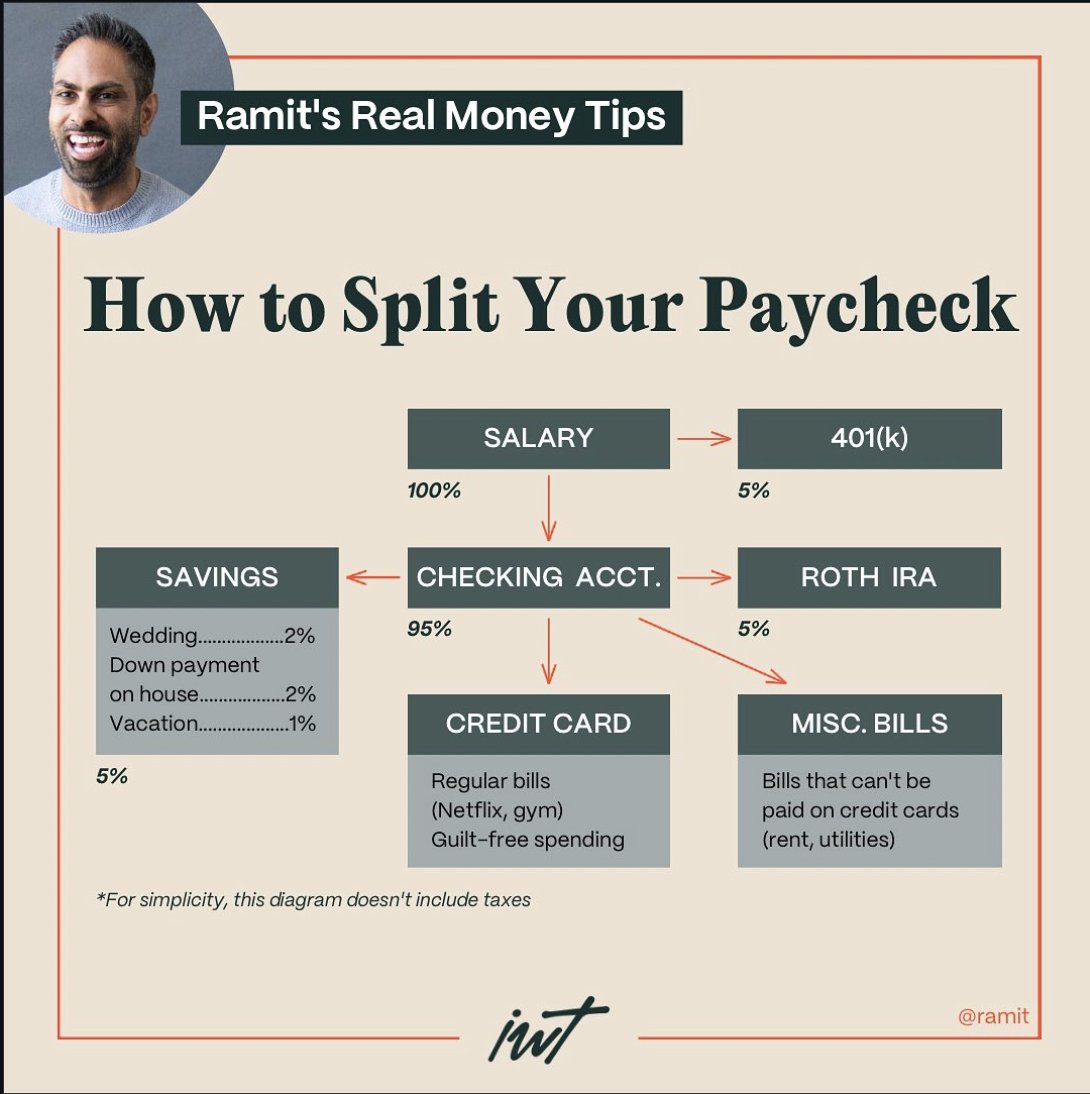
HOW TO SPLIT YOUR PAYCHECK Stop wasting your time sending money to different accounts every pay day. Here’s how to split up your paycheck — to save, invest, and pay bills — automatically. STEP 1 Make sure you have direct deposit set up to deposit into your checking account. If not, set that up right away with your HR rep. STEP 2 Connect your paycheck to your 401(k), so it's automatically funded each month. Even if you already have a 401(k) going, you may have to adjust the amount you contribute every month based on your goals in the Conscious Spending Plan. STEP 3 Set up automatic transfers from your checking account to your savings account. STEP 4 Connect your checking account to your investment account / Roth IRA. (Do this from your investment account, rather than from your bank account.) STEP 5 Connect your credit card to any bills you've been paying via your checking account. (And if you've actually been paying bills by writing checks with a pen, please understand that man has discovered fire and combustible engines and join our modern times.) STEP 6 Then, set it up so that your credit cards are paid from your checking account. (This is set up from your credit card's "Transfer" or "Link Accounts" page.) STEP 7 Some bills, like rent and loans, can't be paid using a credit card. Link these regular bills to your checking account. (Do this by logging in to the company's website and initiating the transfer from your checking account to the company.) Spend time this weekend setting up your system so every paycheck gets split automatically — so you can spend time LIVING your Rich Life. You can learn more about money automation in chapter 5 of my book. If you’ve already set up your automatic money system, how has it affected your life? Let me know below.
Ramit Sethi tweet media
English
10
20
194
21.5K
DBoeger
DBoeger@dboeger·
@LakotaMan1 I can see you. Kerp fighting the good fight.
English
0
0
0
2
Lakota Man
Lakota Man@LakotaMan1·
So, myself and other left wing Twitter accounts are being censored by Elon Musk. Please, tell me, do you see this tweet? Can you see me?
English
4.9K
3.7K
30K
210.4K
DBoeger retweetledi
Warren English
Warren English@TheWarEnglish·
High blood pressure is the most misunderstood yet dangerous health condition. Meds don't even work consistently for 71% of people. Here are 7 foods scientifically proven to lower it naturally without side-effects (bookmark this): 🧵 1. Dark chocolate
Warren English tweet media
English
19
107
488
200.5K
DBoeger retweetledi
Lakota Man
Lakota Man@LakotaMan1·
Your daily reminder that Native Americans weren’t granted citizenship, of our own land, until the until Indian Citizenship Act was passed in 1924.
Lakota Man tweet media
English
464
6.1K
19.7K
322.8K
DBoeger retweetledi
Ethical American
Ethical American@AmericanEthical·
This is one of the best Saturday Night Live skits ever! Americans are waking up! #maga #TrumpWarCrimes
English
238
2.1K
15.1K
430.8K
DBoeger retweetledi
Then/Now
Then/Now@xThen_Now·
99 % of car owners don't know about these features...
English
4
40
228
46.6K
DBoeger retweetledi
Boston Radio Watch®️
Boston Radio Watch®️@bostonradio·
37 years ago tonight, April 1, 1989, Corey Glover and Living Colour performed “Cult of Personality”(1988) on NBC’s Saturday Night Live. The song peaked at #13 on Billboard’s Hot 💯.
English
335
2.1K
12.6K
557.5K
DBoeger retweetledi
Tolkien Universe
Tolkien Universe@tolkienzone·
Some biologists have discovered this strange tree in New Zealand. According to experts, it is heading to Isengard to destroy Saruman.
English
353
3.3K
29.1K
595.7K