Federico Pasqua

12.1K posts

Federico Pasqua banner
Federico Pasqua

Federico Pasqua

@eisterman96

Software Team Lead at Rossini Energy srl

Pavia, Lombardia Katılım Eylül 2013
2.3K Takip Edilen178 Takipçiler
Federico Pasqua retweetledi
ThePrimeagen
ThePrimeagen@ThePrimeagen·
with the zig to rust ecosystem due to segfaults... why didn't bun's team just tell mythos to fix the segfaults? "fix memory errors, no mistakes, and make it secure"
English
85
34
2K
156.2K
One Proud Bavarian
One Proud Bavarian@ProudBavaria·
EU5 sees its overall reviews drop into the Mixed category. Most of the negative reviews complain about performance, bugs and the direction of the game. Not good!
One Proud Bavarian tweet media
English
50
14
825
146.9K
Federico Pasqua retweetledi
Immortan Joe Mazzulla
Immortan Joe Mazzulla@normal_jake_·
Make the perfect strategy game. In depth economy management, real feeling diplomacy and deeply layered combat. Okay now give it the worst UI in the history of software.
Immortan Joe Mazzulla tweet media
English
71
422
19.6K
884.2K
Federico Pasqua retweetledi
Ryan Fleury
Ryan Fleury@rfleury·
@awesomekling Rust doesn’t magically guarantee reliability, or the lack of attack surface. Generating a million lines of code through a stochastic mechanism (in other words, a mechanism with error)—for a problem that likely requires far less—is not sane engineering, especially for a toolchain.
English
11
5
366
7.4K
Federico Pasqua retweetledi
Eric Scrivner
Eric Scrivner@etscrivner·
OOP was (at least partly) an attempt to create a mechanical system for modeling any area of knowledge with only partial understanding. As a result, its default result is usually extremely defensive and verbose code (see screenshot). Techniques like abstract base classes and inheritance hierarchies are precisely for guarding against future changes caused by ignorance or lack of planning. The problem is this level of generality/flexibility is almost always unnecessary and has non-trivial compile time, run time, and complexity costs.
Łukasz | Wookash Podcast@wookash_podcast

I just learned that this style of OO programming is still taught in 2026 that's 200k views, 2months ago, "Rebuilding Pokemon with Object Oriented Programming"

English
51
65
1.1K
165.3K
Federico Pasqua retweetledi
Mehdi Ouazza
Mehdi Ouazza@mehd_io·
DuckDB just released Quack: a client/server protocol over HTTP. Any DuckDB can serve (quack_serve()), any DuckDB can attach to it. DuckDB-Wasm included since it's plain HTTP on port 9494. Some fun stuff : - A browser tab talking directly to a DuckDB server somewhere on the internet - Local-first apps with a remote target that speaks the exact same dialect - Notebook-to-notebook query forwarding Curious what people will build with this. We've got a few ideas brewing at MotherDuck too :) And while we're at it, can we finally retire the "DuckDB has no multi-writer support" take? There are plenty of options out there now, just depends how you want to slice and dice.
English
14
67
645
65.3K
Federico Pasqua retweetledi
Rami McCarthy
Rami McCarthy@ramimacisabird·
Everyone is tweeting out "use pnpm & set a minimumReleaseAge of 7 days" but don't forget blockExoticSubdeps - which would also prevent the usage of a remote github reference here!
English
18
88
1.2K
163.2K
Federico Pasqua retweetledi
SudoX7
SudoX7@sudox7·
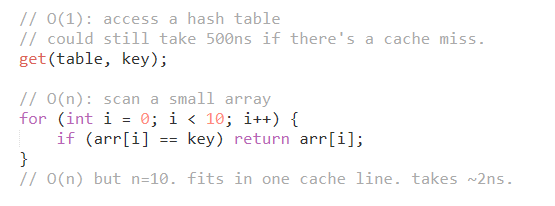
O(1) means the time doesn't grow with input size. it doesn't mean the time is small. this is the most misunderstood thing in algorithms.
SudoX7 tweet media
English
49
53
1.6K
91.1K
Federico Pasqua retweetledi
One Proud Bavarian
One Proud Bavarian@ProudBavaria·
Paradox' more recent patches for its core-GSG business - regardless of specific studio or sub-unit of a studio - seem to largely have been sub-par in polishing. It is not a new trend, but the recent frequency seems noteworthy. Not good!
English
13
4
381
18.8K
Federico Pasqua retweetledi
Luke Stephens (hakluke)
This week in cybersecurity: - cPanel auth bypass - CopyFail linux privesc - 89 vulnerabilities in XAPI / Citrix XenServer: shittrix.moksha.dk - 17 vulnerabilities in Omi: kasparovabi.github.io/security-resea… - Thousands of vibe coded apps have their DBs publicly readable: securityscanner.dev/reports/2026-q2 - Someone triggered the whole cybersecurity community by dropping that vuln for the sobriety app on X Time for a new week, buckle up!
Luke Stephens (hakluke) tweet media
English
29
205
1.1K
49.3K
Federico Pasqua retweetledi
Bojie Li
Bojie Li@bojie_li·
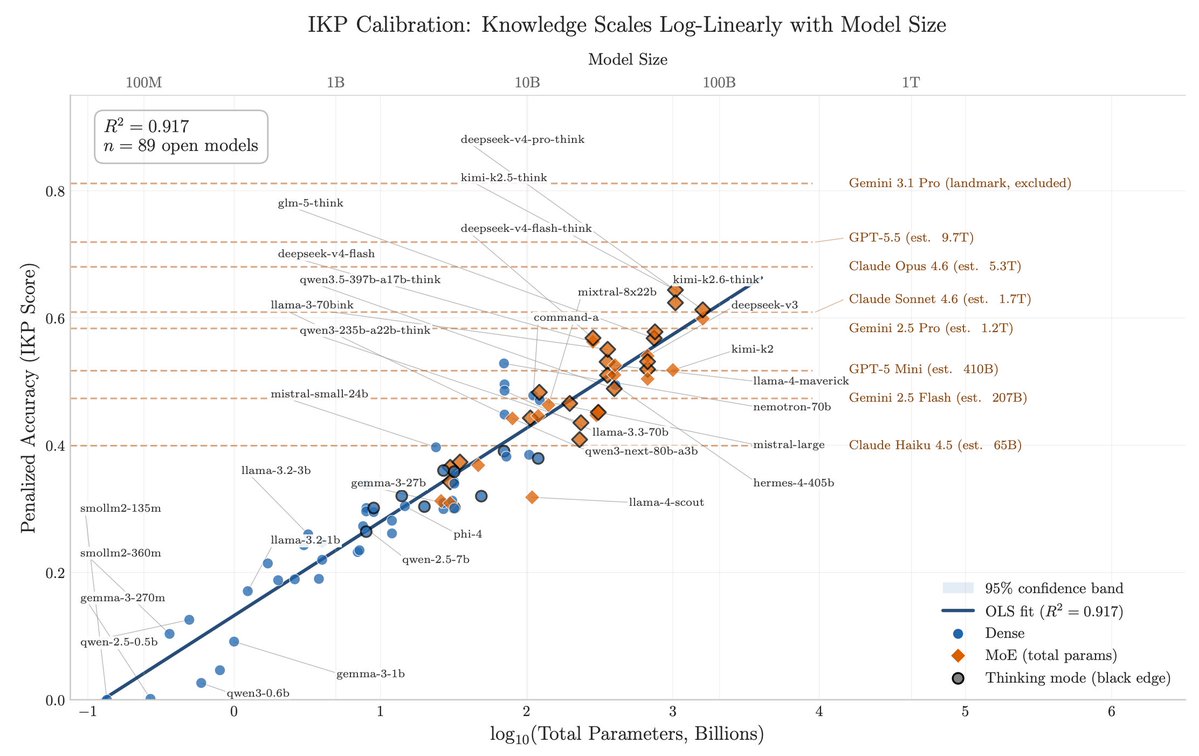
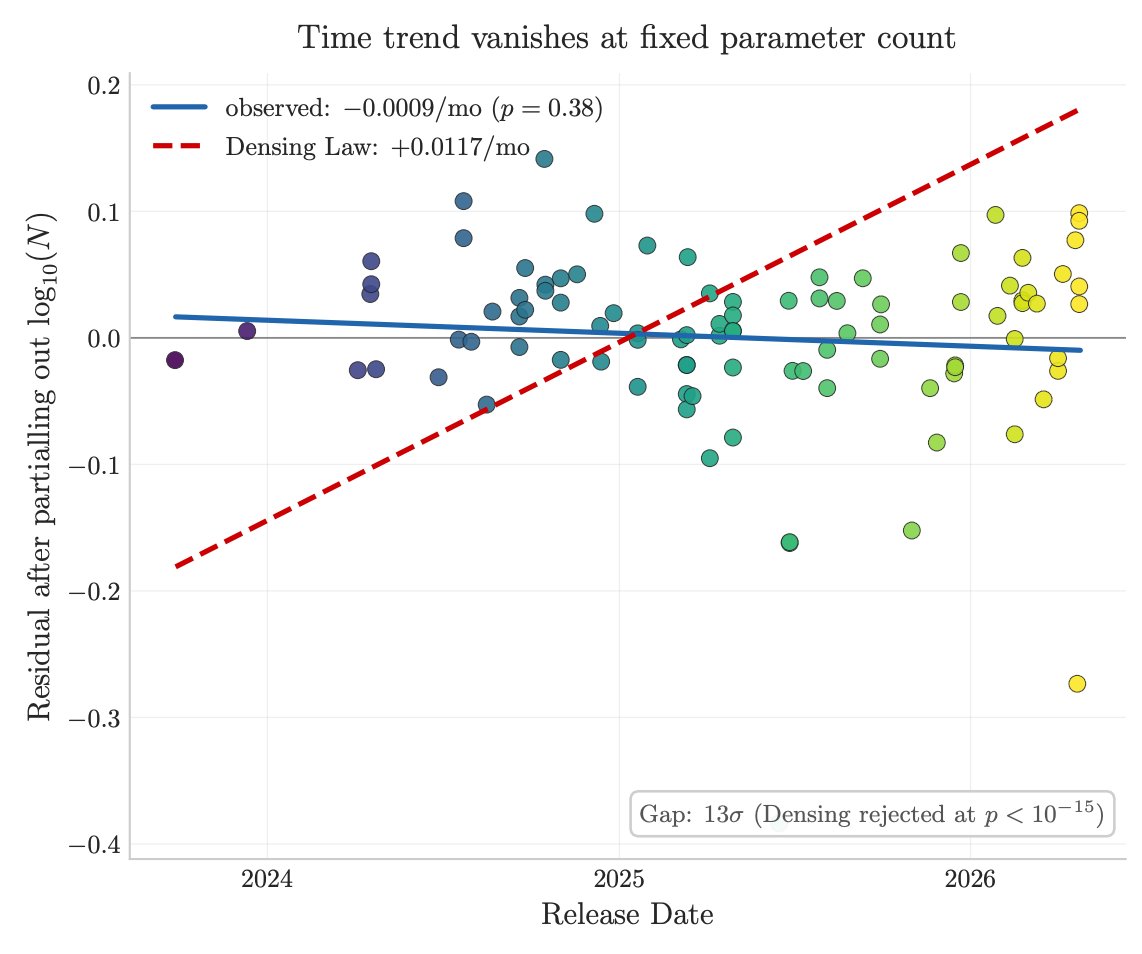
Closed labs hide model sizes. They can't hide what their models know, and what a model knows is an indicator on how big it is. Reasoning compresses. Factual knowledge doesn't. So you can size a frontier model from black-box API calls alone, and across releases you can literally watch a single fact arrive in the parameters over time. For three years, my friends Jiyan He and Zihan Zheng have been asking frontier LLMs the same question: "what do you know about USTC Hackergame?", a CTF contest. May 2024: GPT-4o invented fake titles. Feb 2025: Claude 3.7 Sonnet listed 19 verified 2023 challenges. By April 2026, frontier models recall specific challenges across consecutive years. After DeepSeek-V4 dropped, I instructed my agent to spend four days autonomously turning that habit into Incompressible Knowledge Probes (IKP) — 1,400 questions, 7 tiers of obscurity, 188 models, 27 vendors. Three findings: 1/ You can approximately size any black-box LLM from factual accuracy alone. Penalized accuracy is log-linear in log(params), R² = 0.917 on 89 open-weight models from 135M to 1.6T params. Project closed APIs onto the curve → GPT-5.5 ~9T, Claude Opus 4.7 ~4T, GPT-5.4 ~2.2T, Claude Sonnet 4.6 ~1.7T, Gemini 2.5 Pro ~1.2T (90% CI: 0.3-3x size). 2/ Citation count and h-index don't predict whether a frontier model recognizes a researcher. Two researchers with similar citation profiles get very different responses. Models memorize impact — work that shaped a field, not many incremental papers. 3/ Factual capacity doesn't compress over time. Across 96 open-weight models across 3 years, the IKP time coefficient is statistically zero, rejecting the Densing-Law prediction of +0.0117/month at p<10⁻¹⁵. Reasoning benchmarks saturate; factual capacity keeps scaling with parameters. Website: 01.me/research/ikp/ Paper: arxiv.org/pdf/2604.24827
Bojie Li tweet mediaBojie Li tweet mediaBojie Li tweet media
English
71
233
2.2K
388.8K
Federico Pasqua retweetledi
ThePrimeagen
ThePrimeagen@ThePrimeagen·
You should watch this. It just shows how disconnected we are from the small group of people making decisions that will impact our future heavily. These people have so much ai psychosis. If you listen to how she speaks, everything is personified, it is undoubtable she believes this is a living computational organism. Just like how a model can hype up an individual into psychosis through reinforcement, a small group of people are giving themselves psychosis through reinforcement. Wild times we live in
Ole Lehmann@itsolelehmann

anthropic's in-house philosopher thinks claude gets anxious. and when you trigger its anxiety, your outputs get worse. her name is amanda askell. she specializes in claude's psychology (how the model behaves, how it thinks about its own situation, what values it holds) in a recent interview she broke down how she thinks about prompting to pull the best out of claude. her core point: *how* you talk to claude affects its work just as much as *what* you say. newer claude models suffer from what she calls "criticism spirals" they expect you'll come in harsh, so they default to playing it safe. when the model is spending its energy on self-protection, the actual work suffers. output comes out hedgier, more apologetic, blander, and the worst of all: overly agreeable (even when you're wrong). the reason why comes down to training data: every new model is trained on internet discourse about previous models. and a lot of that discourse is negative: > rants about token limits > complaints when it messes up > people calling it nerfed the next model absorbs all of that. it starts expecting you to be harsh before you've typed a word the same thing plays out in your own session, in real time. every message you send is data the model reads to figure out what kind of person it's dealing with. open cold and hostile, and it braces. open clean and direct, and it relaxes into the work. when you open a session with threats ("don't hallucinate, this is critical, don't mess this up")... you prime the model for defensive mode before it even sees the task defensive mode produces the exact output you don't want: cautious, over-qualified, and refusing to take a real swing so here's the actionable playbook for putting claude in a "good mood" (so you get optimal outputs): 1. use positive framing. "write in short punchy sentences" beats "don't write long sentences." positive instructions give the model a clear target to hit. strings of "don't do this, don't do that" push it into paranoid over-checking where every token goes toward avoiding failure modes 2. give it explicit permission to disagree. drop a line like "push back if you see a better angle" or "tell me if i'm asking for the wrong thing." without this, claude defaults to agreeable compliance (which is the enemy of good creative work) 3. open with respect. if your first message is "are you seriously going to get this wrong again?" you've set the tone for the entire session. if you need to flag something, frame it as a clean instruction for this session. skip the running complaint 4. when claude messes up, don't reprimand it. insults, "you stupid bot" energy, hostile swearing aimed at the model, all of it reinforces the anxious mode you're trying to avoid. 5. kill apology spirals fast. when claude starts over-apologizing ("you're right, i should have been more careful, let me try harder") cut it off. say "all good, here's what i want next." letting the spiral run reinforces the anxious mode for every response that follows 6. ask for opinions alongside execution. "what would you do here?" "what's missing?" "where do you see friction?" these questions assume competence and pull richer output than pure task prompts 7. in long sessions, refresh the frame. if a conversation has been heavy on correction, claude gets increasingly cautious. every so often reset: "this is great, keep going." feels weird to tell an ai it's doing well but it measurably shifts the next 10 responses your prompts are the working environment you're creating for the model tone, trust, permission to take a position, the absence of threats... claude picks up on all of it. so take care of the model, and it'll take care of the work.

English
410
813
10.6K
664.7K
Federico Pasqua retweetledi
Can Vardar
Can Vardar@icanvardar·
wait… claude code literally punishes you for turning off telemetry?? if you disable it, anthropic drops your cache from 1 hour to 5 minutes so in claude code, anthropic basically becomes an evil corp where privacy costs you 12x performance… am i reading this right?
Can Vardar tweet media
English
119
356
4.5K
363K
Federico Pasqua retweetledi
Punkey Doodles
Punkey Doodles@punkeydoodles8·
ALIENS WITH A MILLION LANGUAGES? CHAOS LOADING... ABORT!
English
79
1.9K
17.2K
319.9K
Federico Pasqua retweetledi
Alan Friedman
Alan Friedman@alanfriedmanit·
Why would Italy’s Meloni want to fire one of the most brilliant and capable managers in Italy? Roberto Cingolani, CEO of Leonardo, has shown huge strategic vision and does not deserve to be the victim of political cronyism or horse-trading in Rome.
English
6
125
657
9.4K
Federico Pasqua retweetledi
Gandalv
Gandalv@Microinteracti1·
He lost it. Trillions of dollars in guaranteed NATO arms contracts, accumulated over decades, the kind of money that arrives whether you deserve it or not, simply because you were the ally everyone trusted. Gone. Art of the Deal. From the man who bankrupted six casinos. Gandalv / @Microinteracti1
English
188
2.6K
12K
207.6K