British Strategic Review

2.4K posts

British Strategic Review

British Strategic Review

@ekonomissed

Independent economic analysis to identify options for sustainable national strategies and policies.

London, England Katılım Ekim 2022
57 Takip Edilen54 Takipçiler
Hector Wetherell McNeill
Hector Wetherell McNeill@HectorWMcNeill·
Yes, the RIO-3P package was conceived in the period 1975-1976, initially analysing conventional policy failures to address stagflation . The first draft waspublished by INTERCOMEX Intercambio Internacional de Mercadorias (International Commodity Exchange), Rio de Janeiro, Brazil in 1976 and entitled, "Price Performance Fiscal Policy - A Real Incomes Approach". I subsequently removed "Fiscal" from the subsequent titles (except the 1981 monograph circulated to the main political parties) .
English
1
0
1
30
Hector Wetherell McNeill
Hector Wetherell McNeill@HectorWMcNeill·
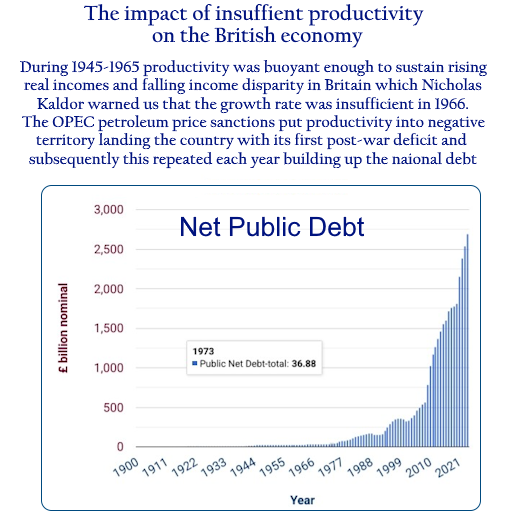
MAKING PRODUCTIVITY WORK FOR BRITAIN Although the greater part of the solution to Britain's economic problems, including lowering the national debt, is to raise productivity, it is important to identify how to maximise the impact of productivity on our real incomes based growth. I refer to real incomes based growth to register the fact that growth requires: 1. A quantitative measurement of identified factors that increase the purchasing power of disposable incomes. 2. Mechanisms or policy instruments to bring this change about. MEASURING BASELINE PRODUCTIVITY The standard measurement of productivity is the quantity or value of output of a process per person each hour or total factor productivity as the quantity or value of output of all factors of production in a reference period. PRODUCTIVITY IMPACT The impact of the productivity of individual companies on the economy depends upon the quality of output and unit pricing decisions. By absorbing the gains from productivity such as reduced unit costs, by augmenting profits, shareholder value and executive bonuses can even mean inflationary output lowering the purchasing power of consumers. Lately some economists have associated this practice with the term “greedflation”. On the other hand, there is the option of taking advantage of lower unit costs to translate these into lower counter-inflationary prices benefitting consumers. Most inflation is cost-push inflation (I can cover this I another post) which has created the phenomenon of anticipatory pricing on the part of companies. This involves an automatic but logical financial response of the raising of output prices to compensate for rising costs to maintain profits, remain in business and safeguard employment as well as to build up cashflow in order to be able to afford the next period's production input requirements facing rising prices. In order for productivity to translate through into counter-inflationary pricing i.e. to reduce inflation or reduce prices absolutely, the unit price responses to rising input prices need to rise at a lower rate or in the opposite direction i.e. fall. This will reduce the margins per unit of output but generate higher purchasing power for consumers and a rise in their real disposable incomes. This is only possible if changes in productivity lower unit costs. Therefore, policy needs to provide incentives for companies to introduce changes to lower unit costs and to set prices at more competitive levels. Although reducing prices reduces margins this needs to be traded-off against higher sales volumes which result from the rise in consumption of lower priced goods. The quantitative measure of the degree to which total sales increase as a function of lowering unit prices is expressed or measured by the income-price elasticity of demand (ipEd) which measures the percentage rise in numbers of units sold as a result of a percentage fall in unit prices. The deciding factor is often the differences in the perceived quality and utility of goods or services concerned. This has become an important factor in the increasingly competitive ITC products such as mobiles. The advantage of lowering unit prices and raising quality is the resulting rise in market share nationally as well as facilitating sales abroad as exports and increasing sales through import substitution. THE PURCHASING POWER OF THE POUND In summary while there is much talk about “growth” which is afforded little support in terms of clarity of what this is, the fundamentally important process of growth is characterised by a rise in the value of the pound resulting from the British economy using productivity to eliminate inflation. This can raise the real incomes of the whole population because the pound in people’s pockets can purchase more goods and services because they are more accessible in terms of price. Unfortunately, the Bank of England’s management of monetary policy has witnessed a complete inability to eliminate inflation with the inflation rate between 1945 and now (2025) averaging roughly 3% or a 27% devaluation for each decade over the last eight decades. Clearly the purchasing power of the pound has been declining and this is because the monetary policy decision cycles have depressed growth because of austerity which has discouraged investment and rising productivity. WHY IS THERE AUSTERITY? Austerity has been a characteristic of monetary policy decision cycles because of the flawed monetary theory which makes use of interest rate rises to lower inflation. The impact of this is to raise financial costs thereby lowering purchasing power and real incomes of constituents creating difficult more austere conditions. Other attempts to stem inflation involve raising tax rates which have exactly the same effect as interest rates of reducing disposable incomes and therefore reducing real incomes. WHY IS INFLATION AN ISSUE? Inflation is a problem because it erodes the value of the currency and real incomes and yet the very policy instruments used to combat inflation, interest rates and taxation, only exacerbate the state of affairs by reducing real incomes still further during repetitive bouts of austerity. A BETTER WAY TO PROTECT REAL INCOMES After 50 years of a failure to eliminate inflation and prevent the drastic depreciation in the value of the pound it has become apparent that monetary and fiscal policies cannot control inflation without damaging real incomes. By far the most effective way to protect the value of he pound and real incomes is through productivity and a proactive management of price-setting to expand the growth in sales of better quality goods and services with more competitive prices since all constituents, including workforces, benefit. The issue is, however, to balance the returns to the constitutional actors of the state in terms of a higher value tax base, higher real incomes for society, adequate compensation for economic unit ownership and workforces and for the individual. The policy which aims to distribute the benefit of growth automatically through these constitutional actors has to be a constitutional economic policy. REAL INCOMES OBJECTIVE PRICE PERFORMANCE POLICY (RIO-3P) The only macroeconomic policy specifically designed to distribute the benefits of growth in a constitutional economics manner of RIO-3P. Price Performance Policy uses an indicator the Price Performance Ratio (PPR) to measure the effectiveness with which a company is able to exert control over output prices in relation to changes in input prices, thus, “price performance”. The higher the gains in standard measures of productivity the more able is a company to effectively reduce output prices and reduce inflation while augmenting consumer real incomes. In order to encourage a maximization of price reductions while ensuring margins are high enough to generate a compensatory income through the rise in sales (through the leverage of the income price elasticity of demand) corporate taxation is replaced by a Price Performance Levy (PPL) which provides rebates according to the value of the PPR attained. Basically, the lower the PPR value below unity (PPR<1.00) the greater the effective reduction in prices arising from productivity and therefore the greater the rebate or levy not paid. This leaves the companies with a better performance with higher net-of-Levy margins and significantly raised sales volumes. This costs the government nothing but the uncollected levy ensures a rising growth rate and state of national income making government policy the catalyst for a high growth rate free from austerity. Clearly the impact is for larger quantities of better quality and lower price goods and services to be sprung into the national market leading to a counter-inflationary growth in purchasing power and real incomes impacting all constituents and constituent actors by raising the purchasing power of their money holdings, including the tax base and state revenues. NATIONAL DEBT Our national debt saga, in terms of peacetime operations, started in 1973 when within 4 months of October in that year OPEC raised the price of petroleum and 6,000 derivatives used by all sectors of the economy by 290% of the pre-October price following a 70% rise in October. This resulted in an impossible to avoid plummet in productivity which endured several years in terms of its impact which was stagflation (rising inflation and unemployment) creating the very first borrowing requirement and deficit. From then on productivity, because of inappropriate monetary and fiscal policies has never recovered sufficiently to prevent annual deficits and the accumulating national debt. With the declining policy-induced devaluation of he pound the tax base and revenues have lost purchasing power. A diagram below shows this growth in national debt arising from this impact of the OPEC 1973 price embargo. This diagram does not include the two war debts, it only shows peacetime performance. REDUCING NATIONAL DEBT RIO-3P is the only macroeconomic policy which can alleviate the quandary of attempting to secure growth and reduce the national debt at the same time. This is quite impossible with the overbearing impact of monetary and fiscal policies whose dual impact is to lower growth and impede the rise in real incomes. A FINAL MESSAGE The link below is to Kaldor’s growth laws where we have added information on the additional benefits of productivity and RIO-3P, which can go a long way to solving a range of issues facing the British economy including the following benefits: · Decline or elimination of inflation · Increased price accessibility of goods and services · Rising real incomes across the board without changes in nominal incomes · Rise in the purchasing power of: o Wages o Savings o Corporate cash flow o Corporate margins o The tax base o Government revenue · Declining poverty · Rise in the value of the currency and its purchasing power · Rise in import substitution · Rise in exports · Rise in the balance of payments · Reduction in the “borrowing requirement” · Reduction in deficits · Reduction in national debt I also provide a link to a more detailed coverage of RIO-3P recently released. Kaldor’s growth laws and impact of RIO-3P: boolean.org.uk/library/Kaldor… RIO-3P more detailed recent release: boolean.org.uk/library/Real_I…
Hector Wetherell McNeill tweet media
English
3
0
0
173
British Strategic Review
British Strategic Review@ekonomissed·
@HectorWMcNeill It is somewhat disappointing that this practical solution to Britain' s significant productivity gap or deficit was first proposed in 1976, if I am correct. The existing schools of economic thought all appear to have missed this completely
English
2
0
0
20
Hector Wetherell McNeill
Hector Wetherell McNeill@HectorWMcNeill·
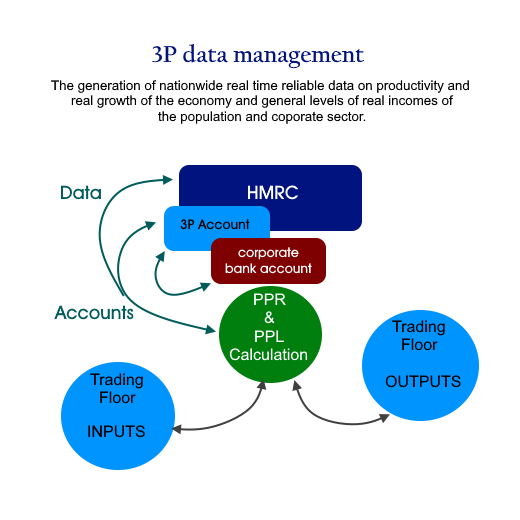
Yes this point came up in feedback on the approach to RIO-3P as far back as 1981 largely from management consultants and a specific well-informed politician. In order to address this problem SEEL-Systems Engineering Economics Lab was set up to monitor applications on global networks in 1983. This was before W3 (the World Wide Web) and since then all forms of IT development solutions have been monitored and assessed. The solution is a cloud-based standard but highly adaptable to corporate input and output profiles by operating with "trading floors" for procurement (inputs) and sales (outputs) somewhat like the Amazon system. The Price Performance Ratio (PPR) is calculated automatically based on production line component profiles and associated sales, minus inventories made in any accounting period. A separate unit calculates the Price Performance Levy in real time to determine rebates or surcharges, again in real time so settlement is also in real time. For security the transaction records are reorded on Accumulogs which are block-chain type immutable records which prevent fraud but also safeguard corporate interests when any mistakes might be made in associated calculations or misallocations of inputs etc because of changes process input profiles. Normally any changes would be notified before they take place through process data profile updates. Additional optimization software would provide guidance to managers to maximise returns based on the simulation of the impacts of any projected prices on expected sales volumes associated with the income-price elasticity of demand, the expected margins net of the Price Performance Levy which depends upon the final PPR. These optimization applications are esentially operations research apps which today increasingly benefit from AI to arrive at final optimised options more quickly. As explained the PPR depends upon the degree of response of output prices to changes in input costs. The significant difference is that the tax authorities become agents in assisting companies become more competitive through a positive incentive. This can actually reduce levies as productivity rises and unit output prices decline generating a rise in constituent and workforce purchasing power and real incomes. In other words policy stimulates more rapid and generalised growth. The most important aspect is that unlike any other policy instruments PPRs are set by companies and these determine the Price Performance Levy (PPL) to be paid. No other policy provides this degree of risk-free freedom for companies to adapt to policy instrument values because companies can set these themselves in a way that contibutes to national growth. The government is not involved in the "calculation" issues because it does not possess the knowledge required to account for every company's circumstances. In term of security and counter-fraud standards, this is only possible with the appropriate data management support which in basic terms is increasingly transparent and with the evolution in IC technologies during the last periods is more robust and reliable.
English
2
0
0
32
British Strategic Review
British Strategic Review@ekonomissed·
@HectorWMcNeill @MsParaDoxy Hector McNeill raises important strategic questions in this post pointing to serious trends in political party orientations and operational structures. He articulated this in his book, "The Briton's Quest for Freedom, Our unfinished journey..." published in 2007 by HPC.
English
0
0
0
11
Hector Wetherell McNeill
Hector Wetherell McNeill@HectorWMcNeill·
@MsParaDoxy provided a link: ineteconomics.org/perspectives/b… to an article by Lyn Parramore entitled, "Meet the Hidden Architect Behind America's Racist Economics" which informs of the research of Nancy MacLean into the lesser known activities of James Buchanan, the developer of constitutional economics. I just noticed this because my own work is an extension of constitutional economics. Constitutional economics asserts that economic policy should support the interests of the state, society, economic units and individuals on the basis of agreeing moral laws and regulations in the form of public goods developed and agreed upon in a participatory manner on the basis of public choice. This spells out seemingly perfect elements and a structure for the operation of a democracy. It is also a fact that Buchanan openly expressed his cynicism of the motivations of representatives of any group or institution in a country being totally self-serving as opposed to the imagined upholding of mutual shared interests and, of course, those of constituents, the voting public. I, personally, took that to reflect a certain realism on Buchanan's part without realising that, according to Nancy MacLean, Buchanan had become financially supported by the Koch brothers to promote the interests of large corporations and coal industries, discrediting advancing environmental knowledge. But this involvement went a lot further. While Milton Friedman openly assisted the Pinochet government, Buchanan, apparantly did so in secret. Besides a worrying list of actual government cut backs in the USA resulting from heavy lobbying, the more insidious technique used to undermine democracy was to bring politicians into line and change the operational structures of political parties to serve large corporate benefactors as opposed to constituent needs. I would add that the phenomenon of Pacs has exacerbated the state of affairs. This is already a reality explaining a 12 years streak of inaction by the Conservatives and expulsion of One Nation MPs, and now, an even more than evident inability to respond to needs in a rational manner by the current Labour government. The 5th column working against the true interests of constituents are the very institutions for whom we vote, political parties. As Buchanan stated, their motivation is not what is on the label or what they put in their manifesto promises, they seek power to be gained by media support funded by their corporate benefactors to enjoy the status and compensation they desire frequently at odds to constituent interests. This is a warning for our opposition parties in the UK to beware of emphasising too much "trust in government" when, in reality there is no control over political parties who will take governmental decisions and allocate national public resources. Don't be misled. This danger applies equally to the economic paradigms of Keynesianism, monetarism and MMT. In 2007, I wrote a book favouring "politics without parties" or a system that supports independents as a way to dismount the unconstitutional influence of large corporations and to uphold the best tenets of constitutional economics. I thought this was an essential condition to avoid extremes 18 years ago. Today it has become an imperative. Along the same lines it is unlikely that large corporations will respond to calls to terminate lobbying and financial influence. On the other hand, the reality is that most of our employment and output is in the hands of over 5 million independent SMEs whose generally depressed circumstances are very much the result of inadequate financial services by the big 5 banks. As a result 80% are averse to external financial support for investment because of the perceived risks, resulting in difficulties in securing growth in productivity and higher incomes. Monetary policy which serves the interests of larger organizations while regularly creating a cycle of bouts of austerity inhibiting the ability to secure higher SME growth. Already the government is directly attacking the rural SME sector, farms, with an inheritance tax that will "preserve" higher cost and less efficient smaller farms while creating smaller higher cost operational units of larger farms forced to downsize and sell land to pay the exorbitant tax. This simply creates the ideal state of affairs for large hedge funds to asset strip the sector as inflation continues to maintain a diminishing terms of trade in agriculture of rising prices and stagnant ouput prices. This trend, over time, will put all of the smaller units out of business. The required policy is land consolidation initiatives. Just as I feel political independents hold out hope for our future, the solution seems to be to combine forces with the most independent compontents of the supply side economy in the form of SMEs. The coming period is one destined to involve the need for transparency, a banishment of naivity and application of hardheaded decisions to reap the rewards and promise of a participatory democracy upholding a constitutional economics.
English
4
0
0
62
Harriet Cross MP
Harriet Cross MP@HarrietCross_MP·
Since imposing the Family Farm and Family Business Tax, the Government have told farmers & business owners to "get their affairs in order". What they meant was to rely on the 7-year rule for Inheritance Tax transfers. 🥀Now we hear reports they are to remove this lifeline. 1/2
English
20
125
578
67.9K
Hector Wetherell McNeill
Hector Wetherell McNeill@HectorWMcNeill·
Good letter. But also stating farming is almost irrelevant to the British economy is absurd. Considerting that the productivity of the sector employing just 1.4% of the working population, or abour 450,000 inidviduals provide cheap primary food produce supporting the population of around 68 million with at least 54% of their food intake. The income and productivity of the sector and relevance to the rural economy could be increased significantly through marketing boards creating more vertical integration to take a larger share of the food industry income. Britain's food industry is the largest processing/manufacturing sector in the country worth over £160 billion. The passing reference to the farm inheritance tax overlooks the permanent economic damage this will inflict on the sector in the formof higher operational costs and a rise in bakruptcies. This is because the sector, as a result of a failure of macreoconomic and monetary policies to eliminate inflation have resulted in the agricultural sector facing a diminishing terms of trade caused by constanrtly rising input prices (costs) and stagnant output prices in a buyers' market. The result is a constant downward trend in real incomes of farms while the very same policies have resulted in significant rises in land prices, to levels wellabove the investment value. This has resulted in farms recording returns on assets on 0.5%. The fundamental law of agricultural sector growth is that with each generation farm areas should be increased in order to ensure that the real income levels of compensation can remain stable. However, the farm inheritance legislation will "protect" smaller less efficient higher cost farms which are likely to go bankrupt if their areas are not increased as a result of the continuing diminishing terms of trade. To add insult to this injury the farm inheritance tax will impact larger more efficient farms by forcing them to sell land and down size in order to pay the exorbitant tax resulting in higher cost operations on the resulting smaller units. Notice the inheritance tax is based on the bloated market price of land rather than it s investment value and, inspite of this, the government expects this to be paid using the very diminished annual income. In absolute terms this will also guarantee that the capacity for production of the sector will be increasingly eroded as a direct result of this legislation, undermining the feasible percentage of production of food consumption produced in this country. This will make the country more reliant on imports and make any notions of a national sustainable food strategy an impossibility. It is regrettable that The Economist has resorted to publishing a political piece that reflects a very poor understanding of agricultural economics.
English
1
0
5
278
British Strategic Review
British Strategic Review@ekonomissed·
By far the most coherent practical policy propos has been advanced by the economist @HectorWMcNeill who developed RIO-Real Incomes Objective economic's Price Performance Policy (3P) a productivity-based counter inflation solution. 2/2
English
0
0
0
11
British Strategic Review
British Strategic Review@ekonomissed·
It has become evident that the advice being provided to Rachel Reeves comes from academics whose prowess in economics is measured by the number of academic papers published and positions held. This explains the Chancellor's inability to express practical cause and effect. 1/2
English
1
0
0
15
British Strategic Review retweetledi
Hector Wetherell McNeill
Hector Wetherell McNeill@HectorWMcNeill·
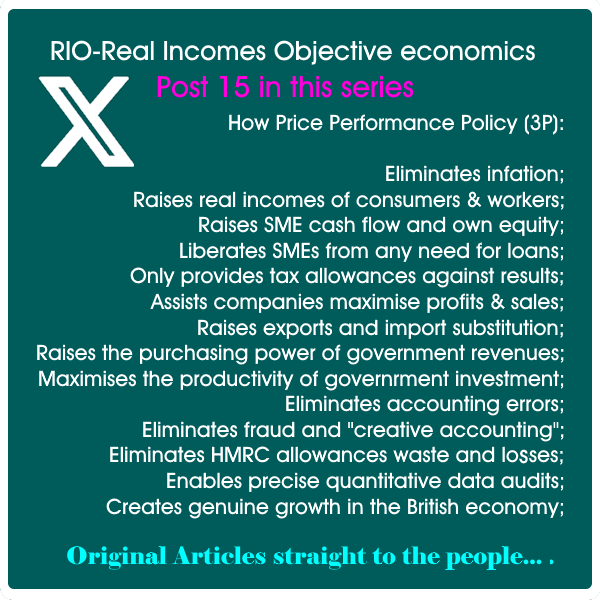
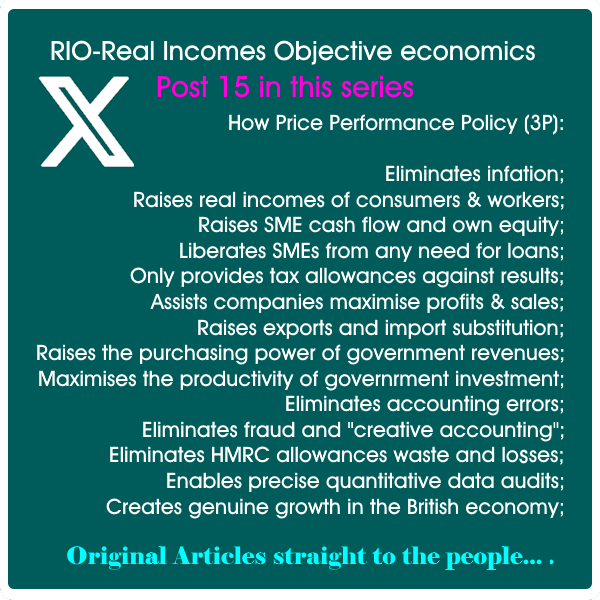
Post 15 in this series, in preparation, will explain why the basic attempts in the United Kingdom to stimulate "growth" do not work and why there is no evidence that the growth initiatives costing the Exchequer around £220 billion each year have made any contribuition. This, combined with inappropriate monetary policy decisions, is why we have arrived in 2025 and no distinct policies to initiate a recovery from our current status as having the second most negative balance of payments in goods on the planet. RIO-Real Incomes Objective economics can guarantee that such an amount, equivalent to the NHS and Defence budgets combined, can be transformed into positive increases in productivity and the elimination of inflation resulting in a generalised rise in real incomes resulting from the rise in purchasing power of the pound. The United Kingdom needs this type of policy to recover from what is, after all, a 50 year period of policy-induced decline in investment and inadequate productivity which has resulted in a significant depreciation in the value of the pound and real incomes.
Hector Wetherell McNeill tweet media
English
0
2
2
200
British Strategic Review retweetledi
Hector Wetherell McNeill
Hector Wetherell McNeill@HectorWMcNeill·
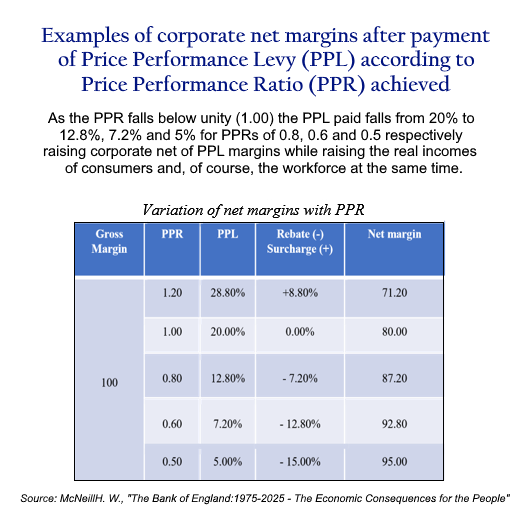
15 TAKING INTO ACCOUNT THE STATE OF THE BRITISH ECONOMY IN POLICY DESIGN RECAP The last post (14) explained that anticipatory pricing made the lowering of output inflation or simple price reductions difficult because in this state of the Price Performance Ratio being less than unity (PPR < 1.00) the profits of companies decline. THE DOMINANT STRUCURE OF THE BRITISH ECONOMY In Britain, about 50% of our employment and output is in the SME category of companies. SMEs can be particularly productive and supportive of the balance of payments of the country. For example, well over 1,500 SMEs in Germany contributed to the dominance of that country's highest positive balance of payments in goods up until 2022 when the Nord Stream 2 pipelines were attacked and the handling of turbine maintenance by the German government resulted in the lower priced Russia gas no longer reaching Germany. Some have suggested that by setting up cooperative banks and local financial intermediaries that Britain could follow the example of China where an emulation of the German local bank operations was carried out to help finance China’s industrial and manufacturing growth. For a long time now, British SMEs have been marginalised in terms of financing conditions to such an extent that only about 20% of SMEs contemplate using bank finance to invest. This has been confirmed in the Bank of England Bulletin. This has become a cultural phenomenon sustained by onerous conditions associated with bank loans & poor service. The Bank of England’s 50 years failure to eliminate inflation and its inappropriate raising on interest rates have raised costs and lowered the real purchasing power of income and profits of SMEs in particular. As a result, SMEs have faced falling terms of trade with rising costs and the need to resort to anticipatory pricing which in turn depreciates the real incomes or purchasing power of disposable incomes of consumers. Over the normal monetary policy decision cycle (MPDC) which sees interest rates rise and fall according to decisions to control inflation, corporate failures are a common occurrence as a result of depression imposed by monetary policy on profitability and demand. In terms of SME culture shaped by the experience with banks and monetary policy, the loan route to SME investment and expansion is unlikely to succeed in the short or medium term. THE ABANDONMENT OF TECHNICAL EDUCATION In the context of SMEs being major contributors to Germany’s former balance of payments success it is notable that the majority of these companies dealt with advancing the state of the art of machine tools and more advanced technology based products. An important support for this reality has been Germany’s excellent technical education system. Unfortunately, what I would record as a serious mistake made by Anthony Crosland in his policy decisions involving education was his Circular 10/65 issued in 1965 by the Department of Education and Science (DES). This requested Local Education Authorities (LEAs) in England and Wales change all state secondary schools to a Comprehensive System. This resulted in the abolition of the old grammar, technical and secondary modern schools as well as the 11-plus examination. Crosland imagined that introducing comprehensive education would increase social mobility but in doing so removed the vital contribution of technical education to the foundation industry and manufacturing and reoriented education to more theoretical academic pursuits. Therefore, unlike Germany, England and Wales saw the subsequent decline in the contribution of secondary education in support of those might have expanded technology activities via SMEs in this country. THE ELUSIVE DEFINITION OF GROWTH Governments, politicians, departments, Chancellors, the Treasury, the Bank of England and the National Audit Office all refer to the importance of “growth”. However, because this is so poorly defined this presents an operation problem. If the objectives of incentives are not clearly defined as measurable and quantifiable factors it becomes virtually impossible and certainly difficult to design and evaluate the results of policies and initiatives taken to incentivise “growth”. In presentations, for example one recently delivered by Gareth Davies, the Comptroller & Auditor General (C&AG), reference is made to the components of growth as including productivity, innovation and resilience but the desired growth objective remains amorphous without any coherent structure or utility to an audit organization aiming to base its work on measurable variables. VALUE FOR MONEY In terms of audit, the phrase, “value for money” is frequently used and considered to be a basis for evaluating actions, Value for money is often measured as the monetary return in a financial investment commonly undertaken on the basis of cost-benefit analysis or assessing if more could been have accomplished with the money spent when comparing feasible options. So, a water distribution centre might be selected because one particular design can serve more houses at a lower capital investment outlay and therefore represent the best value for money. Considering the national interest, in the effectiveness of expenditures from government revenue, the relevant measure of growth is not a series of evaluations to establish “value for money options” to decide if the option chosen was the most promising, but rather the degree to which each initiative contributes to the overall national purchasing power of the national currency or “the value of money”. Completing an audit of a series of initiatives designed to stimulate an undefined growth and based on value for money, in each case, does not provide any information on the general impact of each initiative on the state of the purchasing power of the population which rises with the purchasing power of the currency. THE RELATIONSHIP BETWEEN THE STATE, SOCIETY & ECONOMIC ACTIVITIES The underlying problem causing this lack of a useful definition of “growth” as something which serves the mutual interests of the state, society and economic activities reflects a failure to consider basic constitutional principles. Constitutional economics considers economic policies to have the singular function of supporting the interests of the subgroups: the state, society (all constituents), economic units and each individual. Transactions between subgroups should not constrain the ability of each to pursue their objectives. In all subgroups the only common interest shared is that their participation in the economy is not impaired by the other subgroups including relations between the state and any other subgroup. Therefore, the common national objective becomes the maintenance or growth in the measurable purchasing power of the currency or of disposable real incomes of each subgroup. In all cases the exercise of the freedom of each subgroup to pursue objectives is determined by the purchasing power of their disposable incomes or real incomes. BRITAIN’S EXPERIENCE WITH INCENTIVES One way Britain has attempted to support growth is to introduce initiatives to stimulate investment to raise productivity and profitability through grants and tax allowances linked to such things as capital equipment and even the more generous allowances referred to as “super-deductions”. However, none of these initiatives appear to have turned the dial on achieving a substantial rise in productivity at the national level. The overall trend in productivity in this country over the last 50 years has been one of lagging behind trends in other countries; it has been insufficient to compete effectively. HMRC EFFORTS IN THIS DOMAIN According to the National Audit Office Report for Session 2023-24 published January 2024, entitled, ”Tax measures to encourage economic growth, HM Treasury and HM Revenue & Customs” it is stated that HMRC provides two types of tax related initiatives to stimulate “growth”. These include providing tax relief to incentivise certain sectors or activities. Tax reliefs reduce the tax an individual or business owes, and some reliefs make payments back to taxpayers. Some ‘non-structural’ tax reliefs reflect specific policy choices by ministers to support particular groups or sectors, while others are designed to incentivise behaviour. As at December 2023 the UK had 341 non-structural tax reliefs intended to achieve social or economic objectives. The government can introduce, amend or remove a relief without making wholesale changes to the wider tax system. Ministers introduce and amend tax reliefs through ‘fiscal events’ e.g. at the Spring Budget and Autumn Statement, and voted on by Parliament. HM Treasury and HM Revenue & Customs (HMRC) are responsible for all aspects of the effective working of the UK tax system, including tax reliefs. Both departments are responsible for monitoring the effectiveness of reliefs overall. HM Treasury is responsible for strategic oversight of the tax system, including providing evidence‑based advice to ministers covering its overall effectiveness. HMRC is responsible for administering the system, including the monitoring and evaluation of specific tax reliefs. Around £204 billion in non-structural tax reliefs during 2022-2023 for some 341 different non-structural reliefs and some of £16.6 billion were for incentivising business investment, in total around £220 billion. Of the non-structural reliefs of £204 billion in 2022-23, some £129 billion did not target economic growth. These include tax reliefs for pensions, capital gains tax relief on people’s main home, and zero‑rated VAT on food. Therefore, the total seemingly designed to impact growth was some £75 billion which along with the investment incentives totals £91.6 billion. Therefore, the HMRC made a provision of around £90 billion in the hope that these actions would result in “growth”. These very high sums obviously will have an opportunity cost, opportunities foregone, so checking to see if, first of all this expenditure resulted in additional growth, and if not, what would be a better way to use this procedure of grants and allowances would be a way to see it there are better ways to boost economic growth. However, the most notable omission from what is an audit report is a definition of economic growth, after all an audit is supposed to be evaluating the degree to which a government action or investment is achieving some defined quantified objective, in this case, “growth”. In spite of this fundamental defect in this NAO report the report bends over backwards to remain diplomatic in its description of how the Treasury and HMRC have handled tax incentives for “growth”. It is apparent that in several cases allowances were taken advantage of to an extent that exceeded expectations resulting in a higher than expected aggregate allowance. In fields where tax collectors as well as the Treasury would have no basis upon which to judge submitted applications it was found that there was a considerable amount of fraud in applications for allowances in the fields of SME Research & Development (R&D). As a result of having liaised with many SME managers and companies over the last 50 years of developing the Real Incomes Approach it is apparent that the mistakes made by the Treasury and HMRC are fundamental. Allowances are made without any means of checking the contribution of allowances to growth. Basically, an undefined “growth” is simply assumed to arise from having granted an allowance. Lastly, much of the administration of allowances is undertaken by companies or accountants employed by companies. On the side of companies such allowances of usually not regarded as a boost to investment for productivity but rather as a give-away to augment net of tax margins. NAO REPORT CONCLUSUONS The conclusions of the NAO report were that tax reliefs face significant administrative tasks, and there are too many examples of reliefs not achieving their economic objectives or are subject to significant error and fraud, costing the Exchequer billions of pounds. HM Treasury and HMRC have increased the monitoring, evaluation and reporting of non-structural reliefs, but need to go further. NAO identified examples of tax reliefs where the costs have increased quickly, and far beyond expectations, but it has taken a number of years to identify this, understand why, and then to make changes where there are concerns. Cost increases are not necessarily a sign of failure, as they could be the result of genuine increased uptake and delivery of benefits. However, the government cannot know the cause if it has not carried out adequate compliance work to ensure only legitimate claimants received the relief, and evaluation activity to establish that the relief secures the desired outcome. It is important that the government investigates and responds to increases in costs of reliefs and evaluations promptly. NAO also stated that it is encouraging that there are now more examples of changes where evaluations have found that tax reliefs are not achieving their economic objectives. HMRC has made important commitments to improve how it evaluates non‑structural tax reliefs but it still needs to achieve greater and more timely coverage. HM Treasury and HMRC must ensure that hard lessons are learned from the R&D SME relief, and that they take the steps needed to prevent such a large failure arising again. NAO’s SOFTLY-SOFTLY APPROACH IS INAPPROPRIATE When a government agency is supposedly audited by another “independent” agency established by the state there is a difficulty in how extremely poor performance is described and how reports should be shaped. It is evident that NAO is being very careful in how it handles what appears to be a shambolic handling of a vitally important needs such as enhance economic growth. However, its handling of the overview of the actions by the Treasury and HMRC to stimulate growth is severely hampered by NAO’s own failure to define what measurable elements of growth should be prioritised. Since no government agencies and so-called independent agencies including the government, Treasury, HMRC, Bank of England and NAO have defined the growth objective or benchmarks to be audited, one ends up with a relatively useless process being audited by a relative useless audit. REAL INCOMES AND HOW TO MANAGE GROWTH INCENTIVES Before explaining a simple solution to what currently appears to be a wasteful and ineffective way to stimulate growth managed by the Treasury and HMRC, it is important to be explicit as to what sort of growth is the target of any such an exercise. By increasing productivity through innovation, it is possible to build into this mix an effort to express productivity and innovation as bringing about two measurable events which make a quantifiable contribution to real incomes. A reduction in the rate of inflation of input costs as measured by a reduction of output price inflation to a level below that of the input costs inflation; · A reduction in unit output prices when input costs remain steady. Notice, in each case, this represents a Price Performance Ratio of less than unity (PPR < 1.00) as explained in Post 14. Under the Treasury/HMRC operations there is no undertaking by those receiving tax allowances that this has any relationship to productivity, innovations, resilience or growth. My own understanding as a result of many meetings with SME managers is that allowances are simply regarded as a “give away” which increases net of tax positions. This would suggest that any impact on this amorphous growth that is referred to is likely to be insignificant, even if NAO had worked out quantitative measures as well as units of measurement and a means to measure it. It is, after all, not an easy task to collect data that companies might not even be collecting and recording. EARLY DAYS In 1981, having presented the Price Performance Policy (3P) in a monograph which I circulated to the main political parties in the UK, a manager from the management consulting and audit firm KMG (which later merged with Peat Marwick to form KMPG) informed me that he thought the policy would work but that at that moment companies did not collect the type of information to make it work. Richard Wainright, the economic spokesman for the Liberal Party, also thought the policy would work but expressed his concern surrounding the difficulty of implementing it This feedback alerted me to the need for some form of management information system to support the operation of a policy which I considered to be essential for a return of the United Kingdom to a sustained growth in real incomes. However, because the Treasury and HMRC and, indeed, NAO, have not defined the growth objective it is very likely that they are in the same boat with companies, at this moment, not collecting the essential performance data upon which to base a rational audit on the impact of allowances on growth. Since 1981,there has been a revolution in management information system design and implementation tools in the form of programs, scripting and the internet which have made possible the ability to rapidly integrate required datasets into online data capture as will be described in the descriptions below of how Price Performance Policy operates. POLICY OBJECTIVE RIO-Real Incomes Objective is not designed as an incidental or ad hoc tax allowance provided in parallel with other tax procedures. Under the Real Incomes Approach Price Performance Policy (3P) tax allowances are a generic provision to all companies and self-employed and it replaces corporate taxation with what is referred to as a Price Performance Levy (PPL). The PPL operates on a sliding scale correlated to the range of PPR values attained by a company. All operations below a PPR of less than unity (PPR < 1.00) receive allowances or rebates and the rebates increase the degree to which the PPR falls below unity. This is associated with the impact of the PPR which is to raise the real incomes of consumers as the PPR falls as a result of falling inflation or absolute price reductions. The PPL levy calculation is made according to a formula whose variables are a basic levy B (say 20%) and the PPR which weights the variable B to raise or lower the PPL. Companies with PPR of unity (PPR = 1.00) would pay the basic levy B (20%). Companies with PPRs exceeding unity (PPR > 1.00) would pay surcharges because their performance would be increasing inflation and reducing general real income levels. By way of example one “power” formula, which enhances the impact of the PPR on the rebates for a company’s operation with PPRs of less than unity, is shown below in table and this shows how the more a company reduces its PPR below unity (PPR < 1.00) the more its net of PPL levy margin is raised associated with a rise in the real incomes of consumers/workforce. OPERATIONAL DETAILS Because 3P has a specific growth objective of raising the real incomes of consumers while at the same time raising the net margins of companies this satisfies the constitutional economic condition of economic policy supporting the interests of the state, society, economic units and each individual. Transactions, rather than be of a zero-sum nature or some gaining at the expense of others, they become mutually value-added transactions. Besides the fact that the operation of the PPL raised net margins the associated fall in inflation or absolute fall in unit prices will result in a rise in sales volumes as a result of the effect of the rise in demand according to the income-price elasticity of demand for the good or service in question. THE ROLE OF PRODUCTIVITY & INNOVATION Clearly, to be able to reduce the rate of input inflation in output prices or to simply reduce output prices with no alternation in input costs requires some sort of adjustment in physical productivity or the relationship between physical inputs and outputs. CAPITAL EMBODIED & CAPITAL DISEMBODIED PRODUCTIVITY INCREASES Capital-embodied productivity increases involve some sort of change in the equipment used in a process whereas capital-disembodied productivity increases involve a change in the way resources are allocated to different capital resources through, for example, the use of an operations research program to maximise returns or minimise costs. 3P BUSINESS RULES Unlike marginal cost pricing to maximise returns, under a 3P regime companies would apply a different schema. Any adjustments to processes be these capital-embodied or capital disembodied changes in aggregate unit costs are accounted as the denominator of the PPR calculation and the output price changes as the numerator of the PPR calculation. The objective of the exercise of price setting is to end up with a PPR that provides the most advantageous net of PPL margin. This decision remains with the management of the company. Once the various options designed to lower unit costs have been determined these can be compared in the form of projections into the future of unit costs profiles. However, once the most advantageous or lowest unit cost has been selected there will be a time horizon associated with this, for example, 12 months or 18 months. Under normal circumstances the price reduction would only be introduced once the unit costs has actually fallen to that projected level. However, under 3P the price reduction is introduced at point 0 in this time line or once the selected unit costs projection has been decided. Then the PPL is then applied to the projected period to ensure that the beneficial net of PPL margins are realised. The additional calculation, besides calculating the per unit net of PPL margins received, is to calculate the likely rise in sales volumes and additional revenue arising from the effect of the income-price elasticity of demand for the good or service concerned. This has the effect of accelerating price reductions by bringing them forwards as opposed to allowing them to rest on a slowly falling unit costs line. The result is a higher rate of a national real incomes growth under a regime involving less risk to companies and rising cash flow or corporate income. DATA MANAGEMENT & POLICY GUDANCE As will be evident from the NAO report concerning the Treasury and HMRC approach to allowances and the encouragement of growth, there do not seem to be any modern techniques applied and all evaluations and audits are therefore “after the event” exercises identifying fraud and excessive payments too late to correct. Under 3P an information management system would be used to assess and apply the appropriate PPL according to a company’s PPR on a real time automatic basis. According to the field of operations (sector), each company would make use of an online program which calculates the operational PPR and periodic PPL payment or rebate. The calculation of the PPR required input and output values (prices and quantities) which can be collected through the use of “trading floors” for input procurement purchases as well as output sales. These would operate somewhat like the modern online marketing system like Amazon. PPL rebates are only paid against operational sales prices. Therefore, the impact of the allowance incentive is proportional to the benefit to the economy. All data and statistics necessary to oversee and manage the policy are on hand in real time so that any errors can be corrected as an operational adjustment as opposed to a post-audit realisation after the horses have left the stable. All transactions are recorded on an “Accumulog”, an immutable database. This system avoids delays in assessment and correct payments and provides a nationwide database on the real growth levels of the economy and throughout all sectors. ADDRESSING THE STATE OF AFFAIRS IN THE UK ECONOMY 3P addresses the constraint referred to with respect to SMEs by helping increase their cash flows and own equity to invest while avoiding the use of bank loans as is the want of most SMEs. In the case of larger companies, 3P can have the same benefits for this class of company. THE CONFIDENTIALITY ISSUE Some companies might be reluctant to use 3P in view of the fact that they will be unable to deploy "creative accounting" because the data management system does not allow for “own assessment”. For this reason, participation in the system should be voluntary but it is self-evident that those opting to remain under the conventional corporate tax regime will not be able to compete with companies under the 3P system so volunteer participation is likely to increase. 3P AND BASIC ESSENTIALS 3P can help resolve the issue of the increasing numbers of constituents in this country facing issues accessing basic essentials including food, water for drinking and sanitation, shelter (housing) and energy for cooking, heating & transport. This will be explained in a subsequent post.
Hector Wetherell McNeill tweet mediaHector Wetherell McNeill tweet mediaHector Wetherell McNeill tweet media
English
0
1
2
210
British Strategic Review retweetledi
Hector Wetherell McNeill
Hector Wetherell McNeill@HectorWMcNeill·
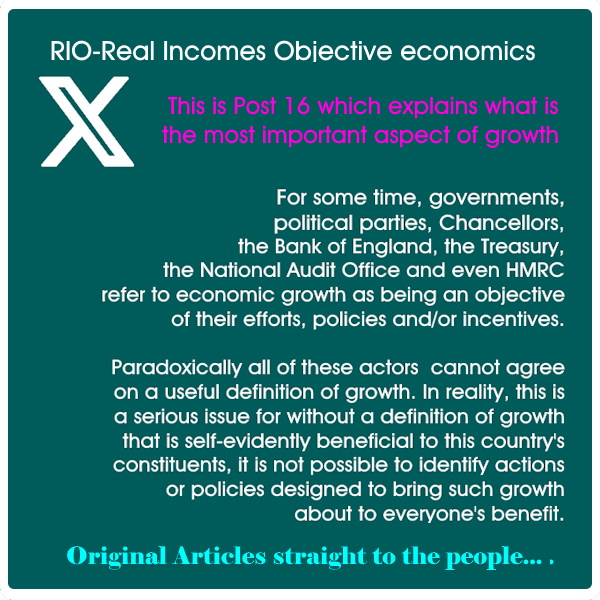
MAKING GROWTH COUNT For some time, governments, political parties, Chancellors, the Bank of England, the Treasury, the National Audit Office and even HMRC refer to "economic growth" as being an objective of their efforts, policies and/or incentives. Paradoxically all of these actors cannot agree on a simple definition of "growth" which in reality is a serious issue for without a definition of growth that is self-evidently beneficial to this country's constituents, it is not possible to identify actions or policies designed to bring such growth about to everyone's benefit. The usual words associated with the word "growth" are, "innovation", "productivity" and any policy actions assessed to be " value for money". Innovation simply means changing the way tasks are accomplished and its strict definition is that it occurs when a change is introduced for the first time in a specific location. Productivity increases are usually associated with more output for less input or sometimes simply as more physical output. Value for money indicates that a chosen action is better than available options in terms of costs, returns or profits. However, all of these associations with growth refer to instances in the changes in the performance of goods or service producers. However, in terms of policy and national growth it is important to identify the benefit of “growth” to the whole nation and this is not the same thing as the instances mentioned. It is therefore important to identify a shared benefit by the state, society, economic units and each individual. The only factor which enables these groupings to exercise their free will in the pursuit of their individual economic objectives is the purchasing power of their disposable incomes. Thus, the single factor which is a measure of a universal benefit of growth is the state of the purchasing power of the currency (pound) and through this the purchasing power of disposable incomes or real incomes. This simple easily defined and measurable consequence of growth depends upon a particular mechanism which can be made to operate through appropriate policies using specific policy instruments. The mechanism is that innovation and productivity be encouraged to lower the unit costs of production with the intent of lowering unit output prices. This proviso adds universal meaning to the interaction of innovation and productivity in being able to not demonstrate VALUE FOR MONEY in some isolated business decision but rather to contribute to the national growth by increasing the VALUE OF MONEY to the benefit of all constituents as consumers and the workforce. This results in a general containment or reduction in inflation as well as a general rise in the purchasing power of the currency benefitting the leverage of government expenditure as well as incomes of individuals and companies.
Hector Wetherell McNeill tweet media
English
0
3
4
261
British Strategic Review retweetledi
Hector Wetherell McNeill
Hector Wetherell McNeill@HectorWMcNeill·
I didn't note anything relating to family farms but I have noted that John Van Reenen makes all the very same mistakes about productivity and its contribution to growth as all conventional economists. He uses the "sizeof the pie" argument which explains little and makes the wring assumption of what type of growth is needed in the UK. With such advice, this, it would seem, is the reason the Chancellor never makes any sense when she talks about "growth" because she can never translate what she says into specific quantifiable benefits for constituents..
English
1
2
3
53
British Strategic Review retweetledi
Hector Wetherell McNeill
Hector Wetherell McNeill@HectorWMcNeill·
15 TAKING INTO ACCOUNT THE STATE OF THE BRITISH ECONOMY IN POLICY DESIGN RECAP The last post (14) explained that anticipatory pricing made the lowering of output inflation or simple price reductions difficult because in this state of the Price Performance Ratio being less than unity (PPR < 1.00) the profits of companies decline. THE DOMINANT STRUCURE OF THE BRITISH ECONOMY In Britain, somewhere around 50% of our employment and output is in the SME category of companies. SMEs can be particularly productive and supportive of the balance of payments of the country. For example, well over 1,500 SMEs in Germany contributed to the dominance of that country's highest positive balance of payments in goods up until 2022 when the Nord Stream 2 pipelines were attacked and the handling of turbine maintenance by the German government resulted in the lower priced Russia gas no longer reaching Germany. Some have suggested that by setting up cooperative banks and local financial intermediaries that Britain could follow the example of China where an emulation of the German local bank operations was carried out to help finance China’s industrial and manufacturing growth. For a long time now, British SMEs have been marginalised in terms of financing conditions to such an extent that only about 20% of SMEs contemplate using bank finance to invest. This has been confirmed in the Bank of England Bulletin. This has become a cultural phenomenon sustained by onerous conditions associated with bank loans & poor service. The Bank of England’s 50 years failure to eliminate inflation and its inappropriate raising on interest rates have raised costs and lowered the real purchasing power of income and profits of SMEs in particular. As a result, SMEs have faced falling terms of trade with rising costs and the need to resort to anticipatory pricing which in turn depreciates the real incomes or purchasing power of disposable incomes of consumers. Over the normal monetary policy decision cycle (MPDC) which sees interest rates rise and fall according to decisions to control inflation, corporate failures are a common occurrence as a result of depression imposed by monetary policy on profitability and demand. In terms of SME culture shaped by the experience with banks and monetary policy, the loan route to SME investment and expansion is unlikely to succeed in the short or medium term. THE ABANDONMENT OF TECHNICAL EDUCATION In the context of SMEs being major contributors to Germany’s former balance of payments success it is notable that the majority of these companies dealt with advancing the state of the art of machine tools and more advanced technology based products. An important support for this reality has been Germany’s excellent technical education system. Unfortunately, what I would record as a serious mistake made by Anthony Crosland in his policy decisions involving education was his Circular 10/65 issued in 1965 by the Department of Education and Science (DES). This requested Local Education Authorities (LEAs) in England and Wales change all state secondary schools to a Comprehensive System. This resulted in the abolition of the old grammar, technical and secondary modern schools as well as the 11-plus examination. Crosland imagined that introducing comprehensive education would increase social mobility but in doing so removed the vital contribution of technical education to the foundation industry and manufacturing and reoriented education to more theoretical academic pursuits. Therefore, unlike Germany, England and Wales saw the subsequent decline in the contribution of secondary education in support of those might have expanded technology activities via SMEs in this country. THE ELUSIVE DEFINITION OF GROWTH Governments, politicians, departments, Chancellors, the Treasury, the Bank of England and the National Audit Office all refer to the importance of “growth”. However, because this is so poorly defined this presents an operation problem. If the objectives of incentives are not clearly defined as measurable and quantifiable factors it becomes virtually impossible and certainly difficult to design and evaluate the results of policies and initiatives taken to incentivise “growth”. In presentations, for example one recently delivered by Gareth Davies, the Comptroller & Auditor General (C&AG), reference is made to the components of growth as including productivity, innovation and resilience but the desired growth objective remains amorphous without any coherent structure or utility to an audit organization aiming to base its work on measurable variables. VALUE FOR MONEY In terms of audit, the phrase, “value for money” is frequently used and considered to be a basis for evaluating actions, Value for money is often measured as the monetary return in a financial investment commonly undertaken on the basis of cost-benefit analysis or assessing if more could been have accomplished with the money spent when comparing feasible options. So, a water distribution centre might be selected because one particular design can serve more houses at a lower capital investment outlay and therefore represent the best value for money. Considering the national interest, in the effectiveness of expenditures from government revenue, the relevant measure of growth is not a series of evaluations to establish “value for money options” to decide if the option chosen was the most promising, but rather the degree to which each initiative contributes to the overall national purchasing power of the national currency or “the value of money”. Completing an audit of a series of initiatives designed to stimulate an undefined growth and based on value for money, in each case, does not provide any information on the general impact of each initiative on the state of the purchasing power of the population which rises with the purchasing power of the currency. THE RELATIONSHIP BETWEEN THE STATE, SOCIETY & ECONOMIC ACTIVITIES The underlying problem causing this lack of a useful definition of “growth” as something which serves the mutual interests of the state, society and economic activities reflects a failure to consider basic constitutional principles. Constitutional economics considers economic policies to have the singular function of supporting the interests of the subgroups: the state, society (all constituents), economic units and each individual. Transactions between subgroups should not constrain the ability of each to pursue their objectives. In all subgroups the only common interest shared is that their participation in the economy is not impaired by the other subgroups including relations between the state and any other subgroup. Therefore, the common national objective becomes the maintenance or growth in the measurable purchasing power of the currency or of disposable real incomes of each subgroup. In all cases the exercise of the freedom of each subgroup to pursue objectives is determined by the purchasing power of their disposable incomes or real incomes. BRITAIN’S EXPERIENCE WITH INCENTIVES One way Britain has attempted to support growth is to introduce initiatives to stimulate investment to raise productivity and profitability through grants and tax allowances linked to such things as capital equipment and even the more generous allowances referred to as “super-deductions”. However, none of these initiatives appear to have turned the dial on achieving a substantial rise in productivity at the national level. The overall trend in productivity in this country over the last 50 years has been one of lagging behind trends in other countries; it has been insufficient to compete effectively. HMRC EFFORTS IN THIS DOMAIN According to the National Audit Office Report for Session 2023-24 published January 2024, entitled, ”Tax measures to encourage economic growth, HM Treasury and HM Revenue & Customs” it is stated that HMRC provides two types of tax related initiatives to stimulate “growth”. These include providing tax relief to incentivise certain sectors or activities. Tax reliefs reduce the tax an individual or business owes, and some reliefs make payments back to taxpayers. Some ‘non-structural’ tax reliefs reflect specific policy choices by ministers to support particular groups or sectors, while others are designed to incentivise behaviour. As at December 2023 the UK had 341 non-structural tax reliefs intended to achieve social or economic objectives. The government can introduce, amend or remove a relief without making wholesale changes to the wider tax system. Ministers introduce and amend tax reliefs through ‘fiscal events’ e.g. at the Spring Budget and Autumn Statement, and voted on by Parliament. HM Treasury and HM Revenue & Customs (HMRC) are responsible for all aspects of the effective working of the UK tax system, including tax reliefs. Both departments are responsible for monitoring the effectiveness of reliefs overall. HM Treasury is responsible for strategic oversight of the tax system, including providing evidence‑based advice to ministers covering its overall effectiveness. HMRC is responsible for administering the system, including the monitoring and evaluation of specific tax reliefs. Around £204 billion in non-structural tax reliefs during 2022-2023 for some 341 different non-structural reliefs and some of £16.6 billion were for incentivising business investment, in total around £220 billion. Of the non-structural reliefs of £204 billion in 2022-23, some £129 billion did not target economic growth. These include tax reliefs for pensions, capital gains tax relief on people’s main home, and zero‑rated VAT on food. Therefore, the total seemingly designed to impact growth was some £75 billion which along with the investment incentives totals £91.6 billion. Therefore, the HMRC made a provision of around £90 billion in the hope that these actions would result in “growth”. These very high sums obviously will have an opportunity cost, opportunities foregone, so checking to see if, first of all this expenditure resulted in additional growth, and if not, what would be a better way to use this procedure of grants and allowances would be a way to see it there are better ways to boost economic growth. However, the most notable omission from what is an audit report is a definition of economic growth, after all an audit is supposed to be evaluating the degree to which a government action or investment is achieving some defined quantified objective, in this case, “growth”. In spite of this fundamental defect in this NAO report the report bends over backwards to remain diplomatic in its description of how the Treasury and HMRC have handled tax incentives for “growth”. It is apparent that in several cases allowances were taken advantage of to an extent that exceeded expectations resulting in a higher than expected aggregate allowance. In fields where tax collectors as well as the Treasury would have no basis upon which to judge submitted applications it was found that there was a considerable amount of fraud in applications for allowances in the fields of SME Research & Development (R&D). As a result of having liaised with many SME managers and companies over the last 50 years of developing the Real Incomes Approach it is apparent that the mistakes made by the Treasury and HMRC are fundamental. Allowances are made without any means of checking the contribution of allowances to growth. Basically, an undefined “growth” is simply assumed to arise from having granted an allowance. Lastly, much of the administration of allowances is undertaken by companies or accountants employed by companies. On the side of companies such allowances of usually not regarded as a boost to investment for productivity but rather as a give-away to augment net of tax margins. NAO REPORT CONCLUSUONS The conclusions of the NAO report were that tax reliefs face significant administrative tasks, and there are too many examples of reliefs not achieving their economic objectives or are subject to significant error and fraud, costing the Exchequer billions of pounds. HM Treasury and HMRC have increased the monitoring, evaluation and reporting of non-structural reliefs, but need to go further. NAO identified examples of tax reliefs where the costs have increased quickly, and far beyond expectations, but it has taken a number of years to identify this, understand why, and then to make changes where there are concerns. Cost increases are not necessarily a sign of failure, as they could be the result of genuine increased uptake and delivery of benefits. However, the government cannot know the cause if it has not carried out adequate compliance work to ensure only legitimate claimants received the relief, and evaluation activity to establish that the relief secures the desired outcome. It is important that the government investigates and responds to increases in costs of reliefs and evaluations promptly. NAO also stated that it is encouraging that there are now more examples of changes where evaluations have found that tax reliefs are not achieving their economic objectives. HMRC has made important commitments to improve how it evaluates non‑structural tax reliefs but it still needs to achieve greater and more timely coverage. HM Treasury and HMRC must ensure that hard lessons are learned from the R&D SME relief, and that they take the steps needed to prevent such a large failure arising again. NAO’s SOFTLY-SOFTLY APPROACH IS INAPPROPRIATE When a government agency is supposedly audited by another “independent” agency established by the state there is a difficulty in how extremely poor performance is described and how reports should be shaped. It is evident that NAO is being very careful in how it handles what appears to be a shambolic handling of a vitally important needs such as enhance economic growth. However, its handling of the overview of the actions by the Treasury and HMRC to stimulate growth is severely hampered by NAO’s own failure to define what measurable elements of growth should be prioritised. Since no government agencies and so-called independent agencies including the government, Treasury, HMRC, Bank of England and NAO have defined the growth objective or benchmarks to be audited, one ends up with a relatively useless process being audited by a relative useless audit. REAL INCOMES AND HOW TO MANAGE GROWTH INCENTIVES Before explaining a simple solution to what currently appears to be a wasteful and ineffective way to stimulate growth managed by the Treasury and HMRC, it is important to be explicit as to what sort of growth is the target of any such an exercise. By increasing productivity through innovation, it is possible to build into this mix an effort to express productivity and innovation as bringing about two measurable events which make a quantifiable contribution to real incomes. · A reduction in the rate of inflation of input costs as measured by a reduction of output price inflation to a level below that of the input costs inflation; · A reduction in unit output prices when input costs remain steady. Notice, in each case, this represents a Price Performance Ratio of less than unity (PPR < 1.00) as explained in Post 14. Under the Treasury/HMRC operations there is no undertaking by those receiving tax allowances that this has any relationship to productivity, innovations, resilience or growth. My own understanding as a result of many meetings with SME managers is that allowances are simply regarded as a “give away” which increases net of tax positions. This would suggest that any impact on this amorphous growth that is referred to is likely to be insignificant, even if NAO had worked out quantitative measures as well as units of measurement and a means to measure it. It is, after all, not an easy task to collect data that companies might not even be collecting and recording. EARLY DAYS In 1981, having presented the Price Performance Policy (3P) in a monograph which I circulated to the main political parties in the UK, a manager from the management consulting and audit firm KMG (which later merged with Peat Marwick to form KMPG) informed me that he thought the policy would work but that at that moment companies did not collect the type of information to make it work. Richard Wainright, the economic spokesman for the Liberal Party, also thought the policy would work but expressed his concern surrounding the difficulty of implementing it This feedback alerted me to the need for some form of management information system to support the operation of a policy which I considered to be essential for a return of the United Kingdom to a sustained growth in real incomes. However, because the Treasury and HMRC and, indeed, NAO, have not defined the growth objective it is very likely that they are in the same boat with companies, at this moment, not collecting the essential performance data upon which to base a rational audit on the impact of allowances on growth. Since 1981,there has been a revolution in management information system design and implementation tools in the form of programs, scripting and the internet which have made possible the ability to rapidly integrate required datasets into online data capture as will be described in the descriptions below of how Price Performance Policy operates. POLICY OBJECTIVE RIO-Real Incomes Objective is not designed as an incidental or ad hoc tax allowance provided in parallel with other tax procedures. Under the Real Incomes Approach Price Performance Policy (3P) tax allowances are a generic provision to all companies and self-employed and it replaces corporate taxation with what is referred to as a Price Performance Levy (PPL). The PPL operates on a sliding scale correlated to the range of PPR values attained by a company. All operations below a PPR of less than unity (PPR < 1.00) receive allowances or rebates and the rebates increase the degree to which the PPR falls below unity. This is associated with the impact of the PPR which is to raise the real incomes of consumers as the PPR falls as a result of falling inflation or absolute price reductions. The PPL levy calculation is made according to a formula whose variables are a basic levy B (say 20%) and the PPR which weights the variable B to raise or lower the PPL. Companies with PPR of unity (PPR = 1.00) would pay the basic levy B (20%). Companies with PPRs exceeding unity (PPR > 1.00) would pay surcharges because their performance would be increasing inflation and reducing general real income levels. By way of example one “power” formula, which enhances the impact of the PPR on the rebates for a company’s operation with PPRs of less than unity, is shown below in table and this shows how the more a company reduces its PPR below unity (PPR < 1.00) the more its net of PPL levy margin is raised associated with a rise in the real incomes of consumers/workforce. OPERATIONAL DETAILS Because 3P has a specific growth objective of raising the real incomes of consumers while at the same time raising the net margins of companies this satisfies the constitutional economic condition of economic policy supporting the interests of the state, society, economic units and each individual. Transactions, rather than be of a zero-sum nature or some gaining at the expense of others, they become mutually value-added transactions. Besides the fact that the operation of the PPL raised net margins the associated fall in inflation or absolute fall in unit prices will result in a rise in sales volumes as a result of the effect of the rise in demand according to the income-price elasticity of demand for the good or service in question. THE ROLE OF PRODUCTIVITY & INNOVATION Clearly, to be able to reduce the rate of input inflation in output prices or to simply reduce output prices with no alternation in input costs requires some sort of adjustment in physical productivity or the relationship between physical inputs and outputs. CAPITAL EMBODIED & CAPITAL DISEMBODIED PRODUCTIVITY INCREASES Capital-embodied productivity increases involve some sort of change in the equipment used in a process whereas capital-disembodied productivity increases involve a change in the way resources are allocated to different capital resources through, for example, the use of an operations research program to maximise returns or minimise costs. 3P BUSINESS RULES Unlike marginal cost pricing to maximise returns, under a 3P regime companies would apply a different schema. Any adjustments to processes be these capital-embodied or capital disembodied changes in aggregate unit costs are accounted as the denominator of the PPR calculation and the output price changes as the numerator of the PPR calculation. The objective of the exercise of price setting is to end up with a PPR that provides the most advantageous net of PPL margin. This decision remains with the management of the company. Once the various options designed to lower unit costs have been determined these can be compared in the form of projections into the future of unit costs profiles. However, once the most advantageous or lowest unit cost has been selected there will be a time horizon associated with this, for example, 12 months or 18 months. Under normal circumstances the price reduction would only be introduced once the unit costs has actually fallen to that projected level. However, under 3P the price reduction is introduced at point 0 in this time line or once the selected unit costs projection has been decided. Then the PPL is then applied to the projected period to ensure that the beneficial net of PPL margins are realised. The additional calculation, besides calculating the per unit net of PPL margins received, is to calculate the likely rise in sales volumes and additional revenue arising from the effect of the income-price elasticity of demand for the good or service concerned. This has the effect of accelerating price reductions by bringing them forwards as opposed to allowing them to rest on a slowly falling unit costs line. The result is a higher rate of a national real incomes growth under a regime involving less risk to companies and rising cash flow or corporate income. DATA MANAGEMENT & POLICY GUDANCE As will be evident from the NAO report concerning the Treasury and HMRC approach to allowances and the encouragement of growth, there do not seem to be any modern techniques applied and all evaluations and audits are therefore “after the event” exercises identifying fraud and excessive payments too late to correct. Under 3P an information management system would be used to assess and apply the appropriate PPL according to a company’s PPR on a real time automatic basis. According to the field of operations (sector), each company would make use of an online program which calculates the operational PPR and periodic PPL payment or rebate. The calculation of the PPR required input and output values (prices and quantities) which can be collected through the use of “trading floors” for input procurement purchases as well as output sales. These would operate somewhat like the modern online marketing system like Amazon. PPL rebates are only paid against operational sales prices. Therefore, the impact of the allowance incentive is proportional to the benefit to the economy. All data and statistics necessary to oversee and manage the policy are on hand in real time so that any errors can be corrected as an operational adjustment as opposed to a post-audit realisation after the horses have left the stable. All transactions are recorded on an “Accumulog”, an immutable database. This system avoids delays in assessment and correct payments and provides a nationwide database on the real growth levels of the economy and throughout all sectors. ADDRESSING THE STATE OF AFFAIRS IN THE UK ECONOMY 3P addresses the constraint referred to with respect to SMEs by helping increase their cash flows and own equity to invest while avoiding the use of bank loans as is the want of most SMEs. In the case of larger companies, 3P can have the same benefits for this class of company. THE CONFIDENTIALITY ISSUE Some companies might be reluctant to use 3P in view of the fact that they will be unable to deploy "creative accounting" because the data management system does not allow for “own assessment”. For this reason, participation in the system should be voluntary but it is self-evident that those opting to remain under the conventional corporate tax regime will not be able to compete with companies under the 3P system so volunteer participation is likely to increase. 3P AND BASIC ESSENTIALS 3P can help resolve the issue of the increasing numbers of constituents in this country facing issues accessing basic essentials including food, water for drinking and sanitation, shelter (housing) and energy for cooking, heating & transport. This will be explained in a subsequent post.
Hector Wetherell McNeill tweet mediaHector Wetherell McNeill tweet mediaHector Wetherell McNeill tweet media
English
1
1
2
61
British Strategic Review
British Strategic Review@ekonomissed·
Mundellian supply side economics is "trickle down economics" and was ineffective. McNeillian supply side economics has a far greater potential to significantly expand the SME sector based on counter-inflationary competitive growth raising national real incomes. 10/10.
English
0
0
0
16
British Strategic Review
British Strategic Review@ekonomissed·
The McNeillian version is particularly suited to SMEs helping secure high growth without debt aligning with the known preferences of SMEs while lowering the risk of investments made to lower unit costs. The impact is lower prices & rise in real incomes of all constituents.9/10
English
1
0
0
17
British Strategic Review
British Strategic Review@ekonomissed·
## Can Supply Side Economics help SMEs in the UK? ## 5.45 million SMEs account for 60% of UK employment and over 50% of national output. A recent BoE Bulletin reported that only 20% of SMEs used bank loans to invest because of unacceptable loan conditions. 1/10
English
1
0
0
178