🧐

6.6K posts

🧐 banner
🧐

🧐

@embaba23

Katılım Kasım 2015
2.1K Takip Edilen47 Takipçiler
Sabitlenmiş Tweet
🧐
🧐@embaba23·
To those who need reminding.
History of Eritrea🇪🇷ታሪኽ ኤርትራ.تاريخ إريتريا@Erihistory

"በቀረው ዓለም ከእዝያ በፊት በታሪክ ማን ከማን ጋር ለምን ያክል ግዜ ረጅም የሆነ ውግያ እንደ ተዋጋ በውል የማውቀው ነገር የለም። በእኛ ዘመንና በአዲስቱ ኢትዮጵያ ከተካሄዱት ጦርነቶች ግን:ከኤርትራ አማጽያን እንዳደረግነው ውግያ ግዙፍና ብዙ ዋጋ ያስከፈለ አለ ለማለት እቸገራለው። ካማንም ባዕድ ጦር ጋር ብንዋጋ ከዚህ ጦርነት የበለጠ ዋጋ አንከፍልም። ለምን? መካድ አንችልም! ሰዎቹ ተዋጊዎች ናቸው ይዋጋሉ። ለዚያ (ለኤርትራ ጦርነት) የተከፈለው መስዋዕትነት ቀላል አልነበረም: የወጣው ገንዘብና ሎጂስቲክስ ቀላል አልነበረም : በአንድ ታዳጊ ሀገር ረዥም: ብዙ የጠየቀ : ብዙ መሳርያ የተሰለፈበት ምናልባት ከኮርያ ጦርነት በመለስ የእኛ ጦርነት ነበር።ይኼንን ሁሉም ይቀበለዋል" Mengistu Hailemariam, 2024 “I don’t know for sure, in history, what war was fought the longest. However, from the wars that have taken place in our time and in modern Ethiopia, I hesitate to say that there was a war as massive and costly as the one we fought against the Eritrean rebels…Even if we fought against any foreign army, it would not be more costly than we did in that war. Why? We cannot deny it! The people (Eritreans) are warriors; they fight. The sacrifice paid for that (the Eritrean war) was not small: the money spent and the logistics were not small either. For a young nation, it was long, it demanded a lot, and involved a massive deployment of weapons—perhaps, after the Korean War, it was this war. Everyone acknowledges this fact." Former President of Ethiopia Mengistu Hailemariam 2024 FACTS -The #Eritrean armed struggle was the longest armed national liberation struggle in Africa & highly developed & effective armed struggle in the world. Many of the largest battles and military operations after WWII; the Red Star 1982 Operations, Nadew 1988, Fenkil 1990 & others, were fought in Eritrea. -Between 1974 & 1991, #Ethiopia lost about 479,589 troops (1% of Ethiopia's then population of 46 million) fighting in Eritrea. Eritrea lost more than 65,000 her finest freedom fighters in the liberation war. 30% of Eritrean freedom fighters were women. -From 1985-1991, #EPLF released 136,000 Ethiopian POWs. In 1985, 8000, in Dec. 1989, 10,000, in early 1991, 30,000, in Jan. 1990, about 2500, and after Independence in 1991, about 86,000 POWs including 900 officers & 3 #Soviet Officers were released. -Mr. Fasika Sidelil, Derg's Economic Policy Chief, recently revealed that from 1974-1991, Ethiopia spent 50% of its GDP to fight against the Eritrean Armed Struggle for self-determination. From 1961 to 1974, Emperor Hailesilassie spent about 500 million U.S dollar, close to 5 billion U.S dollar worth today, for defense budget. This was mainly to fight the war in Eritrea. -In 1991, 200 tanks, 50, 130 mm & 171, 122 mm artillery, 44 BM-21 & 18 BM-24 rockets, 127-ZU-23 anti-aircraft, 1038 mortars and a very large number of ammunitions were also taken from the defeated Ethiopian Army in Eritrea. -In 1991, #EPLF destroyed Ethiopian Navy once and for all. -In 1984, EPLF commandos destroyed 33 Ethiopian military aircraft including 16 MIG fighters. -On 17 July 2001, the government of Ethiopia announced that Ethiopia spent $3 billion in the war with Eritrea, from 1998-2000. -In 1999, Ethiopia spent 700 million U.S dollar, 9.5% of its GDP, to launch one of the biggest Offensive in history to invade #Badme, and in 2000 Ethiopia's defense budget was 620 million U.S dollar to unleash the 3rd Offensive against Eritrea. The government also admitted that the conflict caused massive devastation with staggering human costs, demolished the country’s social and physical infrastructure, and diverted a great portion of the economically active population. @AbiyAhmedAli
English
0
1
1
965
🧐 retweetledi
Ted Reese
Ted Reese@Grossmanite·
"Arsenal manager Mikel Arteta wants a team that plays with 'one brain' - like a centrally planned socialist economy" sublationmag.com/post/arsenal-s…
English
2
3
17
2.8K
🧐 retweetledi
Ignorance, the root and stem of all evil
Russian Foreign Minister Sergey Lavrov responds after French President Emmanuel Macron accused Russia of being a “real colonizer” in Africa. Lavrov recalls a past exchange with EU officials at the United Nations over Mali, the Sahel, and Europe’s role in Africa, arguing that some Western leaders still view Africa as their sphere of influence.
English
17
172
423
25.8K
🧐 retweetledi
Warwick Powell | 鲍韶山
Warwick Powell | 鲍韶山@baoshaoshan·
A while back, when a selection of excerpts from Xi Jinping was published addressing questions of consumption and investment, a coterie of so called experts leapt on it claiming that China accepted their critique of “over capacity / under consumption.” They were wrong. 🧵
Qiushi Journal@QiushiJournal

A new article by General Secretary Xi Jinping on strengthening, optimizing and expanding the real economy was published in Qiushi Journal, 10th issue of 2026. (CN) brnw.ch/21x2weE (EN) brnw.ch/21x2wf4

English
1
6
46
1.8K
🧐 retweetledi
Ghideon Musa
Ghideon Musa@GhideonMusa·
On the occasion of its 35th anniversary of independence, celebrated this very month, Eritrea appears not only as a moral and geopolitical victor over its eternal rivals, but even as an indispensable player in their "salvation." And this doesn't only concern the United States, because, given the current situation, the time will soon come when restoring good relations with Eritrea will also be necessary for the "salvation" of other adversaries who still seem intransigent today, such as Ethiopia and the United Arab Emirates.
Filippo Bovo@FilippoBovo83

investigaction.net/lerythree-au-3…

English
1
53
71
1.8K
🧐 retweetledi
ER MEDIA
ER MEDIA@ERMedia91·
.....In international journalism, few nations are as consistently flattened into a caricature as Eritrea. The portrayal has calcified into a ritualistic script: the “hermit kingdom” defined solely by what the narrative gatekeepers refer as “self-isolation”. Yet, as the chasm between this portrayal and the lived reality widens, we must ask: Is the global press reporting on a country, or merely reciting a practiced monologue?..... x.com/i/status/20539…
ER MEDIA tweet media
English
2
63
79
3.3K
🧐 retweetledi
Paweł Wargan
Paweł Wargan@pawelwargan·
The EU claims that the “Hitler-Stalin Pact of 1939” enabled WWII. It omits ten crucial facts: - The Soviet Union was not even among the first ten countries to enter into treaties and non-aggression pacts with Nazi Germany. In 1939 alone, Lithuania, Romania, Denmark, Italy, Estonia and Latvia all signed non-aggression pacts with Hitler. Poland entered into one as far back as 1934. - The Soviet Union tried to form an anti-fascist alliance throughout the 1930s, and was repeatedly rebuffed by European powers. - Despite that, the Soviet Union was the most powerful bulwark against fascism before the war. The International Brigades in Spain represent the most concrete example of organised antifascist military resistance before Hitler’s invasion of Poland. These Brigades were led by communist parties armed by the Soviet Union, who were abandoned by Western “democracies” and their policies of "non-intervention” which simply left German and Italian intervention uncontested. - In that same tradition, Stalin offered to send one million troops to deter Hitler’s aggression during the 1938 Sudetenland crisis. Poland and Romania objected, while France and Britain decided to pursue appeasement. That appeasement aimed in part at ensuring that Germany’s energies were directed eastwards, against communism. - The Soviet Union was the primary target of German imperialism. The USSR’s leadership was aware of this from the early 1930s — and Germany’s leadership did not hide the fact. Hitler had repeatedly promised that Germany would be the “bulwark" of the West against “Bolshevism”, a position that found broad sympathies among the Western ruling classes. Auschwitz was first built to house Soviet POWs, 3.5 million of whom were exterminated during the war. - Nazi Germany was simply the turning inwards of Western European colonialism. It was in modern-day Namibia that Germany’s Imperial Chancery recorded perhaps the first use of the term Konzentrationslager — the concentration camp — to describe an instrument of mass extermination. - Adolf Hitler drew particular inspiration from the US settler-colonial model. He remarked approvingly how the US settlers had “gunned down the millions of Redskins to a few hundred thousand and now keep the modest remnants under observation in a cage”. He sent jurists to study the US Jim Crow laws, which formed the basis of the infamous Nuremberg Laws. - The Red Army liberated Auschwitz, then liberated Europe. If not for the US, which moved quickly to suffocate the rising communist movements on the continent, we might have seen socialism rise at least in Greece, Italy, France and, eventually, Portugal. - After the war, West Germany quickly reneged on the Potsdam Agreement, filled its security services with former Nazis. NATO, also filled with former Nazis, was founded to wage war on socialism and anti-colonial struggles. In the process it resuscitated the Wehrmacht and paved the way for the German revanchism we are seeing today. - As a result, we have endured decades of US-led imperial hegemony, whose effects are a dying planet and tens of millions of lives stolen by imperialist wars and sanctions alone. That hegemony has absorbed and expanded the historical mission of fascism, carrying it forward into a new century. Gaza is the clearest expression of that process today — but it is by no means the only one.
EUvsDisinfo@EUvsDisinfo

The Kremlin claims the Soviet Union “liberated Europe” in 1945. It omits one crucial fact: WWII was enabled by the Hitler–Stalin Pact of 1939, which carved up Europe between two totalitarian regimes. For millions in Central and Eastern Europe, Soviet “liberation” meant occupation, repression, deportations, and decades without freedom. The Soviet Union was an occupier. Russia is an occupier in Ukraine today.

English
193
1.6K
4.9K
147.7K
🧐 retweetledi
Ben Norton
Ben Norton@BenjaminNorton·
Sanctions are not an alternative to war; they are an even more deadly form of unconventional warfare. Western sanctions killed roughly 38 million people over 50 years. The US government has imposed sanctions on approximately one-third of the countries on Earth, including more than 60% of low-income nations, according to a 2024 report in the Washington Post. A peer-reviewed academic article published in 2025 in the leading medical journal The Lancet concluded “that sanctions do kill: economic sanctions imposed by the USA or the EU were associated with 564,258 deaths … annually from 1971 to 2021, higher than the annual number of battle-related casualties (106,000 deaths)”. geopoliticaleconomy.com/2026/05/09/tru…
Ben Norton tweet media
English
28
878
1.5K
34K
🧐 retweetledi
Donna St. Hill
Donna St. Hill@donnasthill·
Father of African cinema 🇸🇳 Ousmane Sembène on why narrative filmmaking is better than any other media for rapidly raising the critical consciousness of the masses Only Chinese drama rn is consistently demonstrating this transformational power of art and the artist - antithesis
✝️🇺🇸Chet Ozmun🇨🇳☭@OzmunC

"We're just scientists. Is having faith in Communism really that essential?" These are kinds of deep themes being explored in Chinese TV dramas:

English
2
248
980
31.1K
🧐 retweetledi
Yemane G. Meskel 🇪🇷
Press Statement The Backdrop of Unwarranted Sanctions Ministry of Information Asmara, 6 May 2026 "There are reports these days that the illegal and unilateral US sanctions will soon be lifted. We earnestly hope that this act will indeed herald an enduring rectification of misguided policies to ensure justice, legality and fairness". shabait.com/2026/05/06/the…
Yemane G. Meskel 🇪🇷 tweet media
English
7
874
1.1K
36.4K
🧐 retweetledi
Chetuya Chinagolum
Chetuya Chinagolum@Chetuyachinago·
A bitter pill Nigerians have to swallow is that police brutality and extra-judicial killings will continue unabated until the current system is destroyed. The reason is because the current men masquerading as Nigeria Police Officers are essentially British soldiers wearing black masks. To see this, let us go back in time to the colonial era. When the British Imperialists wanted to set up a Policing unit in Nigeria, they faced a very serious problem. Their own Police Unit in England was too soft for colonial policing. Their police was based on the Metropolitan Police Model. The most revolutionary idea of this model is that the power of the police comes from public approval rather than the power of the state. In the Metropolitan model, the police are not there to force the public into submission; they are there to help the public maintain order. If the public loses trust in the police, the police lose their legitimacy. Even today, most UK police do not carry firearms on regular patrol. They carry batons and use communication or de-escalation as their primary tools. Force is only used as a last resort, and it must be the absolute minimum necessary to achieve the objective. The problem with this policing is that it is only designed to "protect" the people. The British on the other hand came to Nigeria to steal, so they were only interested in protecting themselves and not the people. Extracting the wealth of millions of people was never a simple matter because the people would often resist. Since the resistance was always organized and often violent, the British needed a police force that could fight like an infantry unit. To this end, they created a force that lived in fortified barracks, carried rifles, and was trained in military bayonet drills. When the police units were set up, the British faced another challenge. How do you make this force violent to the people so that they beat up their brothers, neighbours, and tribesmen and treat their own friends like a common criminal? To solve this problem, the Imperialists developed the "Alien System." An officer was never allowed to serve in his home county or any county where he had family ties. They would take men from the North and post them to the South, and vice versa. The goal was that if a Yoruba community protested against British taxes in Lagos, a Hausa police officer who did not speak the language and shared no cultural ties with the protesters would have no "sentimental" hesitation in using his baton or rifle to crush the protest. The result was that it turned the police into an internal army of occupation. The officer wasn't a "brother" to the citizen; he was a stranger sent by the state to enforce its will. One of the most profound effects of the Alien System was the intentional creation of a communication gap. When an officer is posted to an area where he doesn't understand the local dialect, he cannot engage in community policing. He cannot listen to grievances or negotiate peace. Because the officer cannot communicate effectively, he relies on the one thing that needs no translation: "Force." The shouting, the slapping, and the brandishing of the AK-47 become the primary modes of communication. But this "Alien System" would still not be complete without the Barracks. Because the officer was an "alien" in the community, he was often viewed with suspicion or hostility by the locals. The officer felt safe only inside the barracks with his "fellow aliens." This created a "Siege Mentality." Every time the officer left the barracks to go on patrol, he felt like he was "going into enemy territory." This is why you see police in Nigeria today riding in the back of trucks with guns pointed outward. They are prepared for an ambush in a land they do not consider their own. Also, the state of the Police Barracks then and even now was really disastrous and basically glorified slums. Officers often live with their families in single, damp rooms with leaking roofs, stinking gutters, and shared toilets that are frequently broken. This is not a matter of mistake or incompetence. It is a psychological factory that systematically conditions officers to be aggressive, extractive, and detached from the civilians they are meant to protect. If the state treats an officer like an animal by housing him in a "pen," that officer subconsciously begins to see himself as less than human. When he steps out onto the road, he "mirrors" this treatment. He treats the public like animals because that is the reality he wakes up to every morning. Also, the practice of "shuffling" or transferring an officer who has committed a crime rather than dismissing or prosecuting them is not a modern Nigerian invention. It is a direct management strategy inherited from British colonial policing, specifically the Royal Irish Constabulary (RIC) model. The police officer, Nuhu Usman, shot an unarmed civilian who was tied down to the ground with his arms chained and was literally pleading for his life. His police career is pretty much filled with stories of violence and how he engaged in extra-judicial killings instead of being dismissed from service. Even the British never dismissed such officers because they are a rare breed. They are the kind of people who had no sympathy for the people and were actively being deployed to quell protests and fight dissent. In essence, the current policing system in Nigeria is the British system and that makes our officers in uniform British soldiers. You cannot reform the system. That is why ENDSARS changed nothing in terms of police brutality and extra-judicial killings. Firing a few officers here and there changes nothing. For a complete change the barracks must be destroyed and burnt to the ground. The only people who are kept in barracks are soldiers who need to train daily and integrate new weapons into their military.
English
18
140
320
7.1K
🧐 retweetledi
Chetuya Chinagolum
Chetuya Chinagolum@Chetuyachinago·
I am not an activist; I consider myself an irredeemable revolutionary thinker. This is the fundamental reason why I refuse to waste my breath discussing the symptoms of a terminal disease, things like fuel subsidy removal, electoral reform, police brutality and probes, or the theatrical debates over the minimum wage happening across Nigeria and the rest of the African continent. No matter what happens in life, I, Chetuya Chinagolum, will never advocate for a better 'Nigerian President,' a smarter 'Central Bank Governor,' or a more pragmatic and nationalistic 'Chief of Army Staff.' I believe the current system and political institutions in Nigeria are beyond repair because the system itself is the problem. I do not want to reform the house or fix a leak in the roof; I want to tear it down to its foundational level and build something entirely new. To me, a revolution is not enough, it is important to defend that revolution. The brilliant African revolutionary, Thomas Sankara, believed a revolution was complete only when every citizen has two meals a day and clean water, when the people no longer fear their leaders, and when the nation no longer depends on foreign aid. Sankara was a genius, heavily influenced by Lenin, the architect of the world’s first socialist state. However, Sankara’s tragedy was that he focused on decolonizing society and building civilian infrastructure while leaving the colonial military architecture intact. Eventually, that military served as a Fifth Column. A faction led by his second-in-command and supposed best friend, Blaise Compaoré, gunned him down and delivered his corpse to the interests of the colonial masters. Consider Patrice Lumumba. He believed he could "Reform" the brutal military machine established by the Belgians in the Congo. Instead, the white officers who held the highest ranks mutinied. A young journalist-turned-soldier named Joseph Mobutu was promoted by Lumumba to calm the troops, but Mobutu had already been groomed by Belgian and US intelligence. He used that very colonial military structure to arrest Lumumba, hand him over to his executioners, and rule as a Western-backed puppet-dictator for 32 years. Even Kwame Nkrumah, A staunch Pan African socialist who was on a mission to transform into an Industrial powerhouse. But the Ghanaian military was a relic of Sandhurst(the elite British academy). His officers were trained to be 'professionals' in the British sense, meaning they were ideologically aligned with London, not with Nkrumah’s Pan-African vision. While Nkrumah was on a peace mission in Vietnam, these Sandhurst-trained officers launched a CIA-backed coup. They preferred the 'prestige' of the British system over the 'disruption' of a socialist revolution. The graveyard of African revolutionary thinkers is deep, and the reason for this repeated disaster is simple: African thinkers are trying to change the situation from within, instead of pursuing the total annihilation of the system. When Lenin and the Bolsheviks seized power in Russia, they didn't 'reform' the Tsar's army,they dismantled it. When Mao Zedong took power in China, he completely shattered the old military. Those who represented the old order faced execution or re-education. They understood that you cannot pour new wine into old, poisoned wineskins. The current Nigerian democratic system is a parasitic construct. It cannot be fixed. It must be dismantled, scattered into a thousand pieces, and blown into the void of space. Every institution in Nigeria today is a tool for colonial extraction and plunder. The Central Bank of Nigeria (CBN), established in 1958 by British advisors from the Bank of England, was designed to keep us tethered. Its policies historically favored banks that funded the export of raw materials to Europe, while strangling local Nigerians who dared to build factories that might compete with British manufactured goods. The Judiciary was set up to protect 'Property Rights', specifically the property of British corporations and the Crown, while punishing 'Sedition' (any resistance against the government). This is why Nigerian judges still wear ridiculous English wigs and gowns, and why the language of the law is a foreign tongue designed to intimidate the common man. It was built to reinforce the authority of the 'State' over the 'People.' As for Education, Lord Lugard was explicit: the goal was to produce clerks, interpreters, and low-level administrators to grease the wheels of the colonial machine. It was never designed to produce engineers, independent thinkers, or revolutionaries. This is why our schools still focus on rote memorization and the empty chase for 'certificates' rather than solving the problems of our soil. Even our land is not ours. During the colonial era, the British declared all 'unoccupied' land belonged to the Crown so they could seize it for mining companies. The 1978 Land Use Act in Nigeria is the direct descendant of this theft, giving a Governor the power to seize any land 'in the public interest,' mimicking the behavior of the colonial masters. The list is endless: the Civil Service, the Police, the entire administrative carcass. This is why I do not support your political parties. This is why I refuse to discuss local politicians, their petty graft, or their fraudulent elections. This is also why I insist that the AES (Alliance of Sahel States) must radically change their military doctrines and purge the colonial institutions they inherited. It is not enough to have a revolution; the revolution must be total. The colonial institutions must be burned to the ground so that power can finally be returned to the people. This is why I write. This is why I am here. And I promise you, this revolutionary movement will inevitably move beyond this platform.
English
32
221
467
8.7K
🧐 retweetledi
روني الدنماركي
روني الدنماركي@aldnmarki·
Vietnamese frontline footage documenting the historic Hồ Chí Minh Campaign of April 1975, which culminated in the complete liberation of Saigon on April 30 and brought 19 years of colonial war to a definitive end.
English
2
436
1.7K
45.9K
🧐 retweetledi
Yemane G. Meskel 🇪🇷
Profile Q & A - The Inseparable Seven: One Family’s Journey Through the Heart of the Liberation Struggle; by Sabrina Solomon Captivating story of an entire family that joined the liberation struggle in the mid-1970s. The story depicts - in microcosm - the resilience summoned and heavy price paid by #Eritrean families all over the country to ascertain their inviolable national rights and human dignity. *"... What makes our story particularly poignant is that every single member – including both parents and the siblings – joined the independence struggle in the field. 'The Fate of One Family' represents the destiny of an entire household that joined the liberation struggle during a time of harsh colonial rule. My father joined in 1976, and the rest of us followed a year later in 1977". *"...Our once inseparable family was virtually disbanded, each member relentlessly dedicated to the fight for independence. I eventually became a tank fighter, operating heavy armor in violent and grueling battles. The journey was extremely painful; I lost many incredible colleagues and friends, including my own brother and sister. It was a relentless struggle, but we never wavered". shabait.com/2026/04/30/the…
Yemane G. Meskel 🇪🇷 tweet mediaYemane G. Meskel 🇪🇷 tweet mediaYemane G. Meskel 🇪🇷 tweet media
English
4
364
445
7.7K
🧐 retweetledi
Yemane G. Meskel 🇪🇷
Mischaracterizations Surrounding Prospects for Eritrea–United States Rapprochement Embassy of the State of Eritrea Washington DC 29 April 2026 *"...While the (Wall Street Journal) article acknowledges Eritrea’s strategic importance in the Horn of Africa and the Red Sea corridor, it advances selective narratives with the evident intention of undermining the timely opportunity for constructive engagement. Indeed, and in the same vein, certain, self-styled, pundits have subsequently reverted to alarmist interpretations across media and social platforms, recycling discredited claims and attempting to cast unwarranted doubt on any positive trajectory in Eritrea–U.S. relations. Such commentaries are neither objective nor constructive; essentially, they represent hired lobbyist advocacies disguised as 'independent' analysis". *"...Eritrea has consistently upheld territorial integrity, international law, and peaceful coexistence. Its regional policy has been guided by, and is anchored on, legitimate security considerations and a clear commitment to stability in the Horn of Africa and the Red Sea basin. The repeated efforts by some voices to suggest otherwise, often in inflammatory tones, amount to little more than noise intended to distract from substantive policy discussions". shabait.com/2026/04/29/mis…
English
3
576
676
13.2K
🧐 retweetledi
Ben Norton
Ben Norton@BenjaminNorton·
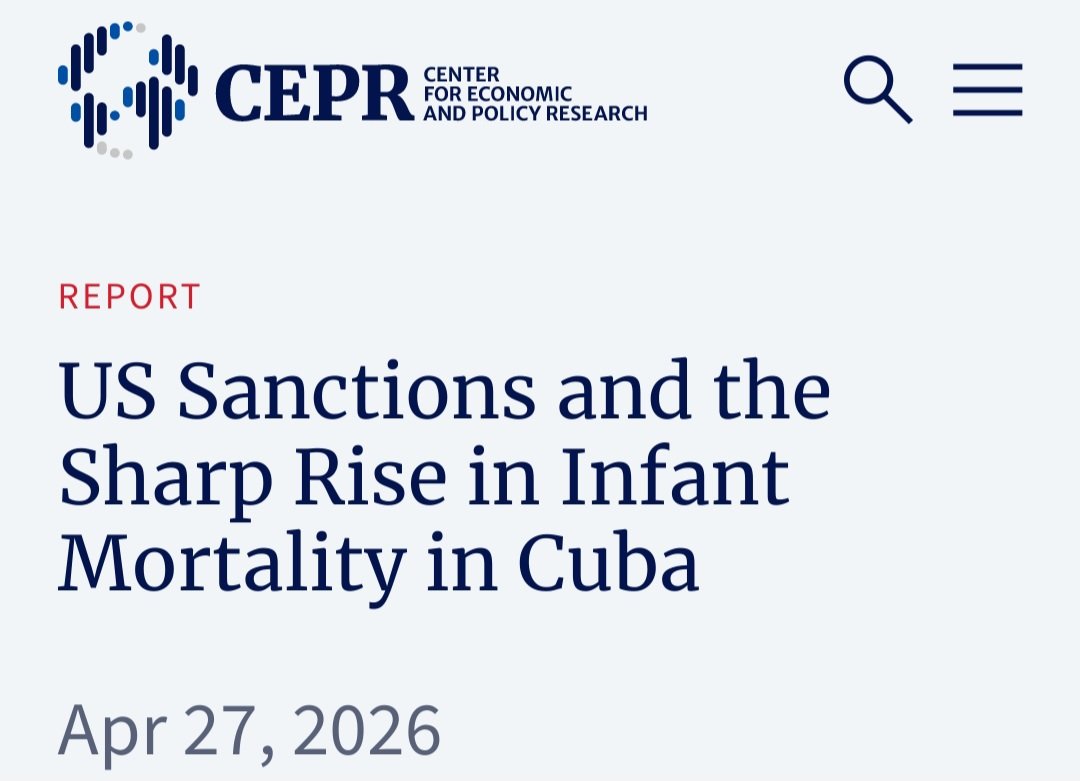
The illegal US blockade of Cuba has been killing babies: A new study found that Cuba's infant mortality rate has risen since 2018, as the US imposed hundreds of more sanctions to try to suffocate the country. Another peer-reviewed study found that Western unilateral sanctions cause approximately 564,000 deaths every year on average, and children under age 5 account for 51% of these deaths. Economic warfare is just as deadly as conventional military warfare, if not more so. Link: cepr.net/publications/u…
Ben Norton tweet media
English
15
312
571
12.8K
🧐 retweetledi
Cuba Analysis
Cuba Analysis@cubanalysis·
Cuban neuroscientist Mitchell Valdés-Sosa on Cuba's biotech sector, 'sonic attacks' probe, COVID role, US blockade's harm, and new Alzheimer's treatments like NeuroEPO (2026). youtube.com/watch?v=myc4iA…
YouTube video
YouTube
English
0
5
12
814
🧐 retweetledi
Cuba Analysis
Cuba Analysis@cubanalysis·
Coming soon, sneak a peek: Leading Cuban neuroscientist Mitchell Valdés Sosa joins Cuba Analysis to discuss Cuba’s commitment to science, sovereignty and socialism.
English
2
2
4
135