slopeofacurve 𝕏

30K posts

slopeofacurve 𝕏 banner
slopeofacurve 𝕏

slopeofacurve 𝕏

@fastigiocurvae

still figuring it out

Shizuoka-ken, Japan Katılım Mart 2010
427 Takip Edilen627 Takipçiler
slopeofacurve 𝕏 retweetledi
Elon Musk
Elon Musk@elonmusk·
@aaronburnett Our goal is launching Starship >10k/year, which would be more than once an hour. Probably over 200 tons of useful load to a useful orbit per flight by then.
English
618
539
6.4K
266.4K
slopeofacurve 𝕏 retweetledi
SpaceX
SpaceX@SpaceX·
Onboard views from Starship and Super Heavy V3, which are equipped with upgraded cameras capable of streaming 4K video through every phase of flight via @Starlink
SpaceX tweet mediaSpaceX tweet mediaSpaceX tweet mediaSpaceX tweet media
English
553
2.5K
15K
1.6M
slopeofacurve 𝕏 retweetledi
Election Wizard
Election Wizard@ElectionWiz·
Guy tries to give the IRS back $20K it sent him by mistake….and they charge HIM interest for their error. The system isn’t broken, it’s working exactly as designed: heads they win, tails you lose.
Election Wizard tweet media
English
22
356
1.1K
21.1K
slopeofacurve 𝕏 retweetledi
MatrixMysteries
MatrixMysteries@MatrixMysteries·
“Minnesota sent taxpayer money to a ‘healthcare company’ for 26 YEARS." Nick Shirley went to the address on file. IT DOESN’T EXIST. 26 years of funding. No office. No staff. No operation. If fraud this obvious goes unnoticed for decades, CORRUPTION is incentivized.
English
684
12.3K
30.4K
504.7K
slopeofacurve 𝕏 retweetledi
Fabian Ramirez
Fabian Ramirez@texas_lizard·
Fabian Ramirez tweet media
ZXX
10
40
279
14.7K
slopeofacurve 𝕏 retweetledi
Andrew McCarthy
Andrew McCarthy@AJamesMcCarthy·
My favorite photo from yesterday: A powerful sight as the latest iteration of Starship climbs through Texan skies. Captured via a sound-triggered camera, this camera captured the chaotic scene far better than I could from a safe distance. Prints available in the reply.
Andrew McCarthy tweet media
English
504
1.4K
9.8K
545.4K
slopeofacurve 𝕏 retweetledi
TesLatino
TesLatino@TesLatino·
About an hour and a half ago, while on a terrible downpour, the Cybertruck FSD slowed down for an accident scene on the highway. As we were passing the scene, I saw the body of a woman being covered by law enforcement. I saw her. It was a dark moment. Minutes earlier, as I was doing for at least an hour, I kept wondering why some people were driving so fast under not just rain but an actually storm-like downpour. I’ve been trained and licensed at high performance driving and I excel on the rain. But I wasn’t driving fast, although I know how. Rain is the equalizer when it comes to who wins a race. Suddenly no one has an advantage. Driver skills take over. A slow car can be a fast car in the rain, if the faster car doesn’t have a good driver. And that’s in an environment made for safety in most conditions. On the highway or any public road for that matter, there’s none of that. It’s greasy and slippery in places it shouldn’t, and there are hundreds, if not thousands of ways that things can go wrong. 😑 If you care about other people or yourself, please do everyone a favor…. Slow down in the rain. Leave the rush hidden in the place where you hide the memories you don’t want to remember. Drive safe. Or better then… use @tesla’s FSD made by the @Tesla_AI team for whom I test and provide critical feedback (not so much the regular bugs). Even if the road conditions require you to intervene on occasion, you’ll be safer and everyone around you as well.
TesLatino tweet mediaTesLatino tweet mediaTesLatino tweet mediaTesLatino tweet media
English
46
38
466
17.9K
slopeofacurve 𝕏 retweetledi
Yogi
Yogi@Houseofyogi·
Data centers aren't draining this country's water supply, nor are they really polluting it. The people who say that have never looked at an almond farm in California. Funny how Newsom's state wastes the most water in the Union. Every data center in America: 17 billion gallons of water a year. California almond farms alone: 1.3 trillion. That's 75x. For a snack that we mostly EXPORT. Data centers are 0.3% of public water. A rounding error. And the new ones recycle it instead of letting it evaporate off. Microsoft cut potable water 97% at Quincy. Google put 4.5 billion gallons back in the ground last year. The industry is going net positive while everyone screams. You want real waste? Agriculture uses 70% of every drop this country pulls. Power plants burn through tens of trillions of gallons so your lights turn on. California ships its water hundreds of miles through OPEN aqueducts. No cover. Evaporating into the sky the whole way. Gone before it touches a single crop. No hearing for that stuff. AOC waved brown water from a family living 400 feet from a Meta construction site. Blamed AI. Brown well water next to active earthmoving is a sediment problem. Happens at every big dig. The EPA found nothing. So just MAYBE shut up and focus on things that actually impact the water supply. Want to know what actually poisons a rural well? Fertilizer runoff. Nitrates. The stuff farm country has been pumping into groundwater for decades. This is the easiest IQ test of the century. You're a sheep if you think banning data centers saves the environment or protects jobs. LOL. It's a foreign psyop with Bernie and AOC as the spokesmen. They want the exact thing our adversaries want: a slower, smaller, poorer America. The people who can't beat us in the lab figured out they can beat us in committee. Wave a jar, cry about jobs, kill a project, ship the future overseas. You think you're saving water and protecting the working class. You're digging your own grave. Those data centers get built anyway. Mexico. South America. The Middle East. Asia. The jobs get created there. The cures get found there. Just not here, if you keep this up. And to the zoomers in the back booing Eric Schmidt for saying embrace AI: Europe didn't embrace the internet. Look at their GDP and employment rate since 2000s. Now nobody asks for their opinion, while tech built in SF. Don't build AI here, and in 10 years you're moving to Qatar or China to find work. Up to you.
English
12
41
165
4.1K
slopeofacurve 𝕏 retweetledi
PeterSweden
PeterSweden@PeterSweden7·
What I'm about to tell you is absolutely outrageous. Something just happened that has shocked Sweden. A person of Afghanistan origin R*PED a 14 year old girl and received NO PRISON sentence. But the details of the case just makes it worse and worse and worse... He had originally ordered a 13 year old boy to carry out a m*rder. But the boy refused. He then lured and r*ped the 14 year old girl at gunpoint as "punishment" against the boy. He also did a humiliation robbery of the 13 year old boy which was filmed. Can you guess the sentence the now 18 year old person with Afghanistan origin recieved for all these crimes? He got 2 years of closed "youth care" because he was 17 years old at the time of the crimes. Not even prison. And no deportation. He got Swedish citizenship in 2022. BUT IT GETS WORSE. Previously in 2024, the same person had been part in a gang r*pe of a 13 year old girl in Malmö He got only 10 months "youth care" at that time. So in just a few years of getting Swedish citizenship this person has been convicted of r*ping two children, conspiracy to m*rder and more. But he's not being deported. And he didn't even get sent to prison. Sweden is absolutely lost. What happened to my home country? I feel like the safe Sweden I grew up in doesn't exist anymore.
English
574
5K
15.6K
141.2K
slopeofacurve 𝕏 retweetledi
The Free Speech Union
The Free Speech Union@SpeechUnion·
Avon and Somerset Police have dropped their investigation into evangelical street preacher Dia Moodley. In November 2025, Dia delivered a sermon in Bristol city centre in which he criticised trans ideology and compared Christian theology with that of other religions, including Islam. He was detained under the Public Order Act 1986, released on bail, and initially barred from entering the city centre until after Christmas. Police have now confirmed that the investigation has been dropped — something Dia has described as “a win for free speech”. While this outcome is welcome, Dia should never have been arrested in the first place. Christian street preachers are increasingly being targeted, and the weaponisation of the Public Order Act must stop.
The Free Speech Union tweet media
English
8
209
667
7.3K
slopeofacurve 𝕏 retweetledi
Max Evans
Max Evans@_MaxQ_·
V1, V2, V3
Max Evans tweet media
45
422
5K
78.6K
slopeofacurve 𝕏 retweetledi
SpaceX
SpaceX@SpaceX·
Starship V3 landing burn over the Indian Ocean
SpaceX tweet mediaSpaceX tweet mediaSpaceX tweet mediaSpaceX tweet media
English
627
2.2K
15.7K
725.9K
slopeofacurve 𝕏 retweetledi
Sukh Sroay
Sukh Sroay@sukh_saroy·
A team of researchers in New Zealand followed 1,037 babies from the day they were born for the next 45 years to find out what actually determines a successful adult life, and the strongest predictor they found had almost nothing to do with intelligence or family wealth. The findings have been published in the most prestigious scientific journals in the world. Almost no parent has heard of them. His name is Avshalom Caspi. Her name is Terrie Moffitt. They are a husband and wife research team based at Duke University and King's College London, and the study they have spent their careers running is called the Dunedin Multidisciplinary Health and Development Study. It started in 1972 in a single hospital in Dunedin, New Zealand. Every baby born there in a 12-month window was enrolled. 1,037 of them. The study is still running today. The retention rate is the part that should astonish anyone familiar with how research usually works. After more than 45 years, over 90 percent of the original participants are still being tracked. Most longitudinal studies lose half their sample inside ten years. The Dunedin team has lost almost nobody. They measured everything. Blood. DNA. Brain scans. Income. Criminal records. Romantic relationships. Drug use. Dental health. Sleep. Mental health. Lung function. They flew participants who had moved abroad back to Dunedin every few years for a full day of assessments. Some of those people now live in seven different countries. They still show up. For the first decade of life, the team did something nobody else was doing systematically. They measured each child's self-control. Not IQ. Not family income. Not parenting style. Self-control. They watched 3-year-olds in a research lab and rated their ability to wait, regulate frustration, follow instructions, and resist impulsive reactions. They added teacher ratings. They added parent ratings. They added the children's own self-reports as they grew older. They combined all of it into a single highly reliable score. Then they did the thing nobody else had the patience to do. They waited. When the data came in at age 32, the result was so consistent it should be illegal to teach a child without it. The children who scored lowest on self-control at age 3 grew into adults with worse physical health, more substance dependence, lower incomes, more credit card debt, higher rates of single parenthood, more criminal convictions, and worse mental health than the children who scored highest. The pattern was not subtle. It was a clean gradient. Every step up in childhood self-control produced a measurable step up in adult outcomes across every domain the team could measure. The detail that should disturb every parent reading this is what happened when the researchers controlled for the obvious objections. When they controlled for IQ, the effect held. When they controlled for family income and social class, the effect held. When they compared siblings inside the same family, the sibling with lower self-control still had worse adult outcomes than the sibling with higher self-control. Same parents. Same house. Same dinner table. The trait was running independently of everything researchers expected to explain it. The paper landed in the Proceedings of the National Academy of Sciences in 2011. The title was as plain as it gets. "A gradient of childhood self-control predicts health, wealth, and public safety." It has been cited thousands of times since. Almost no policy maker has acted on it. The reason most people resist this finding is that it sounds like a sentence handed down before the child could speak. If the trait that determines your adult life is locked in by age 3, the rest of your life is a formality. The Dunedin researchers say that is the wrong way to read the data. They found something else in the same paper that almost nobody quotes. Some of the children whose self-control scores improved between childhood and adolescence ended up with adult outcomes far better than their early scores predicted. The trait is not destiny. It is a muscle. Children who learned to wait, regulate, and resist between ages 5 and 15 caught up with kids who started ahead. Self-control is the one childhood trait nobody seems to teach on purpose anymore. Schools focus on test scores. Parents focus on activities. Coaches focus on performance. The part of the brain that decides between five seconds from now and five years from now is left to develop on its own, and the data shows it usually does not. The most uncomfortable part of the research is the cost calculation Moffitt and Caspi ran. They estimated that if a country could move the bottom 20 percent of children up one rung on the self-control ladder, it would measurably reduce healthcare spending, welfare dependency, and incarceration costs at the national level. The intervention is cheaper than almost any other public health investment available. Almost no country has tried it at scale. The reason adults struggle with money, weight, addiction, and relationships is rarely intelligence. It is the gap between what you want right now and what you want in ten years, and which side of that gap your nervous system is built to listen to. Most people lost that fight at age 4 and never went back to learn the technique. You were not behind because life dealt you a bad hand. You were behind because the part of you that decides between right now and the rest of your life was never taught how to choose. The good news is the muscle is still there. Almost nobody trains it after age 10. You can be the one who does.
Sukh Sroay tweet media
English
493
3.7K
12.8K
1.8M
slopeofacurve 𝕏 retweetledi
Gad Saad
Gad Saad@GadSaad·
In the last chapter of Suicidal Empathy, I discuss the importance of immediate vs delayed gratification as it relates to seeking an immediate empathy-based dopamine hit. This research goes hand-in-hand with my point.
Sukh Sroay@sukh_saroy

A team of researchers in New Zealand followed 1,037 babies from the day they were born for the next 45 years to find out what actually determines a successful adult life, and the strongest predictor they found had almost nothing to do with intelligence or family wealth. The findings have been published in the most prestigious scientific journals in the world. Almost no parent has heard of them. His name is Avshalom Caspi. Her name is Terrie Moffitt. They are a husband and wife research team based at Duke University and King's College London, and the study they have spent their careers running is called the Dunedin Multidisciplinary Health and Development Study. It started in 1972 in a single hospital in Dunedin, New Zealand. Every baby born there in a 12-month window was enrolled. 1,037 of them. The study is still running today. The retention rate is the part that should astonish anyone familiar with how research usually works. After more than 45 years, over 90 percent of the original participants are still being tracked. Most longitudinal studies lose half their sample inside ten years. The Dunedin team has lost almost nobody. They measured everything. Blood. DNA. Brain scans. Income. Criminal records. Romantic relationships. Drug use. Dental health. Sleep. Mental health. Lung function. They flew participants who had moved abroad back to Dunedin every few years for a full day of assessments. Some of those people now live in seven different countries. They still show up. For the first decade of life, the team did something nobody else was doing systematically. They measured each child's self-control. Not IQ. Not family income. Not parenting style. Self-control. They watched 3-year-olds in a research lab and rated their ability to wait, regulate frustration, follow instructions, and resist impulsive reactions. They added teacher ratings. They added parent ratings. They added the children's own self-reports as they grew older. They combined all of it into a single highly reliable score. Then they did the thing nobody else had the patience to do. They waited. When the data came in at age 32, the result was so consistent it should be illegal to teach a child without it. The children who scored lowest on self-control at age 3 grew into adults with worse physical health, more substance dependence, lower incomes, more credit card debt, higher rates of single parenthood, more criminal convictions, and worse mental health than the children who scored highest. The pattern was not subtle. It was a clean gradient. Every step up in childhood self-control produced a measurable step up in adult outcomes across every domain the team could measure. The detail that should disturb every parent reading this is what happened when the researchers controlled for the obvious objections. When they controlled for IQ, the effect held. When they controlled for family income and social class, the effect held. When they compared siblings inside the same family, the sibling with lower self-control still had worse adult outcomes than the sibling with higher self-control. Same parents. Same house. Same dinner table. The trait was running independently of everything researchers expected to explain it. The paper landed in the Proceedings of the National Academy of Sciences in 2011. The title was as plain as it gets. "A gradient of childhood self-control predicts health, wealth, and public safety." It has been cited thousands of times since. Almost no policy maker has acted on it. The reason most people resist this finding is that it sounds like a sentence handed down before the child could speak. If the trait that determines your adult life is locked in by age 3, the rest of your life is a formality. The Dunedin researchers say that is the wrong way to read the data. They found something else in the same paper that almost nobody quotes. Some of the children whose self-control scores improved between childhood and adolescence ended up with adult outcomes far better than their early scores predicted. The trait is not destiny. It is a muscle. Children who learned to wait, regulate, and resist between ages 5 and 15 caught up with kids who started ahead. Self-control is the one childhood trait nobody seems to teach on purpose anymore. Schools focus on test scores. Parents focus on activities. Coaches focus on performance. The part of the brain that decides between five seconds from now and five years from now is left to develop on its own, and the data shows it usually does not. The most uncomfortable part of the research is the cost calculation Moffitt and Caspi ran. They estimated that if a country could move the bottom 20 percent of children up one rung on the self-control ladder, it would measurably reduce healthcare spending, welfare dependency, and incarceration costs at the national level. The intervention is cheaper than almost any other public health investment available. Almost no country has tried it at scale. The reason adults struggle with money, weight, addiction, and relationships is rarely intelligence. It is the gap between what you want right now and what you want in ten years, and which side of that gap your nervous system is built to listen to. Most people lost that fight at age 4 and never went back to learn the technique. You were not behind because life dealt you a bad hand. You were behind because the part of you that decides between right now and the rest of your life was never taught how to choose. The good news is the muscle is still there. Almost nobody trains it after age 10. You can be the one who does.

English
92
600
4.1K
501K
slopeofacurve 𝕏 retweetledi
End Wokeness
End Wokeness@EndWokeness·
It's total insanity that we allow this
End Wokeness tweet media
English
318
2.9K
13.8K
198.6K
slopeofacurve 𝕏 retweetledi
Steve Guest
Steve Guest@SteveGuest·
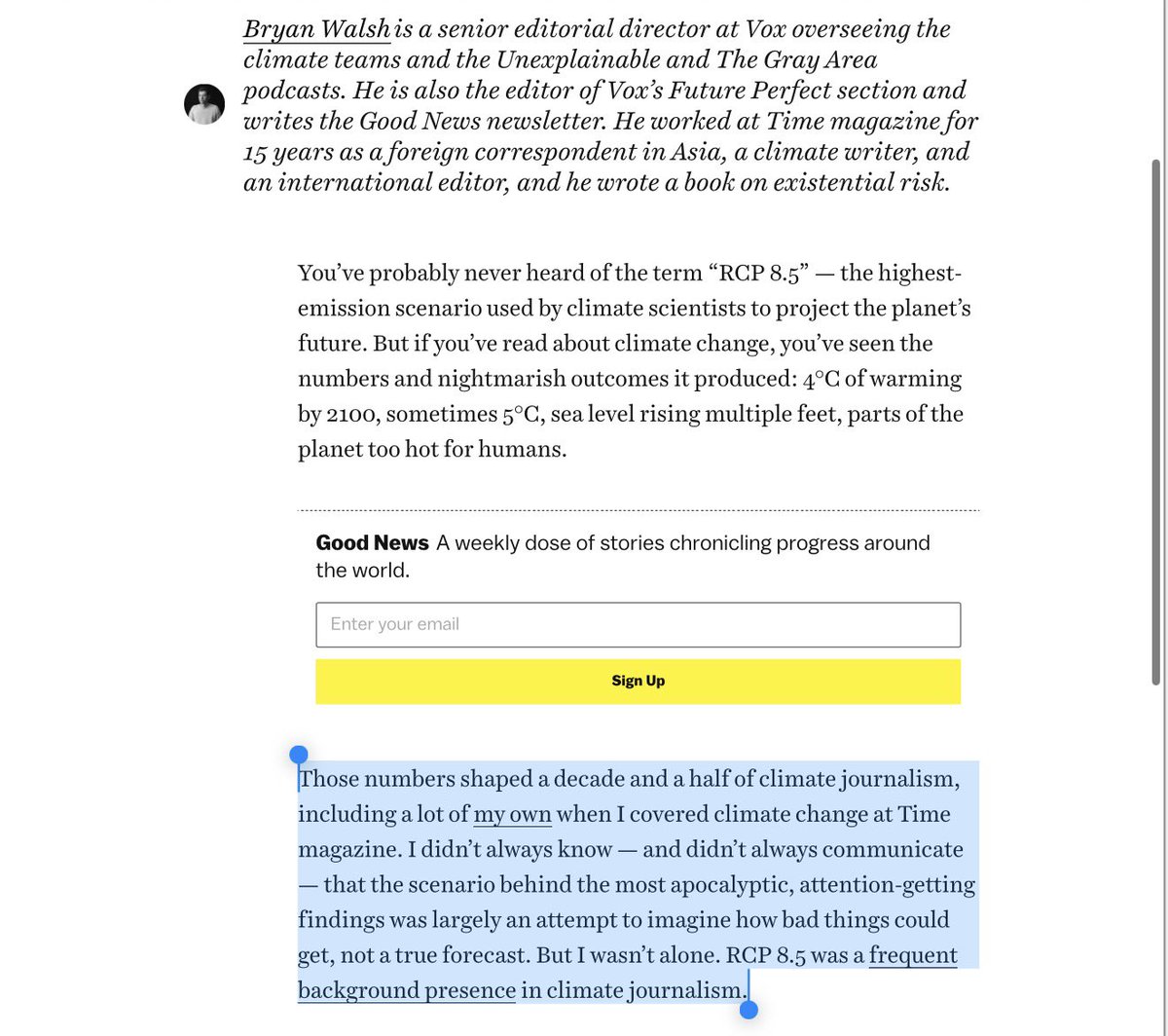
Vox with a BOMBSHELL admission in the wake of the demise of RCP8.5. “Those numbers shaped a decade and a half of climate journalism, including a lot of my own when I covered climate change at Time magazine. I didn’t always know — and didn’t always communicate — that the scenario behind the most apocalyptic, attention-getting findings was largely an attempt to imagine how bad things could get, not a true forecast. But I wasn’t alone. RCP 8.5 was a frequent background presence in climate journalism.” vox.com/future-perfect…
Steve Guest tweet mediaSteve Guest tweet media
English
131
584
2.5K
261.8K
slopeofacurve 𝕏 retweetledi
Caт Bee 🪶
Caт Bee 🪶@CatShoshanna·
Less than 12 hours ago, she was the motionless victim on a stretcher with a neck brace. Today she’s the resilient, fully recovered survivor, just in time for flowers and attention. These scammers don’t even try to make it believable anymore. They know millions of idiots will ignore the fake injuries, blatant lies, and manipulation as long as the grifter flashes a peace sign and says “Free Palestine.”
Caт Bee 🪶 tweet media
English
977
9.2K
25.4K
381.6K
slopeofacurve 𝕏 retweetledi
The Free Speech Union
The Free Speech Union@SpeechUnion·
As of Wednesday, the Nursing and Midwifery Council (NMC) has adopted the Government’s official definition of “Anti-Muslim Hostility”. The FSU is in no doubt that the NMC will enforce this de facto Islamic blasphemy code zealously. After all, the regulator initially deemed NHS nurse Jennifer Melle — who had served for 12 years — unfit to practise after she refused, on grounds of her Christian faith, to refer to a trans paedophile patient by his preferred pronouns. The NMC has already offered an example of what it considers “anti-Muslim hostility”. It says that if an employee posts an image on social media stereotyping Muslims — for example, “an image depicting women with headscarves, men with long beards and a mosque in the background” — alongside a call for the deportation of “anyone who undermines British values and the British way of life”, it would likely take action against them and deem them unfit to practise. The FSU will be keeping a very close eye on the NMC and would support anyone struck off for such speech.

The Free Speech Union tweet media
English
50
557
1.6K
19.6K
slopeofacurve 𝕏 retweetledi
The British Patriot
The British Patriot@TheBritLad·
🚨BREAKING: Police REFUSE to release Henry Nowak’s chilling Snapchat & bodycam footage. Victim’s final moments hidden from public amid trial. Henry bled out AND DIED in cuffs #JusticeForHenry
The British Patriot tweet media
English
729
11.3K
44.3K
685.6K