Sabitlenmiş Tweet
Scott Gray
1.4K posts

Scott Gray
@fredcat1
love stocks and playing with Ai art (unskilled)! Always Prompt😉
Katılım Mayıs 2009
2.1K Takip Edilen686 Takipçiler

Lemonade’s Q1 results are 🔥. So much to share, where do I start?
First, get into the AI mood, click this, + volume ⏫
open.spotify.com/track/20HCH8XT… (by @kidfrancescoli)
🚀10th consecutive quarter of accelerating IFP growth
🔥 Topline at $1.33 Billion (IFP +32%)
🔥 Revenue grew 71% to $258M
🔥 Gross Profit increased 159% to $100M
🔥 3.14M Customers
🔥 Adj. Free Cash Flow $17M
Lemonade Pet exploding!
✅ Surpassed $500M top line early in Q2
✅ #1 most searched pet insurance brand in the U.S.
✅ @lemonade_inc is now the 4th largest pet carrier in the U.S.
✅ AI-powered automation drives record claim handling efficiency (LAE: ~4%)
✅ Our data + tech edge lets us lower prices while boosting profitability
Car picking up speed
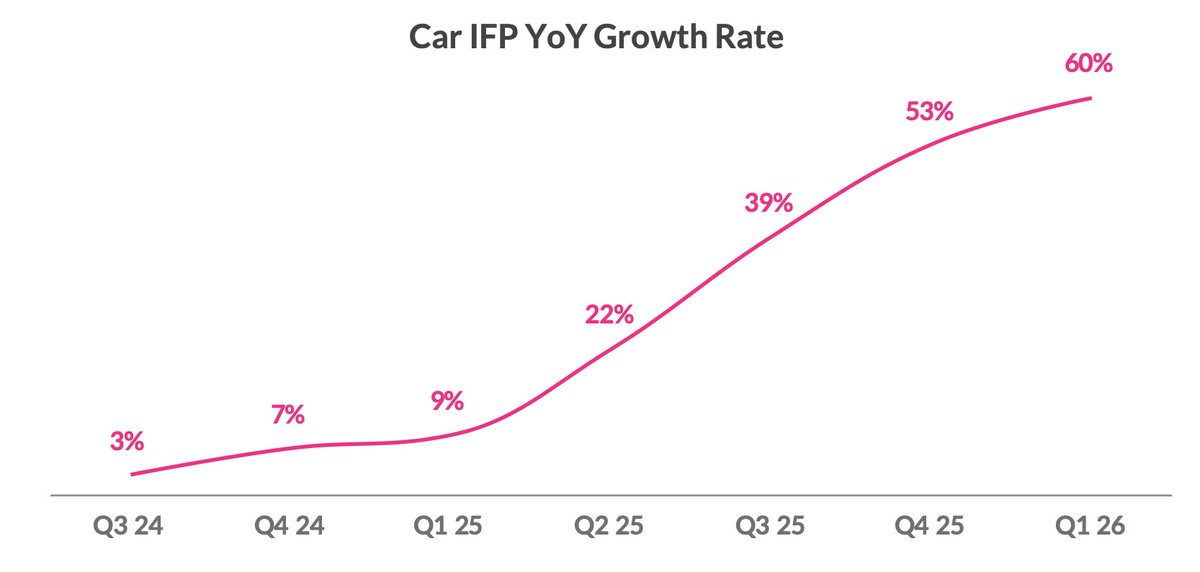
✅ Now at 60% YoY growth, $214M IFP
✅ Loss ratio improved to 74% (14 pts better YoY)
✅ Autonomous Car for @Tesla FSD conversion rate 70% higher than standard
And more...
↗️ Raising 2026 top & bottom line guidance
↗️ IFP per employee > $1M (3x improvement in 4 years)
↗️ Positive Adj. EBITDA in Q4
↗️ Investor Day in NYC November 17

English
Scott Gray retweetledi

@CernBasher Tesla's FSD journey has always been about compounding these kinds of stack improvements!
English

Tesla FSD v14.3: The Removal of a Bottleneck
Most people looking at FSD v14.3 see a familiar story: incremental improvement. A bit faster, a bit smoother, a bit more refined. The headline number - roughly 20% faster reaction time - sounds like a solid upgrade, but nothing revolutionary.
That interpretation misses the point entirely.
v14.3 is not about improving the model. It’s about replacing the system underneath the model.
To understand why this matters, you have to separate two parts of Tesla’s AI stack.
First, there is the training environment. This is where Tesla uses massive compute clusters to build increasingly powerful neural networks. In this environment, the models can be as large and as sophisticated as Tesla wants.
Second, there is the runtime environment inside the car. This is where those models actually have to operate - in real time, under strict constraints of compute, memory, and latency.
Historically, the gap between these two worlds has been a major constraint.
Tesla could train a highly capable model on the server side, but when it came time to deploy that model into the vehicle, compromises were unavoidable. The model had to be compressed, simplified, and optimized to fit within the limitations of the vehicle hardware. In the process, some of its capability was inevitably lost.
The result was not a lack of intelligence, but a bottleneck in how that intelligence was delivered.
With v14.3, Tesla rebuilt both the compiler and the runtime from the ground up using MLIR (Multi-Level Intermediate Representation).
The compiler is responsible for taking a trained model and translating it into a form that can run efficiently on the vehicle. The runtime is responsible for executing that model in real time inside the car.
By rewriting both layers, Tesla has fundamentally improved how models are converted and how they are executed.
This is why the improvements show up not just in raw speed, but in qualitative behavior. Early testers are reporting smoother responses, more natural decisions, and a noticeable increase in responsiveness. These are not just signs of a better model - they are signs of a better system delivering that model.
For the past several versions - v12 through v14 - progress was largely driven by improving the model itself. But the underlying inference framework remained largely the same.
That meant progress was increasingly constrained. Even as the model improved, the system responsible for running it became the limiting factor.
So, v14.3 marks a shift in approach.
Instead of continuing to push only on model performance, Tesla upgraded the entire stack. The focus is no longer just on how smart the model is, but on how efficiently that intelligence can be translated and executed in the real world.
Elon Musk has referred to this kind of change as a “final piece of the puzzle.” That phrasing can be misleading if interpreted as an endpoint.
In reality, this is a reset.
By replacing the underlying system, Tesla has removed a key constraint that was limiting future progress. The implication is not that FSD is complete, but that future versions - v15, v16, and beyond - can advance much more rapidly and with fewer compromises.
In practical terms, this means larger, more capable models can be deployed more effectively. It means improvements made in training are more likely to carry through to real-world performance in the vehicle. And it means iteration cycles can accelerate.
One of the more underappreciated aspects of this change is its potential impact on existing vehicles, particularly those running HW3.
The new MLIR-based system is designed to take better advantage of available hardware through techniques like quantization, operator fusion, and heterogeneous optimization. In simple terms, it allows Tesla to extract more performance from the same physical chips.
A potential “v14 Lite” for HW3 vehicles: With a more efficient runtime, older hardware may be able to run more advanced capabilities than previously thought possible.
So, the real story here is that Tesla has addressed a structural limitation in its AI system. It has improved the way intelligence is packaged, delivered, and executed. This is not just an upgrade. It is the removal of a bottleneck.
v14.3 should not be viewed as the culmination of Tesla’s FSD efforts. The visible changes today may seem incremental. The invisible changes beneath them are anything but. Tesla did not just make the system faster. It made it ready for what comes next.
Elon Musk@elonmusk
Tesla V14.3 self-driving review. The point releases will bring polish. V15 will far exceed human levels of safety, even in completely unsupervised and complex situations.
English

@garyblack00 @fredcat1 Without marketing... Model Y became the world's best selling car, again.
Tesla will ALWAYS have the cost per mile advantage.
And you know what they say about "too many chefs in the kitchen"...
English

Nvidia, Uber, Waymo — The AV Stack Is Being Rebuilt Without Tesla
Surbhi Jain
03/30/2026 14:46:08
Benzinga Newswire
The autonomous vehicle (AV) race was supposed to be Tesla’s to lose. Instead, it's starting to look like a market being rebuilt around it.
Because while Tesla is still pushing its full-stack vision, a very different model is quietly taking shape — one that doesn't need Tesla at all.
The AV Stack Is Splitting — And Scaling Fast
Start with Alphabet’s Waymo.
Following a fresh capital raise, Waymo is accelerating fleet expansion and ride volumes — and as JPMorgan analyst Doug Anmuth notes, estimates are now being revised higher, with the fleet potentially scaling from ~3,000 vehicles to ~50,000 by 2030.
At the same time, Uber Technologies is stitching together a global AV marketplace. Rather than building everything in-house, Uber is partnering across the ecosystem — from Zoox and Wayve to OEMs like Rivian Automotive — while expanding its relationship with Nvidia.
Anmuth highlights that this growing network of partnerships is increasing the likelihood of a fragmented, multi-player AV ecosystem — one that naturally favors a marketplace model like Uber's .
This isn't a single-company race anymore.
It's an ecosystem.
Platform Vs Product Is The New Battle
Tesla's strategy is clear: own the car, the software, and the network.
But the market is moving toward separation.
Uber is building the demand layer. Nvidia is emerging as the compute and software backbone. Waymo and others are scaling the autonomy layer. OEMs are supplying the vehicles.
Each piece is becoming modular — and more importantly, replaceable.
That creates a very different competitive dynamic. Instead of one winner, the AV stack starts to resemble cloud computing — multiple players, each owning a layer.
Where Does That Leave Tesla?
That's the uncomfortable question.
Tesla still has advantages — data, vertical integration, and a massive installed base. But it's increasingly betting on a closed system in a market that, as Anmuth's analysis suggests, is trending toward collaboration and shared infrastructure.
And scale is no longer exclusive.
Waymo is ramping. Uber is expanding. Nvidia is enabling. Tesla doesn't need to lose for this to matter.
But if the future of autonomy is a shared ecosystem, the company that tried to own everything may end up owning less than expected.
$TSLA $GOOG $UBER $NVDA $AMZN $RIVN
English

Yes - Mercedes will get there as others. But they need the miles driven to prove efficacy. Tesla is gaining fast to 10 million miles and has massive compute already built. By the time anyone else has a proven FSD and the compute to handle it, Tesla will have saturated the roads-Providing the most efficient most cost effective product out there. Not to mention the secret fleet already driving out there of cars that people already own that can go out to work for their owners.
English

@garyblack00 @fredcat1 Years ago, Jensen at NVDA saw the future.
Nobody was going to duplicate Tesla miles driven.
But NVDA felt they could duplicate it with simulators.
Fast forward to now.
It does seem to work - look at Mercedes.
So there are only 2 players: NVDA & Tesla.
OEMs buy NVDA package.
English

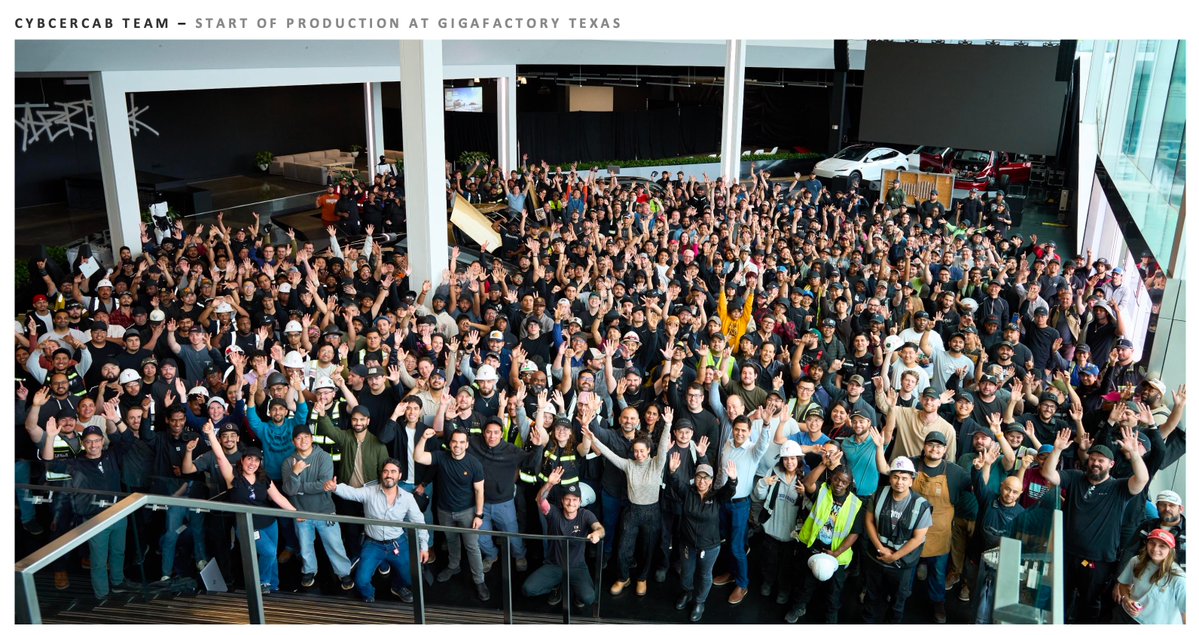
@fredcat1 @garyblack00 Thousands of futuristic Cybercabs being released in a dozen major cities this year will do much of the marketing.
English

@garyblack00 @fredcat1 Seriously? Marketing doesn't have anything with everything you just laid out.
English

I understand your point on marketing, but I’d argue a lot of Tesla’s visibility isn’t traditional marketing—it’s organic. As more people experience the technology firsthand, especially with FSD, awareness is being driven by real-world usage and social sharing. That kind of adoption-led exposure is very different from paid marketing. When people see the Robotaxi they will talk.
English

🚨 The Case for Merging SpaceX, xAI, and Tesla
The real play isn't three separate companies.
It's one unstoppable system: Tesla + xAI + SpaceX.
Energy. Compute. Manufacturing. Robots. Data at planetary scale. Global satellite distribution. And literal access to space.
Tesla already owns the intersection of batteries, vehicles, Optimus bots, and a massive distributed energy + compute grid. Every car on the road is a rolling data node. Every Megapack is energy infrastructure.
Add xAI and suddenly Tesla becomes a vertically integrated AI powerhouse with proprietary real-world data no one else can touch. That's the rocket fuel for frontier models.
Now layer in SpaceX. Starlink gives you a global communications blanket. Rockets solve the ultimate constraint: getting massive compute and power into orbit.
Put it all together and you have something nobody else can copy: full-stack industrial intelligence. Energy generation and storage. Physical hardware and distribution. Global comms. Launch capability. And the smartest AI models on Earth.
Apple, Microsoft, Google? They don't own this stack. Not even close.
Capital-wise, it gets even better. Tesla starts throwing off cash. SpaceX has long-duration contracts and Starlink revenue. xAI brings the explosive upside. One entity means smarter capital allocation instead of three separate balance sheets fighting for resources.
And the narrative? Markets pay huge premiums for category kings. Right now investors have to stitch Musk's vision together themselves. A unified company hands them one clean bet on an AI-powered, energy-abundant, multi-planetary future.
Yes, there are risks: execution complexity, valuation fights, regulatory heat, and serious key-man exposure. Merging won't be clean.
But the upside is wildly asymmetric.
Tesla shareholders get instant exposure to AI and space. SpaceX holders get liquidity and manufacturing muscle. xAI backers plug straight into real-world data, distribution, and capital.
This isn't just a bigger company.
It's the first true full-stack intelligence machine. Capturing energy, turning it into intelligence, deploying it through physical products, and beaming it around the planet (and eventually beyond).
If the mission has always been to build the future faster, combining these three might be the single biggest accelerator.
What do you think? Inevitable or too crazy?
English