
Harley de Vos

2K posts

Harley de Vos banner
Harley de Vos

Harley de Vos

@harley_dv

Lead Sport Psychologist at ACTAS and Sport Psycholog @CP_sport_psychs. PhD candidate studying mental health and sleep in elite athletes @Sydney_Uni and @theAIS

Canberra, Australian Capital T Katılım Ekim 2013
4.8K Takip Edilen1.1K Takipçiler
Sabitlenmiş Tweet
Harley de Vos
Harley de Vos@harley_dv·
🚨 Research Participants Wanted 🚨 Are you a coach or support staff member working in Australian high-performance sport? Do you believe mental health and sleep has an important relationship for your athletes? If so, we want to hear from you! More info: sydney.au1.qualtrics.com/jfe/form/SV_8v…
Harley de Vos tweet media
English
1
3
7
977
Harley de Vos retweetledi
Steven C. Hayes
Steven C. Hayes@StevenCHayes·
This is a word I essentially made up, because no existing word captured what I needed it to describe. Bear with me for a moment, because once this lands, it tends to stay with people. Cognitive defusion is the practice of seeing your thoughts as thoughts, rather than as facts or commands. It's the difference between being inside a thought and stepping back to observe it. When you're fused with a thought, you're looking through it at the world; when you're defused, you're looking at it, the way you'd look at a cloud rather than being lost inside one. Imagine your mind tells you "I'm going to fail this presentation." Fusion means that thought runs your behavior; you cancel, avoid, or freeze. Defusion means you notice the thought, recognize it as a mental event your mind produced, and then choose how to act anyway. #psychologicalflexibility #ACT #ACTtherapy
Steven C. Hayes tweet media
English
7
17
79
4.7K
Harley de Vos retweetledi
Australian Athletics
Australian Athletics@AustralianAths·
He just keeps getting better 🌟📈 Lee O'Halloran has continued his rise in the Para-athletics ranks, securing another Australian record in the Shot Put F46 with a throw of 14.77m to be crowned the Oceania champion! The 15-metre marker awaits. #AthleticsNation
Australian Athletics tweet media
English
1
3
15
778
Harley de Vos retweetledi
Ihtesham Ali
Ihtesham Ali@ihtesham2005·
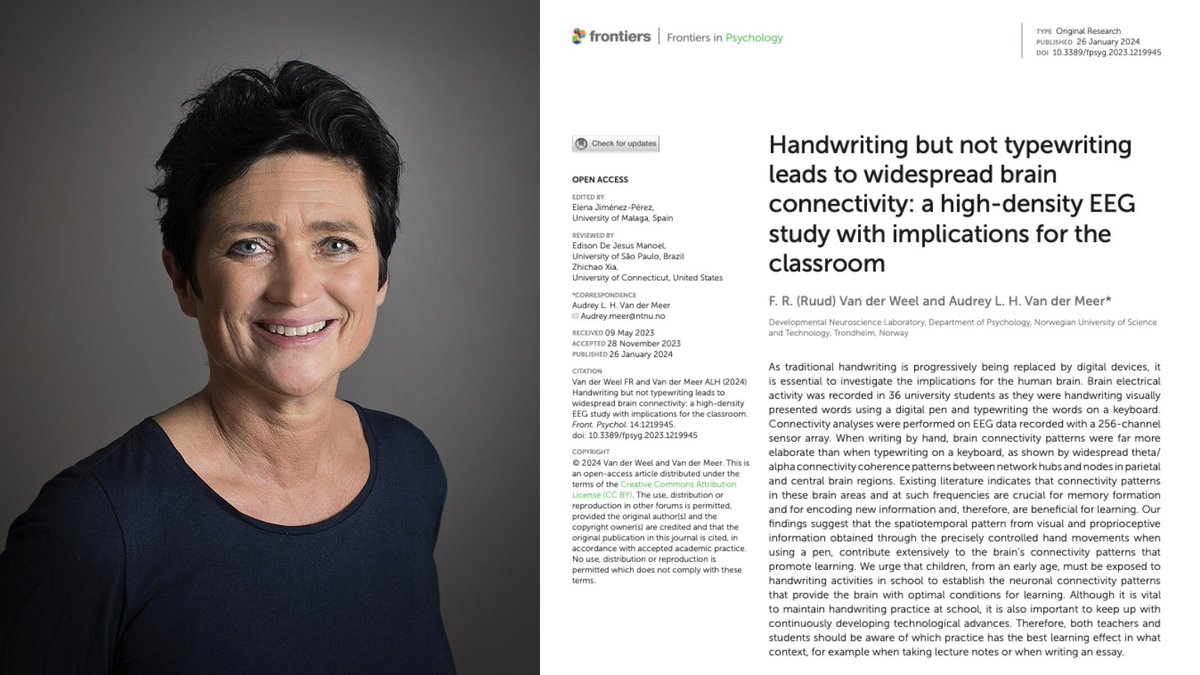
A Norwegian neuroscientist spent 20 years proving that the act of writing by hand changes the human brain in ways typing physically cannot, and almost nobody outside her field has read the paper. Her name is Audrey van der Meer. She runs a brain research lab in Trondheim, and the paper that closed the argument was published in 2024 in a journal called Frontiers in Psychology. The finding is brutal enough that it should have changed every classroom on Earth. The experiment was simple. She recruited 36 university students and put each one in a cap with 256 sensors pressed against their scalp to record brain activity. Words flashed on a screen one at a time. Sometimes the students wrote the word by hand on a touchscreen using a digital pen, and sometimes they typed the same word on a keyboard. Every neural response was recorded for the full five seconds the word stayed on screen. Then her team looked at the part of the data most researchers had ignored for years, which is how different parts of the brain were communicating with each other during the task. When the students wrote by hand, the brain lit up everywhere at once. The regions responsible for memory, sensory integration, and the encoding of new information were all firing together in a coordinated pattern that spread across the entire cortex. The whole network was awake and connected. When the same students typed the same word, that pattern collapsed almost completely. Most of the brain went quiet, and the connections between regions that had been alive seconds earlier were nowhere to be found on the EEG. Same word, same brain, same person, and two completely different neurological events. The reason turned out to be something nobody had really paid attention to before her work. Writing by hand is not one motion but a sequence of thousands of tiny micro-movements coordinated with your eyes in real time, where each letter is a different shape that requires the brain to solve a slightly different spatial problem. Your fingers, wrist, vision, and the parts of your brain that track position in space are all working together to produce one letter, then the next, then the next. Typing throws all of that away. Every key on a keyboard requires the exact same finger motion regardless of which letter you are pressing, which means the brain has almost nothing to integrate and almost no problem to solve. Van der Meer said it plainly in her interviews. Pressing the same key with the same finger over and over does not stimulate the brain in any meaningful way, and she pointed out something that should scare every parent who handed their kid an iPad. Children who learn to read and write on tablets often cannot tell letters like b and d apart, because they have never physically felt with their bodies what it takes to actually produce those letters on a page. A decade before her, two researchers at Princeton ran the same fight using a completely different method and ended up at the same answer. Pam Mueller and Daniel Oppenheimer tested 327 students across three experiments, where half took notes on laptops with the internet disabled and half took notes by hand, before testing everyone on what they actually understood from the lectures they had watched. The handwriting group won by a wide margin on every question that required real understanding rather than surface recall. The reason was hiding in the transcripts of what the two groups had actually written down. The laptop students typed almost word for word, capturing more total content but processing almost none of it as they went, while the handwriting students physically could not write fast enough to transcribe a lecture in real time, which forced them to listen carefully, decide what actually mattered, and put it in their own words on the page. That single act of choosing what to keep was the learning itself, and the keyboard had quietly skipped the choosing and skipped the learning along with it. Two studies. Two countries. Same answer. Handwriting makes the brain work. Typing lets it coast. Every note you have ever typed instead of written went into your brain through a thinner pipe. Every meeting, every book highlight, every idea you captured on your phone instead of on paper was processed at half depth. You did not forget those things because your memory is bad. You forgot them because typing never woke the part of the brain that would have made them stick. The fix is the thing your grandmother already knew. Pick up a pen. Write the thing down. The slower road is the faster one.
Ihtesham Ali tweet media
English
2.4K
44.4K
119.7K
9.7M
Harley de Vos retweetledi
Prof Lennart Nacke, PhD
Prof Lennart Nacke, PhD@acagamic·
Finish the PhD. Not because it's enjoyable. But because that degree will actually matter. You sacrificed for it. You struggled for it. You earned every bit of it. Quick achievements fade. The brutal ones reshape who you are. That's why it counts. Not because of the letters behind your name.
English
4
73
327
15.5K
Ben@AFLSC360
Ben@AFLSC360@AFLSC360·
Who scores more in today’s game at the MCG kicking off at 1:10pm? 🤍💜 Luke Jackson 🖤❤️Archie Roberts Both absolutely elite in 2026 in their respective positions and SC ownership is on the up📈 Drop your prediction below ⬇️ #SuperCoach #AFLSC360
Ben@AFLSC360 tweet media
English
12
6
20
5.1K
Harley de Vos retweetledi
Steven C. Hayes
Steven C. Hayes@StevenCHayes·
I want to be careful here, because this word gets misused in ways that can genuinely put people off. Acceptance in ACT is not what most people think it is when they first hear it. Acceptance means choosing to make contact with your own experience, including the painful parts, without fighting it, defending against it, or needing it to be different than it is right now. It is not resignation. It is not agreement. It is not giving up. It is the decision to stop spending your energy on a war you cannot win, so that energy can go somewhere useful instead. Here's a practical example: someone dealing with chronic pain learns to stop fighting the pain itself and instead focuses on what they can do while the pain is present. The pain doesn't necessarily decrease, but the suffering, the layer built out of resistance, often does. #psychologicalflexibility #ACT #ACTtherapy
Steven C. Hayes tweet media
English
1
17
68
2.5K
Harley de Vos retweetledi
Australian Athletics
Australian Athletics@AustralianAths·
EUGENE BOUND 😤🌲 A record team of 75 athletes have been selected to compete for Australia at the World Athletics U20 Championships in the United States of America in August. Check out the full team 👉 bit.ly/WJ26-Team #AthleticsNation
English
1
6
25
3.4K
Harley de Vos retweetledi
Ben Wilson
Ben Wilson@BenWilsonTweets·
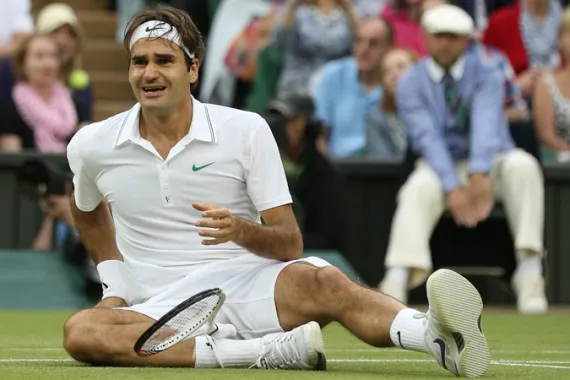
Roger Federer on Self-Doubt: "By the way, your opponents have self-doubt, too. Don’t ever forget that."
Ben Wilson tweet media
English
4
209
2.4K
40.1K
Harley de Vos retweetledi
Australian Athletics
Australian Athletics@AustralianAths·
GLASGOW, are you ready? 💚💛 A history-maker and 16 debutants headline Australia’s 24-strong Para Athletics squad, set to represent Australia at the Glasgow 2026 Commonwealth Games. TEAM ANNOUNCEMENT👉bit.ly/CGA-ParaAthlet… #AthleticsNation
Australian Athletics tweet media
English
0
4
13
1.1K
Harley de Vos retweetledi
Ben@AFLSC360
Ben@AFLSC360@AFLSC360·
Hey legends…..community message 👇 It appears as though whoever stole DRs account is DMing everyone and sending through suss links. Obviously don’t open these. Be good to get the word 🔁 around X on this one pretty quickly so no one falls for anything and gets hacked.
Supercoach With DR@Supercoach_DR1

📉📈G'day guys! The Supercoach Stock Market video is up! A turbo version this week as life has got in the way! Hope you enjoy and all the best of luck with your trades this week! #Supercoach 🚀 LINK: youtu.be/oi3WVbPzRFg

English
4
15
26
4.8K
Harley de Vos retweetledi
Steven C. Hayes
Steven C. Hayes@StevenCHayes·
Most of what gets called evidence-based practice is focused on outcomes: did the client get better? That's obviously important. But it's not sufficient, and here's why. Processes of change are the specific psychological mechanisms through which a treatment produces its effects. Knowing that a therapy works is valuable; knowing why it works, through what mechanism, is what allows you to apply it wisely, modify it intelligently, and combine it with other approaches. Without understanding processes, you're essentially using a tool without knowing how it works, which means you can't troubleshoot it when it doesn't. The ACT model has consistently emphasized this: we don't just want to show that ACT produces good outcomes. We want to show that it does so by changing specific processes, and the research on that has been supportive (though always incomplete). That's how science should work.
Steven C. Hayes tweet media
English
0
10
35
1.6K
Harley de Vos retweetledi
Australian Sports Commission
They shall grow not old, as we that are left grow old: Age shall not weary them, nor the years condemn. At the going down of the sun and in the morning We will remember them. We remember the sacrifice of those who have served and those that are currently serving in uniform.
Australian Sports Commission tweet media
English
0
4
12
408
Harley de Vos retweetledi
Rohan Connolly
Rohan Connolly@rohan_connolly·
So much of the commentary about Elijah Hollands has been essentially looking for a scapegoat. Good to see someone @petryan take a different tack, and good on former AFL club psychologist Jacqui Louder for speaking publicly about it all. theage.com.au/sport/afl/hung…
English
14
10
161
40.3K
Harley de Vos retweetledi
SuperFooty (AFL)
SuperFooty (AFL)@superfooty·
Elijah Hollands’ dad has posted a touching message of support on social media. Story: bit.ly/3OrDJNX
SuperFooty (AFL) tweet media
English
0
38
621
37K
Harley de Vos retweetledi
Steven C. Hayes
Steven C. Hayes@StevenCHayes·
This is related to acceptance but distinct enough that I think it deserves its own explanation. I use the two words somewhat interchangeably, but willingness has a slightly more active, in-the-moment quality to it. Willingness is the choice to make room for a difficult experience, to allow it to be present without fighting it, suppressing it, or waiting for it to resolve before you act. It is not the same as wanting the experience. You don't have to want anxiety in order to be willing to have it. The wanting is beside the point; the choice is the thing. To give you a short example: someone with social anxiety doesn't need to want to feel anxious before they'll go to the party. Willingness means going anyway, with the anxiety present, because the value of connection matters more to them than the comfort of avoidance.
Steven C. Hayes tweet media
English
0
12
29
1.2K
Harley de Vos retweetledi
7AFL
7AFL@7AFL·
"I just want to shout out the Dawson family, and Elijah Hollands last night ... hopefully the AFL community wraps their arms around them. "Speak to your mates, put your arm around your loved ones. You never know who might need it." - Bailey Smith
English
101
238
4.2K
228.1K
Harley de Vos retweetledi
Ben@AFLSC360
Ben@AFLSC360@AFLSC360·
Appreciation post for the AFLSC360 crew 🙌 50 absolute nuffies talking footy every day, helping each other and pushing the content- legendary elite group. Glad you’re getting value out of it 🤝 We’ve got ~10 spots left… hit me up if you’re keen 🙌🍻 #aflsc360 #supercoach
Ben@AFLSC360 tweet media
English
0
6
10
647